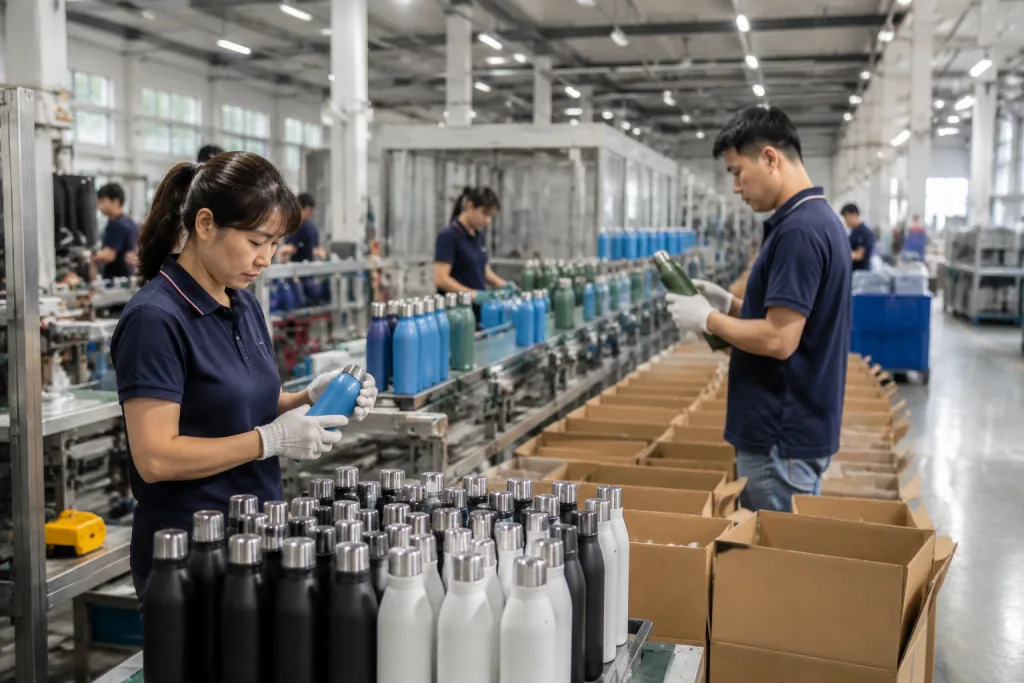
Key Takeaways
- For most B2B orders, MOQ starts at 1,000 pcs per color per size, while new mold projects usually need 3,000-5,000 pcs
- Entry aluminum sport bottles often land at USD 1.60-2.80 FOB China; vacuum stainless versions more often sit at USD 3.80-7.50 FOB
- Typical production lead time is 25-40 days after sample approval, with logo samples in 5-10 days
- Ask for AQL 2.5 inspection, LFGB or FDA contact testing, and 24-hour leak testing before shipment
You can buy a sport bottle from almost any canteen manufacturer in China. Easy part. Picking the right one for your channel, margin target, compliance risk, and repeat-order plan is where buyers get burned. A 600 ml single-wall aluminum bottle that works for a promo run will usually fail in outdoor retail after abuse testing. We have seen buyers ask for the same body to cover both uses, and this is the wrong question to ask. A premium 18/8 vacuum bottle can look clean on a sales sheet, then the math breaks once you add a custom logo, drop-test packaging, and ocean freight. On our line, even a 1.2 mm carton upgrade for transit can change the landed cost enough for the buyer to flag it.
If you are comparing a canteen supplier, canteen factory, or distributor drinkware source in Zhejiang or elsewhere in China, ask for numbers first. Not brochure language. At BottleForge Industrial in Hangzhou, Zhejiang, we usually quote MOQs from 1,000 to 3,000 units per SKU, sampling in 5 to 10 days, and bulk lead times of 25 to 40 days depending on decoration and tooling. That is the baseline you should expect from any serious manufacturer sport bottle program. QC pulled one sample last month where the PO typo switched matte black spray to gloss black, and that single line item would have delayed approval by 3 days if nobody caught it.
Start with the spec table
If you are sourcing custom drinkware, skip the catalog photos at the start. Ask for the spec table first. That is the fastest way to line up a canteen vendor, canteen suppliers, and canteen manufacturers on the same sheet and see who is actually quoting the same bottle. Buyers in Europe and North America usually cut the list faster by checking five points side by side: material, construction, decoration, compliance, and delivered cost. We have seen this go sideways when a buyer compares a 0.4 mm body bottle against a 0.5 mm sample and thinks the FOB gap is factory margin. It is not.
- Single-wall stainless steel sport bottle: 500-750 ml, 0.4-0.5 mm body thickness, weight about 220-320 g, FOB usually USD 2.10-3.40, MOQ 1,000 pcs. Good for gym, office use, or promotional resale where buyers still want a decent hand feel.
- Double-wall vacuum stainless bottle: 500-1,000 ml, inner 304 and outer 201 or 304, 0.4-0.5 mm walls, weight 280-520 g, FOB usually USD 3.80-7.50, MOQ 1,000 pcs. Better for outdoor programs, corporate gifting, or retail shelves where heat retention and finish consistency matter.
- Aluminum sport bottle: 500-750 ml, body around 0.7-0.9 mm, light at 90-150 g, FOB usually USD 1.60-2.80, MOQ 2,000 pcs. Works for canteen promotional programs and event giveaways, though buyers often push back on dent resistance.
- Tritan or recycled plastic bottle: 500-900 ml, body weight 110-220 g depending on shape, FOB usually USD 1.30-2.70, MOQ 3,000 pcs. Suitable for youth programs, sports clubs, and value lines, especially when the line needs more color options.
- Custom growler: 32 oz to 64 oz vacuum stainless, often 0.5 mm body, FOB usually USD 6.50-12.50, MOQ 1,000 pcs. Better for breweries, outdoor use, and specialty distributor growler accounts where lid seal performance gets checked hard.
A good canteen factory in Zhejiang should quote all of that with tolerance ranges, not a headline price only. This is the wrong question to ask: "What is your best price?" Ask for steel grade, powder coat thickness, cap resin, and packed carton size. QC pulled one sample last month where the PO said 500 ml but the approved drawing was for 530 ml, and that 30 ml difference changed the insert fit. If one canteen customizable supplier cannot tell you the steel grade, powder coat thickness, or cap resin, you are not comparing suppliers. You are guessing.
Which bottle fits your sales channel
Use-case fit beats broad claims like premium or eco. A bottle can pass spec and still miss your channel. We have seen new buyers pay 18% more on the first PO because they chased finish and packaging instead of sell-through. This is the wrong question to ask. Start with where you ship it, how fast it turns, and how much complaint risk your channel will take.
Promotional and event business
Campaigns, schools, charities, and trade events usually do better with a custom canteen or aluminum sport bottle than vacuum stainless. Buyers in this lane push on three things: logo area, landed cost, and ship date. On the line, a 600 ml aluminum model with a carabiner cap is simple work, and at USD 1.80 to 2.20 FOB China it protects margin better than a vacuum bottle that gets marked down two weeks before the event. We ship a lot of these in 1-color screen print, and the common pushback is not about insulation; the buyer flagged a late carton mark or a logo that printed 2 mm off-center.
Retail and outdoor
Chains, e-commerce brands, and outdoor distributors care about insulation and leak performance first. A customized drinkware line in 18/8 vacuum stainless usually sells faster because the end customer understands the pitch: cold retention of 12 to 24 hours and hot retention of 6 to 12 hours, depending on bottle geometry. Here, a manufacturer sport bottle with powder coating, laser engraving, and a carry loop cap usually beats cheaper options. QC pulled the sample more than once for lid seepage after a 1-meter inverted hold test, so this category needs tighter cap fit and thread control.
Kids and school programs
For children, material choice and lid design matter more than bottle prestige. A customizable canteen with a pop-up straw needs testing for migration, bite resistance, and easier cleaning. We have had buyers ask for extra charms, bumpers, and flip parts at a 3,000 pcs MOQ, and the math does not work. More parts mean more mold lines to check, more cleaning complaints, and more warranty claims. One inspection finding shows up again and again: straw valves that trap residue after 7 days of school use.
Breweries and specialty beverage
A custom growler or customizable growler is a different job from a daily sport bottle. You need a wider mouth, a stronger handle design, and often a leak-resistant screw cap with food-grade silicone. If you are a canteen distributor moving into drinkware and growlers, do not assume the same carton drop standard is enough. Heavy 64 oz insulated units need stronger partitions and burst-resistant export cartons. We have seen this go sideways when the buyer kept the old 5-ply carton spec and transit crush hit the bottom panel at 22 kg stack load.
You do not buy one best bottle. You buy the best fit for your order profile, your end user, and your failure tolerance.
Price drivers buyers miss first
Ask a canteen supplier for pricing and the bottle body is just the opening number. On plenty of OEM projects, decoration, packaging, and compliance account for 15% to 35% of final FOB value, so two quotes that look alike on the PO can still land USD 0.80 apart. We see this every week on the line.
- Material grade: 304 inner with 201 outer is common for value vacuum bottles; full 304 inside and outside costs more and supports premium positioning. Buyers ask for "304 bottle" all the time, then QC checks the shell spec and the discussion starts.
- Decoration method: one-color silkscreen is cheapest; laser engraving holds up better; 360-degree heat transfer and digital print cost more and need cleaner artwork files. If the AI file has a 0.2 mm hairline, the buyer flagged it before sampling is even done.
- Coating: standard powder coat is usually more durable than smooth spray paint. Texture and special colors raise reject risk; we have seen mixed lots fail color comparison under the light box.
- Cap complexity: a simple screw lid may cost USD 0.18 to 0.35; a straw lid with moving parts may run USD 0.45 to 0.95. This is where the math often breaks, especially once the hinge pin and extra sealing parts get counted.
- Packaging: white box is basic; color box, PDQ tray, mailer-tested carton, or FNSKU labeling all add cost. A buyer once sent a PO with the carton mark typo carried into all 5,000 pcs, and rework was not free.
For a typical 650 ml single-wall stainless customized canteen, you might see this structure: bottle body USD 1.95, cap USD 0.28, one-color logo USD 0.08, white box USD 0.16, master carton and packing USD 0.09. Total FOB Zhejiang, China: about USD 2.56 before testing. For a 750 ml vacuum customized growler, the same build logic can move FOB above USD 7.00 fast, especially if QC pulled the sample and found coating touch-up or lid leakage at 0.03 MPa.
If a canteen vendor or canteen distributor gives you one all-in number, push back. Ask them to split body, lid, decoration, packaging, and test charges. That is the right question. Serious canteen manufacturers do this every day, and the breakdown saves time on repeat orders when you change one item only, like a custom logo, an insert card, or a lid color with MOQ 3,000 pcs.
Factory checks that actually matter
Buyers new to China often ask for every certificate they have heard of. We get why. It is the wrong question to ask. Match the checks to the bottle, the market, and the claim on the PO. For a manufacturer sport bottle program, start with process control and food-contact compliance. Last month a buyer flagged a missing test item on a 750 ml straw lid PO, but the real risk was a seal leak on the line.
Start with the basics. Ask the canteen factory or canteen manufacturer for BSCI or Sedex audit status if social compliance matters to your customers. Ask whether production follows ISO-style documented procedures, even if the factory is not dressing it up for a factory tour. Then get into product controls. On our side, QC usually pulls the first sealing sample with a go/no-go gauge before mass production starts.
- Raw material verification: 304/18-8 stainless declaration, Tritan grade confirmation, silicone and PP specs for lids. Ask for the actual supplier batch record, not a sales sheet. We have seen lid silicone come in 2 Shore points off target, and that shows up fast in leak complaints.
- Food-contact testing: FDA for the US market, LFGB or REACH-related substance control for Europe depending on the item and customer requirement. If the bottle has a printed inner mark or color straw, test the finished assembly, not just the base resin.
- Performance tests: leak test, vacuum retention test, coating adhesion, dishwasher claim validation if advertised, and salt spray test for metal parts when relevant. Ask what the factory actually runs. A supplier saying "passed internal test" means little if the vacuum hold was checked for 12 hours when your retail spec expects 24.
- Inspection protocol: AQL 2.5 is common for major defects; define critical defects as leaks, sharp edges, wrong logo, and odor issues. Be explicit. We once saw a PO typo that changed logo position by 8 mm, and the buyer still rejected the lot.
At our Zhejiang operation, standard pre-shipment checks include 24-hour leak testing on vacuum assemblies by batch, logo adhesion checks, and carton drop review for export loads. Capacity matters too. If a supplier says yes to everything but can only run 80,000 units per month, your 150,000-piece seasonal order will slip. The math does not work. A stable canteen supplier should give you a straight output number, line count, and peak-month plan. For reference, a mid-sized factory handling sport bottles and tumblers should often manage 300,000 to 500,000 units per month across lines. We ship against that number every month, and if one line is down for mold changeover, lead time moves fast.
The point is simple: do not confuse a file folder full of certificates with an actual controlled process in China. A clean AQL report and consistent leak-test records tell you more than a glossy audit summary. We have seen this go sideways when the paperwork looked fine but QC pulled the sample and found odor in the lid pack before loading.
MOQ, tooling, and sampling reality
MOQ is where projects go off budget fast. We see this on the line every week. If you only need a logo on a stock canteen, the minimum is usually workable. If you want a fully customized canteen with a private mold, a new cap, and a retail box with its own insert, the math changes fast, and we have seen buyers get stuck there after approving a 1.2 mm EVA tray they did not budget for.
For stock-body programs, common MOQs in Zhejiang are:
- 1,000 pcs per SKU for standard stainless steel sport bottles
- 1,000 pcs per size per color for vacuum bottles with existing lids
- 2,000 pcs for aluminum canteen promotional styles
- 3,000 pcs for Tritan or recycled plastic styles
- 500-1,000 pcs for plain stock without logo only if the factory has inventory, which is less common in export manufacturing
For custom tooling, expect mold charges from about USD 1,500 for a simpler cap insert to USD 8,000 or more for a fully new bottle-and-lid program. This is the wrong question to ask if you only ask for mold cost. Ask for total launch cost. A simple custom logo on an existing body may take 5 to 7 days. A color-matched powder coat sample with packaging mockup often takes 7 to 10 days. A new mold can take 20 to 35 days before first sample, then another round if thread fit or seal compression is off. QC pulled one sample last month because the lid torque was fine but the silicone seal sat 0.6 mm high, and that is enough to fail a leak test.
If you are a canteen distributor, distributor canteen buyer, or canteen vendors network serving multiple accounts, use modular development. We run this model a lot. Keep the body standard. Change the lid, finish, or print. That gives you a customized drinkware range without paying private tooling on every SKU. The same logic works for a customized growler line: standard vessel, custom badge, custom laser mark, and color box. Buyers push back on this because they want every item to look new, but we ship better margins with this setup and fewer tooling delays.
How to choose your sourcing model
You are choosing a sourcing setup as much as a bottle. That decision changes lead time, risk, and who fixes problems when the PO has a logo size typo or the buyer flagged the carton mark after approval.
Direct from canteen factory
This route gives you direct control over specs, packaging, and technical questions. You can ask the line about wall thickness, vacuum rate, gasket material, and carton dimensions, then check the drawing against a 0.2 mm tolerance instead of waiting for a middle layer to reply. Pricing is usually strongest on orders above 3,000 units. The trade-off is simple: you manage artwork, schedule, and QC checkpoints yourself. We have seen this go sideways when a buyer approved the print file but skipped the pre-production sample.
Working through canteen distributors or canteen distributor partners
If you need small mixed orders, local stock, or credit terms, a distributor can solve a real problem. MOQ pressure is lower, and some buyers need that. A recent pushback we got was for 600 mixed-color units with split delivery, and the math did not work direct from the factory line. You usually pay more for that service, and private-label options are often tighter on lid colors, pack-out, or insert cards.
Hybrid model
A lot of brand owners in Europe and North America now run a hybrid model: direct development with a canteen manufacturer in China, then local fulfillment support or compliance handling through a partner. This works well for customizable drinkware and custom growler programs where design control matters. QC pulled the sample in one project like this, and the local partner caught a barcode placement issue before 4,200 units shipped. This is often the practical answer if your team wants factory-level control without managing every last delivery detail.
When comparing canteen suppliers, canteen vendor options, or distributor growler and distributor drinkware partners, ask the same six questions every time:
- What is the real MOQ by color, by logo, and by packaging?
- What is the standard lead time in low season and peak season?
- Which tests are included in the quote and which are extra?
- What defects trigger rework or replacement?
- Can you provide FOB, EXW, and if needed DDP reference pricing?
- Who owns molds, artwork cylinders, and packaging dies after payment?
Clear answers matter. If one supplier says 25 days and another says 40 days, ask what is driving that gap: stock lid, custom mold, or print queue. The wrong question is "who is cheapest?" Ask who can state the limits up front. The vague supplier usually becomes the problem later, especially after your customized canteen is already on the line.
Compare your next sport bottle program with real factory numbers
Send your target size, material, quantity, and market. We will quote MOQ, FOB pricing, sampling time, and compliance options without sales fluff.
Frequently asked questions
What MOQ should I expect for a manufacturer sport bottle order?
For an existing bottle shape with standard lid, expect 1,000 pcs per SKU as a realistic starting point from a factory in Zhejiang, China. Aluminum styles are often 2,000 pcs, and Tritan or recycled plastic can be 3,000 pcs. If you need a private mold or a unique cap, 3,000 to 5,000 pcs is more common, plus tooling charges from roughly USD 1,500 to USD 8,000. Ask whether MOQ applies by color, by logo, or by packaging version. That detail matters. A buyer who orders 3,000 pcs split across three colors may still be below the true production MOQ if the coating line or print setup is not efficient.
Which material is best for custom drinkware: stainless, aluminum, or Tritan?
It depends on channel and price point. Stainless steel is the safest all-round choice for B2B because it supports both single-wall and insulated programs, handles laser logo well, and positions better in retail. Aluminum is lighter and often USD 0.40 to 1.50 cheaper per unit FOB China, so it suits canteen promotional and event orders. Tritan works for sports, kids, and value-driven programs, especially when transparency matters, but it needs careful lid design to avoid leak claims. If you are building a premium customized drinkware line, start with 18/8 stainless. If you are chasing low landed cost under tight budget, aluminum or Tritan may fit better.
How long does sampling and mass production usually take?
For logo-only development on an existing body, sample lead time is usually 5 to 10 days. If you need Pantone-matched coating, custom packaging, or several print methods to compare, allow 7 to 12 days. Bulk production after sample approval is often 25 to 40 days for normal orders of 1,000 to 10,000 units. Peak season can push this to 45 days or more, especially before major holidays. New tooling changes the schedule completely: 20 to 35 days for first mold sampling is normal, then another 7 to 15 days if adjustments are needed. Always ask your China supplier for a line-by-line schedule, not just one shipping date.
What quality checks should I require before shipment?
At minimum, require AQL inspection, leak testing, logo adhesion checks, and carton verification. AQL 2.5 is common for major defects, while critical defects should include leaking lids, sharp edges, wrong artwork, strong odor, and damaged vacuum units. For insulated bottles, ask for vacuum retention verification by batch and a 24-hour leak test. For Europe, discuss LFGB or relevant REACH-related controls depending on the product. For the US, FDA food-contact expectations are standard. If you sell online, also check barcode placement, carton weight, and drop resistance. A good canteen factory in China should be able to show you a pre-shipment report with photos, counts, and pass/fail criteria.
Is it better to buy direct from a canteen factory or through distributors?
If your order is above 3,000 units, your specs are clear, and you want private-label control, buying direct from a canteen factory is usually better. You get clearer cost breakdowns, easier customization, and direct communication on materials and production. If you need smaller mixed orders, local inventory, or easier credit terms, canteen distributors may suit you better even at a higher unit cost. Many buyers use both models: direct from Zhejiang or other China factories for core SKUs, then distributor support for urgent top-up orders. The right answer depends on your internal capacity to manage artwork, testing, and shipment details.