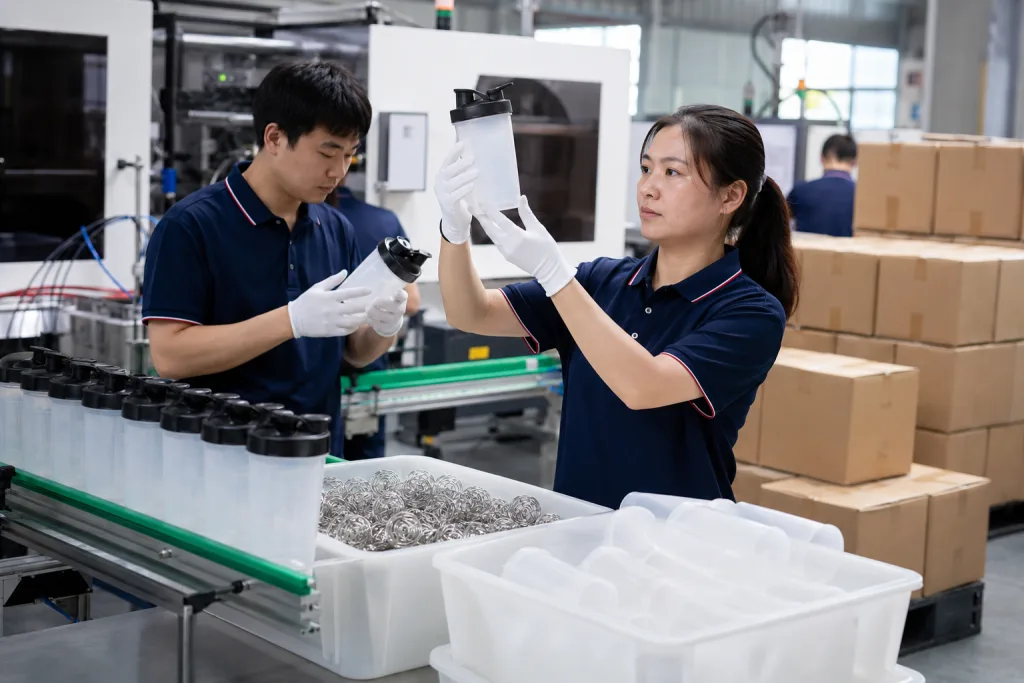
Key Takeaways
- For a custom shaker bottle, PP body wall thickness of 0.9-1.2 mm is a practical range for daily gym use without excessive resin cost
- Most custom logo shaker bottle projects start at 3,000 units per color, with sampling in 7-10 days and production in 25-35 days
- Leak risk usually comes from lid geometry and gasket fit, not just material choice; ask for 24-hour upside-down and 1.2 m drop test data
- FOB China pricing for a 700 ml shaker bottle commonly lands around USD 1.10-2.20 depending on resin, decoration, insert, and packaging
You usually do not have a shaker bottle problem. You have a spec problem. The sample looks clean in a photo, then the lid leaks at 85% fill, the whisk hangs up on a scoop of protein powder, or QC pulls a logo sample that starts peeling after 30 dishwasher cycles. For fitness brands and gym chains buying a bulk shaker bottle or bulk sports water bottle, that miss gets expensive fast because it shows up after production, not at sample approval.
If you source from Zhejiang, China, read the product like an engineer. Marketing copy will not tell you why one lid closes clean at 1.8 mm wall thickness and another starts flashing on the line. A solid manufacturer shaker bottle quote should explain resin grade, wall thickness, lid structure, print method, test standard, MOQ, and carton packout. This is where buyers skip details, and we have seen it go sideways over one typo on a PO. At BottleForge Industrial in Zhejiang, China, our typical MOQ starts at 3,000 units per color and standard lead time runs 25 to 35 days.
Start with bottle body resin
Start with the material line. It drives odor retention, drop performance, compliance cost, and unit price. On shaker projects, we usually run PP, Tritan, and, less often, stainless steel with a mixer insert. For fitness use, PP is still the volume pick because it is lighter, easier on the mold, and cheaper to run on the line. A 600-700 ml PP body for a bulk fitness water bottle or bulk gym water bottle typically prices lower than Tritan by USD 0.18-0.45 per unit at order volumes above 5,000 pieces. That gap shows up fast on a 20,000-piece PO.
PP is not the automatic answer. If your brand sells premium supplements or supplies studio chains with higher shelf pricing, Tritan gives a cleaner clear wall and a stiffer hand feel. Buyers ask for that. We have had one buyer flag a PP sample as "too soft" after a simple squeeze test at the sidewall. Tritan also works better if you want a custom sports water bottle that looks sharper on shelf. The trade-off is cost and a tighter molding window; on some molds, a small temperature drift can show flow marks. Ask the supplier for the exact resin grade, not a broad material label. This is the right question to ask. You need a declaration that supports REACH and food-contact requirements for Europe, plus relevant FDA or LFGB migration documentation if you sell in North America or the EU.
- PP: lower cost, good toughness, standard choice for bulk shaker bottle programs
- Tritan: premium clear look, higher material cost, better shelf appeal
- Stainless steel hybrid: niche use, higher FOB, heavier freight, usually not ideal for protein mixing
Check if the body is 100% virgin resin. Some China factories mix regrind into non-contact parts to shave cost, sometimes 5% to 15% on a run. We have seen this go sideways when repeat orders miss color by half a shade or drop-test results shift lot to lot. For drinkware, food-contact components should stay on 100% virgin material. If your target market is a distributor shaker bottle program, resin consistency matters because repeat orders need to match color and mechanical performance across multiple lots. QC pulled one sample last year where the body wall was in spec at 2.8 mm, but the color still drifted against the approved chip because the resin source changed.
Capacity, wall thickness, and grip feel
Capacity looks simple on paper, but it changes mold size, carton count, and how the bottle feels in the hand. The usual range for a custom made shaker bottle is 500 ml to 800 ml, with 600 ml and 700 ml still the safest picks for gym retail and chain promotions. We ship a lot of 700 ml because the line packs it cleaner into export cartons. Buyers keep asking for a 1,000 ml bottle, then the buyer flags the same issue after sampling: it feels bulky in one hand and misses some car cup holders, so returns go up.
Wall thickness is where experienced buyers pull ahead. This is the wrong question to guess on. If the body wall is too thin, the bottle flexes hard during shaking, threads distort, and sidewall dents show up after drop tests. If it is too thick, you are paying for extra resin with no shelf advantage, and the math doesn't work. For PP shaker bodies, 0.9-1.2 mm is a practical target. For Tritan, 1.8-2.3 mm is common because the bottle is usually built for a stiffer premium hand feel. Ask for the nominal wall thickness and the minimum wall thickness in the CAD or mold-flow report. QC pulled samples before where one panel dropped under spec by 0.15 mm, and that is where complaints start.
Grip geometry matters. A smooth cylinder is cheaper, but a light matte texture or grip panel cuts slip when hands are wet. For a custom gym water bottle or customizable fitness water bottle sold through gym chains, that matters more than a decorative contour. We have seen this go sideways when a buyer approved a glossy body off a rendering, then the first pilot run felt slick after a rinse test. Ask about fill line clarity too. If your protein customer needs 400 ml and 600 ml scale marks, mold-engraved graduations usually outlast pad-printed scales.
A bottle that feels solid at 700 ml and survives a 1.2 meter drop will usually outperform a larger bottle with weak thread engagement, even if the larger bottle looks more impressive in a product photo.
For distributors fitness water bottle programs, capacity also changes pallet math. A 700 ml design may let you load 10-15% more units per carton or pallet than an oversized 900 ml body, which cuts landed cost. We run these carton checks early because 6 mm of extra body diameter can be enough to break the stack pattern.
Lid geometry decides leak performance
If you remember one spec line, make it the lid. Most complaints on a custom shaker bottle trace back to lid fit, drinking spout seal, or hinge fatigue. We see buyers spend 2 weeks on body color and logo size, then gloss over the closure that decides whether the bottle leaks in a gym bag. Ask straight: is the lid screw-on single-start or multi-start, does it use a separate silicone gasket, and how many turns does full closure take? A lid that shuts in 180-270 degrees is easier on the gym floor than one that needs two full turns. This is the wrong question to skip.
For a bulk sports water bottle or bulk shaker bottle, the leak-control setup that holds up best is usually a clean thread profile with a food-grade silicone ring in the primary seal area, plus a firm snap on the flip cap if the design includes a spout. QC pulled samples before where the press-fit lid looked fine but leaked once the neck OD drifted by 0.3 mm on the line. Press-fit lids can work, but they give you less room across mass-production tolerances. On the drawing, check thread depth, pitch, and compression zone. On the test report, ask for these checks:
- 24-hour upside-down leak test at ambient temperature
- Hot-fill hold test if you market warm beverage use
- 1.2 m drop test, 6 faces, with water fill at 85-90%
- Open-close cycle test on flip cap hinge, usually 3,000-5,000 cycles
If your customer is a gym chain, users will drop bottles into lockers and bags. We ship enough of these to know hinge life is not a small detail. One buyer flagged a flip cap after a bag-drop test because the pin boss cracked on sample 4 out of 20. A nice-looking custom logo shaker bottle with a weak flip cap turns into warranty claims fast. For a customizable gym water bottle with a carry loop or handle, ask whether the loop is load-tested. A simple 5 kg static pull test can expose weak assembly points before production.
China suppliers that understand export drinkware should be comfortable discussing AQL levels for lid inspection. AQL 2.5 for major defects and 4.0 for minor defects is a common starting point, and premium retail programs often push tighter once first inspection data comes back. We have also seen purchase orders with the lid spec typed wrong, so check the PO line against the approved drawing before production starts.
Mixing system and user cleaning
The mixing system is why this bottle sells. Most shaker bottles run one of three setups: a wire whisk ball, a plastic agitator insert, or a fixed mesh screen under the lid. Each one brings a different sourcing risk. A wire whisk can mix fast, but if the 304 stainless wire is too thin or the surface finish comes off rough, users feel it on day one. A plastic agitator is quieter and easier to color match to a Pantone chip, but QC pulled samples before where powder sat in a 2 mm corner and never rinsed out clean.
For a manufacturer shaker bottle used with protein powder, pre-workout, or meal replacement, start with the actual formula, not the catalog photo. Fine whey usually breaks up fast. Oat blends and fiber formulas are where the buyer flagged clumping. Ask the factory to run a simple bench test with 25-35 g powder in 300-400 ml water, then record clump percentage after 20 seconds of shaking. This is not overkill. We have seen this go sideways after mass production because the sample mixed well and the line changed the insert mold venting.
What to confirm on the insert
- Stainless whisk grade, usually 304 for food contact
- Wire diameter or mesh thickness
- Whether the insert is removable for cleaning
- Dishwasher recommendation and top-rack limits
- Odor retention after repeated use
Cleaning drives repeat orders more than buyers expect. If the mouth diameter is too small, users cannot get a hand or sponge into the bottom radius. A mouth opening around 85-95 mm is common for shaker bottles because it makes powder loading easier and hand cleaning faster. We ship samples with 90 mm openings for this reason. If you are buying a customized sports water bottle or customized gym water bottle for long-term brand use, this is the wrong question to skip; event giveaway logic does not hold up for daily protein use.
For distributor sports water bottle and distributor gym water bottle accounts, fewer parts usually win. Every extra insert adds assembly time on the line, raises packing mistakes, and creates replacement claims when one piece is missing from a 48 pcs carton. The math does not work if the premium feature is hard to explain at retail. If you need a premium custom fitness water bottle, keep the user benefit obvious enough that the added complexity pays for itself.
Decoration, branding, and carton reality
Branding looks simple on the quote sheet. On the line, it changes cost and defect risk fast. For a custom logo shaker bottle, the usual options are silk screen, heat transfer, in-mold label on some body types, laser marking for stainless parts, and full-wrap digital print for shorter runs. For PP and Tritan sports bottles, silk screen is still the workhorse. We run it every week because the setup is straightforward, the ink hold is decent, and the cost fits most promo and gym retail orders.
Do not approve artwork first. This is the wrong question to ask. Check bottle curvature, usable print area, and dishwasher expectation before the PO is locked, because a logo that looks clean on a flat PDF can distort on a 6 mm taper. A 1-color silk screen on a straight panel may add only USD 0.05-0.12 per unit. A 2-color wrap on a tapered body pushes rejects up when registration is tight; QC pulled one job last month because the second color drifted 1.5 mm at the seam. If your retail target needs a premium customizable shaker bottle, ask whether a matte body with spot gloss logo is possible and what the added scrap risk is. We have seen this go sideways when the buyer wants shelf appeal but not the higher reject allowance.
Packaging gets missed until late, then the math does not work. Buyers often ask for each bottle in a polybag and export carton, then the channel shifts to Amazon FBA or DTC and the buyer flagged scuffing after the first drop test. If you ship into those programs, ask about barcode placement, FNSKU labeling, carton weight cap, and mailer strength at the start. Standard export carton specs for a 700 ml shaker might run 48-72 units per carton, with gross weight around 10-14 kg depending on insert type and packaging. We also check carton wall spec and tape pattern because one weak outer on a 14 kg pack will crush in transit.
- MOQ: often 3,000 units per color for standard molds
- Sample lead time: 7-10 days with logo mock-up
- Production lead time: 25-35 days after deposit and approval
- FOB China price: roughly USD 1.10-2.20 for mainstream PP/Tritan shaker formats
For distributors shaker bottle programs, carton efficiency matters almost as much as unit cost. We ship by pallet, not by theory. A bottle that saves USD 0.03 in production but wastes pallet space is not cheaper once it leaves Zhejiang, China, and this is where buyers usually miss the real cost.
Compliance, audits, and production control
The final spec line is where new buyers get burned. They treat it like filing. It is not filing. It is the control sheet that keeps your bulk fitness water bottle, bulk gym water bottle, or custom sports water bottle out of customs trouble and off a retailer complaint list. If you ship into Europe or North America, the factory should already have material declarations, food-contact test reports, and basic social compliance records ready if your retailer or brand policy asks for them. On our side, QC usually pulls the latest lid and body BOM before quotation so the resin grade on paper matches what runs on the line.
Start with the standards the factory works to every month, not what they say they can apply later. Common checkpoints include REACH, LFGB or FDA-related food-contact support, and ASTM or CPSIA-related requirements if children may use the product. For factory systems, ISO 9001 matters. BSCI or Sedex-style social audit requests are normal for chain retail. Do not assume every China drinkware factory keeps the same document set. Ask for recent reports with dates, lab names, and product references tied to an actual SKU or PO. We have seen buyers approve a report for a 750ml bottle, then find out the order was for a 600ml shaker with a different lid resin. That mismatch is enough to stall a shipment.
Production control also needs to be written down before deposit. For a customized shaker bottle order, confirm how color gets approved, whether pre-production samples are signed, and what the factory checks in-line before final packing. This is the wrong question to ask: “Do you inspect?” Every factory says yes. Ask what they inspect, at which station, and against what standard. On our line, the first article sample is checked with a Pantone book, a caliper for logo offset within 1 mm, and a torque check on the lid thread fit before mass production starts.
- Approved Pantone and logo position before tooling adjustment or production
- Golden sample retained by both buyer and factory
- In-line checks on molding flash, thread fit, print adhesion, and lid assembly
- Final random inspection to agreed AQL before balance payment
If your order is for a distributor fitness water bottle rollout across multiple gyms, batch consistency matters more than saving $0.03 on first cost. We have seen this go sideways. The first 20,000 units look fine, then the next batch uses outsourced caps and the shade shifts enough for the buyer to flag it under store lighting. Ask about monthly capacity too. A factory producing 300,000-500,000 units per month can usually support repeat launches with less drama than a workshop subcontracting half the components. Also ask how many injection machines they run and whether bottle bodies and lids are made in-house or bought outside.
That is the real job when you buy a manufacturer shaker bottle. You are not buying a picture. You are buying a repeatable spec set that survives transport, handling, compliance review, and daily use without turning into returns. Last month we had a PO with the logo position typed as 15 cm instead of 15 mm. Small typo, big mess. This is why the paperwork matters.
Send your shaker bottle spec for a factory review
Share your target capacity, material, logo method, MOQ, and market. We will review the spec line by line and quote practical options with lead time.
Frequently asked questions
What is a realistic MOQ for a custom shaker bottle order?
For a standard mold, 3,000 units per color is a realistic starting MOQ in China. Some simple stock colors can start at 1,000-2,000 units if you accept limited decoration and shared packaging, but custom Pantone matching, private mold changes, or extra inserts usually push MOQ higher. If you need a custom fitness water bottle with 2-color print and retail box, 3,000-5,000 units is more normal. New buyers should also ask about MOQ per SKU versus total order quantity. A supplier may quote 5,000 units total, but still require 1,000 units per colorway. That detail affects your product mix and inventory exposure more than the headline MOQ.
How much should I budget for a manufacturer shaker bottle?
For mainstream 600-700 ml PP shaker bottles, FOB China pricing often falls between USD 1.10 and 1.60 per unit at 5,000-10,000 pieces. Tritan versions commonly land around USD 1.55 to 2.20. Add about USD 0.05-0.12 for a basic 1-color silk screen logo, more for wrap graphics or retail packaging. If you need a wire whisk, custom insert color, and individual box, budget another USD 0.12-0.35 depending on complexity. Tooling changes are separate. Freight can easily change your landed cost by 10-25%, so compare carton count per pallet, not only bottle FOB. Buyers of bulk sports water bottle programs sometimes save more on freight through better packout than through resin changes.
Which material is better for a custom gym water bottle, PP or Tritan?
If your priority is cost control and toughness, PP is usually the better fit. It handles day-to-day gym use well, keeps unit pricing lower, and works for most bulk shaker bottle programs. If your priority is shelf appearance and a more premium hand feel, Tritan is stronger visually because of its clarity and stiffness. The trade-off is a higher resin cost, often by USD 0.18-0.45 per bottle depending on size and market conditions. For either option, ask for food-contact compliance support, virgin material confirmation, and real drop-test data. Material alone does not decide quality. A good PP bottle with solid lid geometry often performs better than a poorly engineered Tritan bottle.
What quality tests should I require before shipment?
At minimum, require a 24-hour upside-down leak test, a 1.2 meter drop test with 85-90% water fill, print adhesion testing, and closure fit inspection. If the bottle has a flip spout, ask for 3,000-5,000 hinge cycles. If it includes a whisk or agitator, request corrosion and fit checks on the insert. For appearance and packing, agree an AQL standard before production; AQL 2.5 major and 4.0 minor is a common commercial level. You should also approve a pre-production sample with your exact logo and color. For retail or chain gym rollouts, a third-party pre-shipment inspection in China is a modest cost compared with a container of leaking customized sports water bottles.
How long does a custom logo shaker bottle project usually take?
If you use an existing mold, sample development usually takes 7-10 days after artwork and Pantone approval. Mass production often needs 25-35 days after deposit and sample sign-off. During peak seasons, especially before summer promotions or Q4 retail pushes, lead times can extend to 40-50 days. If you need a new mold or structural changes, add roughly 20-35 days for tooling and first sample correction. Shipping time is separate, so your total timeline from approval to warehouse receipt may run 45-75 days depending on destination and mode. Buyers sourcing from Zhejiang, China should lock artwork early because late logo revisions are one of the most common causes of schedule slip.