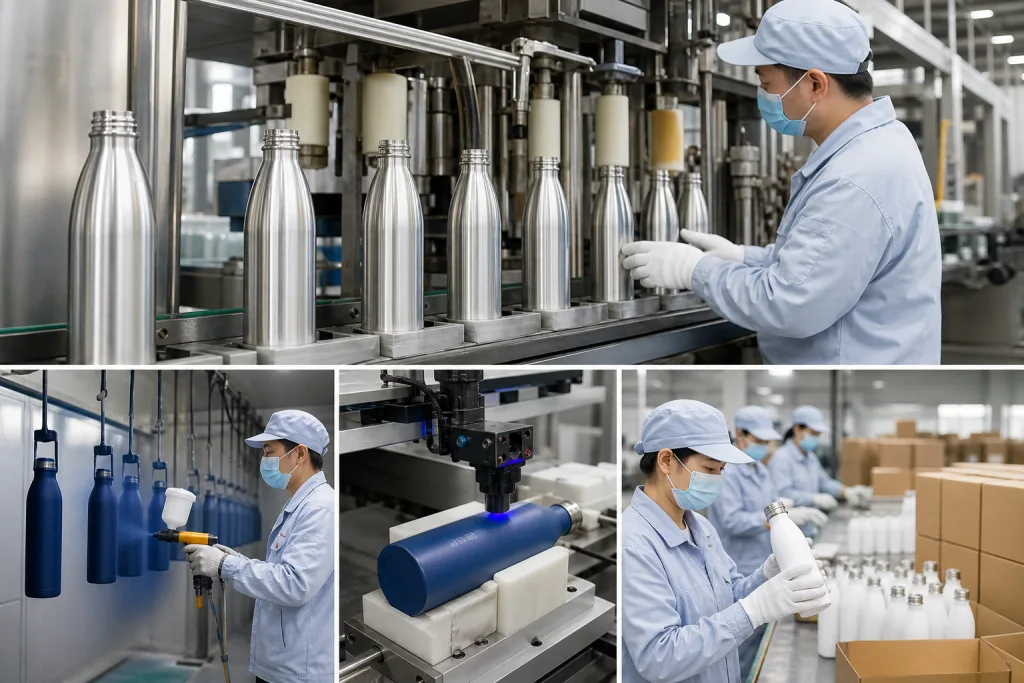
Key Takeaways
- Lock material and insulation first: 18/8 stainless double-wall vacuum usually adds USD 1.20-2.80 per unit versus single-wall at 1,000 pcs
- Most OEM projects start at 500-3,000 pcs per SKU; typical production lead time from Zhejiang, China is 25-45 days after sample approval
- Decoration choice changes both cost and returns: silk screen can save USD 0.12-0.35 per unit, but laser engraving cuts logo wear complaints
- Use AQL 2.5/4.0 and confirm REACH, LFGB or ASTM/CPSIA testing before deposit, not after production
You are not just buying a bottle. You are locking in a supply model, a compliance path, a decoration method, and a margin that still has to hold when freight jumps and retail returns hit. We have seen first-time buyers ask for price on day one, then change the spec after QC pulled the sample and found the wrong lid fit by 0.8 mm. That is the wrong question to ask first. A manufacturer refillable water bottle project works only when the factory setup, the product spec, and the sales channel line up.
In Zhejiang, China, we see the same thing 3 or 4 times a month: buyers compare two quotes with a 20% gap, then find out one uses 18/8 stainless, one uses 18/0, one includes third-party testing, and one does not. We ship both Europe and North America orders, and the buyer usually flags price before they check claim risk. That math does not work. If you buy custom drinkware for Europe or North America, your first job is to narrow the decisions that actually control cost, lead time, and return exposure.
Start with four buying decisions
Most B2B buyers overcomplicate this. If you are sourcing from a canteen factory or a broader custom drinkware supplier in China, four decisions usually drive 80% of the result. We see this on the line every week, often starting from a PO that asks for a quote before the bottle type is even locked.
- Decision 1: Product architecture. Single-wall, double-wall vacuum, plastic, glass, tritan, or growler format. This is the first call because a 0.4 mm stainless single-wall body and a vacuum body do not belong in the same price discussion.
- Decision 2: Channel fit. Retail shelf, promotional giveaway, e-commerce, gym chain, school program, or distributor drinkware catalog. A buyer once flagged a cap scuff that passed for promo use but failed for retail display, so this question needs a hard answer early.
- Decision 3: Compliance level. EU food contact, REACH, LFGB, North American ASTM or CPSIA if children are involved. This is where QC usually pulls the sample list and checks whether the lid, straw, paint, and carton claim all match the market requirement.
- Decision 4: Customization depth. Stock color plus logo, mixed-color assortment, custom lid, custom mold, barcode labeling, retail box, and pallet configuration. MOQ changes fast here; a stock bottle with one logo is one job, while a custom lid tool and barcode-by-SKU program is a different factory setup.
If you skip this order, you get noise. One canteen vendor looks cheap because the quote is built on a stock 600 ml single-wall body with one-color silk screen and polybag packing. Another canteen manufacturer looks expensive because the quote includes 304 stainless double-wall vacuum, powder coat, laser logo, drop-tested color box, and AQL inspection. Those are not comparable offers. We have seen buyers line up 3 quotes like this and argue over a $0.28 gap when the specs are miles apart; this is the wrong question to ask.
For most brand owners and canteen distributors, the process is straightforward. First, set the shelf price or target landed cost. Then choose the bottle type that can hit that number without creating complaint risk. Then lock decoration and packaging. At our Hangzhou, Zhejiang operation, capacity is roughly 300,000 units per month across stainless and plastic programs, and we ship both stock programs and custom runs, but the right answer still depends on your sales model. An event order, a craft retail growler, and a manufacturer refillable water bottle line for repeat replenishment do not run the same way. The math does not work if you start with a custom mold before you know the channel.
You do not want the cheapest unit. You want the cheapest unit that can survive compliance, freight, and customer use.
Choose the bottle type by margin
Material choice is where margin gets won or lost. A quote sheet can look clean at first, then the claims start: odor after 2 weeks, dents on arrival, leaking lids, or a retail buyer saying the shelf pickup was weak. We have seen projects go sideways over a 0.1 mm wall difference.
Common options and where they fit
- Single-wall stainless steel: lower cost, lighter to ship, and fine where long insulation is not part of the sell-in story. Typical FOB China range at 1,000 pcs: USD 1.80-3.20 depending on size, finish, and lid.
- Double-wall vacuum stainless: the standard pick for premium retail and corporate gifting. Typical FOB range: USD 3.80-7.50 at 1,000 pcs. On our line, QC pulled more paint-chip checks on matte dark colors than on brushed finishes.
- Tritan or food-grade plastic: a practical fit for sports programs and value-driven promotions. Typical FOB range: USD 1.20-2.80. Buyers often push back on odor, so we usually confirm resin grade before sampling.
- Glass with sleeve: stronger on clean-taste perception, but breakage risk is higher and the pack-out needs more discipline. We usually tighten carton partitions here because one drop test failure can kill the margin.
- Growler formats: usually 32 oz to 64 oz, often stainless insulated. Good for customized growler or distributor growler programs with beverage channels. MOQ discussions come up fast on these because lid tooling and carton size change the math.
If the buyer is a canteen distributor serving schools, gyms, or promo channels, single-wall or Tritan customizable canteen models usually pencil out better than vacuum bottles. That is the plain answer. If the customer is a specialty retailer or corporate gift agency, the extra USD 1.50-3.00 for a double-wall bottle often separates a healthy margin from a price fight. We ship both, but this is the wrong question to ask if you have not fixed the channel first.
Ask for the exact spec sheet, not just the material name. For stainless bottles, confirm 18/8 or SUS304 for inner and outer walls where corrosion resistance matters. For vacuum models, confirm copper coating if advertised, the vacuum retention target, and body thickness. A common body thickness range is 0.4-0.5 mm on both walls. Thin bodies save cents and bring dent claims later, especially in parcel delivery and Amazon FBA. The buyer flagged this on one 500 ml order after corner crush showed up in the first arrival batch.
If you are sourcing from canteen suppliers or canteen manufacturers in Zhejiang, China, compare the same build against the same build: capacity tolerance, net weight, steel grade, lid material, sealing ring, and carton drop performance. We run into this every season. One quote looks cheaper, then QC finds a lighter bottle, a softer gasket, or a PO typo that changed the lid insert. That is how a good-looking price turns into returns and rework.
Match customization to the selling channel
Buyers often ask for a canteen custom program. That is the wrong question to ask. The first check is whether the selling channel can carry the added cost, lead time, and MOQ without choking reorder speed. An event-driven canteen promotional order runs on different math than a customized drinkware retail launch; we have seen one PO marked "gift use" still ask for retail color boxes, and the margin was gone before the line started.
For promotional projects, keep the spec tight. We run a stock mold, 2-4 stock body colors, one-position silk screen or heat transfer, and a standard export carton because that mix usually ships fastest with the cleanest margin. MOQ may start at 500 pcs per color for some stock models, with pre-production samples in 5-7 days and bulk lead time in 20-30 days. On the floor, a one-color screen on a semi-auto printer is simpler to hold than a multi-pass graphic, and QC pulls fewer touch-up samples.
Retail is different. Shelf sales need branding people can see from 1.5 meters, so powder coating, Pantone-matched painting, laser engraving, debossed silicone parts, custom hang tags, instruction sheets, and color boxes usually earn their cost. A canteen customizable retail project often lands at 1,000-3,000 pcs per SKU to keep decoration and packaging efficient. Buyers push back on that MOQ all the time, but the math does not work well below that if you want stable packing output and clean carton assortment.
There are trade-offs, and this is where projects go sideways. Silk screen is economical, but logo durability depends on ink, cure, and usage; if oven cure drifts even 10 degrees C, scratch resistance changes fast. Laser engraving costs more on coated stainless, but it solves many abrasion complaints. Full-wrap heat transfer can look strong on customized canteen runs, but artwork approval and registration control matter. For custom growler or customizable growler orders, oversized logos often distort around curved bodies, so get a wrapped artwork proof and an actual sample before deposit; last quarter a buyer flagged a 3 mm shift at the seam on a 64 oz body.
Do not overlook packaging. If you sell to a canteen vendor network or distributor canteen catalog, plain white box packaging can be acceptable. If you sell DTC or retail, ask for barcode printing, FNSKU labeling, master carton marks, and drop-tested inner protection. We commonly see buyers save USD 0.18 on packaging and then lose USD 0.60-1.20 per unit in damage or relabeling. QC pulled one sample with a split corner after a 76 cm drop test, and that small failure usually turns into chargebacks later. The right canteen customized program is not the one with the most options. It is the one with enough customization to support your channel without slowing replenishment.
Price the project the right way
A quote you can use has more than one unit price. If you are screening a canteen supplier, canteen vendors, or a manufacturer refillable water bottle partner, ask for the full cost build, line by line, so your team can compare offers without guessing. We see buyers miss this on the first RFQ, then come back after QC pulled the sample and found the logo size on the PO did not match the approved artwork by 3 mm.
- FOB Ningbo or Shanghai price by quantity break: 500, 1,000, 3,000, 5,000 pcs
- Tooling or setup charges for custom parts
- Logo cost by method and number of positions
- Packaging cost: polybag, white box, color box, PDQ, master carton
- Sample fee and sample lead time
- Testing cost if third-party lab reports are needed
- Payment terms, usually 30% deposit and 70% before shipment for new buyers
For stock stainless models, MOQ is commonly 500-1,000 pcs per color. For custom colors, special lids, or a fully customized drinkware program, MOQ may move to 2,000-3,000 pcs per SKU. New molds can range from USD 2,500 for a simple lid component to above USD 12,000 for a complete bottle system, depending on complexity. We run into the same buyer pushback here: "Why is the mold charge so high for one lid?" Usually the answer is steel grade, cavity count, and whether the lid has a silicone fit tolerance under 0.3 mm.
Price the hidden costs too. This is the wrong question to ask if you only compare ex-factory numbers. We have seen a lower inland quote lose once trucking, port transfer, and consolidation were added, with shipping released in 18 days instead of 12 days from Zhejiang. Zhejiang still has an edge: accessory suppliers are close, sourcing loops are shorter, and we ship through Ningbo and Shanghai every week.
For canteen distributors and distributor growler buyers, ask one more thing: can the factory hold repeat color consistency and keep spare parts available. A cheap first order does not mean much if the lid shade shifts on reorder or replacement straws are out of stock 60 days later. On the line, color drift shows up fast under the light box, and the buyer flagged it on one repeat order even though the bottle body was within spec. Reliable refill programs depend on consistency more than a headline price, especially once you move past one PO and start monthly replenishment from a canteen factory instead of a one-off promotional source.
Control compliance before production starts
Compliance is where first-time buyers burn 2 to 3 weeks. A factory can reply in 10 minutes and still miss your market requirement sheet. If your order ships to Europe or North America, lock the testing plan before sample approval, not after the line starts.
For adult drinkware, the usual checkpoints are food-contact material declarations, REACH for coatings and accessories, and LFGB when the channel asks for it. For children’s bottles, the bar is tighter. You may need ASTM or CPSIA-related documentation based on the lid design, age grade, and sales channel. If the bottle has a straw, bite valve, or carry strap, this is the wrong question to ask at the end; QC pulled the sample on one project because the bite valve wall was only 1.2 mm and the buyer flagged small-parts risk.
Ask the canteen manufacturer or canteen factory for current reports, but do not accept an old report tied to another SKU. Reports need to match the exact material set you are buying: body, lid, gasket, straw, paint, plus decoration method. We have seen this go sideways over one PO line change. Switch from laser to silk screen, or from a stock black gasket to a dyed gasket, and the risk profile changes with it.
On quality control, define the inspection standard in writing. AQL 2.5 for major defects and 4.0 for minor defects is a common baseline for drinkware. Confirm 100% leak testing, vacuum performance checks by batch on insulated bottles, coating adhesion checks with a cross-hatch cutter, and carton drop tests where retail packaging is involved. If you use a third-party inspector, book the window early. In peak season, factories in Zhejiang, China run full, and a late booking can push shipment by 3-5 days.
If you are comparing canteen suppliers, ask whether they run BSCI or ISO-aligned systems and whether they keep incoming material traceability by lot. These are not paper claims. They decide whether the factory can isolate one silicone gasket issue in 2 hours or spend 2 days opening cartons after 10,000 units are packed.
Judge the factory beyond the sample
A polished sample proves the factory can make one good piece. It does not prove they can run 20,000 pieces on the line and hold the same finish, weight, and fit. When you shortlist canteen manufacturers or canteen vendors, check production discipline first. This is the right question.
Ask practical questions and press for numbers. What is the monthly output by category? How many automatic polishing or powder-coating lines are running today, not listed on an old brochure? Are lids made in-house or bought outside? How do they check incoming accessories: visual check only, or go/no-go gauge and drop test? What is the real lead time in peak months, not low season? At BottleForge in Hangzhou, Zhejiang, standard lead time is usually 25-35 days for repeat stock-based orders and 35-45 days for more customized drinkware projects after sample approval. That matters more than a sales promise of 18 days that slips to 31 once the PO lands. We have seen buyers flag this after one missed vessel booking.
Check communication discipline too. Good canteen suppliers send artwork layouts before sampling with logo size, curvature limits, Pantone references, and packaging marks. They will also tell you where the print will distort on a tapered wall or why a 1.0 mm line will fill in after powder coat. QC pulled the sample on one project because the buyer's PO had the carton mark typo carried into 12 master cartons. A weak supplier just says yes, then pushes the engineering problem to mass production. That usually goes sideways.
For a custom canteen program, ask for photos or video of in-line leak testing, vacuum testing, logo inspection, and packing. Ask to see the pressure gauge, the vacuum test record, or the station where the line checks lid fit after assembly. If you need a customized growler or distributor canteen assortment, ask whether the factory can consolidate different SKUs in one shipment and manage mixed carton labels. One buyer pushback we get is simple: "Can you ship 4 SKUs under one booking and keep outer marks separate by warehouse code?" If they cannot answer that cleanly, the math does not work. That saves warehouse labor on your side.
The best canteen manufacturer is usually not the one with the widest catalog. It is the one whose process matches your risk tolerance, order size, and replenishment pattern. A catalog with 200 bottle shapes looks good on page one. It means little if the factory cannot explain defect controls, MOQ logic, and export documents without hand-waving. If they can walk you through inspection points, carton count tolerance, and why one color needs a higher MOQ, that is a stronger buying signal.
Build for repeat orders, not one PO
The final decision rule is simple: buy like the second and third POs are already on the line. Treat it like a one-off, and you miss the settings that make repeat orders clean, fast, and profitable.
Start with SKU discipline. We have seen buyers open with 8-12 colors on PO1, then watch 4 of them stall in stock for 90 days. A tighter start is 2-4 core colors and 1-2 capacities. That keeps MOQ under control and helps your canteen distributor or distributor drinkware channel reorder without debating dead shades every cycle. For most programs, 750 ml and 1,000 ml cover the volume better than a shelf full of niche sizes. This is the wrong question to ask: "How many colors can you make?" The better question is how many you can reorder at speed.
Then standardize the parts that should stay fixed. Keep one lid platform across multiple bodies if possible. Use one master carton spec. Reuse insert cards. Align logo positions off one print file, with the mark sitting in the same 35 mm zone each run. That cuts setup loss, and repeat FOB pricing often improves by 3-8% once the line has the program dialed in.
For buyers working with canteen distributors, custom growler channels, or customizable drinkware catalogs, ask the factory to hold approved golden samples and color standards. QC pulled the sample from our cabinet last month because a buyer flagged a red that drifted half a shade from the first lot. That check matters. Reorder consistency protects your brand and makes a canteen customized line easier to extend later into a customizable canteen family, a customized growler offer, or a broader custom drinkware program.
China sourcing works well when the details are written down and repeatable. If your canteen supplier in Zhejiang knows your AQL level, packaging standard, compliance file, barcode format, and booking window, the next order runs like a system instead of a scramble. We have seen this go sideways over one PO typo in a barcode suffix. That is the real goal when you choose a manufacturer refillable water bottle partner.
Get a practical quote for your bottle program
Send your target price, market, quantity, and artwork. We will recommend the right manufacturer refillable water bottle spec, MOQ, and lead time.
Frequently asked questions
What MOQ should I expect for a custom refillable water bottle?
For stock molds with simple logo decoration, MOQ is often 500-1,000 pcs per color or SKU. For Pantone body color, special lid parts, or full retail packaging, expect 1,000-3,000 pcs per SKU. If you need a fully custom mold, the first order may need 3,000-5,000 pcs to make the tooling economics work. Stainless vacuum bottles usually have higher practical MOQs than simple plastic sports bottles because coating, welding, and packing setups are more involved. Ask the factory for MOQ by decoration method, not just by model, because silk screen, laser engraving, and heat transfer each affect setup differently.
How long does production usually take from China?
For a stock model with approved artwork, typical lead time is 20-30 days. For a customized drinkware order with new color, new packaging, or mixed accessories, 25-45 days is more realistic. Pre-production samples usually take 5-10 days for standard items and 10-15 days if you need new print proofs or packaging dummies. Add another 3-7 days if third-party inspection is required before shipment. In peak season, especially before summer and year-end gifting cycles, Zhejiang factories can run full, so book your PO and approvals early. If a supplier promises 12-15 days on a decorated stainless program, ask how they will protect quality.
Which material is best for B2B custom drinkware programs?
It depends on your channel. For value-driven promotions, Tritan or food-grade plastic usually gives the best FOB cost, often around USD 1.20-2.80 at 1,000 pcs. For retail and gifting, 18/8 stainless double-wall vacuum is the safer premium choice, commonly USD 3.80-7.50 depending on size and finish. Single-wall stainless sits in the middle and works for lighter-weight event or fitness use. Glass can look premium but requires stronger packaging and carries a higher breakage rate. If corrosion resistance, taste neutrality, and long-term brand perception matter, specify SUS304 or 18/8 clearly rather than accepting vague 'stainless steel' wording.
What compliance documents should I ask a canteen manufacturer for?
At minimum, ask for food-contact compliance documents relevant to your market and the exact bill of materials you are buying. For Europe, REACH and often LFGB are common checkpoints. For North America, requirements vary by channel, and children’s products may need ASTM or CPSIA-related documentation. Make sure reports cover body, lid, gasket, straw, paint, and logo process if applicable. Also request a quality plan: 100% leak test, AQL standard, and batch checks for insulation on vacuum bottles. A report from a different model or old accessory set is not enough. If you change the lid, coating, or decoration, update the compliance file.
How do I compare quotes from different canteen suppliers fairly?
Use a line-by-line comparison sheet. Match capacity, material grade, wall thickness, lid construction, sealing parts, logo method, packaging, and Incoterm. Then compare sample cost, MOQ, lead time, testing inclusion, and payment terms. A quote that is USD 0.60 lower may be using thinner steel, simpler packaging, or no third-party testing. Also compare logistics assumptions: FOB Ningbo or Shanghai is easier to benchmark than vague ex-works pricing. Finally, ask about repeat-order consistency. If lids, coatings, or colors change between batches, your real cost goes up through claims and rework. The best quote is the one with the lowest delivered risk, not just the lowest unit number.