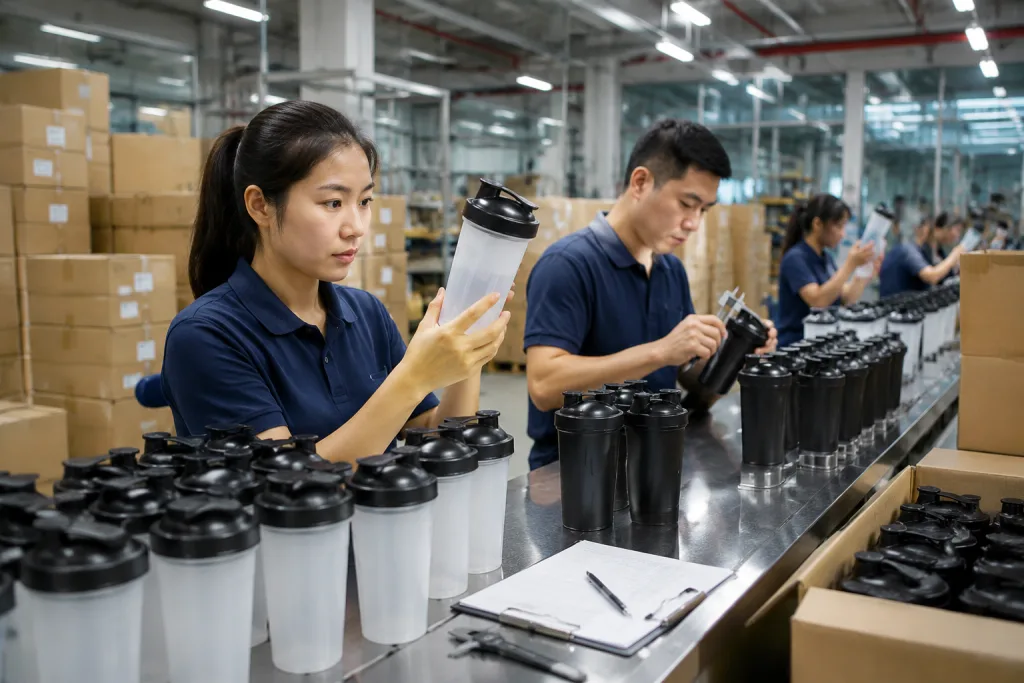
Key Takeaways
- A standard PP protein shaker at 5,000 units typically lands around USD 1.10-1.85 FOB China before special inserts or premium decoration
- Custom color, logo method, and mixing component design usually change lead time by 7-15 days
- Most factories in Zhejiang set MOQs at 3,000-5,000 units per SKU, with color-specific MOQs on lids and bodies
- Tooling for a fully customized shaker can range from USD 2,500 to USD 8,000 depending on mold count and insert complexity
Finding a manufacturer protein shaker is not the hard part. China has hundreds of factories pushing the same 500 ml and 700 ml bodies, matching color cards, and sample quotes that look cheap until the spec sheet gets tighter. The real question is why one supplier is at USD 1.35 FOB and another is at USD 2.10, or why one says 20 days and another needs 45. We see this on the line all the time. The gap usually sits in material grade, decoration method, tooling exposure, and how the order is built across MOQ tiers.
At BottleForge Industrial in Hangzhou, Zhejiang, we run into the same early mistake with custom drinkware buyers from Europe and North America: they compare shaker pricing to a custom canteen, customizable growler, or distributor drinkware program as if the math is the same. It is not. A shaker with a mixer ball, seal fit, and lid torque check at 0.8 N.m follows a different cost model, and this is the wrong question to skip at RFQ stage. If you want reliable pricing from a canteen factory in Zhejiang, China, break the job into unit economics, MOQ tiers, and production timing before the buyer flags a number that was never built on the right assumptions.
Why shaker pricing moves so much
A buyer new to this category often thinks a protein shaker is just another custom drinkware item. That is the wrong starting point. A travel tumbler or custom growler usually runs with fewer parts on the line. A shaker has a body, lid, cap, seal area, and a mixing part such as a whisk ball, plastic grid, or snap-in agitator. QC pulled samples on a 5-part shaker last month and found flash at the cap hinge plus fit issues on the seal groove. Each added part pushes up resin cost, assembly time, defect risk, and inspection points.
For a typical manufacturer protein shaker program in China, the main cost drivers are material, volume, wall thickness, and part count. A 600 ml PP shaker with a simple screw lid and PE mixer insert can land far below a 700 ml Tritan shaker with a carry loop, embossed scale, and stainless spring whisk. Wall thickness catches buyers off guard. Moving from 2.2 mm to 2.8 mm on the body can improve hand feel and shelf impression, but it also raises resin consumption by roughly 10% to 18% depending on geometry. We run ultrasonic wall checks on first-off samples, and this is where the math changes fast.
Decoration is the next big swing factor. One-color silkscreen on a straight wall is cheap and steady. Full-wrap heat transfer or in-mold label adds setup time, scrap risk, and slower packing speed. If your design team wants a matte body with gloss logo, a translucent lid, metallic masterbatch, and a custom Pantone match, the quote should rise. That is normal. The buyer flagged this exact point on a Zhejiang order after asking why packing dropped from 48 pcs per carton to 36 once the finish changed. We have seen this go sideways when the visual target is fixed but the budget is not.
Useful benchmark: for a standard export-grade PP shaker, factories with monthly capacity around 300,000 to 500,000 units will usually quote more aggressively at 10,000 units than at 3,000 because machine utilization and color batching improve. On our side, a 10,000-piece run often cuts color change waste by one hopper batch of 25 kg compared with a broken 3,000-piece schedule. Buyers who understand that usually get cleaner offers from a canteen supplier or distributor canteen partner sourcing across categories.
Real FOB cost bands by specification
For FOB out of China, this is the range we usually quote with standard export cartons, basic polybag packing, and no retail box. On the packing line, that usually means a plain 5-layer master carton and no inner divider unless the cup shape needs it.
- PP shaker, 500-700 ml, one-color logo: about USD 1.10-1.45 at 10,000 units
- PP shaker with mixer insert, dual-color lid, scale marks: about USD 1.28-1.65 at 5,000-10,000 units
- Tritan shaker, premium finish, stainless whisk: about USD 1.75-2.45 at 5,000-10,000 units
- Shaker with retail box, barcode sticker, insert card: add roughly USD 0.22-0.55 per unit
These bands assume a competent canteen manufacturer or canteen vendor in Zhejiang, China running virgin food-contact resin and normal QC. In our plant, QC pulled a sample last month because the color masterbatch lot was off by one shade against the signed Pantone chip. If you need REACH-tested colorants, California Proposition 65 screening, or ASTM-related packaging compliance for a retail channel, expect separate testing and paperwork charges on top. Buyers ask if this is already buried in unit price; most of the time, it is not.
Material drives cost fast. PP is the workhorse for sports nutrition shakers because it holds up, runs clean on the line, and keeps the math workable. Tritan gives you a clearer bottle wall and a better hand feel, but the resin cost jumps. We have seen 700 ml Tritan jobs land 12 days later than PP on the same PO when resin booking got tight. Stainless steel shaker bottles are a different project entirely and belong closer to the custom drinkware or custom canteen thermal category than basic sports shakers. This is the wrong question to ask if you are trying to compare them against entry PP pricing.
Where buyers get surprised
The lowest quote often leaves out the items that decide whether the order ships clean: mold polishing grade, Pantone-controlled masterbatch, spare parts allowance, or AQL inspection handling. We have seen this go sideways when a buyer flagged leaking lids after pilot run and the supplier said leak test was never included. Ask straight: does the price cover assembly, 100% leak test, carton drop standard, and export mark printing? A canteen distributor or distributor growler buyer mixing SKUs should also ask whether the factory is combining carton specs across the range, because 3 mm corrugate and 5 mm corrugate do not price the same. Small upgrades like these can add 5% to 12% to the final landed calculation if you do not lock them down early.
For most promotional and gym-channel programs, the target is not the lowest ex-factory number. It is the lowest repeatable FOB price with an acceptable leak rate, stable decoration, and on-time booking.
MOQ tiers and what they really mean
MOQ is where sourcing talks go off track fast. We hear “3,000 units MOQ” on calls every week, and buyers often read that as 3,000 mixed pieces across 4 colors, 2 logos, and open packing options. That is not how the line runs. In most factories, including ours in Hangzhou, it means one model, one standard mold, and one decoration setup on the screen-print station. For a manufacturer protein shaker, the practical MOQ logic usually looks like this.
- Stock color, stock mold, one logo: 3,000 units
- Custom body color or custom lid color: 5,000 units per color is more realistic
- Two or three SKU mix on one order: 1,000-2,000 units per SKU if total volume reaches 5,000-10,000
- Fully customized canteen customized style tooling: MOQ often starts at 5,000-10,000 units after mold approval
Color MOQ exists for a simple reason: resin batching and machine purging cost money. We cannot run 300 units in dark green, 400 in orange, and 250 in smoke black without charging for setup waste, purge loss, and extra labor on the injection line. Last month a buyer flagged exactly this split and asked why the quote jumped; the answer was 18 kg of resin loss across color changes. The same rule applies whether you are buying customizable canteen bottles, customized drinkware sets, or a custom growler program through canteen distributors.
Packaging has its own MOQ, and this is the part buyers miss. A plain master carton can work from 1,000 units up, but an offset retail box often needs 2,000-3,000 pieces per artwork version before the math works. Add hang tags, barcode label application, or insert cards, and each item adds setup time at packing. QC pulled a sample last quarter where the PO barcode ended in 8716, but the artwork file showed 8176; small mistake, full recheck. If your buyer team is supplying multiple canteen vendors or distributor drinkware channels, keep the packaging structure simple unless the retailer margin pays for the extra handling.
A practical launch plan is one body color, one lid color family, and one print position. Start there. After the first order ships, you have leakage data, complaint rate, and reorder speed from actual sales instead of conference-room guesses. We have seen this go sideways when a brand opens with 6 SKUs at 1,200 units each and then tries to rebalance stock 12 days after receipt. That is the wrong question to ask. The better question is how to get one SKU moving cleanly before you widen the range.
Tooling, samples, and pre-production risk
Buying a stock-model shaker with logo printing only often means no tooling charge. You cover the sample fee, screen charge, and freight. Once you ask for a new silhouette, a custom cap, a supplement base, or your own mixing insert, tooling starts. On our side, that usually means the line needs new steel, new fit checks, and a fresh 0.2 mm thread review before we even talk mass production.
Typical mold costs in China for this category are:
- Minor lid modification or insert tool: USD 2,500-4,000
- New body plus lid molds: USD 4,500-8,000
- More complex multi-part custom shaker system: USD 8,000-15,000+
The reason is simple. A shaker is not just a hollow bottle. Thread precision, seal compression, hinge life on a flip cap, and mold release angle all have to match, or the part fights itself at assembly. We have seen buyers send a clean rendering that looks good on screen and fails on the tool because the undercut is wrong or the parting line lands right on the logo panel. This is the wrong question to ask: "Can you make it look exactly like this drawing?" Better question: "What will run cleanly at scale?"
Sampling moves the schedule fast. A pre-production sample from existing molds usually takes 5-7 days after artwork approval. A color match sample usually needs 7-10 days; Pantone drift is one of the most common buyer complaints, and QC pulled the sample more than once for that alone. New tooling development often takes 20-35 days before T1, then revisions follow. If you need logo placement approval, a drop test, dishwasher test, or migration-related lab checks, add another 7-14 days. We ship plenty of rush orders, but the math does not work if T1 is late and everyone still expects vessel cut-off on Friday.
For B2B buyers managing a broader portfolio including customizable canteen, customized growler, or canteen promotional items, the same rule applies: cheap sampling early often turns into expensive correction later. We have seen this go sideways when the approved sample had no signed leak standard and production ended up debating whether 30 minutes upside-down was enough. Ask for a signed sample approval process, critical dimensions, leak test standard, and AQL plan before deposit. AQL 2.5 for major defects and 4.0 for minor defects is still common for drinkware export orders, though some retail customers ask for tighter controls.
Lead time from inquiry to vessel booking
Lead time is not one number. Split it into commercial lead time and factory lead time. On our side, a stock-mold protein shaker can move fast once the spec is locked; on the line, delays usually start after the buyer changes lid color, logo size, or carton insert after we already cut the screen mesh.
A realistic timeline for a stock-mold manufacturer protein shaker order from Zhejiang looks like this:
- Quotation and spec alignment: 2-5 days
- Pre-production sample: 5-10 days
- Artwork and sample approval: 3-7 days on buyer side
- Mass production: 20-30 days for 5,000-20,000 units
- Inspection and booking: 3-7 days
For a normal project, that usually means 30-45 days after final approval and deposit. If the mold is custom, plan 45-75 days. Tool complexity matters, but revision rounds matter more; we have seen a shaker cap tool lose 6 days because the buyer flagged a 0.8 mm logo depth and asked for a recut. In peak season, especially before summer outdoor campaigns and Q4 promotional demand, add another 7-15 days. Zhejiang factories serving both custom drinkware and canteen customized export programs often run tight capacity in those windows, and vessel space gets booked earlier than buyers expect.
What extends the schedule
- Frequent Pantone changes after sample sign-off
- Retail box edits after print plates are made
- Late barcode or FNSKU submission for Amazon-related orders
- Missing compliance requirements until after deposit
- Mixed orders combining shaker, custom canteen, and custom growler items under one ship window
If the deadline is fixed, count back from ETD, not from the PO date. This is the right question to ask first. Also check whether your canteen factory holds stock resin, standard lids, and packaging materials; if not, 3 days becomes 9 days fast. We run into this on mixed orders all the time, especially when a PO has a carton mark typo or the buyer sends the FNSKU after QC pulled the sample. A supplier with 400,000 units monthly output and in-house decoration usually protects lead time better than a trader passing work across 3 subcontractors.
How to compare suppliers without fooling yourself
Most quote comparisons fail for a simple reason: buyers line up prices without lining up the assumptions. If one canteen vendor quotes USD 1.22 and another quotes USD 1.48, check whether both are pricing the same resin grade, same net weight, same logo method, same leak test, and same packing spec. We see this on the line all the time. One quote is based on a 78 g body, the other on 72 g, and the spreadsheet still shows them as equal. It is not equal. The spreadsheet is lying to you.
Build a comparison sheet first, then send it to every supplier. Include body material, bottle weight, lid weight, mixer type, logo process, packaging, MOQ, sample time, production days, payment terms, and testing scope. Ask for proof, not broad answers: caliper photos, carton dimensions in mm, and sample weights from a bench scale. QC pulled a sample once that was 6 g under the PO target, and the buyer had no clue because the quote only said "standard bottle." A serious canteen supplier or canteen manufacturer in China should answer in plain terms.
Then check the risk points. Does the factory actually understand BSCI, ISO 9001, REACH, and retailer audit language, or are they repeating sales words? Can they manage AQL inspections? Will they share a simple QC flow covering incoming resin, in-process leak check, print adhesion, and final packing verification? This is the wrong question to ask if you only ask, "Do you have QC?" Ask what they check, at which station, and who signs off. We have seen an inspection report fail on logo adhesion after 3M tape pull because the ink cure time was cut short by one shift.
Judge the supplier hard on communication accuracy. If a canteen distributors partner or canteen factory says 18 days for a fully printed 10,000-unit order in peak season, challenge it. Ask how many lines they run, how long silk print curing takes, and whether lid assembly is manual or semi-auto. The math doesn't work in a lot of these promises. We ship enough peak-season orders to know that honest timing beats pretty timing every time. The best factories in Zhejiang are direct about what is easy, what needs tooling, and what can go wrong.
That matters even more if your business spans distributor growler, distributor canteen, and broader custom drinkware sourcing. A supplier who handles changes badly on a protein shaker program will probably create the same problems on a customizable canteen or customized growler order. We have seen this go sideways over a one-line PO typo on lid color, then the same factory missed the carton mark on the next SKU. Consistency is the real buying metric. Repeat orders pay for the whole sourcing effort.
Get a factory quote with real cost assumptions
Send your target volume, material, logo method, and deadline. We will map MOQ, FOB pricing, and production timing from our Zhejiang manufacturing team.
Frequently asked questions
What is a realistic MOQ for a manufacturer protein shaker order?
For a stock-mold shaker with standard materials and one basic logo, 3,000 units is a realistic entry point from many factories in China. If you want custom body or lid colors, 5,000 units per SKU is more common because resin batching and machine changeover add waste. For fully customized shapes or unique closures, expect 5,000-10,000 units after tooling. If you are combining the order with custom canteen or custom drinkware items, some factories in Zhejiang will allow mixed SKUs as long as the total order reaches 8,000-10,000 units and each SKU still meets color and packaging minimums.
How much should I budget per unit for a custom protein shaker?
A practical FOB budget is USD 1.10-1.45 for a standard PP shaker at 10,000 units with one-color print and simple packing. At 5,000 units, a more common planning range is USD 1.25-1.65. Tritan bodies, stainless whisk balls, dual-color lids, and retail packaging can push the cost to USD 1.75-2.45 or higher. If your order needs gift box packing, barcode labels, or special testing, add roughly USD 0.22-0.55 per unit plus possible lab fees. Buyers working across customized drinkware, custom growler, and canteen promotional programs should budget separately for tooling, sampling, and compliance rather than hiding them inside unit cost.
How long does production usually take after sample approval?
For a standard stock-mold shaker, most direct factories need 20-30 days for production after sample approval and deposit. Add 3-7 days for final inspection, booking, and export paperwork. That means many orders are ready in about 30-45 days total. If the order includes custom color matching, retail packaging, or multiple decorations, add 7-10 days. New tooling can extend the schedule to 45-75 days because T1 sampling, revisions, and sealing validation take time. In peak seasons, especially across Zhejiang, canteen manufacturers and canteen suppliers may need an extra 7-15 days depending on machine loading and subcontract decoration capacity.
What quality checks matter most for protein shakers?
Leak testing is first. Ask how many units are pressure-checked or inverted during production and final QC. Then confirm print adhesion, thread fit, lid torque consistency, odor control, and carton drop performance. Many importers still use AQL 2.5 for major defects and 4.0 for minor defects, although retailer programs can be stricter. If you sell into the EU or North America, ask for food-contact declarations, REACH-related material control where relevant, and any retailer-required test reports. A canteen factory that also produces custom canteen and customized growler lines should already understand these checkpoints, but you still need them written into the PO and sample approval file.
Should I source protein shakers from a direct factory or a trading company?
If your project is straightforward and volume is above 5,000 units, a direct factory usually gives you better control over cost, production timing, and corrective action. You can discuss resin grade, wall thickness, mold status, and decoration limits directly with the people running the order. That is valuable on a manufacturer protein shaker project where sealing and assembly matter. A capable trading company can still help if you are buying mixed lines like customizable canteen, customized drinkware, and distributor growler products from different factories in China. The key is transparency. You should know who owns the molds, where production happens, and who is responsible when quality or lead time slips.