Key Takeaways
- Entry MOQ for a standard manufacturer plastic water bottle is often 3,000-5,000 pcs, while custom-color tooling programs usually start at 10,000 pcs.
- Common FOB China pricing runs about USD 0.75-1.80 per unit for 500-750 ml bottles, depending on resin, lid complexity, and print method.
- Pre-production sampling normally takes 5-10 days; bulk production is typically 20-35 days after deposit and artwork approval.
- Decoration, leak-risk lids, and retail packaging can add 18%-45% to landed cost faster than resin changes alone.
The price gap hits first. One manufacturer plastic water bottle quote lands at USD 0.78, another at USD 1.36, and both claim similar capacity, printing, and packaging. Then the dates slip: 18 days becomes 35, samples miss brand review, and the shipment window to Europe or North America gets tight fast. We see this on the line all the time. A 0.3 mm wall-thickness change or a new screen-print fixture can move cost and lead time more than the sales sheet shows. For procurement teams, the job is not finding a canteen manufacturer. The job is filtering hard factory data from sales talk.
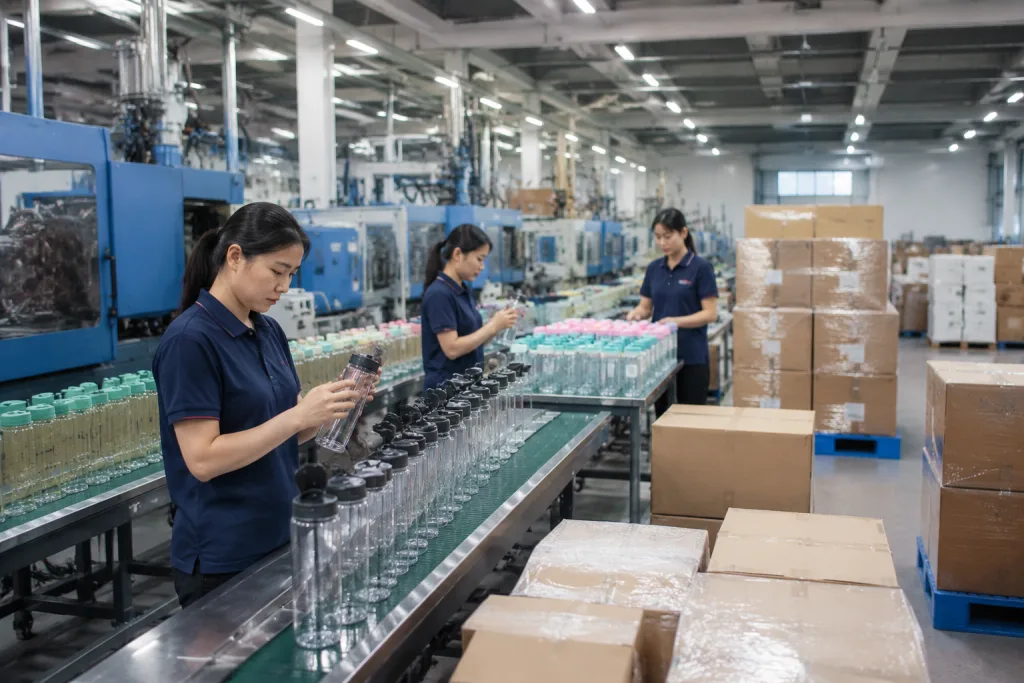
In Zhejiang, plastic bottle sourcing comes down to tooling, decoration details, resin grade, and carton count per CBM. That is where the math lives. If you buy custom drinkware, custom canteen programs, or even a customizable growler for retail, you need numbers you can budget against, not round claims. BottleForge Industrial in Hangzhou, Zhejiang builds around 600,000 units per month, and we run enough repeat SKUs to spot the pattern before you place the PO. We have even seen a buyer flagged delay start from one typo in the PO—matt print approved, but glossy packed.
Where your unit price really moves
If you are buying a manufacturer plastic water bottle, the wrong question is “What’s your body price?” The bottle body is one line on the sheet. Your real FOB China price usually moves on four cost blocks: resin, lid assembly, decoration, and packing. In Zhejiang, we see this every week. A buyer asks about the shell, then the cap BOM lands with a straw, seal ring, spring, and carry loop, and the math changes fast.
For a standard 600-700 ml single-wall plastic bottle, typical FOB ranges look like this:
- Simple PET or Tritan-style body with screw lid: USD 0.75-1.05 at 5,000 pcs
- Body with flip straw lid or carry loop: USD 0.95-1.35 at 5,000 pcs
- Double-part lid with silicone spout, lock, or handle: USD 1.20-1.80 at 5,000 pcs
Resin choice matters, but less than new buyers expect. Moving from commodity PET to a higher-clarity BPA-free copolyester often adds USD 0.08-0.22 per unit. A more complex cap can add USD 0.18-0.45. That gap is bigger because the lid runs more parts, more assembly time, and more leak-risk checks on the line. We’ve seen buyers push hard on bottle wall thickness, then miss that a 6-part lid costs more than the body.
Decoration is usually the next price swing. One-color silkscreen may add only USD 0.03-0.06. A wrap print or multi-position print can add USD 0.08-0.18. If you want a canteen customized with metallic effect, gradient spray, or heat-transfer graphics, the add-on can reach USD 0.12-0.30. Packing also bites. A retail box, barcode label, paper sleeve, or molded insert often adds more than the logo, and QC pulled samples before because the insert slot was 2 mm too tight and scratched the bottle shoulder.
The most reliable quote is not the lowest unit price. It is the quote that separates bottle, lid, print, packaging, and test cost clearly enough for you to challenge it.
If you are a canteen distributor or distributor drinkware buyer building a seasonal program, ask for a cost table by component. We ship these as a simple breakdown: body, lid, straw, seal, print, pack, testing, then mold cost if any. That lets you cut features without restarting the project from zero. It also stops the usual PO mess, like “loop lid” typed on the order when the approved sample was a lock lid.
MOQ tiers that change the math
MOQ is the cost split, not a factory habit. On our side, one line item covers color masterbatch setup, screen charges, cap stock, labor booking, and carton pack-out. We’ve seen buyers push back on a 5,000 pcs MOQ, then accept it once they see the cap supplier wants a full color batch and the outer carton only packs cleanly at a set quantity. Ask this first: which MOQ is tied to the process, and which one sales can move?
Typical MOQ by project type
- Existing mold, standard color, one-color logo: 3,000-5,000 pcs
- Existing mold, custom Pantone body or lid: 5,000-10,000 pcs
- New cap color plus custom packaging: 5,000-8,000 pcs
- New mold or heavily customized canteen program: 10,000-30,000 pcs
At 3,000 pcs, the factory is guarding setup time on the line. At 10,000 pcs, resin buying and scheduling usually get cleaner, and unit cost often drops 5%-12% against a 3,000-piece run. That gap is real. We run jobs where a 0.5-hour color change and a 2,000-carton order swing the math more than buyers expect. If you manage multiple SKUs, combine colors or keep one lid across several bottle bodies. That relieves MOQ pressure fast.
Here’s the shop-floor rule: if the bottle body uses an existing mold, MOQ has more room than the lid and the packaging. We can ship neutral stock bodies, then print later after artwork approval. Caps are tighter. If you ask for a custom loop color, a translucent cap, or a seal hardness change, the cap vendor may hold the line at a higher minimum than the bottle factory. We’ve seen this go sideways over a 60A vs 70A seal spec that looked minor on the PO.
For custom growler or customizable canteen programs, buyers often split one bottle color into two print versions. That works better than splitting into two body colors. The math doesn’t work the other way in most cases, because each body color adds purge loss, setup scrap, and extra cap matching checks. If your annual demand is 20,000 units, show the canteen suppliers your release plan early. A capable canteen manufacturer may make 10,000 now and hold 10,000 worth of packaging or components for later release; QC pulled the sample on one such job last month, and the held gift box lot still matched the first run color within tolerance.
Lead times by stage, not promises
Lead time gets easier to control when you break it into factory stages. One neat promise like 25 days sounds clean, but it hides the real gates in front of shipment. We build B2B schedules around sample approval, raw material booking, production, inspection, and vessel cut-off. On our side, QC tags each stage on the whiteboard by line number, because a 0.3 mm logo shift found at sample stage is cheap to fix; found during packing, it burns days.
A realistic timeline for a standard manufacturer plastic water bottle from Zhejiang or other East China clusters looks like this:
- Quote and specification confirmation: 1-3 days
- Artwork check and virtual mockup: 1-2 days
- Pre-production sample: 5-10 days
- Mold adjustment if needed: 7-15 days
- Bulk production after deposit: 20-35 days
- AQL inspection and rework buffer: 2-4 days
- Booking and port handoff: 3-7 days
For a stock-color item with basic silkscreen, 20-25 production days is a fair target. For custom canteen work with a new cap color, leak-test protocol, and retail carton, 30-40 days is the honest answer. We have seen buyers push for 25 days on both, and the math doesn't work. In peak windows before summer campaigns or Christmas promotions, add 7-10 days. China factory calendars matter. The line slows around Lunar New Year, and October bookings get tight fast.
The usual delays are not on the molding machine. They come from artwork revision, color approval, and packaging sign-off. Last month a buyer flagged one typo on a PO label panel after sample approval, and that alone cost 4 days because the film had to be remade. If carton drop-test results fail, rework can eat another week. QC pulled the sample, found a corner burst after the second drop, and the outer carton spec had to move up by one paper grade.
Ask your canteen supplier for a milestone schedule with one date for sample approval and another for bulk ex-factory. Ask which line will run your order. This is the right question; monthly capacity alone tells you little. A factory producing 600,000 units per month should still show line-specific planning, especially if your lid assembly depends on one outsourced component with a 5,000-piece MOQ.
The expensive details buyers miss
Most overruns start in the parts nobody notices on the first rendering. The bottle shape looks simple, then the quote gets hit by testing, compliance files, or retail pack rules. We’ve seen this go sideways after mold kick-off, when the buyer flagged a missing warning line on the PO and the whole insert had to be reprinted. EU and North America buyers should lock these points early. This is the wrong question to ask: “What is your bottle price?” Ask what the finished landed spec will cost.
Start with compliance. For the EU, you may need REACH-related declarations and food-contact testing based on material, colorant, and what claims you print on the pack. For the US, retailer checklists often pull in California Proposition 65 screening, ASTM-related checks for some categories, or CPSIA items if the bottle is sold for children. These are not big per-unit charges, but they are project costs and they show up fast on low-MOQ runs like 3,000 pcs. QC usually sends 3-5 samples to the lab, and basic lab testing can range from USD 250 to USD 900 per SKU depending on scope.
Then look at performance testing:
- Leak test: standard lids are often covered in normal line checks, but a custom valve usually adds fixture setup and extra cycle testing on the air-pressure rig
- Dishwasher claim validation: this often means a better decoration process or more wash trials; on printed bottles, we’ve had to move from standard silk screen to a tougher ink system
- Drop resistance: this matters for e-commerce and school-use bottles; a 1.2 m drop spec sounds simple until the base cracks on the second sample round
- Odor and stain resistance: sports and outdoor buyers ask for this more than they say; tea, coffee, and electrolyte mix will expose weak resin fast
Packaging is a silent cost driver. A plain export carton is cheap. A promotional retail box with inner tray, color print, FNSKU label placement, suffocation warning text, and bilingual compliance copy is not. On the line, label position alone can slow packing if the mark must sit within a 3 mm window from the side seam. For Amazon FBA or major retail prep, extra labeling and carton rules can add USD 0.05-0.18 per unit plus labor.
If you work with canteen distributors or buy as a distributor growler buyer for 4 or 5 accounts, standardize these details. Run one barcode position. Run one carton size family. Keep one insert style if you can. The math works better there than squeezing another cent out of resin pricing. We ship cleaner that way, defect rate stays down, and lead time holds closer to 12 days vs 18 days once repeat orders start. Good canteen vendors in China will push this point because the line runs smoother and fewer carton mix-ups hit final inspection.
How to quote apples to apples
Ask five canteen suppliers to quote from a loose brief and you will get five different bottles dressed up as one item. We see this every week. One factory prices PET, another prices copolyester, one runs a 55 mm lid, another builds around a 63 mm lid with a heavier silicone seal, and the carton packout shifts from 48 pcs to 60 pcs. That comparison breaks fast.
Your RFQ for manufacturer plastic water bottle sourcing should spell out the commercial points that move cost on the line:
- Capacity and fill line: for example 650 ml brimful, 600 ml nominal
- Body material and wall expectation: PET, PE, PP, Tritan-style copolyester, target weight or wall thickness
- Lid structure: screw cap, straw lid, flip lid, carry handle, lock
- Decoration method and print size: silkscreen, heat transfer, in-mold label
- Packaging: polybag, egg-crate divider, white box, color box, PDQ, master carton count
- Compliance scope: REACH, LFGB-related request, BPA-free declaration, retailer protocol
- Trade term: FOB Ningbo, FOB Shanghai, or EXW
Ask for bottle weight and carton gross weight too. This is where buyers often miss the math. A 20-gram change in bottle body weight changes drop performance and freight loading, especially once you ship 50,000 pcs per color. QC pulled a sample last month where the approved bottle was 86 g, but mass production drifted to 78 g and panel squeeze was obvious by hand. For large programs, request AQL terms up front. A common protocol is AQL 2.5 major and 4.0 minor for final random inspection. If your market is sensitive to scuffing or print variation, lock the cosmetic standard before production starts, because we have seen this go sideways after arrival.
This matters even more for canteen customizable and customized growler projects, where styling pulls attention away from process detail. The buyer flagged color and handle shape, but missed the 5-layer carton spec on the PO, and that is the wrong question to ask if you want a clean quote. A disciplined RFQ lets you compare a canteen factory in Zhejiang against another factory in China on real manufacturing variables, not who made the nicer quotation sheet.
When plastic is still the right choice
Plastic is not always the cheapest option. On big runs, it is often the practical one. If your program targets schools, gyms, outdoor events, or value retail, a manufacturer plastic water bottle usually beats stainless on landed cost, breakage risk, and color range. We ship these in high-cube cartons because the weight stays low, and that freight math matters. You can run bright Pantone programs, translucent finishes, clear measurement marks, and lighter shipment weights that metal does not match at the same budget.
For promotional demand, canteen promotional buyers often need FOB cost under USD 1.20 with acceptable logo quality. We hear the same pushback on calls: "Can you do stainless at this price?" Usually, no. The math does not work unless you strip features, cut finish quality, or shrink capacity. Plastic still fits giveaway programs, entry retail, and seasonal campaigns. It also works when you need 40,000-100,000 units split across several distributor canteen accounts and need replenishment fast.
The right plastic program is not the lightest bottle on the table. This is the wrong question to ask. If the wall is too thin, returns climb. If the cap hinge is built cheap, leak claims show up fast. On our line in Hangzhou, Zhejiang, the better mid-market bottles sit above the absolute low-cost body-weight threshold, and the cap uses seal geometry we have already pressure-tested. QC pulled the sample more than once on thin-wall jobs where panel flex was obvious by hand. Saving USD 0.04 at production can create a 2%-4% complaint rate later, which wipes out the margin you thought you protected.
If you buy custom canteen, customizable drinkware, or customized growler items for repeat retail business, ask for one pilot run before full rollout. A 1,000-2,000 piece market test gives you real feedback on color acceptance, leakage performance, and carton survivability. We have seen this go sideways when a buyer skipped testing and then flagged scuffing after the first pallet drop test. Good China suppliers usually prefer a pilot to a rushed 50,000-piece order with vague specs or a PO typo on logo position. It is the cleaner way to build a long-term distributor relationship than chasing the lowest opening quote.
Get a clear bottle quote with real factory numbers
Send your target capacity, lid style, logo method, and quantity. We will reply with MOQ, FOB pricing, sampling days, and realistic production lead time.
Frequently asked questions
What is a normal MOQ for a custom plastic water bottle from China?
For an existing bottle mold with one-color logo, 3,000-5,000 pieces is a normal MOQ. If you need a custom body color, custom lid color, or retail gift box, many canteen suppliers will push that to 5,000-10,000 pieces because of color setup and packaging minimums. A fully new mold or heavily customized canteen project can start at 10,000 pieces and go above 30,000. If your forecast is smaller, ask the factory whether they can use stock components and only customize print. That often keeps the MOQ lower than changing both body and cap colors at the same time.
How much should I budget per unit for a manufacturer plastic water bottle?
For a 500-750 ml bottle, a realistic FOB China budget is USD 0.75-1.05 for a simple screw-lid bottle at 5,000 pieces. A bottle with a straw lid, carry loop, or more complex closure usually lands around USD 0.95-1.35. Premium closures, heavier wall weight, multi-color decoration, and retail packaging can push the FOB price to USD 1.50-1.80 or higher. Add testing, inspection, and freight separately. If a quote looks unusually cheap, check bottle weight, cap structure, seal material, and carton spec. Those four items explain most price gaps between canteen manufacturers.
How long does production usually take after I approve the sample?
After sample approval and deposit, standard bulk production is usually 20-35 days. A simple stock-color bottle with one-color silkscreen can be finished in about 20-25 days. A customized drinkware order with custom color matching, leak testing, and color retail box is more often 30-40 days. Sampling before that normally takes 5-10 days. During peak shipping months or before major China holidays, add 7-10 days to stay safe. You should also reserve 3-7 days for booking, trucking to port, and export handoff after final inspection.
What quality checks should I require before shipment?
At minimum, ask for leak testing, print adhesion check, color verification, carton drop check, and final random inspection using an agreed AQL standard. Many B2B buyers use AQL 2.5 for major defects and 4.0 for minor defects. If the product is for retail or e-commerce, add barcode verification and packaging review. For sports and school bottles, hinge durability and strap pull tests are worth discussing. If you are sourcing from a canteen factory in Zhejiang or elsewhere in China, ask for pre-production sample approval plus final inspection photos and quantity reconciliation before the balance payment is released.
Is it better to buy from a trading company or directly from a canteen factory?
Direct factory buying usually gives you better control over mold status, lead time, and engineering detail, especially for custom drinkware. A real canteen factory can explain resin grade, wall thickness, assembly process, and defect controls. That matters when you are comparing custom canteen or customizable growler options. A trading company can still be useful if you need mixed product categories or lower combined MOQs across several SKUs. The key is transparency. Ask who owns the mold, where production happens, monthly capacity, and whether the supplier can support audits such as BSCI or ISO-based systems. If answers are vague, keep digging before placing the PO.