Key Takeaways
- A 750 ml single-wall stainless model usually starts around USD 2.10-3.40 FOB China at 3,000 pcs, while double-wall versions often land at USD 4.80-7.50.
- For custom canteen projects, a realistic production lead time is 25-40 days after sample approval, with pre-production samples in 7-12 days.
- Food-contact compliance should be checked against REACH, LFGB or FDA, and incoming/outgoing inspection should follow an agreed AQL such as 2.5/4.0.
- The best manufacturer military canteen choice depends on use case first: field durability, retail margin, or promotional price ceiling.
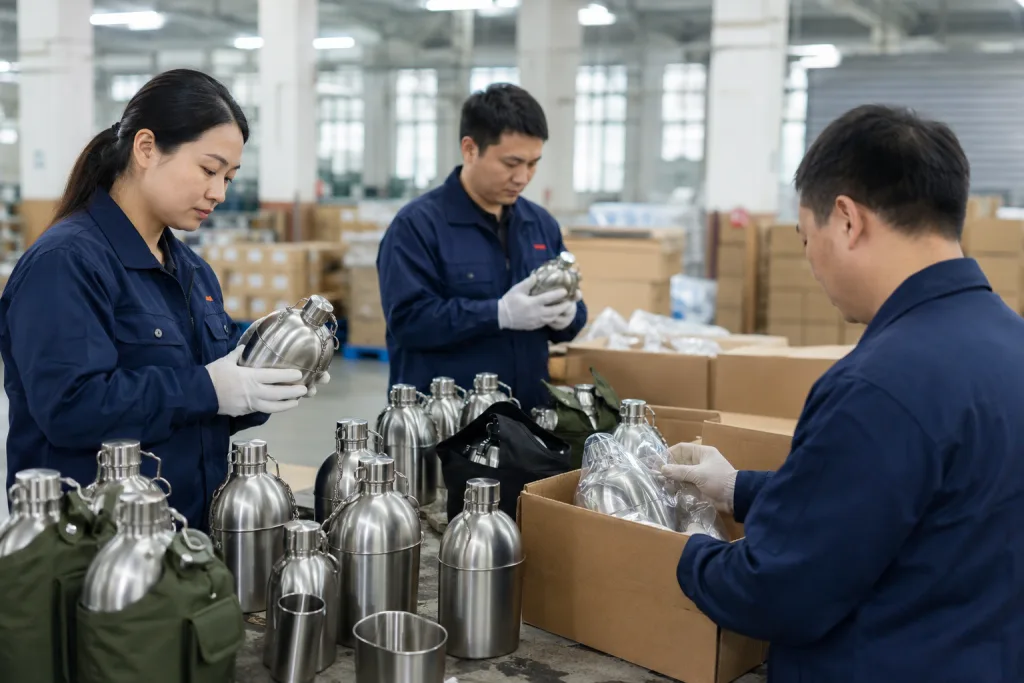
You are not buying a military canteen on impulse. You are buying for a contract, a distributor line, a promotional program, or a private-label range that has to take abuse, pass compliance, and hit a target cost. Buyers get stuck here fast. We have seen a catalog sample pass the photo check, then fail at 1.2 m drop testing because the cap wept after 3 cycles. Other times QC pulled the sample and found coating rub marks, odor retention after 24 hours, or a carton label mismatch that the buyer flagged for Europe and North America. Small miss, big headache.
At BottleForge Industrial in Hangzhou, Zhejiang, China, we run into this most often when a buyer asks for a manufacturer military canteen before the use case is locked. That is the wrong question to ask. A camp retail SKU, a canteen promotional order, and a government-adjacent field bottle do not share the same priorities, even if the body shape is close. One PO last quarter had the lid color code typed wrong by one digit, and the whole approval loop slowed down 12 days. If you want the right canteen customizable program, compare specs head to head with capacity, wall thickness, leak standard, and pack-out details, not just photos and FOB prices.
Start with the job, not the bottle
When you source from a canteen factory in Zhejiang or elsewhere in China, the first mistake is treating every custom canteen like the same SKU. We see this every week. A buyer sends one reference image, asks for FOB, and wants to compare factories before the job is even defined. That is the wrong question to ask. Start with what the bottle needs to do on the line, in the field, or on the shelf. In one recent PO, the buyer even typed the capacity wrong by 50 ml, and the quote was off from the start.
A manufacturer military canteen normally falls into four B2B use cases:
- Field or tactical style retail: buyers care about dent resistance, cap retention that will not swing loose, muted coating, and fit with pouches or clips. We usually check wall thickness first here, often 0.6 mm vs 0.8 mm, because that choice changes the whole feel of the bottle.
- Promotional distribution: the target is lower unit cost, faster decoration, and a look that sells across a broad customer base. This is where the buyer flagged price first and scratch resistance second, which tells you right away not to overbuild the body.
- Private-label outdoor line: appearance, margin, packaging spec, and repeatable quality drive the project. QC pulled the sample on one order because the coating gloss on the lid did not match the body, and that small miss was enough to hold approval.
- Distributor canteen replenishment: carton count, stable SKU dimensions, and short reorder lead time matter most. We ship these jobs best when master carton size is locked early, down to a few mm, because one spec drift can break pallet math.
If you are a canteen distributor or one of several canteen distributors serving different channels, write down the top requirements in order. Be specific. For example: leakproof performance, unit cost under USD 3.00 FOB, and logo durability for 10,000 dishwasher cycles. If you stop at "good quality" or "best price," the math does not work. A ranked list cuts bad options fast, and it gives the factory something real to quote against. We have seen buyers trim 2 or 3 unsuitable constructions in one round just by setting the cost ceiling first.
In our factory workflow in Hangzhou, Zhejiang, China, we move faster once the buyer confirms six basics: capacity, wall construction, mouth diameter, cap style, decoration method, and target price. Those six points tell the sales engineer and the tooling side what to do next. We run a quick mold check, usually against existing neck sizes and body drawings, and then we can say if the project fits a standard mold or needs a new tool. That split matters. Standard mold can save 20-35 days and several thousand dollars in development cost. On the floor, even a mouth diameter change of 3 mm can push the job into new tooling.
The point is simple: before you compare canteen manufacturers, compare the intended use. Once the use case is clear, you can judge the right structure, price band, and compliance path with less guesswork. Skip that step and the project can go sideways before sampling starts.
Head-to-head spec table that actually helps
Below is the comparison B2B buyers usually ask us for on the first RFQ. It beats brochure copy because it links each canteen option to unit price, fit, and sourcing risk, the same way we check it on the line before quoting MOQ.
| Type | Typical Capacity | Material | FOB China | MOQ | Best Fit |
|---|---|---|---|---|---|
| Classic single-wall canteen | 500-1000 ml | 18/8 stainless steel, 0.5-0.6 mm | USD 2.10-3.40 | 3,000 pcs | Promotional, entry outdoor retail |
| Double-wall insulated canteen | 530-750 ml | 18/8 stainless steel, 0.4/0.4 mm | USD 4.80-7.50 | 2,000-3,000 pcs | Premium retail, private label |
| Aluminum canteen | 600-1000 ml | Aluminum body with inner coating | USD 1.60-2.80 | 5,000 pcs | Low-cost promotions |
| Canteen with cup or cover set | 750-1100 ml | Stainless plus PP/silicone parts | USD 3.90-6.20 | 2,000 pcs | Camping sets, gift programs |
What does this mean in practice? This is the part buyers usually miss.
Single-wall stainless
This is usually the safest place to start for a custom canteen. We run more of these than any other type because 0.5-0.6 mm single-wall bodies take abuse, hold shape well in transit, and give fewer odor claims after first wash. Decoration is flexible: silkscreen for promo runs, laser for clean logo detail, powder coat for shelf impact, wrap print if the artwork needs coverage. If your ceiling is strict, this is the right question to ask first, not insulation. QC pulled the sample last month on a 750 ml run and the only issue was a logo position drift of 1.5 mm.
Double-wall insulated
If the buyer expects temperature retention, this is the commercial step up. A decent vacuum unit can hold cold for about 18-24 hours and hot for 8-12 hours depending on fill conditions, but the math changes fast once you add copper coating, larger lids, and retail-grade powder coat. Weight goes up. Freight goes up too. Shape options narrow because the vacuum line has less tolerance than a single-wall press. We have seen buyers flag a wide-body sketch that looked good on the rendering but failed cup-holder fit by 6 mm.
Aluminum
Some vendors push aluminum on price, and on paper it looks attractive at 5,000 pcs. On actual shipments, this is where things go sideways if the inner coating is inconsistent. We have seen taste complaints, denting at the shoulder, and coating checks fail after transit drop tests. For a short promo cycle, it can still work. For a serious manufacturer military canteen program, it is usually the wrong base unless the buyer accepts the tradeoff upfront. One PO we received even had the body spec typed as "alumium," which tells you how loose some of these programs start.
Set-based canteens
If you need stronger perceived value, a nesting cup or cover set does raise the shelf story. It also adds parts, pack-out steps, and defect points. A simple bottle might pass final inspection clean, while the set version gets held for cup fit, silicone smell, or carton mismatch. We ship both quote versions for this reason: bottle only, then full set with the margin gap shown clearly. Last season a buyer pushed back on a 2,000 pcs set quote after seeing assembly time add 12 days vs 18 days across two packing options.
Material decisions buyers regret later
Material choice hits more than unit cost. It shows up in compliance, how the item feels in hand, decoration pass rate, and the return file six months later. For a manufacturer military canteen project, food-grade 18/8 stainless steel is usually the safe call. We run it on the line every week. It is stable, accepted across Europe and North America, and fits customized drinkware programs that need 12 days in service testing instead of 18 days of back-and-forth over early failures.
For bodies, you will often see 0.5 mm or 0.6 mm single-wall stainless. That 0.1 mm matters. QC pulled samples last quarter where a buyer pushed for lighter weight, then flagged denting after carton drop. Thicker walls take abuse better, but they also add weight and FOB cost. On vacuum items, many factories use 0.4 mm inner and 0.4 mm outer walls to keep forming stable at the hydroforming station. Ask for actual wall thickness on the quotation sheet. "Premium steel" is the wrong question to ask.
Caps are another weak point. A stainless body with a low-grade polypropylene cap liner still fails odor or leakage checks. We have seen this go sideways after a 72-hour odor test, even when the bottle body passed clean. For field-style canteens, you should ask about:
- PP or Tritan cap components
- Food-grade silicone gasket hardness
- Thread cycle testing
- Drop testing from 1.0-1.2 meters
- Salt spray resistance for exposed metal accessories if any
Some buyers also ask whether a customizable growler or custom growler platform can be adapted into a canteen body. Sometimes yes. Often no. The buyer flagged this on one PO after seeing the neck finish match a growler drawing, but the carry loop position was wrong by 8 mm for belt-hook use. Growler structures are usually built for beverage storage and shelf display, not the flatter profile, retention loop, or belt-hook handling military canteen buyers ask for. A customizable growler or customized growler line may share tooling logic with customized drinkware, but it is a different job.
For most B2B canteen suppliers, the better question is not "What material is cheapest?" It is "What material gives me the lowest total claim rate at my target price?"
That is the engineer's view. It saves money. A canteen manufacturer offering a price 8 percent lower but shipping more denting, more odor complaints, or more print failures is not cheaper once the claim sheet lands. We have had buyers argue over 3 cents on material, then lose 11 cents per unit on rework. The math doesn't work.
Customization routes and their real limits
A canteen custom program looks easy on the drawing until decoration hits the line. That is where experienced buyers start pushing back, and where weak suppliers get exposed fast. We have seen a PO approved from a nice render, then QC pulled the sample and the logo was 6 mm too close to the shoulder radius. Bottle shape, surface finish, and MOQ decide what will work.
For a standard single-wall military-style bottle, the common decoration options are:
- Silkscreen: low setup cost, solid for 1-2 spot colors, best for 3,000+ pcs. On our line, a simple one-color print runs cleanly if the artwork stays off the weld zone.
- Laser engraving: durable, premium look, especially on powder-coated stainless bodies. A 20W fiber laser gives crisp marks, but fill size still has limits on curved panels.
- Heat transfer or water transfer: suitable for camouflage or wrap graphics, but process control has to be tighter. The buyer usually wants full wrap; the hard part is keeping seam alignment within 1.5-2.0 mm.
- Embossed or debossed accessories: practical on straps, pouches, or silicone parts if tooling allows. This works well on a silicone strap tab, less well on soft webbing where depth gets lost.
If you need canteen promotional orders, silkscreen is usually the cheapest route. A one-color print may add only USD 0.08-0.18 per unit depending on size and order volume. Laser engraving often adds USD 0.15-0.35. Full-wrap transfer can add USD 0.30-0.80 and raises reject risk if alignment tolerance is tight. Buyers ask for photo-grade camo on a low-volume order all the time. The math does not work.
For a fully canteen customizable private-label program, ask your canteen factory to confirm the decoration safe area with a flat artwork template. A sample photo is not enough. On a curved shoulder, the printable height can drop by 12-18 mm versus the straight body, and concave panels cut it again. We usually mark the safe area from an actual wrapped template after the first sample, not from sales artwork.
Packaging also matters in customized canteen projects. This gets missed. If you are selling into Amazon or large retail distribution, you may need barcode placement, FNSKU labeling, drop-test-ready inner packs, or mail-order-safe kraft boxes. One buyer flagged a barcode panel because the scanner window was too close to the box edge by 5 mm. A distributor drinkware buyer may care more about master carton efficiency and pallet loading than gift-box appearance. A distributor growler buyer might accept a heavier carton, while a distributor canteen buyer serving outdoor chains may insist on PDQ-ready or shelf-ready presentation.
At BottleForge, typical MOQ for custom logo drinkware starts at 1,000 pcs on some existing models, but for a true manufacturer military canteen shape with custom finish, 2,000-3,000 pcs is more realistic. Our standard stainless line ships over 300,000 units per month, and that matters on repeat orders because buyers do not want a second run built on a different setup. We run the same tooling and process window where possible. That is the right question to ask, not just headline capacity.
Compliance, testing, and inspection discipline
Buyers in Europe and North America should treat compliance as part of product design, not paperwork pushed to the last PO revision. We see this on the line all the time: a 0.3 mm silicone seal change can shift the test scope, so a China canteen supplier should tell you exactly which standards fit the construction you are buying.
For food-contact drinkware, the baseline is usually FDA or LFGB by market, plus REACH for European distribution where it applies. If the canteen has coatings, inks, straws, or textile sleeves, each component needs its own review. QC pulled one sample last month where the bottle body passed but the strap webbing had no supporting file. For children-oriented formats, ASTM or CPSIA can also come into play based on the final product category and age grading.
On the factory side, ask for an inspection plan, not a promise. This is the wrong question to ask if you only ask, "Do you check before shipment?" A practical export standard is AQL 2.5 for major defects and 4.0 for minor defects, with checks covering:
- Leak test
- Vacuum retention test if insulated
- Coating adhesion
- Logo position and color tolerance
- Carton drop condition
- Barcode scan readability
- Accessory count per set
If you are working with multiple canteen manufacturers or canteen vendors, compare how they sample during production, not just at final pack-out. One supplier may quote 6% lower because they skip in-process checkpoints at cap assembly or printing. We've seen this go sideways. The buyer flagged it after arrival: mixed cap torque at 0.8 N.m to 1.6 N.m, uneven powder coat on the shoulder, and print variation from carton to carton.
Lead time should be broken down honestly. Sample confirmation can take 7-12 days. Material prep and decoration setup may take another 5-8 days. Mass production often runs 20-30 days after deposit and artwork approval. If someone offers a heavily customized canteen customized order in 12 days during peak season, ask more questions. We ship rush orders, but the math doesn't work if you still need mold polishing, screen approval, and carton print proofing.
China is still the dominant sourcing base for this category because tooling, stainless forming, decoration, and packaging supply chains are concentrated here. That helps only when your canteen manufacturer keeps traceable records and stable QC. A cheap first quote means little if the inspection log is missing, the PO has a color-code typo, or the factory cannot tie the finished lot back to the stainless coil and packaging batch.
Which format fits your channel best
Start with buying logic that holds up on the shelf and on the PO. For a canteen distributor building an outdoor assortment, the single-wall stainless manufacturer military canteen is usually the right first SKU. It takes abuse well enough, cuts freight weight against double-wall, and gives you clean logo space on the body. On our line, a standard 500ml single-wall body in 304 stainless usually runs about 180g, which keeps carton weight under control. It also gives you room to add a matching customizable drinkware range later.
If your customers want all-day cold retention, move to vacuum insulation. Just price it honestly. Landed cost climbs fast once you add coating, laser mark, custom box, and compliance testing. We have seen projects jump from workable to dead on arrival after one buyer added three packaging revisions and an LFGB request in the same PO. This fits premium retail. For canteen promotional campaigns under USD 5.00 landed, the math often does not work.
If you supply event merchandise, NGOs, schools, or broad corporate programs, be careful with odd body shapes. Standard molds usually give you better cap fit, faster replenishment, and lower carton damage rates. QC pulled one shaped sample last season because the cap torque drifted after transit, while the standard body passed drop testing cleanly. A canteen customizable program does not need a special silhouette to sell. We ship plenty of repeat orders with a standard body, matte coating, engraved logo, and tailored packaging. That is the safer commercial play.
For buyers already sourcing custom drinkware, the canteen format also stretches into adjacent categories like a custom growler gift set or a coordinated stainless bottle family. This matters when you want one canteen supplier covering several SKUs while keeping finish consistency across them. The buyer flagged this on one 3-SKU launch after black powder coat came back with a visible shade shift of about 0.6 Delta E between factories. The same logic applies if you need customized drinkware, customizable growler, and customized canteen products under one seasonal launch.
The channel fit is straightforward:
- Promotional buyers: single-wall, standard mold, 1-color print, simple box.
- Outdoor retail brands: single-wall or double-wall stainless, powder coat, laser mark, reinforced cap loop.
- Distributors: stable replenishment models with repeatable cartons and documented QC.
- Private-label importers: balanced spec with compliance file, barcode control, and a reorder plan.
When you ask a canteen manufacturer for quotation, ask for three levels: good, better, and best. We run quotes this way because it exposes the cost jumps fast, often in one sheet instead of 10 email rounds. One buyer even sent a PO with the print spec typo'd as "later mark" instead of "laser mark," and the tiered quote caught it before sampling. This is the right question to ask.
Compare your canteen spec with a factory quote
Send your target capacity, wall construction, logo method, packaging, and order volume. We will quote the right manufacturer military canteen options with realistic MOQ and lead time.
Frequently asked questions
What MOQ should I expect for a custom manufacturer military canteen order?
For an existing mold, most canteen manufacturers in China will quote around 2,000-3,000 pcs per color for a stainless manufacturer military canteen. Simpler logo jobs on standard drinkware sometimes start at 1,000 pcs, but that is less common for flatter canteen bodies with custom fittings. If you need a new mold, practical MOQ often moves to 5,000 pcs or more, depending on tooling cost and component complexity. You should also ask whether MOQ applies per SKU, per color, or per mixed carton program. Some canteen suppliers allow 2-3 logo versions within one order if the base bottle and coating stay the same, which helps distributors test a line without overcommitting.
How do I choose between single-wall and insulated canteen designs?
Choose single-wall when durability, lighter weight, and lower FOB cost matter more than temperature retention. A typical 750 ml single-wall stainless canteen may weigh 220-320 g and quote around USD 2.10-3.40 FOB China. An insulated version of similar size may weigh 380-520 g and quote USD 4.80-7.50. For promotional programs, single-wall is usually the safer commercial choice. For premium retail, insulated can make sense if your end customer expects 18-24 hours cold retention. Ask your canteen factory for actual weight, wall thickness, and leak-test records. Those numbers matter more than broad claims like outdoor grade or premium quality.
What compliance documents should a canteen supplier provide for Europe and North America?
At minimum, ask for food-contact test support relevant to your market: FDA for the US, LFGB for Germany-focused or broader EU retail expectations, and REACH screening for applicable materials and chemicals. If the item includes coatings, inks, silicone parts, or textile sleeves, those components should also be covered. A capable canteen supplier should also provide packing specs, product dimensions, and QC records tied to your PO. For larger retail or importer programs, ask whether the factory operates under ISO-style quality systems and whether social compliance such as BSCI is available. Documents should match the exact structure you buy, not a random report from a different bottle.
How long does production usually take for a customized canteen project?
For a standard mold with custom logo and normal packaging, expect 7-12 days for pre-production sampling and about 25-35 days for mass production after sample approval and deposit. If you add a new coating color, transfer print, custom accessory, or gift box, lead time can stretch to 35-45 days. Peak season pressure can add another 7-10 days. Serious canteen vendors will separate sample time, material prep time, and production time instead of giving you one vague date. If your order ships FOB from Zhejiang, China, also leave buffer for final inspection and container booking. Tight retail launch dates need backward planning, not optimistic promises.
What makes one canteen factory better than another for distributor business?
For distributor business, the best canteen factory is usually not the one with the lowest opening quote. You want repeatability. Check whether the supplier can hold stable specs across repeat POs, support AQL 2.5/4.0 inspection, and manage mixed packaging requirements without carton errors. Ask about monthly capacity, reorder lead time, and whether replacement caps or accessories can be supplied separately. A factory producing 300,000 units per month with standard stainless programs is often more reliable for ongoing distributor canteen business than a smaller workshop chasing custom shapes. Good canteen distributors also look at communication speed, barcode accuracy, and the supplier's willingness to document approved samples against mass production.