Key Takeaways
- A 500ml 18/8 vacuum bottle usually lands around USD 3.20-5.80 FOB China at 1,000-5,000 units depending on coating, lid, and print
- Typical MOQ is 500-1,000 units per color for stock molds, but new lid or body tooling often starts at 3,000 units
- Standard production lead time is 25-35 days after sample approval and deposit, with 7-12 extra days in peak season
- Leak, insulation, coating, and carton testing should be tied to AQL 2.5 and market rules like REACH, LFGB, or ASTM where needed
You already know the catalog photo is the easy part. The hard part is why one stainless thermos quote lands at USD 3.80 and another at USD 6.40, and why one factory says 20 days while another asks for 45. We see this on the line every week. A 0.4 mm body wall, a heavier lid at 68 g, or an extra leak-test step will move cost fast. If you buy for an outdoor retail line or a promotional program, those gaps hit margin, launch date, and the complaint count your team deals with later.
When you source a manufacturer insulated water bottle from China, the quote is a stack of shop-floor choices: steel grade, vacuum process, lid tooling, decoration method, test standards, carton rules, and MOQ. This is the wrong question to ask if you only compare FOB price. The buyer flagged a USD 0.22 difference on one PO last month; the real gap came from 304 stainless on both offers but different copper coating coverage and a 24-hour heat retention target versus 12 hours. Zhejiang factories make it look simple. It isn’t complicated, but it is precise. You need the numbers before you commit.
What actually sets the unit price
In a custom thermos program, body shape is only one cost layer. A realistic FOB Zhejiang, China quote for a 500ml double-wall stainless bottle with powder coating and one-color logo is usually USD 3.20 to USD 4.40 at 1,000 units. Change the lid to a multi-part design, add a copper-plated inner wall, widen the mouth by 8 mm, add a silicone boot, pack each piece in an individual box, and print two logo positions, and the same bottle can reach USD 4.90 to USD 5.80. Buyers ask why a factory thermos quote jumps by more than 20%. In most cases, the first RFQ missed details. We see this every week: the PO says “standard lid,” then the artwork file shows a carry handle lid with a straw set.
The main cost drivers are straightforward:
- Steel grade: 18/8 stainless steel costs more than 18/0, but it is the safer choice for outdoor retail and long-term corrosion resistance. We run salt-spray and dishwasher checks on retail projects, and 18/0 gets buyer pushback fast.
- Weight: a 500ml body can vary from about 280g to 360g. Thicker material improves dent resistance but raises cost fast. On the line, a 0.4 mm wall and a 0.5 mm wall do not price the same.
- Vacuum structure: standard vacuum is cheaper than copper-coated vacuum, but copper plating can improve heat retention by 10% to 20% in some models. QC pulled the sample once and found the copper layer was patchy near the shoulder, so this part needs process control.
- Lid complexity: simple screw lids are low risk. Flip lids, handle lids, straw lids, and multi-part caps add assembly time and defect risk. More parts, more trouble. A 5-piece lid usually needs extra leak testing at 60°C.
- Decoration: silk screen is usually the lowest cost. Laser engraving, UV print, heat transfer, and wrap-around artwork cost more. The buyer flagged a Pantone mismatch last season on a UV print run, and rework ate the margin.
- Packaging: white box, color box, PDQ tray, barcode labeling, and drop-test requirements all add cost. A color box with a 1.2 m drop-test target is not “just packaging”; it changes carton spec and packing speed.
For promotional thermos orders, the logo method matters as much as the bottle itself. A one-color silk screen print may add only USD 0.08 to USD 0.18 per piece. Laser engraving is often USD 0.12 to USD 0.25. Full-wrap transfer can add USD 0.35 to USD 0.70 depending on coverage. This is the wrong question to ask: “What is your best price?” Ask for a line-by-line breakout instead. Otherwise you are not comparing the same product, and we’ve seen this go sideways after the pre-production sample when one supplier quoted a white box and another quoted a color box with barcode label.
MOQ tiers that change your economics
MOQ is where first-time buyers burn 2 to 3 weeks. On stock molds, a thermos manufacturer in Zhejiang will usually quote 500 units per color for a simple branded order, or 1,000 units total across 2 colors if the finish is standard. We run this kind of order on the line with existing spray fixtures and a standard silk-screen plate, so it works for a promotional run. Ask for a new lid, custom Pantone powder coat, embossed mark, or exclusive base mold, and the MOQ often jumps to 3,000 to 5,000 units. That jump surprises people, but the math is plain.
Typical tiers look like this:
- 300-500 units: possible only on selected stock bottles, with limited lid options and color choices. Unit pricing is higher, and QC usually pulls the sample from existing warehouse stock.
- 1,000 units: the practical entry point for most custom logo stainless programs. At this level, buyers usually get cleaner carton planning and fewer arguments over setup cost.
- 3,000 units: where custom colors, more packaging options, and better landed cost start to pencil out. This is also where a Pantone approval chip and outer carton print change stop being a headache.
- 5,000+ units: suitable for outdoor chains, distributors thermos programs, and annual repeat SKUs. At this volume, we ship with steadier material planning and fewer stop-start production gaps.
If you buy thermos bulk for retail, the price break from 1,000 to 3,000 units is often USD 0.25 to USD 0.55 per piece. From 3,000 to 5,000 units, savings may be another USD 0.10 to USD 0.25. The biggest drop is usually that first step up, because setup labor, print screens, and stainless coil planning spread across more pieces. We have seen buyers push hard for 1,200 units with gift boxes and two lid types; usually the savings disappear in repacking and changeover time.
A common mistake is forcing a highly customizable thermos project into a low MOQ. You end up paying near-tooling-level cost and still do not get real exclusivity. We have seen this go sideways. One PO even had the lid code typed wrong, and the buyer flagged it only after sample approval. If your annual forecast is under 2,000 units, stay close to stock molds and customize logo, coating, and packaging. If your forecast is 10,000 units or more, talk about dedicated tooling, because the amortized mold cost per bottle becomes reasonable. This is the right question to ask early, not after the sample room has already cut a new fixture.
A practical rule: if your bottle needs a brand-specific lid or silhouette, ask for tooling cost, cavity count, and break-even quantity before approving samples.
Sample to shipment timeline, stage by stage
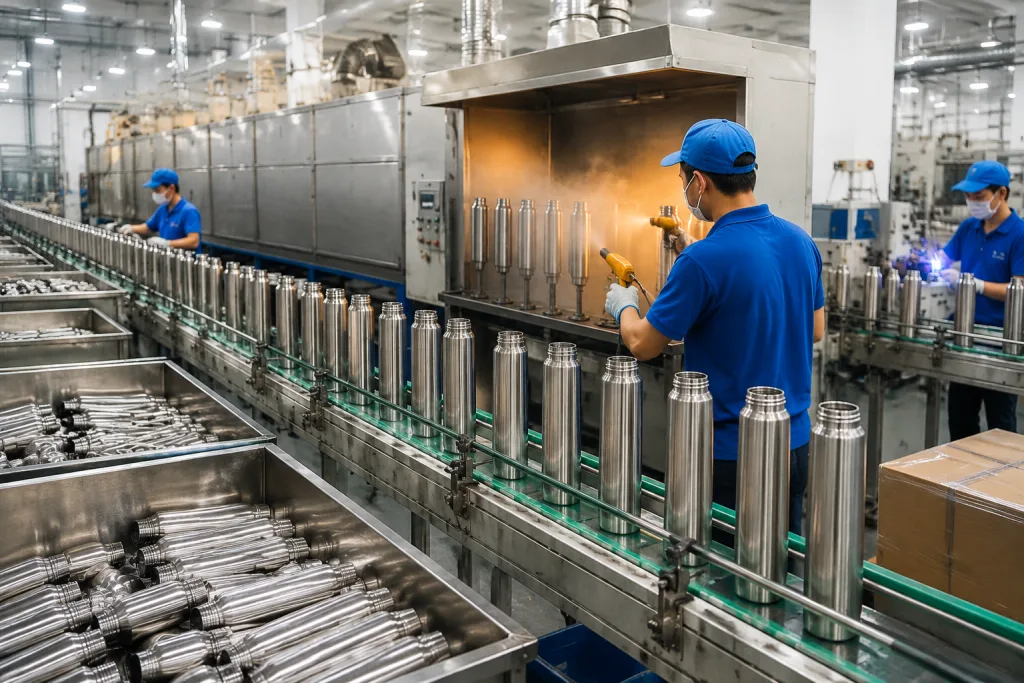
Lead time is almost never one number. On our line, a manufacturer thermos order moves step by step: sampling, approval, raw material booking, body forming, vacuuming, coating, logo application, assembly, inspection, then vessel booking. If a factory says 30 days, ask a better question: approved from which point? We’ve seen POs sent without artwork, without Pantone, and once with the carton size line left blank. In those cases, the clock has not started. No deposit, no packaging file, no run.
Normal timeline for stock molds
- Quotation and drawing check: 1 to 3 days
- Pre-production sample: 5 to 7 days for stock body with custom logo
- Revised sample: 3 to 5 days if only print or coating changes
- Mass production: 25 to 35 days after sample approval and deposit
- Final inspection and booking: 3 to 7 days
Your working total is usually 35 to 50 days from approved sample to FOB shipment. Peak season from August to November adds 7 to 12 days fast; coating capacity is usually the first squeeze. Before Chinese New Year, add more unless the PO lands early and materials are booked. BottleForge Industrial, for example, plans around 600,000 units per month across drinkware lines, but the line still gets stuck at coating and lid assembly during gifting season. QC pulled the sample on one rush order last October, and the silver logo was 1.5 mm off-center, so the whole print slot moved by two days. Buyers don’t like hearing that, but the math doesn’t work if every stage is already full.
Timeline for custom mold projects
- 3D drawing and structure review: 3 to 7 days
- Tooling fabrication: 15 to 30 days for body or plastic lid parts
- Tooling sample and fixes: 7 to 15 days
- Mass production: 30 to 40 days after final approval
That puts a true custom thermos project closer to 60 to 90 days. Add another 3 to 5 days if the packing set includes a retail insert, hangtag, FNSKU label, or multilingual care manual. This is the wrong place to push for shortcuts. A new tool needs structure review, trial shots, fit checks, and usually one round of fixes after the first sample; we often check thread fit with a go/no-go gauge before signoff. If a supplier promises 20 days for a new tool, ask what they are skipping. We’ve seen this go sideways.
Where outdoor and promo specs diverge
Outdoor retailers and promotional brands both buy stainless vacuum bottles, but they do not build the spec the same way. Outdoor buyers usually push on heat retention, drop resistance, and whether reorder lot No. 3 matches lot No. 1. Promo buyers push on logo size, ship date, and unit price. We see this on the line all the time: one PO asks for a 1.2 m drop check, the next one asks for a bigger front print area. Use the wrong spec sheet and the factory will quote the wrong bottle.
For outdoor retail, a safer baseline is 18/8 inner and outer, 0.4mm to 0.5mm outer wall thickness, powder coating, BPA-free PP lid parts, silicone seal, and tested leakproof performance. That baseline holds up better in real use. For a 500ml bottle, around 12 hours hot and 24 hours cold is common for mass-market models tested under controlled conditions. If a manufacturer insulated water bottle claim says 24 hours hot on a standard 500ml bottle at a low price, ask how it was tested. This is the right question. We have had buyers flag claims like that, then QC pulled the sample and the bottle weight came in 35 g light, which told the story fast.
For promotional thermos orders, you may accept a simpler lid and thinner outer wall if the bottle is mainly for giveaways. The math only works if the use case is short-cycle. You still need minimum compliance discipline. Ask for REACH for Europe, LFGB if food-contact requirements call for it, and California Proposition 65 screening when relevant for North America. If the item is for kids or school channels, ASTM-related checks may also come into the discussion depending on design details and components. One factory-floor detail that gets missed: a thin wall bottle with a big logo panel often needs extra carton protection, or the buyer will flag dents before the event stock even hits the venue.
Decoration choices also split by channel. Outdoor brands often choose laser mark for durability or a subtle one-color print, and we usually run an adhesion check after powder coat cure before mass print. Promotional thermos programs lean toward bright Pantone coatings, large logos, and individual color boxes, often with a 1,000 pcs MOQ to keep box cost under control. None of those choices are wrong. The wrong move is buying a distributor thermos spec for an outdoor shelf, or buying a premium retail spec for a one-week campaign where the budget never supported it. We've seen this go sideways, including a PO with the logo position typoed by 8 mm, and that small miss turned into a full carton rework.
How to control quality before balance payment
If you are buying from thermos manufacturers in China for the first time, build QC into the PO and inspection plan before the line starts. Arguing after shipment is the wrong question to ask. We usually write the standard, defect limit, inspection timing, and sample reference into one sheet, then match it against the approved sample on the floor. For stainless bottles, cover vacuum retention, leak test, coating adhesion, logo position, color tolerance, odor, and carton condition. QC pulled one sample last month with a logo shifted 2 mm off center; the buyer flagged it right away, and that saved a full batch from going out wrong.
A practical QC framework for a bulk thermos order includes:
- AQL standard: commonly AQL 2.5 for major defects and 4.0 for minor defects, unless your channel needs stricter limits.
- In-line checks: coating, print, and assembly inspections during production, not just at the end.
- Finished goods inspection: random sampling after at least 80% of goods are packed.
- Reference sample: signed golden sample for color, logo size, lid feel, and packaging.
Ask your supplier thermos team which tests are standard and which are extra-cost. Leak testing is standard, and most factories run it on the line. Salt spray for coating, dishwasher testing, or third-party lab migration tests are often charged separately. Carton quality gets ignored too often, and we have seen this go sideways. A bottle can pass production and still arrive dented if the export carton wall is too weak, say 5-layer instead of the agreed spec, or if pallet rules were never confirmed.
If you ship to Amazon or a distributor warehouse, lock barcode placement, carton marks, pallet height, and drop-test expectations before packaging starts. One PO we received had the outer carton mark typo in the SKU, and the whole packing line had to stop for relabeling. Rework in China costs time. Relabeling after arrival in Europe or North America costs cash, and the math does not work. Good manufacturers thermos programs treat packaging as part of product quality from day one.
The RFQ details that save weeks
The fastest way to get clean pricing from a thermos factory is a complete RFQ. Not a mood board. Not a screenshot that says “something like this.” We need the physical spec and the commercial spec in the same file, or the line starts guessing. With a clear RFQ, quotes from China are usually comparable in 24 to 72 hours. Without it, 6 suppliers will fill gaps 6 different ways, and you lose 7 days sorting out what diameter, coating, and pack-out they assumed. We’ve seen this go sideways over a 2 mm body diameter change.
Your RFQ should include:
- Capacity and dimensions: 500ml, 750ml, 1L, target diameter and height
- Material: 18/8 inner and outer, or any alternate request
- Finish: powder coat, spray paint, brushed, polished, or mixed finish
- Lid structure: screw cap, flip lid, carry loop, straw, handle
- Logo method: silk screen, laser, transfer, embossing
- Packaging: white box, color box, gift box, carton quantity
- Compliance: REACH, LFGB, BSCI audit request, ISO system request
- Order quantity and target date: 1,000 now, 5,000 annual, shipping month
- Trade term: FOB Ningbo or Shanghai, or ex-works if you use your own forwarder
If you need a customizable thermos for a distributor channel, say whether the bottle must share components across several SKUs. This matters. Shared lids and one master carton size usually cut dead stock, and they make replenishment easier when QC pulled the sample and found the wrong loop color on 1 of 3 lid versions. If you need a thermos customized for retail launch, ask for a costed option table with separate line items: standard lid vs handle lid, one-color logo vs laser, white box vs color box. This is the right question to ask. A good thermos vendor in Zhejiang should quote those options cleanly instead of hiding the variables inside one vague number.
That is how you avoid false savings. The cheapest quote is often the least defined quote, and the math doesn’t work once the buyer flagged the missing insert card, barcode label size, and drop-test requirement.
Get a costed thermos quote with real lead times
Send your capacity, lid style, logo file, MOQ, and target ship date. We will reply with FOB pricing, sample timing, and workable options from Zhejiang.
Frequently asked questions
What is a realistic FOB price for a stainless insulated bottle?
For a standard 500ml double-wall 18/8 stainless bottle, realistic FOB China pricing is usually USD 3.20 to USD 4.40 at 1,000 units if you use a stock mold, powder coating, and one-color logo. Add a complex lid, copper lining, silicone boot, gift box, or wrap print, and it often moves to USD 4.90 to USD 5.80. At 3,000 to 5,000 units, you may save USD 0.25 to USD 0.55 per piece compared with a 1,000-unit run. If a quote is far below that range, check steel grade, bottle weight, and whether packaging and logo are included.
How long does a custom thermos order usually take?
For a stock bottle with custom color and logo, plan 5 to 7 days for the sample and 25 to 35 days for mass production after approval and deposit. Add 3 to 7 days for final inspection and booking, so a practical total is 35 to 50 days FOB. In peak season, especially from August to November or before Chinese New Year, add 7 to 12 days. If you need new tooling for the lid or bottle body, the full cycle is more like 60 to 90 days because tooling, test samples, and revisions take time.
What MOQ should I expect for a customized thermos?
For stock molds, many factories in Zhejiang, China will accept 500 units per color or around 1,000 units total for a simple custom logo order. That usually works for promotional brands or test launches. If you want a custom Pantone coating, non-standard packaging, or multiple print locations, 1,000 units is a safer commercial MOQ. For an exclusive lid, new base, or dedicated mold, the MOQ often starts at 3,000 to 5,000 units, plus tooling charges. If your annual demand is below 2,000 units, stay close to existing molds to avoid paying custom-tooling economics on a small run.
Which compliance documents matter for Europe and North America?
For Europe, buyers commonly ask for REACH compliance and sometimes LFGB for food-contact confidence, depending on the channel. For North America, requests often include BPA-free declarations, California Proposition 65 screening where relevant, and retailer-specific packaging or chemical restrictions. If the bottle is aimed at children, ASTM-related checks may matter depending on the design. On the factory side, BSCI social audit and ISO system documentation are also common buyer requirements. Ask for actual test reports tied to the material or model, not just a general statement, and confirm whether the report is current within the last 12 to 24 months.
How do I compare quotes from different thermos suppliers fairly?
Use one specification sheet and make every supplier quote against it. At minimum, fix the capacity, bottle weight, steel grade, coating type, lid structure, logo method, packaging, MOQ, and trade term. Also ask each thermos supplier to break out tooling, sample charge, unit price, packaging cost, and test cost separately. A 500ml bottle quoted at USD 3.60 can become USD 4.30 after adding the color box, barcode, and second logo location. Without a line-by-line quote, you are not comparing the same product. Require a sample before PO confirmation, and tie production to a signed golden sample and AQL standard.