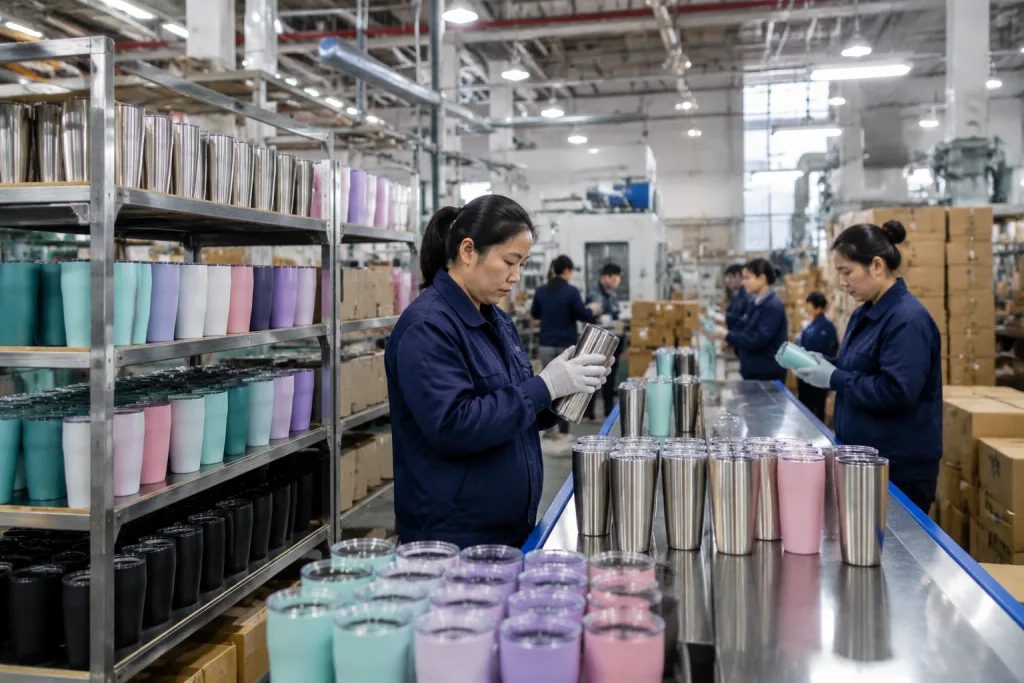
Key Takeaways
- Most B2B insulated tumbler projects start at 1,000-3,000 pcs per color, with sample lead time 5-7 days and mass production 25-35 days in Zhejiang, China
- 18/8 stainless steel, 0.4-0.5 mm inner wall, and copper-plated vacuum insulation usually justify a 10-18% higher unit cost by reducing complaints and heat-loss returns
- Silkscreen is usually the best value under 3,000 pcs, while powder coat plus laser engraving gives stronger logo durability for distributor drinkware programs
- AQL 2.5, 24-hour leak test, and REACH or LFGB documentation should be agreed before deposit, not after goods are packed
You are not buying a tumbler. You are buying a repeatable result: correct capacity, stable vacuum performance, clean logo placement, compliant materials, and an on-time shipment that lands without a chargeback. On our line, QC pulled a 30 oz sample last month because the logo sat 1.8 mm off center—small miss, big problem at retail. That is why a manufacturer insulated tumbler quote from China can vary by 30% even when two products look almost the same in photos. The gap usually comes from steel grade, wall thickness, lid tooling, decoration method, and how the factory checks leakage and cosmetic defects.
For buyers in Europe and North America, the practical question is simple: which spec fits your channel, margin, and risk tolerance? This is the right question. A Zhejiang factory can offer MOQ 500 and sampling in 7 days, but the math does not work if the construction does not match the use case. We have seen this go sideways when a buyer pushed for a thinner outer wall to save $0.28, then flagged denting after drop tests. Below is the head-to-head view smart buyers use before they approve a custom drinkware program.
What you are really comparing
Comparing one manufacturer insulated tumbler quote to another starts with the BOM, not the product name. This is the wrong question to ask: “Why is one cheaper?” Ask what changed in steel grade, vacuum build, lid fit, coating, print method, and inspection scope. If one canteen supplier in China quotes USD 3.85 FOB Ningbo and another quotes USD 4.60, you need to see where the extra USD 0.75 lands. We have seen buyers miss a 0.05 mm wall difference on the drawing, then flag dents after the first drop test.
At BottleForge Industrial in Zhejiang, we usually break a tumbler down like this:
- Body material: 18/8 stainless steel for food-contact inner wall, sometimes 18/0 outer wall on price-driven projects. Buyers ask for 304 stainless on the PO, and QC checks that against the material cert before the line runs.
- Wall thickness: common range 0.4 mm inner and 0.45-0.5 mm outer. Thinner walls cut cost and dent faster. We measure this with a micrometer, and the buyer flagged it once when the outer wall came in light by 0.03 mm.
- Insulation: double-wall vacuum, often with copper coating to improve thermal retention by roughly 10-15%. On the floor, that means an extra process step, and the math does not work for every low-price promo order.
- Lid type: slider lid, flip lid, screw lid, or straw lid. Lids drive most leakage complaints. We ship plenty of clean body sets, then lose time on a silicone ring fit issue of 1 mm.
- Finish: spray paint, powder coating, electroplating, or bare stainless. Powder coat looks better after transit abuse, but we have seen thin spray jobs fail tape testing.
- Decoration: silkscreen, heat transfer, water transfer, laser engraving, 3D UV print. Decoration pricing moves fast once you add a second position or wrap coverage over 180 degrees.
If you also source a custom canteen, customizable growler, or custom growler from the same canteen factory, the logic stays the same. The shape changes. The cost drivers do not. A serious canteen manufacturer or canteen vendor should explain the tradeoffs in plain numbers instead of hiding behind “premium quality.” We have seen this go sideways when a PO says “matte black” but does not specify powder coat or spray paint.
You do not need the highest spec. You need the spec that fits your sales channel with the lowest failure rate.
Head-to-head spec table that matters
Below is the spec table buyers usually ask for after round-one pricing. It is not every option we run on the line, but it covers about 80% of custom drinkware orders across retail, corporate gifting, and distributor canteen programs. On one recent RFQ, the PO even had “sliver lid” typed instead of “slider lid,” and we still knew the target build right away.
Common insulated tumbler configurations
- Entry retail spec: 20 oz, 18/8 inner + 18/0 outer, 0.4/0.4 mm walls, standard slider lid, spray finish, silkscreen logo. Typical FOB China price: USD 3.60-4.20 at 3,000 pcs.
- Mainstream gift spec: 20 oz, 18/8 inner + outer, 0.4/0.45 mm walls, copper-lined vacuum, powder coat, laser logo, improved slider or screw lid. Typical FOB Zhejiang: USD 4.50-5.60 at 2,000 pcs.
- Premium outdoor spec: 30 oz, 18/8 inner + outer, 0.5/0.5 mm walls, copper-lined vacuum, powder coat, handle lid or dual-function lid, gift box. Typical FOB China: USD 6.20-7.80 at 1,000-2,000 pcs.
- Promotional spec: 16 oz, simplified body shape, spray finish, one-color print, white box. Typical FOB: USD 2.90-3.40 at 5,000 pcs.
Use-case fit matters more than shaving off USD 0.12. This is the wrong question to ask if the product is headed to e-commerce. We have seen weak lids get hit in reviews within 2 weeks, even when the body passed a basic 4-hour hot test. For canteen event programs, buyers usually care more about color match and logo read from 1 meter than about 12-hour ice retention. For brewery and outdoor-shop accounts, the buyer flagged narrow openings more than once; a wider mouth and 0.5 mm wall often sell better, even with higher freight on the carton scale.
China factories with monthly capacity above 300,000 units usually can mix sizes within one finish family, but MOQ still lands per color and per lid. That point gets missed a lot. A realistic MOQ is 1,000 pcs for an existing mold, 3,000 pcs if you want uncommon colors or a new lid insert. QC pulled the sample on a recent mixed-color order and found a lid shade shift after the second bake cycle, so the math does not work if you try to spread 600 pcs over 4 colors. That is standard whether you are dealing with canteen suppliers, canteen vendors, or a dedicated canteen manufacturer in Zhejiang.
Which build fits which channel
The right manufacturer insulated tumbler for your program depends on the sales channel. We see new buyers add features that do not move sell-through, then get stuck with a FOB that is $0.60-$1.10 too high. Wrong place to spend.
Corporate gift and canteen customized projects: Go with a 20 oz or 30 oz tumbler, powder coated, then laser engraved. Powder coat hides fingerprints from office use, and laser holds up better than print after 3 months of daily washing. On the line, we usually run a 20W fiber laser for this finish. Unit economics typically work at USD 4.80-6.20 FOB on 2,000 pcs. This is a clean fit for customized canteen or customizable canteen projects tied to employee kits or customer gifts.
Retail and Amazon FBA: Leakage and packaging decide whether the SKU survives. Ask for a drop-resistant individual box, barcode labeling options such as FNSKU, and a lid with tighter tolerance; our lid gauge check is often within ±0.15 mm for FBA orders. A $0.12 stronger box can prevent far more than $0.12 in returns. QC pulled the sample more than once because the buyer flagged dented corners, not the cup itself. If you are building a customizable drinkware line, color consistency between batches matters more than the cheapest opening price. We have seen this go sideways fast.
Outdoor and specialty stores: A heavier body, 0.5 mm outer wall, and screw lid usually make sense. These accounts pick up the cup, squeeze it, and judge quality in 5 seconds. Buyers in this channel also ask for a custom growler or customized growler in matching colors, often in the same PO with 3 SKUs and one shared lid color. A canteen customizable collection with shared powder coat colors helps you hit MOQ faster across multiple SKUs. The math works better.
Promotional distribution: For canteen promotional work, speed and logo impact usually beat insulation duration. Standard molds, common Pantone-adjacent coatings, and one-color silkscreen keep the project inside budget; a 1-color screen setup is simply faster to ship than chasing a custom lid insert for a 5,000 pc rush order. We ship a lot of these with a plain white box and standard export carton. This is where a canteen distributor or canteen distributors group usually wants the simplest spec that still looks clean on arrival.
If you are unsure, do not ask your canteen factory for the best tumbler. Ask which build has the lowest complaint rate in your channel. That gets a better answer, and usually a more honest one.
Logo methods and cost tradeoffs
Decoration is the point where the project starts to look like your brand. It is also where lead time gets burned. On insulated steel, every logo method has its own unit cost, wear result, and artwork limit, and we usually confirm the print area with a steel ruler on the line before mass production.
- Silkscreen: Best for simple 1-2 color logos. Setup is low, print cost is efficient, and unit add-on is often USD 0.08-0.18 depending on size and colors. Good for canteen custom and canteen promotional orders above 1,000 pcs. We normally run this on straight-wall bodies because curved shoulders make screen alignment drift by 1-2 mm.
- Laser engraving: Strong durability, clean look on powder coat, usually USD 0.15-0.30 add-on. Ideal for premium customized drinkware and distributor drinkware programs. QC pulled the sample last month on a black powder coat tumbler, and the etched edge stayed sharp after 500 rub cycles.
- Heat transfer or water transfer: Better for complex graphics or wrap designs, but cost is higher and registration control is more demanding. Typical add-on USD 0.25-0.60. This is where buyers push for photo-quality art on a tight budget, and the math doesn't work if the seam match has to stay within 0.5 mm.
- 3D UV print: Good for short-run visual impact, not always the best for heavy-abuse outdoor use. We ship plenty of promo orders with this method, but we've seen this go sideways on bottles that get tossed into tool bags or metal cup holders.
If you are buying from China for Europe, also check whether your logo placement intersects with REACH-tested coating areas or food-contact zones. Good factories in Zhejiang will keep decoration away from the rim and inner wall unless a tested process is specified. We usually hold at least 5 mm down from the rim on painted steel, and this is the right question to ask before sampling, not after the PO is signed.
For a canteen customized line extension, try to standardize print locations across tumbler, custom canteen, and customizable growler formats. That cuts artwork approvals from 3 rounds to 1 in some mixed-SKU orders. If your order includes multiple SKUs, ask the canteen manufacturers whether one packaging insert can be shared across sizes; we have done one insert for 500 ml, 750 ml, and 1,000 ml with only the carton sticker changed. Saving USD 0.05 on packaging across 20,000 units is more useful than arguing over USD 0.01 on a logo charge.
Compliance, testing, and inspection points
First-time buyers often think stainless steel is safe by default. This is the wrong question to ask. 304 stainless alone does not clear an order. You still need material declarations, coating control, and a written inspection plan tied to the exact SKU, lid, and finish. For North America and Europe, the document set changes by sales channel, but the baseline is not complicated. On our line, QC pulled a random coated body last month and found a color coat thickness swing from 18 μm to 31 μm, which is exactly how trouble starts.
- Material compliance: REACH for EU market, and often LFGB if your customers request it. For the US, ask about FDA food-contact compliance where applicable. Ask for reports tied to the same 304 stainless, same lid resin, and same coating batch number—not a report borrowed from another bottle.
- Physical tests: 24-hour leak test, vacuum retention check, coating adhesion cross-hatch test, salt spray test for coated bodies if needed, and drop test for packaged units. We usually run the leak test with the cup inverted on absorbent paper for 24 hours, then do cross-hatch with a 1 mm blade spacing cutter so there is no argument later.
- Factory systems: ISO 9001 is common. Social compliance such as BSCI can matter if you supply chain stores. Ask who owns the records on the floor; if the factory cannot show training logs or calibration stickers on gauges, the certificate by itself does not say much.
- Inspection plan: AQL 2.5 for major defects and 4.0 for minor defects is a common starting point on drinkware. Put defect photos in the checklist. Words alone cause fights.
The major defects we see most are leaking lids, weak vacuum, off-center logo, and dents showing under shrink wrap. Define them before production. Don’t wait. For a manufacturer insulated tumbler order, if you leave this to pre-shipment inspection, the buyer flagged it, the factory defends it, and the math doesn’t work for either side. We have seen a 2 mm logo shift turn into a full carton rework because no one signed the visual standard in advance.
In our Zhejiang, China production flow, we prefer to approve a golden sample, then lock the carton spec, barcode file, and inspection checklist before mass production starts. Basic stuff. It saves weeks. We have had buyers send a PO with the barcode digit transposed by 1 number, and catching that before printing 20,000 cartons is better than arguing after the truck is booked. If you work with several canteen suppliers or canteen vendors, compare more than certificates. Ask how fast they can send actual test reports tied to the same material and coating you are buying—12 days vs 18 days matters. A certificate from another SKU is not enough.
MOQ, lead time, and freight reality
B2B buyers fixate on unit price and miss the timing and freight math. We see this on the line all the time. Saving USD 0.20 ex-factory sounds good, but the math doesn't work if the order slips 12 days or the carton size pushes freight up because the box is 8 mm taller than plan.
For standard shapes from a canteen factory in Zhejiang, sample lead time is usually 5-7 days with a logo mockup, then 7-12 days for a fully finished pre-production sample. Mass production is usually 25-35 days after deposit and sample approval. If you open a new lid or body tool, add 20-30 days and roughly USD 2,000 to USD 8,000 for tooling, depending on complexity. Last month a buyer flagged a straw-lid hinge fit, and the revised steel took another 9 days before T1 sampling.
MOQ is usually:
- Existing mold, standard finish: 1,000 pcs per size
- Powder coat with custom color: 2,000-3,000 pcs per color
- New mold or custom lid: case by case, often 3,000-5,000 pcs
Freight matters because tumblers are bulky. A 20 oz insulated tumbler with box usually packs at roughly 24-28 pcs per carton, depending on the insert and lid shape. QC pulled the sample carton first because this part gets missed. If you are also buying custom canteen or customized growler items, mixed loading often lifts container utilization by 8%-12%. Ask your canteen supplier for carton dimensions early so your forwarder can calculate CBM from real numbers, not a guess on a draft PO.
China sourcing works best when the order plan matches real MOQ and vessel timing. This is the wrong question to ask: "Can you do 4 colors at 500 pcs each at the same price?" We've seen this go sideways. Four colors at 500 pcs each often cost more, delay more, and create more QC trouble than two colors at 1,000 pcs each, especially when the powder line needs separate color cleaning between batches.
Questions to settle before deposit
Want fewer surprises? Close the non-obvious points before deposit hits the factory account. These questions matter whether you buy from canteen manufacturers, a canteen vendor, or a custom drinkware exporter in China. We have seen a PO move to production with the steel grade left as “SS inside/outside,” and QC had to stop the line 2 hours later.
- What exact steel grades are used for inner and outer walls? Ask for 18/8 confirmation in writing. If the buyer flagged rust risk before, ask for the mill cert too.
- What are the wall thicknesses? 0.4/0.45 mm and 0.5/0.5 mm do not perform the same. We check this with a micrometer, and the weight shift is not small.
- Is the vacuum area copper coated? This affects insulation and positioning. On the line, you can see the difference in heat retention test results.
- What is the leak-test standard and sampling level? Ask the factory to write the method, pressure, hold time, and AQL level. “We test every piece” is not a standard.
- What counts as a major cosmetic defect? Put it in the QC checklist. A 1.5 mm paint chip near the logo gets rejected by one buyer and passed by another.
- Can the same lid fit future sizes? This matters for long-term canteen custom and customizable drinkware planning. We have had buyers push for one lid across 20 oz and 30 oz, then find the thread finish does not match.
- What packaging is included? White box, color box, master carton strength, barcode labels, and pallet rules all affect total cost. Carton spec is where the math often breaks, especially when the buyer wants a 5-ply master under a 24 kg limit.
A good canteen distributor or distributor canteen buyer usually builds one approval sheet for artwork, Pantone reference, barcode, packaging marks, and test requirements. That sheet cuts repeat-order time — we have seen 12 days versus 18 days on artwork and packing confirmation alone. Put in the lid photo, carton mark layout, and even the barcode position in mm. If your supplier in Zhejiang or elsewhere in China resists writing down these basics, treat that as a warning sign. This is the wrong question to skip. The right factory does not fear specifics; we run on specifics, and repeat business comes from that.
Send your tumbler spec and get a practical quote
Share capacity, target price, logo method, and destination market. We will match the right insulated tumbler build, MOQ, and lead time from our Zhejiang production base.
Frequently asked questions
What MOQ should I expect for a custom insulated tumbler order?
For an existing tumbler mold, you should expect 1,000 pcs per size as a realistic starting MOQ in China. If you want a standard body with powder coat in a custom color, many factories in Zhejiang will ask for 2,000-3,000 pcs per color because coating setup and material loss increase. If you need a new lid, handle, or body mold, MOQ often moves to 3,000-5,000 pcs plus tooling. Be careful with very low MOQ offers below 500 pcs. They often mean limited color choice, leftover materials, or higher per-unit cost hidden in packaging and logo charges. For a mixed custom drinkware program, ask whether the factory can combine tumbler, custom canteen, and growler items to help you reach coating or carton minimums.
How do I judge whether one tumbler quote is really better than another?
Start with a side-by-side spec sheet. Check steel grade, wall thickness, lid structure, vacuum type, coating, logo process, packaging, and test requirements. A USD 4.10 quote may look better than USD 4.75 until you notice the cheaper version uses 18/0 outer steel, thinner 0.4/0.4 mm walls, no copper coating, and a simpler lid. Ask each canteen supplier to confirm FOB term, sample charge, MOQ, and lead time in writing. Also ask for carton dimensions and gross weight because freight can change the real landed cost by 5-12%. Finally, compare the QC plan. A supplier agreeing to AQL 2.5, 24-hour leak testing, and approved golden sample control is often worth paying a little more.
Which logo method is best for durable branded tumblers?
For most B2B programs, powder coating plus laser engraving is the safest choice if you want durability and a premium look. The extra cost is usually around USD 0.15-0.30 per unit over a basic print, but the logo holds up better during warehouse handling and daily use. If your design is simple and budget matters more, silkscreen is still effective at roughly USD 0.08-0.18 per unit depending on color count and size. For wrap graphics, heat transfer or water transfer works, but expect higher setup complexity and more approval steps. If you are building a canteen customized or customizable drinkware line across several SKUs, keep the decoration process consistent. It simplifies approvals and gives your distributor drinkware range a cleaner visual identity.
What compliance documents should I ask for when sourcing from China?
At minimum, ask for material and coating compliance relevant to your market. For Europe, REACH is commonly requested, and many buyers also ask for LFGB on food-contact drinkware. For the US, buyers often ask for FDA-related food-contact confirmation where applicable. If you sell to major retailers, social compliance such as BSCI may also be required. Beyond certificates, request product-specific test reports tied to the same material, coating, and lid you are ordering. A general factory certificate is not enough. You should also define the inspection standard before production, typically AQL 2.5 for major defects and 4.0 for minor defects. Include leak testing, vacuum retention checks, coating adhesion, and carton drop testing in the requirement sheet.
How long does production usually take for custom insulated tumblers?
For a standard tumbler using an existing mold, count on 5-7 days for a logo sample and 25-35 days for mass production after deposit and sample approval. If the order includes a custom color that needs confirmation under your lighting standard, add a few days. New tooling can add 20-30 days depending on whether you are changing the body, lid, or both. During peak season from late summer through Q4, some China factories will quote 35-45 days, especially on powder-coated models. If you need barcode labels, color boxes, or Amazon FBA prep such as FNSKU, approve those files early. Packaging approvals are a common hidden delay, especially for first orders from new canteen manufacturers or canteen vendors.