Key Takeaways
- Most avoidable hydration bottle claims come from 5 areas: leakage, coating failure, odor, dimension drift, and packaging damage
- For painted stainless bottles, set coating adhesion to 100/100 on cross-hatch and salt spray targets of 24-48 hours depending on finish
- Typical MOQ is 1,000-3,000 units per color, with sampling in 7-12 days and bulk lead time of 30-45 days in Zhejiang, China
- Use pre-shipment AQL 2.5/4.0 plus 100% leak testing to catch defects before FOB release
You usually do not lose money on a hydration bottle order because the sketch looked rough. You lose it on odor claims, logos that fail the rub test, lids leaking after a 1.2m drop, or carton sizes that blow up your pallet plan. We’ve seen this go sideways. Most of these failures are visible before tooling, before deposit, and long before the line starts mass production.
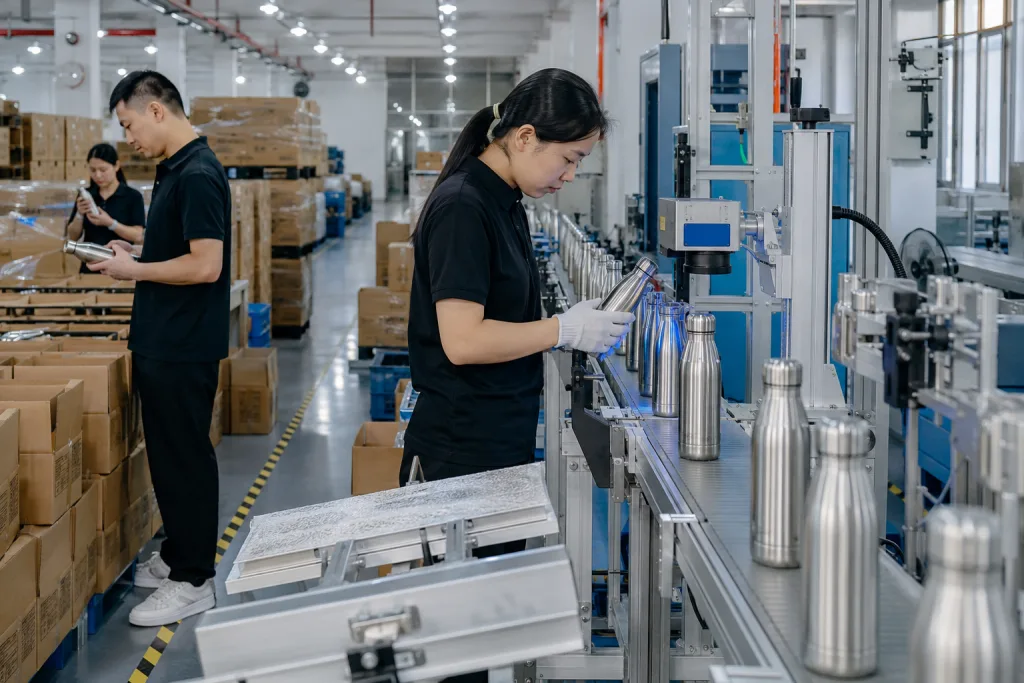
If you are buying custom drinkware from Zhejiang, China for retail, promo, or distributor channels, build the spec around failure modes first. This is the right question to ask. That applies whether you need a custom canteen, a custom growler, or a large manufacturer hydration bottle program. A capable canteen factory in China can run 400,000 to 600,000 units per month, and we ship programs at that scale, but speed will not rescue a weak spec. Your paperwork will. QC pulled the sample too late on one PO last month, and the buyer flagged a lid odor issue that should have been caught at pre-production.
Where bottle programs usually fail
Buyers usually start with shape, capacity, and print area. Good for a mood board. Not enough for production control. A manufacturer hydration bottle project fails when the commercial spec does not match the real factory process on the line. The usual mistake is assuming every canteen manufacturer or canteen supplier builds the same way. They do not. Even inside Zhejiang, one line may draw 18/8 stainless with a neck tolerance held at ±0.15 mm, while another buys caps outside and runs a softer gasket compound that changes leak performance after a 60°C hold test.
The practical way to buy is to map the order around failure points. This is the right question to ask. QC pulled the sample too many times after mass production started because no one checked these items up front:
- Body failure: denting, weak vacuum retention, rust spots, welding marks, wall thickness below spec.
- Lid failure: thread mismatch, gasket shrinkage, straw valve leakage, odor transfer after sealing test.
- Decoration failure: silk screen rub-off, laser inconsistency, powder coat chips, color mismatch above Delta E target.
- Compliance failure: REACH, LFGB, FDA contact claims, BPA-free wording with no supporting declarations.
- Logistics failure: master carton crush, barcode mistakes, mixed lid colors, weak inner partitions.
If you are sourcing a customizable drinkware line for retail or a canteen promotional campaign, ask the factory to review your RFQ with a process engineer, not only a sales rep. We’ve seen this go sideways. A serious canteen factory should tell you where the concept is risky, and the buyer should want that pushback early. For example, a matte dark coating plus a large wrap print on a tapered bottle will abrade faster than a laser mark; on one 5,000-piece run, the buyer flagged edge rub after the cartoning drop test because the PO missed an inner bag requirement.
Leakage starts with lid geometry
The costliest defect in hydration bottles is usually leakage, because the damage spreads fast. One bad unit can soak the printed insert, weaken the carton base, and stain the 11 bottles packed around it. We see buyers write cap specs too loosely: “flip lid,” “straw lid,” or “screw top.” That is sales language, not a production spec. On our line, QC pulled a sample last month where the lid looked fine but missed neck tolerance by 0.3 mm, and it failed after carton drop.
For a customized canteen or customized drinkware order, lock these points before sample approval:
- Thread standard and neck finish drawing with tolerance, not just photos.
- Gasket material: usually food-grade silicone, Shore A hardness range, and color.
- Leak test method: upside-down static test 30 minutes, plus air-pressure or vacuum test where applicable.
- Straw assembly details: bite valve slit length, tube insertion depth, and vent design.
- Torque range for cap application, commonly measured in kgf·cm or N·m.
A lot of complaints start when a good bottle body gets matched with an unproven cap from another canteen vendor. We’ve seen this go sideways. If your supplier is acting as a canteen distributor instead of a true manufacturer, ask which parts are made in-house and which are bought in. Cap outsourcing is common in China. That alone is not the problem. The problem is no incoming QC by lot. We run incoming checks with a torque tester and a go/no-go thread gauge, because one cap lot can pass on sample day and fail 12 days later in bulk packing.
What to write into your QC plan
Require 100% leak testing on assembled units. For random inspection, use AQL 2.5 for major defects and 4.0 for minor defects. If the product is sold with electronics, paper inserts, or premium gift packaging, define leakage as a critical defect. On larger runs above 20,000 units, approve a golden sample and a sealing sample. The sealing sample stays on the line as the pass/fail reference. This is the wrong question to ask: “Did you test the lid?” The right question is whether the factory logged torque, test time, and result by shift. We usually mark the sealing sample with the PO number in red ink after the buyer flagged a lid mix-up on one order.
When a factory says “we tested the lid,” ask: tested how many pieces, at what torque, for how long, and before or after drop test?
This applies whether you buy a custom canteen, customizable canteen, or a customizable growler. Lid geometry is not a minor detail. It is the product. A 1 mm gasket change or a cap that seats 15 degrees short will decide whether we ship clean cartons or rework the whole batch.
Vacuum, odor, and hidden material issues
Insulated bottles can pass a quick visual check and still fail after 2 weeks in the market. The complaint never says "bad weld seam" or "polishing residue left inside." The buyer says the bottle sweats on the desk, smells metallic after the first wash, or loses cold by lunchtime. We see this on the line when vacuum hold is weak, lid resin is off-grade, or QC pulled the sample and found black residue under the thread.
For stainless steel bottles, you want 18/8 or SUS304 for body and all parts touching water, unless there is a stated reason to use another grade. If the bottle is sold as a premium manufacturer hydration bottle, vague wording like "stainless steel material" is not enough. Put the grade, wall thickness, and insulation type on the PO. Typical single-wall thickness is 0.4-0.5 mm. Vacuum body outer wall is often 0.4-0.5 mm and inner wall 0.3-0.4 mm depending on shape. We have seen buyers push for a 3-5% cost cut, then the supplier swaps a thinner inner wall or cheaper lid ring. The math does not work if the bottle still has to pass drop test and heat retention.
Odor complaints usually come from these sources:
- uncured print or coating near the mouth area,
- silicone or PP lid parts with poor resin control,
- insufficient cleaning after welding, polishing, or electropolishing.
Ask for retention testing with a written method, not a sales phrase. For vacuum items, specify a heat retention target, for example: fill at 95°C, ambient 20°C, measure after 6 hours and 12 hours. For cold retention, define whether ice is used and how much, such as 30% ice by volume. We ship against methods like this because "12 hours hot" by itself is the wrong question to ask. One factory may test a 500 ml straight bottle, another a 1000 ml wide-mouth shape, and the numbers will drift fast.
If you are sourcing from Zhejiang or elsewhere in China for Europe, request declarations tied to REACH and, where relevant, LFGB. For North America, align claims with FDA food-contact expectations and any retailer-specific protocol. A responsible canteen manufacturer or custom growler supplier should also provide material declarations for silicone, PP, Tritan, or stainless contact parts. Ask for the resin grade, steel source, and batch trace. Last month a buyer flagged a lid issue, and the supplier could only show "PP food grade" on the sheet with no source factory listed. That is already a traceability failure before production starts.
Decoration fails faster than buyers expect
Decoration is where a nice sample turns into a claim. Fast. The first sample is often hand-finished at the bench; bulk runs on the line with jigs, timers, and shift changes. If you are buying canteen custom, canteen customizable, or customized growler products for retail shelves, spell out the look you want and the abuse it must survive.
Different decoration methods fail in different ways:
- Silk screen: low setup cost and a fit for simple spot colors, but abrasion shows up fast if ink viscosity or oven cure is off. We check mesh count and cure temperature, because QC pulled samples before that looked fine at 9:00 and scratched by noon.
- Heat transfer: works for gradients and full-wrap graphics, but alignment drift of 1.5 mm and edge lifting show up on bottles with compound curves. Buyers ask for full wrap on a deep shoulder shape; this is the wrong question to ask unless the artwork can tolerate distortion.
- Laser engraving: durable and clean-looking, but the color effect depends on the coating stack and the steel surface. On 304 stainless with a thin powder layer, the mark can read dark gray on one lot and silver on the next.
- Powder coating: good grip and texture options, but edge chips show early if pretreatment is weak. We’ve seen this go sideways after a salt-spray check found poor adhesion around the rim radius.
Set measurable standards. For print adhesion, require cross-hatch adhesion of 100/100 after cure. For coated surfaces, define a tape test standard and a rub test, such as 50 dry rubs and 20 wet rubs with no legibility loss. If you sell through a distributor drinkware network, ask for carton simulation. Print can pass the lab and still fail after 18 days in sea transit because units rub against dividers; we ship test packs with the same inner partition and drop them on a carton corner before sign-off.
Color control matters too. If your brand color is important, set a Delta E tolerance with approved master reference, commonly under 2.0 or 2.5 depending on finish. Matte coatings hide some mismatch. Gloss finishes amplify it. For large-volume programs above 10,000 units, approve a production color panel, not just a pre-production sample; the buyer flagged one run last year because the PMS match was fine under D65 light but looked off under store LEDs.
A good canteen vendor should tell you that oversized logos on a hard curve will distort. No mystery there. If nobody mentions this during development, assume the artwork review is shallow. We usually check wrap position with a paper mockup and a seam reference line, and we have seen approved files come back as returned stock because the PO had a 3 mm logo shift nobody caught.
Dimension drift breaks accessories and cartons
Some defects do not show up on first look. We’ve had bottles pass visual QC, then fail at assembly because the diameter ran 1.5 mm over spec, the handle torque was loose on the gauge, or the base cup missed the secondary package by 2 mm. That hits hard if you are building a family of custom drinkware SKUs or trying to share accessories across a line of customizable growler and bottle models.
Dimension drift usually starts at the line: worn tooling, unstable neck forming temperature, or weak incoming inspection on bought-in parts. If your project uses interchangeable lids, boots, or tea strainers, ask for a control drawing with the critical points boxed out in red. This is not paperwork for show. QC pulled a sample for one buyer last quarter, and the neck OD was still inside visual acceptance but out on caliper check. At minimum:
- body diameter and height,
- neck inner and outer diameter,
- thread pitch or mating profile,
- mouth roundness tolerance,
- base flatness.
For packaging, lock in bottle weight tolerance and finished unit dimensions, because freight and carton yield shift on small changes. A bottle that grows from 8.8 cm to 9.1 cm diameter does not sound like much, but it can force a new insert die line, cut units per carton, and change pallet count. We ship this every week. For Amazon or DTC buyers, it may also move the item into a different dimensional weight tier. The buyer flagged this on a PO once after the mailer test, and the math didn’t work anymore.
If you work with canteen distributors or a distributor canteen program, tell the factory to validate fit with every approved accessory before mass production. Use actual parts, not a drawing only. We have seen this go sideways in China: the body passed, the lid passed, the sleeve passed, then the full pack failed because each part sat at the opposite end of tolerance. On one run, the silicone boot shrank 0.8 mm after aging test and the assembled set would not seat in the tray. That is a system failure, not a parts failure.
A serious canteen supplier keeps first-article measurements, in-process checks, and final pack-out dimensions on file. Ask to see the records. AQL 2.5 alone is the wrong question to ask here, because appearance sampling does not catch a neck that is drifting batch by batch. If they cannot show dimensional logs from calipers, thread gauges, or carton drop-test samples, they are leaning too much on visual judgment.
Packaging and compliance can still sink the order
Buyers spend 90% of the discussion on the bottle and give the carton one line on the PO. That is the wrong question to ask. On our line, transit claims usually trace back to packing, not the bottle itself. We’ve seen 3 mm dents blamed on steel quality when the real cause was a loose divider set. Under FOB terms, the argument starts once goods leave the factory gate, so the packaging spec needs the same detail as the bottle spec.
For export hydration bottles, define:
- individual pack style: polybag, tissue, kraft box, color box, molded pulp, or EPE sleeve,
- master carton burst strength or edge crush standard,
- drop test expectation for retail gift box packs,
- barcode placement, FNSKU or retailer label format,
- carton marks, pallet rules, and loading orientation.
Typical failures are plain stuff. Unbagged bottles scuff each other in transit. Weak partitions crush corners. Labels placed over a carton seam wrinkle, then the scanner misses them. QC pulled the sample last month and found a barcode bridging a tape line by 12 mm. For Amazon FBA, carton dimensions and overweight control are not optional. A proper distributor growler or bottle shipment needs scan-ready labels, moisture-resistant outer cartons, and pallet stacking that fits your warehouse rules. Buyers sometimes push back on carton cost for a $0.18 upgrade, then lose far more on one rejected inbound lot.
Compliance paperwork is another late-stage trap. If your canteen manufacturers or canteen vendors say “all tests passed,” ask for the report name, lab name, SKU covered, and test date. We ship to EU and North America, and buyers often ask for audit visibility before they release the order. For social compliance, many want BSCI or an equivalent audit on file. For quality systems, ISO 9001 is common, but the math doesn’t work if you treat it as product approval. It shows a system exists. It does not prove your exact bottle, lid, ink, and pack-out are controlled.
Before balance payment, book a pre-shipment inspection with AQL and a packaging checklist tied to your PO. We’ve seen this go sideways over one typo in a shipping mark. For a standard program in Zhejiang, bulk lead time is usually 30-45 days after deposit and sample approval, with MOQ often 1,000-3,000 units per item or color. That window is enough to run carton validation, a simple drop test, and label checks if you lock the spec early. If packaging starts when goods are waiting for container booking, you are already late.
How to write a better RFQ
The fastest way to cut claims is simple: stop sending weak RFQs. We see buyers send the same “best price” inquiry to 10 factories with one bottle photo, capacity, and logo count. That is not enough. The line will fill the blanks on its own, and later QC pulls the sample and the buyer flags the lid fit, print size, or carton drop result. Whether you are speaking to a canteen manufacturer, canteen supplier, or canteen distributors with factory partners, your RFQ needs to lock the spec before quoting. This is the wrong question to ask: “What’s your best price?” Ask, “What are you quoting exactly?”
Include these items in one document:
- SKU description, target market, and intended channel: retail, promo, gym, school, outdoor.
- Material callout: SUS304, Tritan, PP, silicone, coating type, and any recycled-content claim.
- Capacity with brimful and usable fill volume if relevant.
- Critical dimensions with tolerance.
- Logo method, Pantone references, placement drawing, and durability target.
- Leak test, retention test, odor expectations, and drop or transit test.
- Packaging details, barcode format, and pallet constraints.
- Inspection plan: AQL level, defect definitions, and who approves golden sample.
Put the details in one file, not 6 scattered emails. A lid OD tolerance of ±0.20 mm, a 1.2 m drop test, or a master carton limit of 18 kg changes the quote fast. We have seen POs with a typo in the Pantone code, and then 2,000 pcs land in the wrong red. That is an expensive mistake.
Then ask direct commercial questions. What is the MOQ by color? What is the sample charge and refund policy? What is the lead time for PPS, tooling, and mass production? For a standard custom bottle program in China, we usually quote 7-12 days for a logo sample and 30-45 days for mass production. If you need a fully new mold or a complicated customized canteen lid with a straw assembly, hinge, and seal ring fit check, add 20-30 days. The math does not work if a factory promises new tooling and bulk shipment in 18 days.
Ask what the factory does badly, not just what it does well. Some plants run straight-wall tumblers all day but get unstable on technical straw lids with 3 silicone parts and a bite valve. Others can build a robust custom growler but struggle with gift-box packing where the EVA tray is off by 2 mm and the bottle rattles in transit. We have seen this go sideways. A low opening price is cheap only on paper. If your supplier in Zhejiang gives clear limits, test protocols, and lead times they will actually hit, that is usually the safer buy.
Send your bottle spec for a factory risk review
We will flag leakage, coating, packaging, and compliance risks before sampling, with realistic MOQ, lead time, and FOB pricing guidance from Zhejiang, China.
Frequently asked questions
What MOQ should I expect for a custom manufacturer hydration bottle?
For standard stainless or Tritan bottles, MOQ is usually 1,000-3,000 units per model, often split by 1-3 colors. If you want one stock body with one-color logo, some China factories can start at 500-1,000 units. A new lid mold or fully custom body usually pushes MOQ higher, sometimes 3,000-5,000 units to justify tooling and setup loss. For gift-box packaging, ask whether the MOQ applies to the bottle only or to the full packed set. In Zhejiang, a realistic sample timeline is 7-12 days for decoration on an existing mold, and 30-45 days for bulk after deposit and approved PPS.
How do I verify leakproof performance before mass production?
Ask for the exact test method in writing. A useful basic standard is 100% leak testing on the line, plus random inspection with bottles filled, capped at defined torque, inverted for 30 minutes, then checked after a drop or vibration test if transit risk is high. For straw lids, include side-lay testing because many leaks appear only when the vent and bite valve are horizontal. If your bottle will be sold in premium packaging, classify leakage as a critical defect. Also ask whether the cap is made in-house or sourced from another supplier, because incoming cap lots are a common leak variable.
Which decoration method is safest for custom drinkware durability?
There is no single safest method for every case. Laser engraving is usually the most durable because there is no raised ink film to rub off, but it depends on coating and metal finish. Silk screen is cost-effective for simple logos but needs strong curing and adhesion control. Powder coat gives a premium feel and good grip, but edge chipping can happen if pretreatment is weak. For retail or distributor drinkware programs, specify durability targets: cross-hatch adhesion 100/100, defined rub tests, and carton transit simulation. If your brand color is strict, also set a Delta E tolerance, usually under 2.0-2.5.
What compliance documents should a canteen supplier provide for Europe or North America?
For Europe, ask for REACH declarations and, when needed by your channel, LFGB-related food-contact testing. For North America, align food-contact claims with FDA expectations and any retailer protocol. You should also request material declarations for silicone, PP, Tritan, or stainless parts that contact liquid. If the factory claims BPA-free, ask which parts that statement covers. For factory-level systems, ISO 9001 is useful, and many buyers also ask for BSCI or equivalent social audit visibility. The key point is traceability: reports should show product scope, date, lab name, and the exact materials tested.
Should I buy from a canteen distributor or directly from a canteen factory in China?
It depends on complexity and your internal bandwidth. A good canteen distributor can simplify communication, consolidate mixed SKUs, and help if your annual volume is still modest. Direct factory buying usually gives better process visibility, faster engineering feedback, and cleaner control over QC, especially for a customized canteen or custom growler project. The risk with traders or mixed-source vendors is part traceability, especially on lids, gaskets, and packaging. If you buy through an intermediary, ask who actually makes the body, who makes the cap, and where final assembly happens. For larger programs above 10,000 units, direct factory access is usually worth it.