Key Takeaways
- Basic stainless manufacturer hip flask orders usually start at 1,000 pcs per size, with FOB China pricing around USD 1.35-2.80 depending on capacity and decoration
- Typical lead time is 7-12 days for sampling and 25-40 days for mass production, but custom molds can add 15-25 days
- Leak testing, polish grade, logo process, and gift box packing can change unit cost by 12%-35% more than steel cost alone
- AQL 2.5, REACH testing, and carton drop tests should be agreed before deposit, especially for EU promotional and retail programs
You can buy a hip flask cheap, or you can buy it without ugly add-on costs. Those are different deals. First-time buyers usually stare at the unit price, then the factory adds a mold charge, one-color logo limit, leak test reject, carton revision, or a lead time that slips from 25 days to 55. We have seen this go sideways over a 0.3 mm cap fit and one PO typo on carton marks. If you are sourcing from a manufacturer hip flask supplier in China, the right question is not "Who is cheapest?" The right question is what drives cost and what stalls the line.
For procurement teams in Europe and North America, hip flasks usually sit beside other custom drinkware programs. The same buyer may be pricing a flask against a custom canteen or a travel tumbler in the same quarter. In Zhejiang, where stainless drinkware factories cluster within a few hours' drive, the numbers are steady if you ask early and ask cleanly. We run quotes like this every week, and the buyer often flags MOQ, logo position, and drop-test packing before price.
What really sets flask pricing
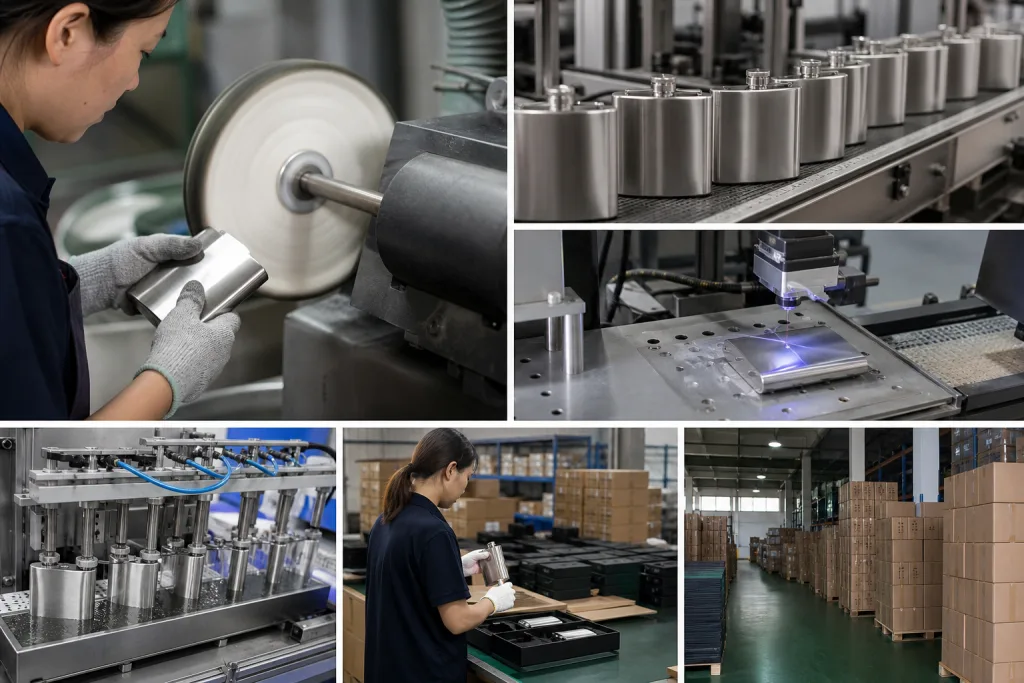
A manufacturer hip flask looks simple on paper: stamped stainless shell, welded neck, threaded cap, surface finish, packaging. On the factory side, price usually shifts in five spots: material grade, body thickness, shape complexity, decoration, and packing. Ask only for a target price, and 7 out of 10 suppliers in China will quote the cheapest reading of your spec. We’ve seen this go sideways. A buyer sends “8 oz flask, gift item,” and the line runs the thinnest body with a basic white box.
For a standard 6 oz or 8 oz flask in 18/8 stainless steel, common body thickness is 0.4-0.5 mm. Move to 0.6 mm and dent resistance improves, but unit cost can rise by USD 0.10-0.22 depending on size and current steel pricing. QC pulled the sample on a 0.4 mm body last month and the sidewall oil-canned after a light press test. 201 stainless can cut cost, but for export drinkware we usually advise 304 food-contact grade because REACH and buyer testing go more smoothly. This is the wrong question to ask: not “what is your cheapest flask,” but “what steel grade and thickness are you quoting.” In Zhejiang, serious export factories will understand this fast.
Shape matters too. A classic curved flask uses mature tooling and stable welding; we run those on existing jigs and the neck alignment stays tighter. A flat-sided or heavily contoured design can require new forming tools, custom jigs, and more polishing labor. That can mean a one-time tooling charge of USD 300-1,500 and another 5-10 production days. On one custom profile, the buyer flagged a 1.2 mm neck offset after trial forming, so the tool had to be corrected before mass production. If you add a captive cap arm, PU leather wrap, funnel set, or gift-box insert, the assembly line slows and reject rate goes up. The math doesn’t work if you expect gift-set assembly at plain-flask pricing.
- Entry level: plain brushed flask, 6-8 oz, single-color print, white box
- Mid-range: mirror polish or matte paint, laser logo, color box
- Retail-ready: electroplated finish, deboss wrap, barcode labeling, inner tray, carton drop test standard
If you also buy custom canteen or customizable growler programs, apply the same logic. The cheapest quote often leaves out the spec details you need, like 0.5 mm vs 0.4 mm body thickness, barcode placement, or a 1.2 m carton drop requirement. We ship plenty of projects where the PO missed one small line item, then the buyer comes back after sampling. Better to lock the details before the line starts.
Price bands by MOQ tier
MOQ is where 7 out of 10 new buyers burn time first. Hip flasks do not need the same MOQ as some insulated bottles, but the cost curve changes fast at 500, 1,000, 3,000, and 10,000 units because we still have setup, polishing, leak test, and packing labor on the line. A canteen factory or canteen manufacturer selling into promo and retail usually prices hip flasks the same way: low MOQ is possible, but you are paying for downtime between runs. We have seen buyers push for 300 pcs, then flag the quote as "too high" after the math is already obvious.
As a practical FOB China guide, a standard 8 oz stainless manufacturer hip flask with leak-tested cap and basic retail carton usually lands in these ranges. This assumes a normal 304 stainless body, standard neck tooling, and a pass on the air-pressure leak tester before pack-out:
- 500 pcs: USD 1.95-2.80 each, if the supplier accepts below-standard MOQ
- 1,000 pcs: USD 1.55-2.20 each
- 3,000 pcs: USD 1.35-1.90 each
- 10,000 pcs: USD 1.18-1.65 each
These numbers assume standard shape, 304 stainless, one logo position, and plain carton pack. Add a gift set with 4 shot cups and funnel, and you may add USD 0.65-1.40 per set depending on EVA insert style and cup wall thickness, often 0.4 mm vs 0.5 mm. Add a rigid magnetic box, and the packaging alone can cost more than the flask body. That is the wrong place to chase "cheap" pricing, because QC usually pulls dents, glue marks, or weak magnet closure from those boxes before they ever reach final inspection.
For buyers building a broader custom drinkware range, some factories will combine MOQ across related SKUs. We run this case by case. A canteen supplier may accept 3,000 total units split into flask, custom canteen, and customized drinkware gift formats if the decoration process matches and the outer carton spec stays the same, such as one master carton size and one print method. We have seen this go sideways when one PO line says laser logo and another says silk print, or when the buyer changes carton drop-test requirement after sample approval.
Ask whether MOQ is based on total order quantity, per color, per logo, or per packaging configuration. Those are four different answers.
At BottleForge Industrial, our typical MOQ for stainless projects is 1,000 pcs per model, and output from Zhejiang lines can reach 300,000 units per month across mixed drinkware categories when packaging materials are confirmed on time. On our side, that only works if the gift box artwork, barcode placement, and carton marks are locked before mass production. One typo on a PO can hold a full packing run for a day.
Decoration changes the economics fast
Logo method is where buyers misread the quote fastest. A hip flask has less print area than a tumbler or customizable canteen, yet finish matters more because people hold it 20 cm from their face and gift buyers inspect every mark. We’ve seen QC pull samples over a 0.3 mm scratch near the shoulder. If the artwork has fine lines or metallic ink, the process changes both unit cost and reject rate. This is the wrong question to ask: “Which logo method is cheapest?” Ask which method holds your artwork on this shape.
Common decoration methods
- Silkscreen: usually the lowest cost for 1-color logos, around USD 0.05-0.12 per unit
- Laser engraving: durable, premium look, usually USD 0.08-0.20 per unit
- Embossed or debossed wrap: stronger gift appeal, but setup and manual labor can add USD 0.25-0.70
- UV print or full-wrap graphic: possible on some flat designs, often USD 0.18-0.45 extra
Mirror polish looks easy on paper. It isn’t. The line spends more hand time on buffing wheels because scratches show at once, and one dust mark can fail appearance check under a 6000K lamp. Matte spray, powder coat, or rubber finish hides small surface issues better, but then you need cross-hatch adhesion and abrasion testing. For retail in Europe, ask for coating test standards and migration compliance if any external wrap or paint might contact skin for long periods. We’ve seen this go sideways when a buyer approved the color first and asked for the test report later.
Buyers sourcing canteen customized or customized growler lines sometimes get an advantage here. If your canteen supplier or canteen vendors already run the same laser, screen, or powder line, artwork setup can be shared across projects, especially if the jig width and Pantone callout stay the same. We run this often on mixed orders above 3,000 pcs MOQ. That can save a few cents per unit and shorten pre-production approval by 1-3 days.
Watch low quotes that include "free logo." Usually that means one basic silkscreen position only, no Pantone tolerance commitment, and no allowance for curved placement drift. The buyer flagged this on one PO last month because “center logo” was written with no mm drawing. If your brand standards are tight, ask for logo size, placement tolerance in millimeters, and photo approval from first article production. The math doesn’t work if you save USD 0.03 and then scrap 8% on logo position.
From deposit to vessel booking
Lead time on a manufacturer hip flask order is usually under control if the spec is standard. The steel forming step is rarely the problem. What slips the schedule is approval drift: logo revision V3 to V5, gift box size change from 210 mm to 215 mm, new barcode request, compliance file chase, or the 30% deposit landing late. Buyers sometimes blame the canteen factory or canteen manufacturers, but we’ve seen the delay come from three handoff points both sides touched.
A realistic schedule for a repeat flask order from China looks like this:
- Day 1-3: quotation confirmation, artwork check, PI issue
- Day 3-5: deposit received, pre-production sample arranged
- Day 7-12: sample finished and approved
- Day 13-30: mass production for 1,000-5,000 pcs
- Day 31-35: inspection, final packing, balance payment
- Day 36-40: container loading or LCL handover
For a new mold or a heavily customized canteen-style body, add 15-25 days for tooling and pilot validation. Tooling is not a paper step; the line will cut pilot parts, QC pulled the sample, and we check neck fit and weld consistency before sign-off. If your program includes custom growler, customizable drinkware, and flask items packed in one assortment, add another 5-8 days for kitting and carton consolidation. The math doesn't work if three SKUs finish on three different dates but the buyer still wants one shipment.
China factory calendars matter. Before Lunar New Year, real capacity tightens 4-6 weeks earlier than overseas buyers expect, and we start hearing the same pushback: “production is only 20 days, why can’t you ship?” Because caps, gift boxes, and straps are on different schedules. In Zhejiang, subcontract packaging suppliers and cap vendors become the bottleneck even when the stainless line is ready and the polishing wheels are already running. Around September to November, sea freight planning needs more care because vessel space for holiday programs tightens. We’ve seen this go sideways after a booking was pushed 12 days.
If you sell through Amazon FBA or major retail distribution, put FNSKU labeling, carton marks, pallet rules, and booking window into the PO from day one. This is the right place to be strict. We ship faster when the PO already shows label position, outer carton mark size, and pallet height limit such as 1.6 m. Those details affect packing speed, carton count, and inspection timing. Last month the buyer flagged a one-letter typo on a carton mark after packing started, and that alone cost 2 days.
Where quality costs less than failure
Hip flasks look simple. On the line, failure is binary: it leaks or it does not. We watch the cap thread, neck weld, and sealing gasket first, and QC pulled a sample last month where the thread pitch was off by 0.2 mm. Save USD 0.03 here and the math doesn’t work once returns hit. We’ve seen this go sideways on canteen promotional programs and distributor growler gift sets, where end users open the box 12 days or 3 weeks after shipment and the leak shows up too late to fix.
For B2B export orders, agree these points before production starts:
- AQL standard: commonly AQL 2.5 for major defects, 4.0 for minor
- Leak test: 100% air-pressure or water inversion test, depending on design
- Material report: 304 stainless declaration, plus REACH or LFGB-related testing if required
- Packaging test: carton drop test and barcode scan check
- Appearance criteria: scratch tolerance, weld polishing, logo position tolerance
If your flask is sold in the US gift channel, ASTM-related packaging safety and labeling questions may come up based on the outer pack and accessories. For EU projects, REACH is not optional if you have coatings, wraps, or inks; the buyer flagged this on a 5,000-piece order after seeing solvent ink on a neck wrap. Chinese factories that also make custom canteen and customized drinkware for chain retailers usually run a testing workflow already, but you still need to state the exact market destination on the PO. This is the wrong question to leave until packing.
One sourcing point matters more than buyers expect: ask who makes the cap and gasket. A lot of flask bodies are made in-house, while caps come from a partner vendor with an MOQ of 3,000 sets. That setup is normal, but incoming QC has to catch fit issues before assembly, and we use a go/no-go thread gauge for that. Reliable canteen vendors and canteen suppliers will tell you this straight instead of claiming every part is vertically integrated.
When to bundle with other drinkware
Not every buyer should source hip flasks by themselves. If you run distributor canteen accounts or wholesale drinkware programs, bundling a flask project with custom canteen, customized canteen, customizable growler, or customized growler styles often cuts cost and cleans up follow-up. The wrong bundle does the opposite. We have seen buyers push 4 SKUs onto one PO, then QC pulled the sample and found three different surface standards on the same matte black finish card.
Bundling works when the products actually share production points:
- same steel grade and finish family, such as 304 stainless with one powder coat line setting
- same logo process, for example one 20W fiber laser file and one fixture size
- same packaging supplier, with one carton spec and one insert die line
- same compliance documents and destination market, so the paperwork set does not split
- same shipment window, so we ship in one booking instead of chasing partial cargo
For example, a canteen manufacturer in Zhejiang might quote a flask at USD 1.62 FOB on 1,000 pcs. Pair it with 2,000 custom canteen units and 1,000 customizable drinkware gift boxes using the same matte black powder coat and laser logo, and the flask may drop to USD 1.48. The reason is plain: one coating batch, one logo setup, one packaging buy. We run this kind of order every month. On one line, the hanger jig spacing was 18 mm, so the flask and canteen bodies could pass through the same powder coat rack without a fixture change. If your custom growler line needs a different Pantone target, a separate test requirement, and a foam gift insert, the math does not work. Lead time slips first.
Buyers often ask whether canteen distributors should use one supplier for everything. This is the wrong question to ask. Use one factory when the overlap is real on process, paperwork, and packing. Use separate canteen suppliers when the technical gap is wide enough that one line becomes the bottleneck. We have had a buyer flag this after a PO typo merged two cap specs into one item code, and the whole schedule moved 12 days. A strong canteen vendor should say clearly where their production fits and where the order sits outside their best process window.
Use this benchmark: if combining SKUs saves less than 5% total landed cost but adds more than 10 days to the critical path, skip the bundle.
Get a real flask quote with actual timelines
Send your target size, logo method, packaging, and quantity. We will reply with FOB pricing, MOQ, and a production schedule from our Zhejiang team.
Frequently asked questions
What is the normal MOQ for a manufacturer hip flask order?
For a standard stainless hip flask, normal MOQ is 1,000 pcs per model and usually per color. Some China factories will accept 500 pcs for repeat shapes, but expect a higher FOB price, often 15%-30% more. If you need custom packaging, gift sets, or multiple logo versions, the practical MOQ may shift to 1,000 pcs per packaging configuration. In Zhejiang, factories with broader custom drinkware lines sometimes combine MOQ across a flask and a custom canteen or customizable growler program, but only when finish, logo process, and carton spec are shared. Always ask whether MOQ applies per SKU, per color, or per artwork version.
How much should I budget per unit for a custom hip flask from China?
For a basic 6 oz or 8 oz stainless flask, budget around USD 1.35-2.20 FOB China at 1,000-3,000 pcs. At 10,000 pcs, a standard item may drop to USD 1.18-1.65. Laser logo usually adds USD 0.08-0.20; gift box packing can add USD 0.25-1.20 depending on insert type. A set with funnel and cups often lands around USD 2.20-3.80 FOB. If your quote is well below that, check steel grade, wall thickness, leak testing, and packaging assumptions. Many low prices exclude the exact finish or QC level you need for export retail.
How long does production usually take after sample approval?
For a repeat flask design, mass production normally takes 25-40 days after approved sample and deposit. Sampling itself is usually 7-12 days. If you need a new body mold, special wrap, or a combined customized drinkware set, add 15-25 days. During peak shipping season or before Lunar New Year in China, you should build in another 7-14 days buffer. The biggest avoidable delays are packaging revision, late barcode confirmation, and changing logo files after sample sign-off. If your order must hit an event date, ask the factory for a day-by-day production schedule instead of a single estimated ship date.
What quality checks matter most on hip flasks?
The essential checks are leak testing, thread fit, weld finish, and surface inspection. Ask for 100% leak testing, either water inversion or air-pressure method. Agree AQL 2.5 for major defects and 4.0 for minor defects before production starts. For export to Europe, request REACH-related compliance support for inks, wraps, or coatings where relevant. Also confirm 304 stainless contact material and define acceptable scratch tolerance, because mirror polish shows defects quickly. If the flask is packed in a gift box, include carton drop testing and barcode verification. A flask that arrives pretty but leaks is a failed order.
Can I source hip flasks from the same supplier as my canteen or growler line?
Often yes, and it can work well if the process overlap is real. Many canteen manufacturers and canteen suppliers in Zhejiang also produce flasks, custom canteen items, and some customized growler formats using the same polishing, coating, laser, and packing resources. You save time when artwork approval, testing, and packaging procurement can be shared. But if your flask is a gift-box item and your growler project needs separate pressure-related tests, the bundle may slow the whole PO. A good rule: combine SKUs only when the shared process can save at least 5% and does not add more than 10 days.