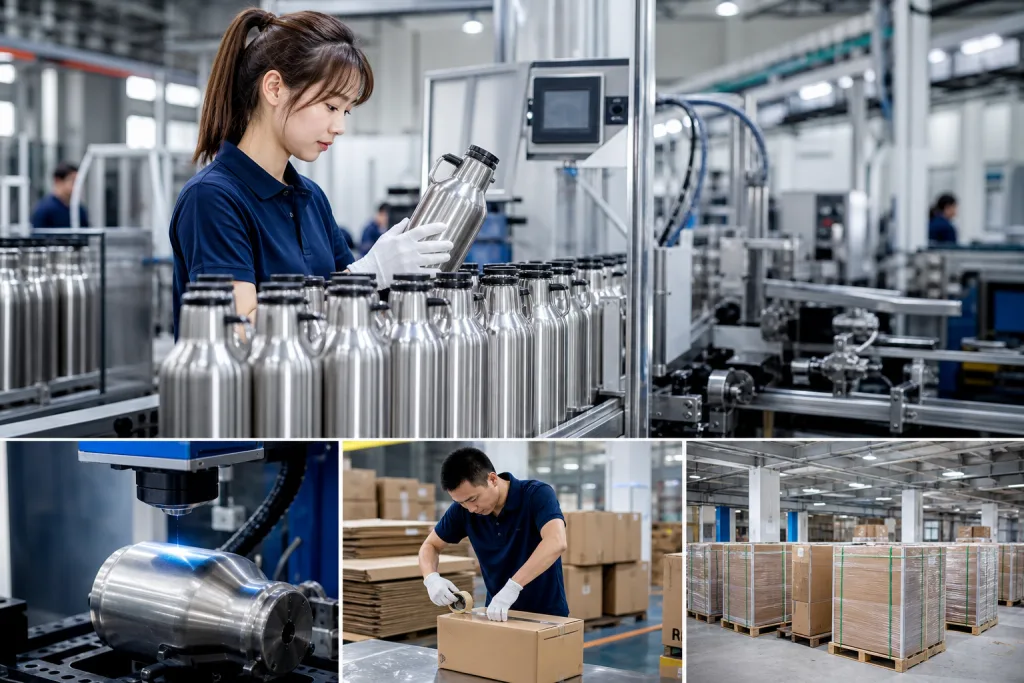
Key Takeaways
- A 64 oz stainless growler usually needs 0.45-0.55 mm inner wall steel and 0.50-0.60 mm outer wall steel for stable production
- For new custom growler tooling or private mold work, expect MOQ from 3,000 pcs and 35-55 days after sample approval
- AQL 2.5 major / 4.0 minor is common for distributor drinkware, but leak testing should be 100%
- Powder coating is better for outdoor use than basic spray paint, but it needs controlled curing at about 180-200°C
A manufacturer growler looks simple on a quotation: 64 oz, 304 stainless steel, vacuum insulated, logo printed, packed in a color box. That line is too thin for a safe purchase order. The risk sits in the small fields: 0.5 mm or 0.6 mm wall thickness, PP or stainless cap liner, powder coating or spray paint, 1.2 m carton drop test, AQL 2.5, and whether the quoted price includes a 100% air-pressure leak test at the line or just a quick visual check under the packing lamp.
If you are buying custom drinkware for a retail chain, brewery program, outdoor brand, or distributor growler catalog, read the spec sheet like an engineer. Price comes second. We manufacture in Zhejiang, China, and we see the same mistake about 3 times a month: buyers compare FOB Ningbo prices before they compare steel grade, cap structure, and test standard. The buyer flags USD 0.18 on the unit price, then QC pulls the sample and finds a loose silicone ring after 8 hours upside down. This is the wrong question to ask.
Capacity Is Not Just Volume
The first spec line usually reads 32 oz, 40 oz, 64 oz, or 128 oz. For a manufacturer growler, that number is not just a selling size. It drives tooling, vacuum hold time, carton strength, freight cost, and the way the buyer’s customer actually carries the bottle. A 64 oz customized growler is the standard brewery and outdoor retail size because it holds roughly 1.89 liters. It works for beer, kombucha, cold brew, or water, and it still fits 7 out of 10 backpack side pockets we checked if the body diameter stays below 115 mm. The caliper matters.
Ask one question early: is the stated capacity brimful capacity or usable capacity? Brimful means filled to the lip. Usable capacity normally leaves 15-25 mm of headspace, which matters for carbonated drinks and foam. We had one buyer flag this after QC pulled the sample and measured only 60 oz comfortable fill on a product sold as 64 oz. Bad reviews start there.
For canteen custom projects, we define three drawing points: total height, body diameter, and mouth diameter, each with tolerance marked in mm. A 58-65 mm mouth opening is easier for ice filling and brush cleaning, but a wide mouth needs a stronger cap and steady gasket compression. A narrow mouth pours cleaner. The wrong question is “which one looks better”; the better question is whether the user is filling it from a tap, a coffee brewer, or a campsite water bag.
Check carton math before the PO is signed. A 64 oz vacuum growler packed 12 pcs per master carton may push the carton over 16 kg gross weight depending on gift box thickness, foam insert, and lid weight. For European distributors, we often recommend 6 pcs per carton for safer manual handling and lower damage risk. Yes, freight cost changes, but the math does not work if cracked color boxes lead to 3 rejected pallets at arrival inspection.
Steel Grade And Wall Thickness
The second spec line should not stop at “stainless steel.” For food-contact custom drinkware, we usually run SUS304 inside and SUS201 or SUS304 outside. If you sell into Europe or North America, set 304 inner wall as the default. It holds up better against tea, coffee, beer, juice, and alkaline washing detergent. For higher-end retail or coastal markets, full 304 inner and outer construction is the safer call. QC pulled one sample last March after a salt-spray check showed tiny rust points around the rolled mouth, and the buyer flagged the word “stainess” on the PO at the same time. Small detail. Big argument later.
Wall thickness needs numbers on the quote sheet. A typical insulated custom growler uses 0.45-0.55 mm steel for the inner wall and 0.50-0.60 mm for the outer wall. If you cut it too thin, you may save USD 0.08-0.12 per piece, then lose it on dents during forming, polishing, or carton drop. If you make it too thick, the bottle feels heavy and the math doesn't work for freight. Insulation does not improve just because the steel is thicker. We check gauge with a digital micrometer at incoming inspection, and a good canteen manufacturer should confirm the gauge before quoting, not after a buyer sends photos of collapsed shoulders.
Look at the bottom structure too. A recessed base helps stability and hides small scratches on powder coating after shelf handling. A separate base cap can make the growler look cleaner, but it creates one more welding or press-fit point for the line to control. For outdoor distributor canteen programs, ask for a bottom drop test from 1.0 m on a plywood or concrete-equivalent surface, with acceptance criteria agreed before production. We have seen this go sideways when the test surface was changed after mass production, then 500 pcs got rejected for a dent size nobody defined.
Food-contact compliance is not decoration on the spec sheet. For the EU, ask for LFGB or relevant food-contact migration testing, plus REACH for coatings where applicable. For the United States, FDA food-contact expectations and California Proposition 65 screening may be relevant depending on your channel. In China, a canteen manufacturer can often show 6 old reports from past projects, but ask for current material and coating reports tied to the same production process, not a similar bottle from three years ago. Our lab file usually lists steel coil heat number, coating batch, and sample date; if those three lines do not match the order, the report is weak.
Vacuum Performance And Lid Design
Vacuum insulation is where a cheap quote turns into a claim debit 45 days later. A vacuum manufacturer growler needs 100% vacuum testing after welding and before final packing. Random testing misses the bad one, and the bad one looks perfect until a customer fills it with cold beer and finds sweat on the outside. In our Zhejiang factory, standard output for stainless insulated bottles and growlers is about 450,000 units per month, and every insulated unit goes through the vacuum check station before surface finishing. QC marks failed pieces with a red paint pen, not a spreadsheet note.
For a 64 oz customized drinkware growler, we set a practical target at 24 hours cold retention and 8-12 hours hot retention, tested at room temperature around 20-25°C. Be careful with claims like 48 hours cold. The math does not work unless the test is packed with ice and kept under lab-style conditions; your retail buyer will judge it with real beer or water. Define the test method on the PO: starting liquid temperature, fill level, ambient temperature, and final temperature after the fixed hour mark. Last month a buyer flagged “48H CLOD” on an artwork file, and the bigger issue was not the typo, it was the unapproved performance claim.
The lid has three jobs: seal, pour cleanly, and survive being opened every weekend. Common choices are a stainless screw cap with silicone gasket or a PP inner cap with stainless cover; swing handle caps need extra attention because the handle pin can loosen after drop testing. Silicone should be food-grade and set around 50-60 Shore A hardness. Too soft, it deforms. Too hard, it leaks when the mouth tolerance drifts by 0.2 mm. We run the gasket check with a Shore durometer and reject caps when the mouth fit feels loose before torque testing.
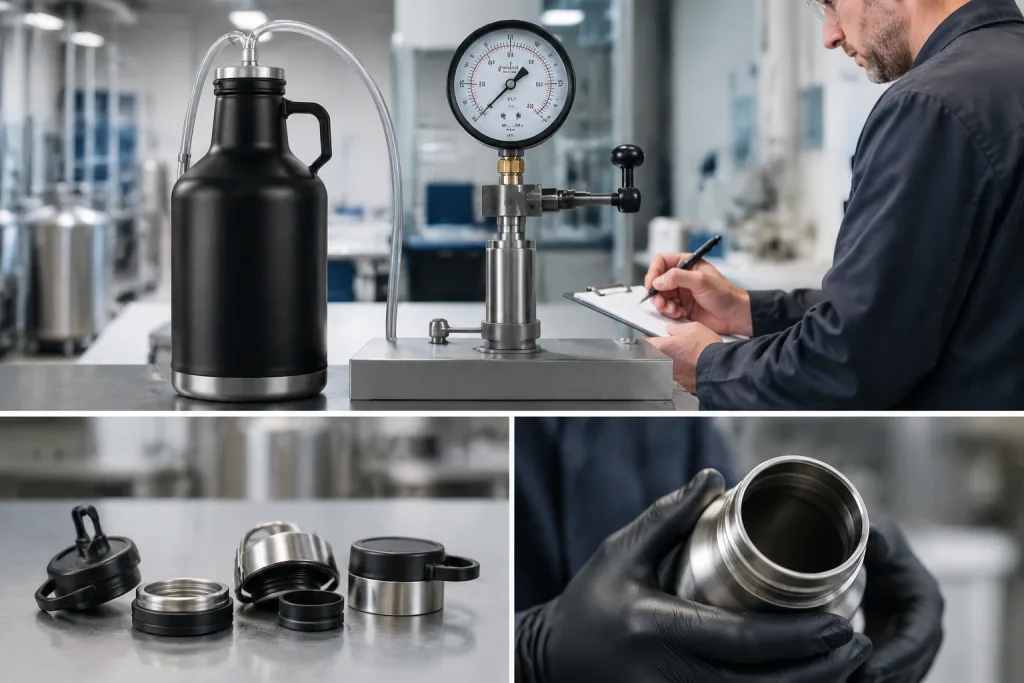
For beer growlers, ask whether the design is suitable for short-term carbonated beverage use. Most vacuum growlers are not pressure-rated like kegs, and no honest canteen supplier should sell them that way. For kombucha, beer, or sparkling drinks, use clear warning language and run leak testing with cap torque control. A practical cap torque range might be 12-18 kgf·cm, but it depends on thread pitch and gasket design. Put that range into your inspection checklist, because we have seen this go sideways when the buyer approved the lid by photo only and QC pulled the sample leaking at the thread after 6 hours.
Finish, Logo, And Retail Appearance
Surface finish is where the buyer first decides if the growler feels cheap or retail-ready. For a custom canteen or customizable growler, we normally run powder coating, spray painting, raw stainless, electro-polished finish, laser engraving, silk screen printing, heat transfer, or water transfer. Each one fails in its own way. Powder coating chips when the pretreatment bath is dirty or the hanging hook leaves oil on the shoulder. Silk screen printing scratches when ink adhesion is weak; QC pulled one matte navy sample last month and the logo came off after 20 rubs with 3M tape. Laser engraving lasts, but it will not give you a red, blue, or full-color logo.
For outdoor and brewery programs, powder coating is the safer choice most of the time. The line should include degreasing, drying, spraying, curing around 180-200°C, and adhesion testing. Ask for a cross-hatch test result, not just a clean sample photo shot under soft light. Photos lie. For customized canteen orders in matte black, navy, olive, or sand colors, ask for Delta E color tolerance before bulk production. A tolerance within Delta E 1.5-2.0 is reasonable for controlled brand colors; a low-cost promo order might accept Delta E 3.0 if the buyer signs it off. We check this with a color meter, not by arguing under the office lamp.
Logo size must be written in millimeters and by position. “Large logo on front” is not a production instruction, and this is the wrong question to leave open after deposit. For a 64 oz growler, a front logo area of 60 x 80 mm is common. Wraparound artwork needs a distortion check because the body is curved, and a 2 mm shift near the seam is easy to spot on matte coating. If you are a canteen distributor managing several SKUs, use one artwork control sheet per SKU with Pantone code, logo method, placement from base, and approval signature. We once had a PO typo showing 160 mm from base instead of 60 mm; the buyer flagged it at pre-production, not after 3,000 pcs were printed.
Packaging belongs in the appearance spec too. A canteen promotional order may use a white box or kraft box to cut cost, while retail-ready distributor drinkware usually needs a printed color box, barcode, warning text, and sometimes FNSKU labeling for marketplace fulfillment. Use 5-ply export cartons for heavier growlers; a 12 kg carton with thin paperboard will arrive with crushed corners. For North America, we often print carton marks with PO number, SKU, quantity, gross weight, net weight, and country of origin: Made in China. Do not treat carton marks as clerical work. We have seen shipments delayed because the outer carton showed the old SKU from the buyer’s last order.
MOQ, Tooling, And Price Reality
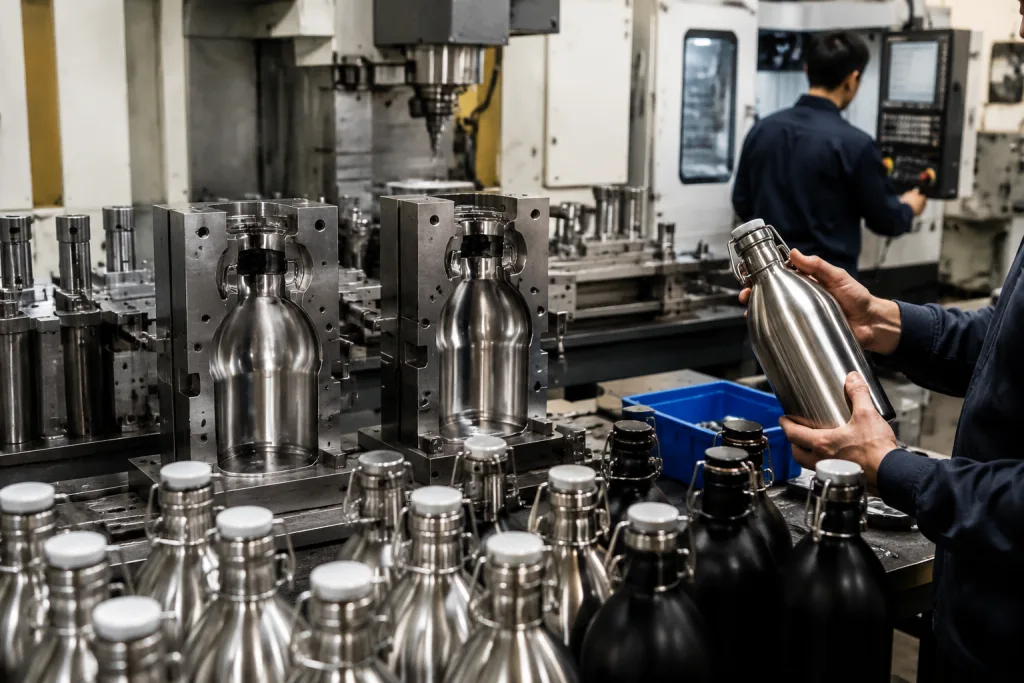
MOQ comes down to how much you change on the growler. With an existing mold and a one-color logo, we run 500-1,000 pcs per color for some canteen orders, but the unit price starts to make sense at 3,000 pcs. If the buyer asks for a new body shape, handle, cap, or base, MOQ usually starts from 3,000 pcs, with tooling from USD 1,500 to USD 8,000 depending on the forming difficulty. A full new double-wall stainless mold set costs more when the body radius is tight; our tooling room once rejected a 64 oz shape because the 304 stainless outer wall wrinkled at the shoulder during trial drawing.
FOB pricing moves with steel cost, coating, packaging, logo process, and inspection requirements. A current practical range for an existing 64 oz stainless vacuum growler is around USD 6.80-10.50 FOB Ningbo or Shanghai at 3,000 pcs, before premium packaging or complex decoration. If a quote lands far below that, ask what got cut: 304 outer wall, powder coating thickness, carton strength, individual leak testing, or inspection time. We have seen this go sideways. QC pulled the sample on one low-price order and found the powder coat at 45-50 microns instead of the buyer’s requested 70 microns.
Lead time needs an actual calendar, not a guess. For a normal customized growler using existing tooling, plan 7-10 days for sampling, 3-5 days for sample freight, and 30-40 days for mass production after deposit and sample approval. For new tooling, add 15-25 days before the approval sample. Before summer retail launches or Q4 promotional programs, the line fills fast; last May, one buyer approved artwork 12 days late and lost the coating slot, pushing shipment from 38 days to 51 days. Late booking usually costs more than a fair deposit sent on time.
Payment terms for new buyers are usually 30% deposit and 70% balance before shipment, or against copy of bill of lading for approved accounts. Large canteen distributors sometimes negotiate LC or staged payment after credit review. Be careful with any canteen factory promising low MOQ, fast lead time, and the lowest price on the same PO. The math doesn't work. On our side, finance will not release stainless steel purchasing for a 3,000 pcs growler order until the deposit clears, even if sales already marked the PI “urgent.”
Inspection Lines Buyers Should Add
A spec sheet without inspection criteria is a wish list with a unit price. For manufacturer growler orders, we write the inspection plan before the PO is signed, not after the buyer flags leakage in pre-shipment photos. Standard third-party inspection often uses ANSI/ASQ Z1.4 with AQL 2.5 for major defects and 4.0 for minor defects. For critical issues like leakage, sharp metal edges, wrong material, or unsafe odor, set zero tolerance. The math does not work if a leaking growler is counted the same as a small paint dot. Last month QC pulled 32 pcs from the line and found 1 cap with a torn silicone gasket; that carton stopped right there.
Your inspection checklist should include capacity check in ml, weight check in g, mouth diameter in mm, cap fit by thread turns, gasket presence, vacuum performance, leak test, coating adhesion, logo position, barcode scan, carton drop test, and packing count. For leak testing, we run 100% factory testing plus random final inspection. Simple test. Fill the growler with water, tighten the cap to the defined torque with a torque wrench, invert for 5-10 minutes, then check the neck and cap seam for seepage on dry tissue paper. For shipment approval, inspectors should sample tighter if the order is for a new canteen supplier; we have seen first orders go sideways because the buyer accepted “factory tested” without asking for the actual leak-test record.
Cosmetic standards need photos, numbers, and a reject line. Define acceptable viewing distance, usually 30-50 cm under normal light, and tell the inspector whether to use a light box or regular workshop lighting. Set limits for dust spots by diameter, scratches by length, orange peel by visible area, color mismatch against the approved sample, and welding marks near the shoulder. For raw stainless, polishing direction should be consistent from body to neck. For powder coating, bare metal exposure should be rejected. For laser logos, check burn color and edge clarity; we once had a 0.8 mm logo shift that looked fine on one sample but crooked across a 1,200 pcs shelf display.
Social and factory compliance may matter to your customers, especially if the growlers go into retail or corporate promotion channels. BSCI, Sedex, ISO 9001, and basic factory audit documents are common requests from European and North American buyers. Not every canteen manufacturers group has every certificate, and some trading companies borrow factory documents too loosely. Ask whose name is on the certificate, where the production site is located, and whether the audit covers the Zhejiang or China facility actually making your goods. We have had buyers send a PO with “Sedex factory required” typed as “Sedef factory required”; small typo, big delay when the document team has to confirm what the retailer meant.
Send Your Growler Spec Sheet For Factory Review
We will check capacity, steel grade, logo process, MOQ, packaging, FOB terms, and lead time before you commit budget.
Frequently asked questions
What MOQ should I expect for a manufacturer growler order?
For an existing stainless vacuum growler mold, a realistic MOQ is 500-1,000 pcs per color for simple logo work, but 3,000 pcs is where pricing becomes more stable. If you need a canteen customizable shape, new cap, special handle, or private mold body, plan for 3,000 pcs minimum and tooling charges from about USD 1,500 to USD 8,000. Some canteen vendors will quote lower MOQ, but they may combine production with another order or use stock bodies. That can work for a test, but confirm color consistency, logo placement, and delivery date in writing.
Is 304 stainless steel necessary for a custom growler?
For the inner wall, yes, we recommend SUS304 as the default for Europe and North America. It has better corrosion resistance for beer, coffee, tea, juice, and cleaning detergent than lower-grade steel. For the outer wall, SUS201 can be used on price-sensitive canteen promotional orders, but full 304 inner and outer construction is better for premium retail. Ask your canteen manufacturer to state the grade on the quotation and commercial invoice. Also request food-contact test reports that match the material and coating used in production, not only an old report for a similar bottle.
How long does sampling and production usually take?
For a customized growler using existing tooling, sampling normally takes 7-10 days after artwork confirmation. International sample shipping adds 3-5 days by courier. Mass production is usually 30-40 days after deposit and signed sample approval. If you need a new mold or custom canteen cap structure, add 15-25 days for tooling and first trial samples. Before Chinese New Year, May-June outdoor season, and Q4 promotional periods, lead times can stretch by 10-20 days. A serious canteen factory should give you a dated schedule with artwork cutoff, material purchase, coating, assembly, inspection, and loading.
What logo method is best for distributor growler programs?
For long-term distributor growler programs, laser engraving and powder coating with silk screen printing are the most common choices. Laser engraving is durable and works well for brewery, outdoor, and corporate programs, but it is usually single-color because it reveals the metal or base layer. Silk screen printing gives stronger color control for brand logos, usually using Pantone references, but it needs adhesion testing. For complex full-color artwork, heat transfer can work, although it is less rugged for hard outdoor use. Specify logo size in millimeters, placement from the base, and acceptable color tolerance before approving production.
Should I buy from a canteen supplier or a trading company?
Both can work, but you need to know who controls production. A direct canteen supplier or canteen factory is better when you need engineering changes, stable steel gauge, vacuum testing, and repeat orders. A trading company may be useful for small mixed-SKU orders, but it can add communication layers when defects appear. Ask for the factory name, location in China, monthly capacity, audit documents, and whether your order will be made on their own lines. For orders above 3,000 pcs, we suggest a pre-production sample, mid-production update, and final AQL inspection regardless of which canteen vendors you use.