Key Takeaways
- For a 5,000-unit order, expect MOQ around 3,000 pcs per model and 35-45 day lead time after sample approval.
- A borosilicate glass bottle bulk program usually lands around USD 1.55-3.20 FOB China depending on capacity, sleeve, lid, and decoration.
- Use AQL 2.5 for major defects and AQL 4.0 for minor defects, with drop, leak, and adhesion tests before shipment.
- Ask for full spec details: glass thickness around 2.2-3.0 mm, carton drop standard, REACH or LFGB support, and spare-rate policy for breakage.
You are not buying a sample for a photo shoot. You are buying a production run that must ship on time, pass compliance, survive a 1.2 m drop test in carton, and still look clean on a retail shelf. This is where first orders go sideways. A custom glass water bottle looks simple, but the risk sits in glass grade, lid torque, decoration rub resistance, pack-out, and how the factory controls breakage on the line. We have seen QC pull a sample with a good logo and a bad thread fit; the buyer only noticed after capping tests.
Let’s use one real buyer case from quote to final inspection. Assume you are a wellness brand or sustainable retailer in Europe or North America placing your first bulk glass water bottle order from Zhejiang, China. You need a manufacturer glass water bottle partner that can handle 3,000 to 10,000 units, logo work, compliance paperwork, and repeatable QC without burning margin. We run orders in that range every month, and this is the wrong question to ask first: “What is your lowest bottle price?” Ask about breakage rate, lid fit tolerance in mm, and how they pack 24 pcs per master carton.
A realistic first order brief
Say you run a wellness brand selling refillable drinkware on Shopify, in boutique retail, and through 3 regional distributors. You need a 550 ml custom glass water bottle with a bamboo-look lid, silicone sleeve, and a one-color logo. Forecast: 5,000 units split into 2 sleeve colors. Fair enough. But if you're looking for a manufacturer glass water bottle source, the real job is finding a supplier that can turn your retail concept into a production spec the line can run. We see this gap all the time. A cap sketch looks good on screen, then the torque test fails at 14 kgf·cm.
The first mistake is asking only for price. That's the wrong question to ask. A borosilicate glass bottle manufacturer in China cannot quote cleanly from a vague brief, and the spread between 2 factories can come from details you never wrote down. Send a short RFQ with the specs that drive cost and production: capacity, net bottle weight target, dimensions, sleeve material, decoration method, packaging, destination market, and testing requirements. For example: 550 ml high borosilicate body, wall thickness 2.5 mm, screw lid with food-contact PP inner, silicone sleeve in Pantone 7717 C and 7604 C, silk screen logo in white, individual kraft box, barcode label, and REACH food-contact documentation for Europe. One more thing: put the logo position in mm from the base. QC pulled a sample last month where the PO said “center print,” and the buyer flagged a 6 mm shift.
That detail matters because borosilicate glass bottle suppliers often quote different constructions under the same product photo. One factory prices high borosilicate with a cleaner mouth finish and tighter tolerance, say +/- 1.5 mm on body height. Another prices thicker soda-lime glass, a cheaper lid insert, and lighter outer cartons at 5-ply instead of 7-ply. On paper, the gap might be only USD 0.22 per unit. In shipment, that cheap quote can cost more. We've seen breakage go from 1.2% to 3.8% and claims follow right behind it.
In our Hangzhou, Zhejiang production network, a practical MOQ for a customized glass water bottle is usually 3,000 pcs per size for standard molds, with sample lead time around 7-12 days and mass production 35-45 days after deposit and sample confirmation. That's the normal run. If your opening target is below that, you need to pick the compromise upfront: stock components, 1 sleeve color instead of 2, or simpler decoration. The math doesn't work if you want full custom at 800 pcs. We ship small trial orders, but then we usually strip back the box spec, use an existing lid tool, or skip a separate barcode label on the first run.
Quoting the bottle you actually need
Once 3 or 4 borosilicate glass bottle vendors reply, stop comparing unit prices line by line until the spec is normalized. We see buyers do this every week, and it wastes time. A solid quote from a borosilicate glass bottle factory should show these points clearly, not buried in a WhatsApp screenshot or a one-line PDF from the line planner:
- Glass material: high borosilicate or soda-lime
- Capacity and tolerance: for example 550 ml plus or minus 5%
- Bottle weight: such as 320-380 g
- Wall thickness: typically 2.2-3.0 mm for this format
- Lid construction: stainless cap shell, PP inner, silicone seal
- Decoration: silk screen, decal, laser mark on cap, or sleeve emboss
- Packing: egg-crate divider, individual box, or PDQ display
- Trade term: FOB Ningbo or FOB Shanghai
For a 5,000-piece bulk borosilicate glass bottle order, you might see FOB China pricing like this: plain bottle with standard lid at USD 1.55-1.95; borosilicate glass bottle custom with sleeve and one-color logo at USD 2.10-2.65; upgraded gift-box retail pack at USD 2.70-3.20. Treat that as planning range, not market law. In Zhejiang, two factories can quote the same 550 ml bottle 18 cents apart because one is using a 2.2 mm wall and the other is closer to 2.8 mm, and QC pulled the sample at different finished weights.
If you sell into wellness and sustainable retail, ask for two cost versions early: one with a bamboo veneer cap and one with a plain powder-coated stainless cap. Ask on day one. The veneer version photographs better, but it also drives moisture-risk complaints and consistency issues when veneer grain shifts lot to lot. We have seen buyers flag this after mass production because 600 caps in one batch ran darker than the approved sample. Many buyers assume the premium look pays for itself. The math does not work if replacement claims start in month two.
Your lowest quote is usually the least complete quote. If the supplier does not state glass type, wall thickness, seal material, and carton spec, you are not looking at a real comparison.
That is even more true when comparing borosilicate glass bottle wholesale offers from trading companies, integrated factories, and mixed vendor groups. Some borosilicate glass bottle distributors do a decent job managing a project, especially when the PO has a typo or the artwork file is late, but you still need the production facts under the sales language. This is the wrong question to ask: "Who is cheapest?" Ask who is quoting the same bottle, with the same 5-ply export carton, same seal material, and the same inspection standard.
Sampling before you lock production
Assume you narrowed the list to two borosilicate glass bottle manufacturers and asked for samples. This is QC work. Not shopping. We’ve seen buyers approve a sample because it looked clean on the conference table, then reject bulk goods 18 days later because the logo sat 2 mm low. Approve against a written sample checklist, or don’t approve it.
Your checklist should cover dimensions, capacity fill, logo position, color match, lid torque feel, seal compression, sleeve fit, base stability, and odor. Use calipers on the mouth diameter and bottle height. Weigh the unit on a 0.1 g scale. Fill it with 60 to 80 degrees C water if that matches the use case, then leave it on kraft paper for 20 minutes and check for leakage after the seal expands. Run 10 dishwasher cycles only if the factory claims dishwasher suitability; if not, keep that claim off the packaging. This is the wrong place to guess.
For a custom borosilicate glass bottle or customizable glass water bottle, decoration approval matters more than new buyers expect. QC pulled one sample last month where the silk screen shifted 1-2 mm and the buyer flagged it at once. Decals can show edge lift if firing is poor. Bamboo-look lids can swing in stain tone from one batch to the next. Silicone sleeves can drift from Pantone when the supplier swaps silicone batch. One unit looks acceptable. On 5,000 units, the math doesn’t work.
Ask the borosilicate glass bottle manufacturer for a signed pre-production sample, packaging sample, and carton layout before mass production. Get the carton mark file too; we once saw a PO typo put the wrong item code on 240 master cartons. If you need a borosilicate glass bottle customized for Amazon FBA, add FNSKU placement, suffocation warning format if required, and carton weight limits, usually under 15 kg for easier warehouse handling. For boutique retail, ask for scannable barcode verification and drop-tested individual boxes.
From what we see in China, buyers who sign off a clear sample pack cut avoidable disputes by 30% or more. Buyers who approve from cellphone photos usually pay for that shortcut later. We ship against signed samples for a reason.
Production control inside the factory
After you pay the deposit, the order leaves the sales sheet and hits the line. Ask how the borosilicate glass bottle factory controls each step: incoming materials, forming, annealing, decoration, assembly, and final packing. If they answer with broad words, push. Last month a buyer asked for “full inspection” but could not define the defect limit; that is the wrong question to ask.
A competent manufacturer glass water bottle program should track at least the following checkpoints:
- Incoming inspection: glass tube or body quality, lid insert material, silicone sleeve hardness, carton strength
- In-process inspection: body dimensions, mouth roundness, thread fit, visual defects, logo registration
- Assembly inspection: seal placement, lid closing, sleeve fit, barcode position
- Final random inspection: appearance, quantity, packaging, leak test, drop test
For QC language, use a short written standard the line can follow. Example: AQL 2.5 major, AQL 4.0 minor, zero tolerance for glass cracks, chipped rim, leaking lid, wrong logo, wrong barcode, mold contamination, or carton shortage. Minor defects may include slight print position shift, small sleeve flash, or tiny cosmetic marks outside the main viewing area. We usually add one working spec such as mouth OD tolerance at ±0.5 mm, so QC pulled the sample and the workshop reads the same target.
Glass bottle quality depends on annealing and pack-out discipline. A bottle can pass visual check and still break in transit if internal stress is not released or the divider is too soft. Ask if the factory runs thermal shock spot checks and packed-carton drop tests. For export retail packs, a common carton drop sequence is 1 corner, 3 edges, and 6 faces from around 76 cm, adjusted to the actual carton weight. If your product uses a silicone sleeve, confirm whether it is assembled before packing or packed separately. Pre-assembled looks better at unboxing, but we have seen this go sideways: dust gets trapped under the sleeve, and packing speed drops by about 12% on a manual line.
At BottleForge-style production planning in Zhejiang, one line can usually handle around 80,000 to 120,000 drinkware units per month depending on complexity, but your order is competing with other SKUs. We ship by slot, not by hope. A clean bottle with a simple one-color logo might run in 28 days; a sleeve bottle with gift box and barcode stickers often needs 35 days because QC pulled the sample twice after print registration drifted 1.5 mm. That is why realistic lead time matters more than optimistic promises.
Pre-shipment inspection and breakage math
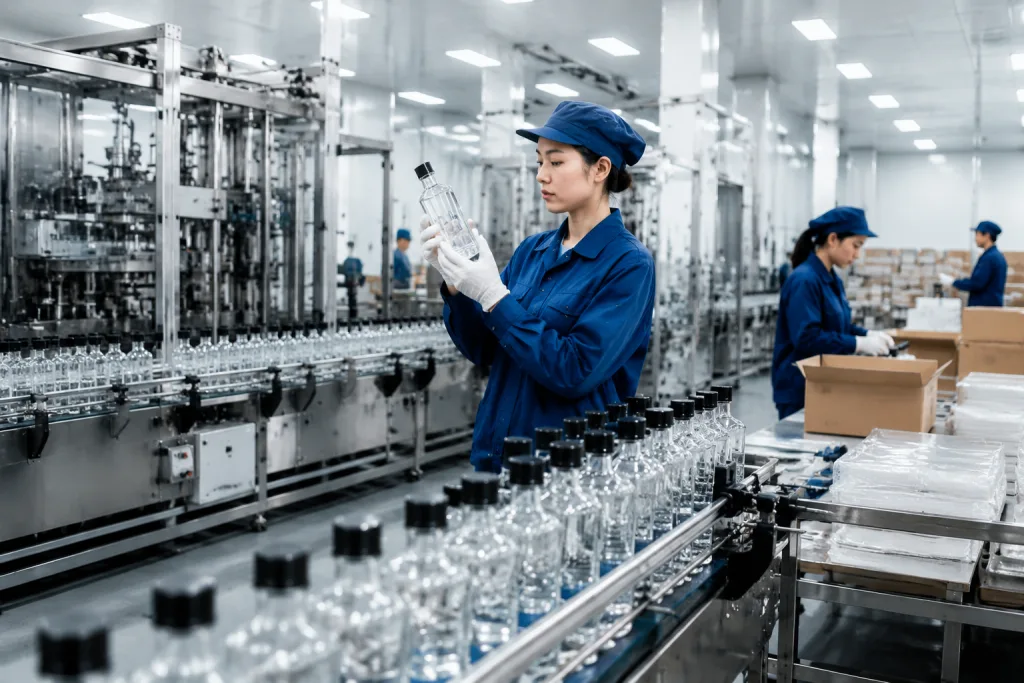
Before the balance payment, book a pre-shipment inspection once at least 80% of the goods are packed and 100% are finished. We run PSI at that stage because opening sealed export cartons too early tells you nothing useful. For bulk glass water bottle orders, this is basic control, not an optional extra. Use your own inspector or a third party, but the checklist needs to cover appearance, function, and packaging integrity in one report.
For a distributor glass water bottle program, inspect at three levels: unit, inner box, and export carton. On the unit side, check chips, cracks, bubbles, sharp points, contamination, logo durability, lid fit, leakage, and wobble. QC pulled the sample and set bottles on a flat steel table to catch base wobble fast. On the packaging side, verify carton dimensions, carton gross weight, barcode scan, shipping marks, divider structure, and count per carton. Then run random carton drop tests from 76 cm and do a basic transit simulation. We have seen this go sideways when the divider board was 1 mm thinner than the approved sample.
Buyers often focus on defect percentage and ignore breakage policy. This is the wrong question to ask. On a 5,000-piece borosilicate glass bottle bulk shipment, even a 1.5% transit damage rate means 75 damaged units before you process one customer complaint. Ask the supplier to define an overproduction spare rate, often 1% to 3%, and confirm if those spares ship free in the same container. Then ask how claims are handled: photo evidence, carton code traceability, and the claim window after arrival. One buyer flagged 2 broken bottles on arrival, but the carton code was missing, so the factory and forwarder pushed blame back and forth for 12 days.
If you are working with borosilicate glass bottle distributors or a borosilicate glass bottle distributor instead of directly with the factory, make sure the breakage clause is written into the purchase order, not buried in chat history. We ship against PO terms, not screenshots. You want one clear answer: who owns the damage risk at each step under FOB, and what extra support is offered beyond the trade term? If the PO has a typo on the item code or misses the spare rate, fix it before shipment. The math does not work once the container has sailed.
Documents to collect before shipment
- Commercial invoice and packing list
- Final approved artwork record
- Inspection report with photos
- Material declaration for food-contact parts
- REACH, LFGB, or ASTM support where applicable
- Carton specs and pallet loading data
What smart buyers standardize next time
After the first order ships, the job changes. You are no longer buying a one-off; you are building a repeat system the team can run again without fresh mistakes. Write down what worked, what slowed approval, and where the line lost time. For wellness brands and sustainable retailers, the fastest margin fix is usually SKU cleanup, not one more decal option. We’ve seen buyers add 6 print variations, then get stuck on a carton mark typo on the next PO.
If your first customized borosilicate glass bottle order sells well, do not rush into four new sizes at once. Keep the same neck finish, lid platform, and carton footprint where possible. This is the right move. Shared components cut MOQ pressure, make spare-part planning easier, and let your borosilicate glass bottle customizable program scale without reopening every tool and packing spec. A 400 ml, 550 ml, and 750 ml family that shares cap architecture is easier to source than three unrelated designs, and QC pulled this issue before: one off-size lid needed a different silicone ring by 1.5 mm, which broke the whole replenishment plan.
Score your supplier on the boring items, because those are the items that hit your launch date: on-time sample submission, final mass production lead time, defect rate, response speed, carton consistency, and documentation accuracy. Put it in a sheet. We run this review after each PO. A borosilicate glass bottle vendor that is 4% cheaper but misses ex-factory date by 12 days can cost more than the price gap once your seasonal launch slips. The buyer flagged this with us before—price looked good, but the math didn't work after 18 days on sample revision and a missed vessel cutoff.
For repeat orders from China, ask for a master specification sheet covering glass type, capacity, wall thickness, unit weight, lid BOM, seal material, sleeve Shore hardness, logo method, approved Pantone, packaging pack-out, and inspection standard. This document should sit beside the PO every time. Include a factory-floor check point like bottle mouth ID in mm, net weight tolerance in g, and carton drop test result, because vague specs create arguments later. This becomes your control document whether you work with one borosilicate glass bottle vendor, compare borosilicate glass bottle vendors, or appoint distributor borosilicate glass bottle partners in different markets.
The buyers who get stable results are rarely the ones chasing the absolute lowest FOB number. They are the ones who specify clearly, sample properly, inspect before payment, and treat packaging as part of the product. This is the wrong question to ask: “Can you do it 3% cheaper?” Ask how the supplier will hold print position, protect the bottle in transit, and keep the same seal compression on repeat runs. We ship repeat SKUs more smoothly when the carton divider, cap torque, and logo file are locked from order two. That is how a custom glass water bottle order from Zhejiang, China becomes a repeat SKU instead of a one-season experiment.
Source your glass bottle order with fewer surprises
Send your target capacity, packaging need, artwork, and forecast. We will review feasibility, MOQ, lead time, and QC points before you place a production order.
Frequently asked questions
What MOQ should I expect from a manufacturer glass water bottle supplier in China?
For a standard-mold glass bottle, a realistic MOQ is usually 3,000 pcs per size and colorway, though some factories in China can accept 2,000 pcs if you use stock lids and simple packaging. If you want a borosilicate glass bottle custom project with a new mold, sleeve, and retail box, MOQ often moves to 5,000-10,000 pcs because tooling, setup loss, and carton printing all add cost. Ask whether MOQ applies per SKU, per decoration color, or per total order. That detail changes your planning more than buyers expect. In Zhejiang, many export-focused drinkware suppliers will work flexibly on first orders if component sharing is possible across sizes.
Is borosilicate always better than soda-lime for a custom glass water bottle?
Not automatically, but for premium wellness retail, high borosilicate is often the safer choice. It generally handles thermal shock better, feels lighter at similar capacity, and supports a cleaner premium story. A 550 ml borosilicate bottle may run with wall thickness around 2.3-2.8 mm and still keep weight manageable. Soda-lime can be cheaper, sometimes by USD 0.15-0.35 per unit, but it is usually heavier and less forgiving for hot-fill use cases. What matters is matching material to your market claim. If your bottle will be sold for tea infusions, warm water, or temperature change use, ask your borosilicate glass bottle manufacturer for actual thermal and leak test data instead of marketing language.
How do I control breakage risk on a bulk glass water bottle order?
Start with structure, not promises. Confirm glass thickness, annealing control, divider design, carton burst strength, and whether each bottle is in an individual box. Then require packed-carton drop testing before shipment. For a 24-piece master carton, check gross weight, edge protection, and pallet stacking pattern. On the commercial side, ask for 1% to 3% spare units packed into the same shipment. On the QC side, use a pre-shipment inspection with leak tests, rim checks, and carton drop checks. A supplier saying “glass is fragile” is not a plan. A written breakage policy, traceable carton marks, and spare-rate agreement are what protect your margin after the goods leave China.
Which compliance documents should Europe and North America buyers request?
Request documents based on market and product construction. For Europe, buyers commonly ask for REACH support and, where relevant, LFGB or other food-contact declarations for lid, seal, sleeve, and coatings. For North America, ask for material declarations and testing support aligned with your product claims, with ASTM references where applicable for packaging or category expectations. If the bottle is for children, the testing scope changes and becomes stricter. Also request a bill of materials for all food-contact parts, including PP inner cap, silicone seal, paint, and decoration ink. A borosilicate glass bottle supplier should be able to explain what is already tested and what would require fresh lab work, usually adding 5-10 working days.
Should I buy direct from a borosilicate glass bottle factory or through a distributor?
That depends on your order volume and internal bandwidth. If you are placing 5,000-20,000 units and can manage sampling, artwork approval, QC, and freight coordination, buying direct from a borosilicate glass bottle factory usually gives you better cost visibility and faster technical answers. If your volumes are smaller or your team is thin, a borosilicate glass bottle distributor can help consolidate SKUs, manage communication, and reduce admin load. The tradeoff is usually higher pricing and less transparency on factory-level controls. For either route, you still need the same facts: material spec, MOQ, lead time, AQL standard, compliance support, and a written damage policy tied to your purchase order.