Key Takeaways
- Typical MOQ starts at 1,000 pcs for stock-shape logo orders and 3,000-5,000 pcs for full custom canteen tooling
- Normal production lead time is 25-40 days after sample approval, with 7-15 days added for new tooling
- A realistic FOB China range for stainless drinkware is USD 2.20-8.80 depending on capacity, finish, lid, and packaging
- Logo method, AQL inspection level, carton drop-test requirements, and REACH/LFGB testing should be priced before PO
If you search for manufacturer drinkware, you are not buying a shelf bottle. You need a landed cost your boss will not tear apart, a delivery date the line can hit, and a supplier who prices the hard stuff before the PI. Last month a buyer flagged a $0.06/color logo gap after QC pulled the pre-production sample under the D65 light box. That is where margin disappears.
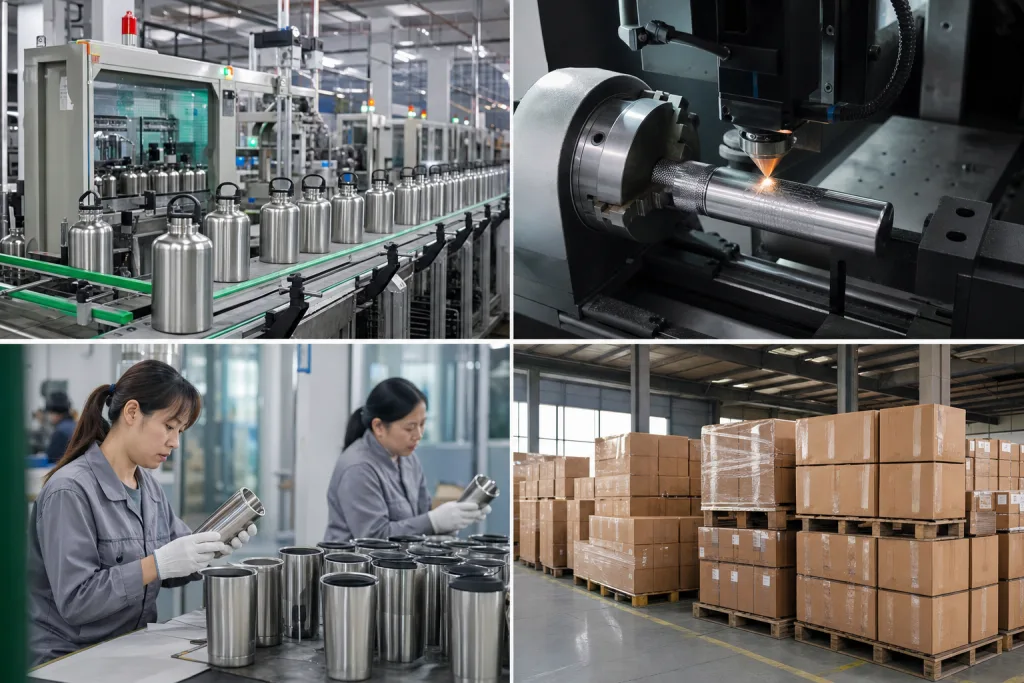
From our factory base in Hangzhou, Zhejiang, we quote custom drinkware for European and North American buyers 5 days a week. The awkward truth: the bottle body is often not the biggest risk. Tooling, powder coating, carton spec, AQL inspection, and FOB vs DDP terms can move your margin by 8-25% if you do not lock them early. We have seen a 52×38×26 cm carton spec change add 0.18 kg per carton, and the math does not work when the buyer only checks unit price.
Start With The Real Cost Stack
A proper manufacturer drinkware quote should not hide behind one tidy unit price. For a 500 ml double-wall stainless bottle, the raw steel body may be only 35-45% of the FOB cost. The balance sits in labor, vacuum furnace time, cap assembly, powder coating, logo printing, color box, scrap allowance, factory overhead, and export handling. We run the cost sheet line by line; last month QC pulled a 500 ml sample with a 0.42 mm outer wall, and the buyer flagged a USD 0.18 gap between two factories that looked “same spec” on paper. It was not the same spec.
For standard 304 stainless steel vacuum drinkware from China, realistic FOB ranges are usually:
- 350-500 ml bottle: USD 2.20-4.50 with single-color logo and color box; add cost if the buyer wants full-wrap printing or a thicker 350 g mailer carton.
- 750-1,000 ml canteen custom order: USD 4.20-7.20 depending on lid complexity and coating; a straw lid with silicone parts takes more assembly time than a simple screw cap.
- 64 oz custom growler: USD 6.80-12.50, especially if the cap has a handle, silicone seal, or pressure-sensitive structure. We check these caps with an air leak tester before packing.
- Plastic sports bottle: USD 0.85-2.60 depending on material, Tritan or PP, and mold ownership. Private mold fees change the math fast, even when the unit price looks low.
Steel grade matters. About 7 out of 10 new buyers ask for 18/8 stainless, which normally means 304 stainless steel. Wall thickness is often 0.4-0.6 mm for bottle bodies, while heavy growler styles use thicker gauge material. Our line checks body thickness with a digital micrometer at incoming inspection, not after the logo is printed. Thicker steel improves dent resistance but adds weight and cost. A cheap quote is often just thinner sheet, lower-grade inner steel, or a cap with loose sealing tolerance. We have seen this go sideways.
Separate EXW and FOB before you compare prices. EXW may look USD 0.12-0.35 cheaper per unit, but then you handle inland freight, export customs, and local coordination in Zhejiang or another China port region. For first orders, FOB Ningbo or FOB Shanghai is cleaner. One buyer once sent a PO with “FOB Hangzhou” typed in by mistake; the forwarder caught it, but it still cost 2 days before we could book the truck.
MOQ Tiers Change The Math
MOQ is not a punishment. It is how a canteen factory spreads setup labor, coating line changeover, printing screens, carton purchasing, and QC time across enough units. At BottleForge Industrial in Zhejiang, we run about 450,000 drinkware units per month across stainless bottles, tumblers, growlers, and kids bottles. Even with that capacity, a 300-piece fully customized drinkware order usually fails the cost check unless it uses stock bodies, stock lids, and cartons already sitting in our ERP. The line still needs a powder booth clean-down, a screen frame, a first-article check with calipers, and 2 hours of packing table setup. The math doesn't work.
Use these MOQ tiers as a planning guide before you push your buyer or sourcing team for a target price:
- 500-1,000 pcs: works for stock-shape custom drinkware with laser engraving or one-color screen print. Expect 2-3 available body colors, standard white box or bulk pack, and no special insert unless the buyer accepts a surcharge.
- 1,000-3,000 pcs: a workable tier for canteen promotional orders and distributor drinkware tests. We can run powder coating, sleeve, insert card, and stronger export carton options, but QC will still flag print drift over 0.5 mm.
- 3,000-5,000 pcs: normal entry point for canteen customized body color, new lid color, and custom box. Production planning gets cleaner here because coating, logo printing, and packing can stay on the line for a full shift instead of being squeezed between larger jobs.
- 8,000-10,000 pcs and above: better pricing leverage and dedicated material purchase. This is also where free samples or shared mold cost becomes a real discussion, not just a nice sentence in an RFQ.
For a new custom canteen mold, MOQ usually starts at 5,000 pcs per size, sometimes 10,000 pcs if the shape is unusual or needs new cap tooling. A customizable canteen using an existing bottle body with your own lid color and logo is easier. We ship this route often: stock 304 stainless body, matched PMS powder coat, logo file checked in AI format, then lid color confirmed by a 60 mm sample chip. This is why 7 out of 10 canteen distributors launch with a proven factory shape first, then invest in original tooling after 2-3 reorder cycles show stable sales.
Do not compare a 1,000-piece quote against a 10,000-piece quote as if they are the same product. At 10,000 pcs, printing waste, carton purchasing, and coating line setup are diluted. A 5-12% unit price gap is normal. Last month a buyer flagged a 9% gap on the PO, but QC had already pulled the 1,000-piece sample run and the coating loss alone was 6.4 kg. Small orders pay for awkward setup. Bigger orders spread it out.
Tooling And Samples Add Days
Lead time starts when the details are frozen, not when the first email lands. For manufacturer drinkware projects, we count four gates: quote sign-off, sample making, production, then inspection/shipping release. If the buyer changes artwork, Pantone color, barcode, or packaging file after sampling, the clock resets partway; last month QC pulled the sample for a 0.6 mm logo shift after the PO showed “matte black” but the artwork file said Pantone 426C.
For a stock-shape canteen customizable order, we run this schedule:
- Quote and specification check: 1-3 working days, assuming the capacity, material, lid type, and carton mark are all clear.
- Logo sample or pre-production sample: 5-10 days for laser engraving or screen print; 10-14 days for powder-coated color samples, because the line needs a clean spray booth changeover.
- Mass production: 25-35 days after sample approval and deposit, not after “verbal OK” on WhatsApp.
- Final inspection and shipment booking: 3-7 days depending on AQL result and vessel space; if AQL 2.5 fails on scratches near the shoulder, add rework time.
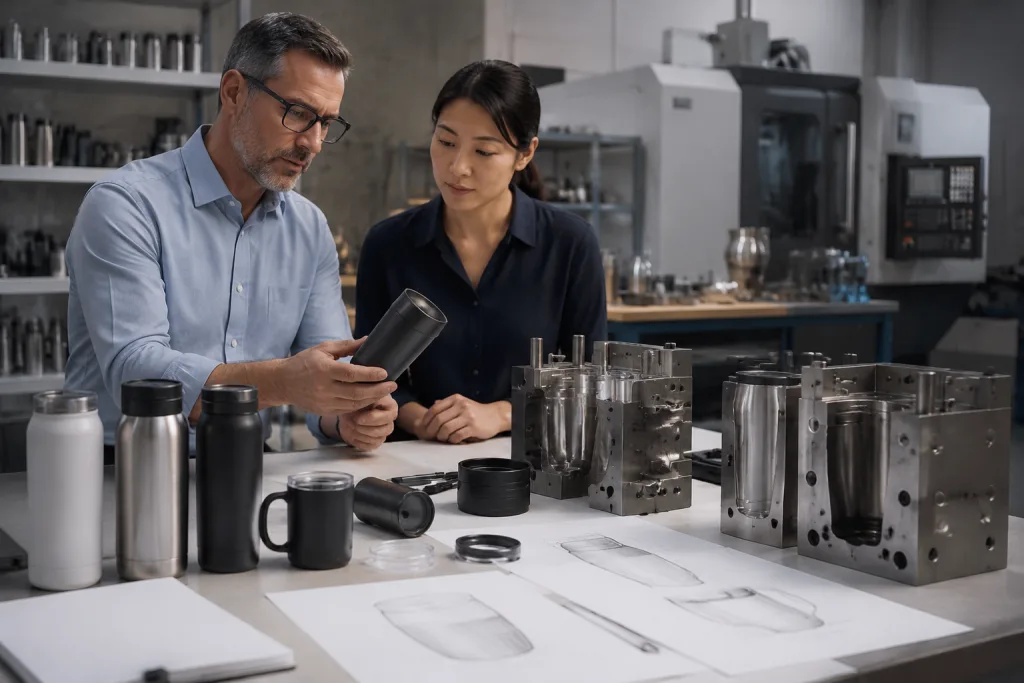
For new molds, add time. No shortcut here. A new bottle body mold may take 20-35 days, while a new plastic cap mold can take 25-45 days depending on cavity number and texture. A customized growler with a new handle cap and silicone gasket can need two or three tool sets, and the buyer often flags the first T1 cap because the grip ribs feel too sharp. Tooling cost can range from USD 800 for a simple accessory tool to USD 8,000 or more for a complete bottle and cap program.
Samples also carry hidden cost. A single pre-production sample sent by courier to Germany, Canada, or the United States may cost USD 45-95 freight; we weigh it on a 0.1 kg scale because DHL bills by chargeable weight, not good intentions. If you request three logo methods, two colors, and two packaging versions, the sample bill is no longer symbolic. The math doesn't work. Approve the structure first, then test decoration on one confirmed body, so cost and timing stay under control.
Decoration Is A Price Driver
Logo decoration is where custom drinkware budgets drift first. Laser engraving burns clean at 0.2-0.4 mm depth, silk screen depends on mesh and fixture fit, and transfer logos can lose 3-5% in scrap when the curve is wrong. Last month QC pulled 32 bottles from a 1,000 pc canteen run because the “included logo” quote did not specify print size or second-position cost. A canteen vendor quoting only “logo included” is leaving out the part that changes the price.
For stainless bottles and canteens, typical decoration costs are:
- Laser engraving: USD 0.12-0.35 per position. It is durable and clean; we run it often for distributor canteen programs and corporate gifting where buyers reject peeling risk.
- One-color silk screen: USD 0.08-0.22 per position. Best on flat panels or gentle curves; a screen charge may apply, and our printer will ask for logo height in mm before making the plate.
- Multi-color screen print: USD 0.18-0.60 depending on color count and registration difficulty. Two-color is usually fine; four-color on a tapered bottle is where the line slows down.
- Full-wrap heat transfer: USD 0.45-1.20. Good for photo-style artwork, but we still run adhesion testing after 24 hours because soft coating and transfer film do not always behave together.
- Powder coating: often USD 0.35-1.10 added versus plain stainless, depending on color, texture, and line quantity. MOQ can jump when the buyer wants matte sand finish instead of our stock black.
If you are buying customizable drinkware for retail, ask for a tape adhesion test with 3M 600 tape, a cross-hatch test with 1 mm cuts, and a written dishwasher expectation in cycles. Be careful with “dishwasher safe” claims. We have seen this go sideways: 500 ml powder-coated bottles looked good after hand washing, then showed rim wear after 18 high-heat dishwasher cycles. For North America and Europe, define the test method and the cycle count instead of accepting a soft claim.
Artwork file quality also controls the schedule. Vector AI, EPS, or PDF files are preferred, and Pantone codes should be listed for printed logos and coating colors. If your brand team sends only a 600 px PNG, we can redraw it, but that adds 1-3 days and creates approval risk. Small detail, big delay. One PO we received had “Panton 186C” typed wrong, and the buyer flagged the red shade only after the pre-production sample was already sprayed.
Compliance And QC Are Not Optional
A cheap customized canteen gets expensive fast when customs, Amazon compliance, or a retail buyer rejects the shipment. For Europe, buyers usually ask for LFGB and REACH, with food-contact migration testing added when coating, ink, or silicone touches the drinking area. For the United States, FDA food-contact compliance and California Proposition 65 assessment may be relevant. Kids bottles are stricter. ASTM, CPSIA, and small-parts review can decide whether the cap design passes. The right test depends on the full BOM: 304 stainless body, powder coating, logo ink, silicone ring, straw, lid pin, and any plastic that touches water. Last month QC pulled a kids bottle sample because a 6 mm decorative plug could be removed by hand. That is how orders get stuck.
Factory audits matter too. BSCI, ISO 9001, or a customer social audit may be required by larger retailers before they even release the PO. Not every canteen supplier in China has every certificate ready for every product, so ask before artwork approval, not after mass production. A valid report for one tumbler does not automatically cover a new coated bottle with a different lid and silicone ring. The math does not work. We have seen a buyer send a 2023 LFGB report for a plain stainless sample, then ask us to ship a matte coated bottle with a PP flip lid and colored silicone gasket under the same file. The line was fine; the paperwork was not.
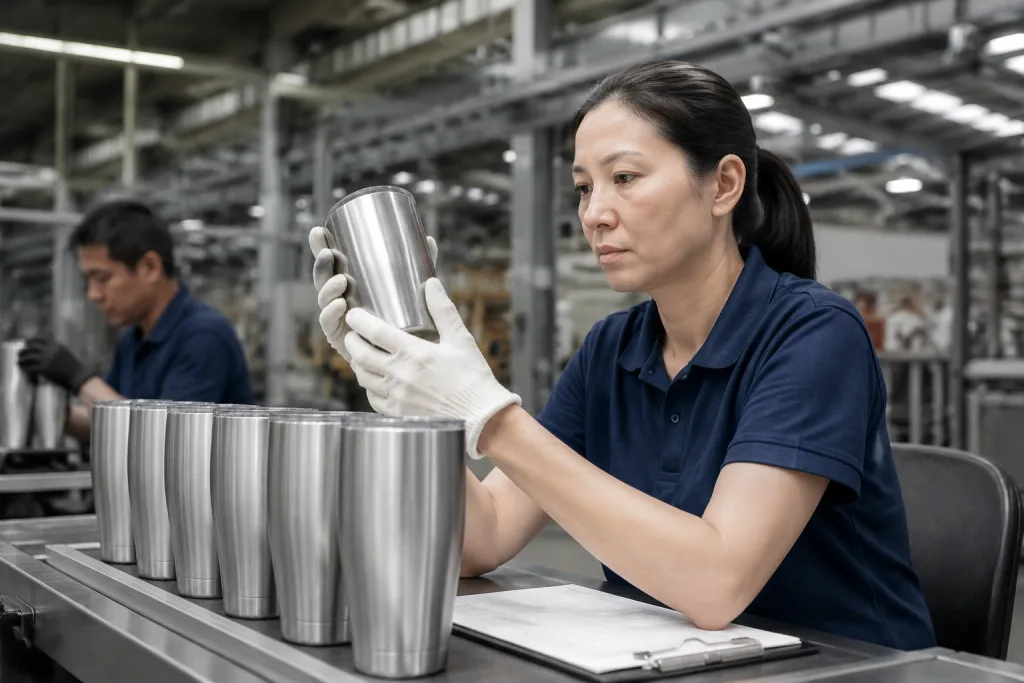
QC should be written into the purchase order, including the inspection standard, defect list, and who pays for reinspection. Normal final random inspection uses AQL, often Level II with critical defects at 0, major at 2.5, and minor at 4.0. For drinkware, critical checks include leakage, vacuum performance, sharp edges, odor, logo position, coating scratches, color deviation, barcode scan, carton mark, and drop-test condition. Make it specific. “Good quality” means nothing on a PO. We run leak tests with the bottle inverted for 30 minutes, then check cartons against the shipping mark because one typo in an SKU code can stop a warehouse receiving team.
For vacuum bottles, we recommend hot water retention checks during production, not only at final inspection. A common internal test is filling with water around 95°C, measuring after 6 hours or 12 hours, and comparing against the approved specification. Short test, big value. If vacuum failure is discovered after packing, sorting is slow and painful; 3,000 packed bottles can take 2 workers more than a day to open, test, repack, and relabel. We have seen this go sideways when the buyer flagged weak heat retention after delivery. A practical manufacturer drinkware partner will show you the risk before you pay the balance.
Packaging And Freight Affect Margin
Packaging is not just decoration. It changes carton size, loading quantity, breakage rate, and warehouse labor. A simple white box may cost USD 0.12-0.25. A printed color box can be USD 0.25-0.65. Rigid gift boxes may exceed USD 1.20 per unit and cut container loading by 8-15% on some bottle shapes. We check this on the packing bench with a carton caliper and a 1.2 m drop-test corner sequence, because nice packaging that fails at the corner is still bad packaging. For Amazon-style distributor drinkware, you may also need FNSKU labels, suffocation warnings for polybags, master carton labels, and drop-test packaging.
For a 500 ml stainless bottle, a master carton might hold 24 pcs and weigh 9-12 kg. A 40HQ container can load roughly 35,000-55,000 units depending on bottle shape and packaging. Large custom growler programs load far fewer units because volume, not weight, becomes the limit. The buyer often asks, “Why is this supplier USD 0.08 cheaper?” Sometimes this is the wrong question to ask. If their color box is 6 mm wider and the carton only stacks 7 layers instead of 8, the math does not work. We run carton loading in Excel against actual carton dimensions before we quote serious FOB pricing.
Sea freight timing from China to Europe or North America moves a lot, so use planning ranges. After production, allow 3-7 days for inspection, trucking, customs, and port handling. Ocean transit may be 25-35 days to major West Coast ports, 35-50 days to East Coast ports, and 30-45 days to many European ports. Rail or air saves time but changes the cost fast. Last April, QC pulled the sample on a Friday, the truck left Hangzhou on Tuesday, and Ningbo cut-off was missed by 18 hours because the PO had the consignee address typo in line 2.
If you are a canteen distributor planning a promotion date, do not count backward from the event using factory production time only. Count sample approval, mass production, inspection, vessel booking, ocean transit, customs clearance, domestic trucking, and your own warehouse receiving. A safe first-order plan is 75-110 days from final artwork to available inventory. Shorter plans go sideways. We ship repeat plain-stock bottles in 45-60 days when cartons and artwork are locked, but a new custom drinkware order with color box, barcode label, and buyer carton mark usually needs the full buffer.
How To Compare Canteen Vendors
To compare canteen manufacturers, put every quote into one sheet. Same capacity, same steel grade, same lid, same coating, same logo size, same box type, same Incoterm, same inspection requirement, same test requirement. If Vendor A prices 304 stainless with 0.5 mm wall thickness and Vendor B quietly quotes 201 stainless at 0.4 mm, the low price is not a saving. It is a missing cost.
A clean RFQ for manufacturer drinkware should include capacity, material, target weight, lid type, insulation target, coating finish, Pantone color, logo method, packaging structure, barcode rules, compliance market, order quantity, delivery port, and required ship date. Add target carton drop test if your retailer asks for it; we often run 60 cm drop tests before mass packing because crushed corner boxes are an easy claim. If existing molds are acceptable, say it clearly. A good canteen factory can recommend a stock body that fits your price point instead of opening tooling you do not need.
For distributors, the strongest first project is often not the most customized one. We’ve seen this go sideways when a buyer starts with a new lid, new body, new color, and gift box on a first 1,000 pcs trial; the math does not work. A canteen promotional order using an existing 750 ml body, powder coating, laser logo, and retail sleeve can ship faster and still look brand-owned. After you sell 3,000-5,000 pcs and collect complaints on grip, leakage, and shelf look, move to a canteen customized lid or a custom color series.
Judge communication too. A serious canteen manufacturer answers with trade-offs: “This lid adds USD 0.28 but improves leak resistance,” or “This coating needs MOQ 3,000 pcs per color.” Weak canteen vendors only say yes. We run into this during pre-production: QC pulled the sample, the lid thread felt tight, and the vendor had never checked it with a torque gauge. In China manufacturing, “yes” is cheap; controlled execution protects your margin.
Ask for the costed specification sheet before you ask for the final discount. It will tell you whether you are negotiating the same product.
Send Your Drinkware RFQ For A Costed Quote
Share quantity, artwork, target market, and delivery date. We will return practical MOQ, FOB cost, sampling, and lead-time options.
Frequently asked questions
What is a realistic MOQ for custom drinkware from a manufacturer?
For stock-shape custom drinkware, 1,000 pcs is a realistic MOQ for many stainless bottles or tumblers with laser engraving or one-color screen print. Some factories may accept 500 pcs if the bottle, color, and packaging are already available, but the unit price will be higher. For canteen customized projects with special powder coating, retail packaging, or multiple logo positions, plan on 3,000 pcs. For a new custom canteen or custom growler mold, 5,000-10,000 pcs is more realistic because tooling, testing, and setup costs need volume to make sense.
How long does manufacturer drinkware production take after deposit?
If you use an existing bottle body and approve artwork quickly, normal production takes 25-40 days after deposit and sample approval. Add 5-10 days for a logo sample, or 10-14 days for coated color samples. If new tooling is involved, add 20-45 days depending on whether it is a bottle body mold, cap mold, or silicone accessory. You should also budget 3-7 days for final AQL inspection, export paperwork, trucking, and vessel booking before the cargo actually leaves China.
Why do canteen suppliers quote very different FOB prices?
Different FOB prices usually come from different specifications, not magic purchasing power. One canteen supplier may quote 304 inner and outer stainless steel, 0.5 mm wall thickness, powder coating, color box, and AQL inspection. Another may quote thinner steel, plain white box, simpler lid, and no testing. Logo method also matters: laser may add USD 0.12-0.35, while full-wrap heat transfer can add USD 0.45-1.20. Ask every canteen vendor to quote the same material, weight, packaging, Incoterm, and compliance requirement before comparing.
Can I order a canteen customizable design without paying for a new mold?
Yes, if you choose an existing factory body and customize the surface, lid color, logo, sleeve, or packaging. This is the usual path for first-time B2B buyers and canteen distributors. You can still make the product feel brand-owned with Pantone powder coating, laser engraving, custom insert card, retail box, and carton labels. The MOQ may stay around 1,000-3,000 pcs. A fully original shape, special handle, or new cap structure usually requires tooling and raises the MOQ to 5,000 pcs or more.
What compliance documents should I request for distributor drinkware?
For European distributor drinkware, ask about LFGB food-contact testing, REACH, and material declarations for stainless steel, plastic, silicone, coating, and ink. For the United States, FDA food-contact compliance and Proposition 65 review may be needed. Kids bottles may require CPSIA and ASTM-related checks. Also request factory audit documents such as BSCI or ISO 9001 if your retail customers require them. Make sure reports match the actual product materials and finishes; a test report for a different lid or coating may not protect your order.