Key Takeaways
- A 0.4-0.6 mm wall thickness variance can be enough to cause denting, condensation, or uneven paint adhesion in metal bottles.
- For printed custom drinkware, ask for AQL 2.5 major and 4.0 minor, plus a signed color target, before mass production.
- Most factory lead times run 25-35 days after sample approval; complex customized growler runs can take 40-45 days.
- A realistic MOQ for a custom canteen is often 1,000-3,000 units, with FOB China pricing starting around USD 1.20-1.80 for basic plastic and USD 3.20-6.50 for stainless steel.
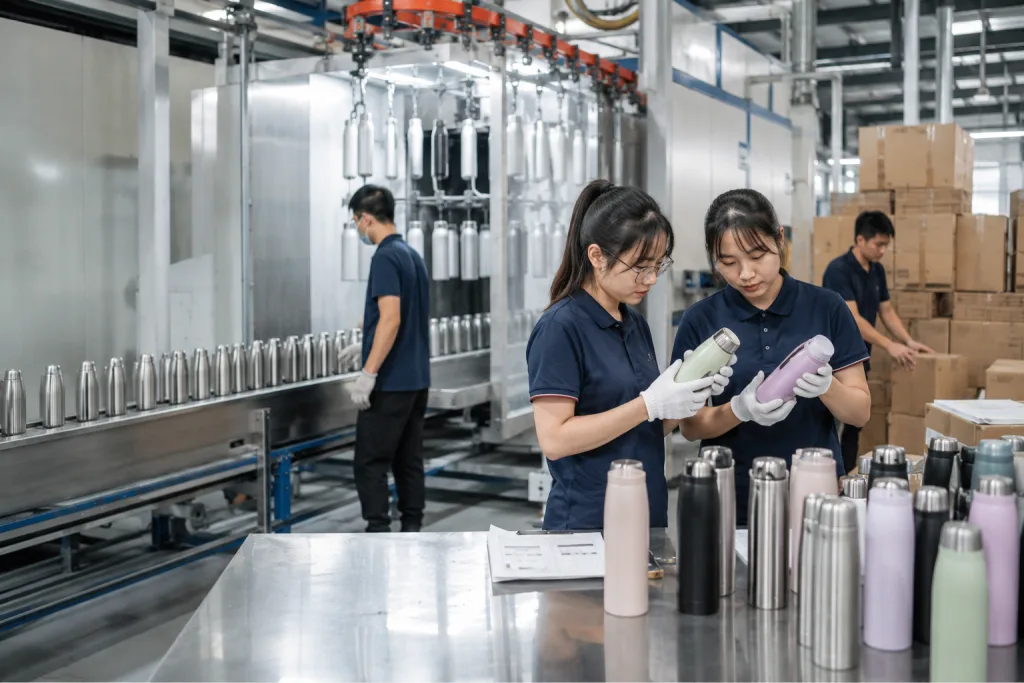
Buying a manufacturer drink bottle looks simple until the first carton lands with leaking lids, uneven print, or bottles that pass on paper and fail in use. The job is not chasing the lowest quote. It is stopping the usual production misses from becoming claims, chargebacks, and dead stock. If you source custom drinkware for retail, e-commerce, or promotions, you need specs a factory can hold, not a pretty sample that dies at packing. We have seen a 2 mm lid gasket gap turn into a full return case after QC pulled the sample from the line.
From our factory in Zhejiang, China, the pattern is familiar: the buyer asks for “better quality,” the supplier cuts the price, and nobody locks the critical tolerances. Then the order goes out with mixed cap torque, weak laser marks, or bodies that pick up dents in transit. That is the wrong question to ask. Spec around the failure points, and a canteen manufacturer can quote cleanly, inspect to AQL, and keep your order steady across 5,000 or 50,000 units. One PO typo on cap color can cost a week; we ship by the carton, not by guesswork.
Where bottle leaks really start
The first leak usually starts in the closure, not the bottle body. We have seen a manufacturer drink bottle pass photo approval and still drip because the gasket sat 0.3 mm too shallow, the thread pitch drifted, or one molding cavity delivered a different lid torque. For a custom canteen or customized canteen headed to retail, one leaking unit in a carton is enough to trigger returns. Amazon cases make that expensive fast.
Spec the cap like it matters, because it does. For screw caps, ask for a torque window, usually 0.8-1.5 N·m depending on the closure design. For flip lids, require cycle testing, not a quick visual check. QC pulled the sample on one lot and found the gasket was TPE instead of silicone, which changed the seal after hot water. A good canteen supplier should tell you the material, Shore hardness, and whether the lid passed hot-fill or inverted-leak testing at 60-90 degrees C. If your use case includes hot drinks, say it on day one. Too many vendors build for cold water and hope nobody notices.
What belongs in the purchase spec is simple:
- Leak test at 100% for the first production run, then per AQL lot sampling.
- Closure torque range by lid type.
- Gasket material and Shore hardness.
- Drop test height, usually 1.0-1.2 m for consumer packaging.
That looks technical on paper, but the math works. We have seen a cap that matched the sample on the bench and failed in mass production because the line held the mold at a different cooling time, and the buyer flagged it after the first carton was opened.
Print and logo defects compound fast
Logo defects turn a custom drinkware order from fine on paper to a customer complaint fast. We have seen a screen print drift 1.5 mm off center, laser engraving come out light on one batch and dark on the next, and pad print ghost on a curved body when the jig flexed. This shows up a lot on canteen customized and customizable drinkware orders: the buyer approves one clean sample, then expects the line to repeat it across 10,000 pieces. It will not, unless the factory locks the process.
The right move is to choose the decoration method by use, not by habit. For one-color branding on stainless steel, laser engraving is steady, but it will not give the same bold hit as a printed mark. For multicolor retail packaging, silkscreen or UV print may be the better fit, but then you need Pantone references, artwork placement drawings, and an approved golden sample. A competent canteen manufacturer in Zhejiang or elsewhere in China should state the print tolerance and the curing control they run on the line. If they cannot, you are buying hope, and that is the wrong question to ask.
Use these controls in your order sheet:
- Artwork file format and Pantone code, not just a screenshot.
- Placement tolerance, typically within 1.5 mm for premium branding.
- Adhesion test requirement, such as cross-hatch or tape pull.
- Scratch resistance expectation for handling and transit.
For canteen promotional runs, a simpler decoration usually holds up better than a busy layout that starts flaking after a few dishwasher cycles. QC pulled the sample on a 24-hour tape test and the edge lifted, so we changed the ink cure instead of arguing about the artwork. If your channel is distribution, distributor canteen programs should put repeatability ahead of visual tricks.
The wall thickness trap
Most buyers look at capacity and miss wall thickness. That is the wrong question to ask. On 304 stainless drinkware, a 0.1-0.2 mm shift can change the hand feel, dent resistance, and how the tube behaves at the vacuum forming station. On plastic, uneven wall flow shows up as sink marks, warping, or a cap that sits off by 0.5 mm after cooling. We have seen a buyer approve a drawing, then the line rejected the first run because the shoulder was thin where the body met the neck. If you are sourcing from a canteen factory, ask where the part is weakest before you lock the drawing.
For a stainless model, a common spec is 0.4-0.5 mm inner wall and 0.4-0.5 mm outer wall, depending on the construction. For simple plastic custom canteen items, 1.8 mm can work well if the mold is stable and the gates are balanced. I would take a steady 1.8 mm part over an “extra thick” promise that drifts across cavities by 0.3 mm. QC pulled the sample on one job and found one cavity at 1.72 mm, another at 1.96 mm; the buyer flagged it, and the PO had to be revised. Ask for cavity-by-cavity inspection notes if the bottle uses multiple molds.
Do not buy thickness as a marketing claim. Buy it as a controlled tolerance.
If your line includes custom growler or customizable growler formats, the same rule applies with more pressure on the part. Large bottles show defects fast because the body flexes more, the handle carries higher stress, and pallet rub can turn a small wall issue into a claim. We ship these in 6-pack cartons, and a 2 mm corner crush on the outer box can be enough to start trouble. For distributor growler programs, that is where hidden claims start.
MOQ and pricing hide the real risk
A low quote is not a win if the factory has to improvise to hit it. We have seen that go sideways on the line: mixed resin lots, cartons that fail a 5 kg drop, or a cap pulled from a second-tier mold that never matched the signed sample. For a manufacturer drink bottle program, price only means something when the build is fixed on paper. In Zhejiang, China, the gap between an export-ready order and a messy one is often three lines in the spec sheet.
Typical MOQ is 1,000-3,000 units for a basic custom canteen, 3,000-5,000 for a more customized drinkware build with special decoration, and 5,000+ for complex tooling or custom growler programs. FOB China pricing often starts around USD 1.20-1.80 for basic plastic and USD 3.20-6.50 for stainless steel, but the final number moves with lid design, print count, and packaging. A canteen distributor buying for retail should ask for separate prices for bottle, lid, insert card, and master carton. We ship cleaner quotes that way. A buyer once flagged a PO typo on “master carton” and caught a hidden pack-upcharge before the deposit left.
Be careful with supplier language. A “canteen supplier” may quote one clean number, but a serious canteen manufacturer should split tooling, sampling, test reports, and packaging changes. This is the wrong question to ask if you only compare the headline. We had one order where the lid tooling alone added USD 680, and the buyer had never asked for it on the first round. If you are comparing canteen suppliers, that breakdown matters more than a ten-cent difference that disappears when the cartons are upgraded.
Testing that should not be optional
Production QC is where a lot of buyer pain gets stopped early. The right question is not whether the factory has inspection. It is what they inspect, how they sample, and what happens when one lot drifts. For export orders, ask for AQL with a written acceptance plan. A common starting point is AQL 2.5 for major defects and 4.0 for minor defects, but the target should match the channel. Retail and Amazon orders usually need tighter control than internal corporate gifts. We run that split on the line all the time.
Ask for the actual test stack, not a vague promise. A proper canteen factory should show leak testing, dishwasher or handwash durability checks if relevant, lid cycle testing, drop testing, and package compression checks. For Europe-bound orders, REACH compliance and food-contact declarations matter. For North America, the materials and coatings need to line up with FDA expectations and, where needed, ASTM-style test methods from the lab. QC pulled the sample once and found a lid torque issue at 18 cycles; the buyer flagged it before shipment, which saved a rework lot. If a factory in China says “no problem” without documents, that is a warning sign.
- Incoming material check for steel grade, resin, and coatings.
- In-process inspection on mold, print, and assembly.
- Pre-shipment inspection with photo records and count reconciliation.
- Carton drop and compression testing for export freight.
This is where canteen manufacturers separate themselves from canteen vendors who only resell. The manufacturer can usually control the line and fix a typo on the PO before packing starts. The vendor can only report after the fact. That is the wrong place to be when a 20,000-piece order is already on the dock.
Packaging is part of the product
Packaging failures look like a manufacturing defect. A thin carton, a weak divider, or loose bottle-in-bag packing can wreck an otherwise clean order. We’ve seen a 0.8 mm insert turn into scuffed powder coat on the line, then the buyer flagged it as a bottle quality issue. That matters for distributor drinkware and canteen promotional runs where the box is part of the sale. If the bottle arrives marked up, nobody gives you credit for a good cap seal.
Lock the pack spec before mass production. Call out inner bags, dividers, master carton strength, and pallet pattern in writing. For export, I want drop-tested retail cartons and a master carton that can hold 3-5 layers high, depending on freight mode. For a custom drinkware gift set, protect the lid and base with inserts. A custom canteen with a powder-coated finish needs more protection than bare steel. The coating shows rub marks fast.
Channel labeling needs the same discipline. Amazon FBA orders need FNSKU placement, barcode placement, and carton labels done at the factory, not after the goods hit a warehouse. Distributor canteen and distributor growler orders often need country-of-origin marks, care instructions, and batch codes. We ship those details off the PO, then QC pulled the sample against the carton draft. Put it in writing before sampling. Once production starts, packaging changes burn time fast.
What to ask before you approve sample
A sample only helps when it answers the right questions. We see buyers approve a nice-looking sample, then the bulk run shifts in color, hand feel, or lid torque. Before you sign off, ask the factory which parts are hand-finished, which parts are set for mass production, and which parts were made just for display. That split matters when you are buying customized canteen items, customizable canteen runs, or a canteen customized for a distributor program.
Use the sample stage to lock the standards you will enforce later:
- Weight tolerance, usually within 3-5% for plastic and tighter for steel.
- Color target, matched against a physical master sample under the same light box.
- Thread fit, opening smoothness, and cap closure force.
- Finish acceptance, including orange peel, gloss, and weld visibility where relevant.
For China sourcing, ask for a pre-production sample and a sealed golden sample. We keep one in the office and one by the line. Once the line starts moving, that reference stops arguments fast. A buyer once flagged a PO typo on the lid code, and the sample saved the order before we cut tooling. If you are working with a canteen distributor or direct canteen manufacturer in Zhejiang, this control catches most of the drift before it becomes a claim. It is plain work, and it pays for itself.
Spec your next bottle with fewer surprises
Send the target use, volume, and decoration method. We’ll build the quote around production risks, not a generic brochure spec.
Frequently asked questions
What MOQ should I expect for a manufacturer drink bottle order?
For a basic custom canteen or plastic custom drinkware item, MOQ is often 1,000-3,000 units. For stainless steel, especially with custom decoration or special lids, 3,000-5,000 units is more common. If you want a custom growler or highly customized drinkware with tooling changes, expect 5,000 units or more. A small MOQ can look attractive, but it often means fewer test options and less process control. Ask whether the MOQ includes one logo color, one carton spec, and one packaging method, because those details change the real minimum.
How long does production usually take in China?
For standard orders after sample approval, lead time is usually 25-35 days in China. If the order needs new tooling, a specialized lid, or a customized growler format, 40-45 days is more realistic. Add another 5-10 days if you need lab testing, third-party inspection, or a revised artwork approval cycle. In Zhejiang, many factories can move faster on reorders, but the first order should still include enough buffer for material sourcing and pre-shipment checks.
What QC terms should I put in the purchase order?
Use concrete terms: AQL 2.5 major and 4.0 minor, leak test requirements, drop test height, carton compression target, and a defined decoration tolerance. For a canteen manufacturer or canteen supplier, include the exact gasket material, wall thickness target, and packaging structure. If the order is for Europe, add REACH and food-contact declarations. If you are selling into North America, include the expected testing standard and request the COA or lab report before shipment.
Is laser engraving better than print for a custom canteen?
It depends on the channel. Laser engraving is more durable and usually cleaner for one-color branding on stainless steel, especially for distributor canteen programs. Print gives you more visual impact and more flexibility for canteen promotional orders or retail packaging. The problem is not the decoration method itself; it is whether the factory can hold placement and curing consistently. For any customized canteen order, ask for an approved master sample and a scratch or tape adhesion test before mass production.
What documents should I request from a canteen factory?
Ask for a quotation with FOB terms, a product spec sheet, material declarations, and photos of the sample approval. For export to Europe, you want REACH-related documentation and food-contact compliance. For North America, ask for the relevant material and coating statements, plus any third-party test report the factory has. A BSCI audit, if available, helps with social compliance, but it does not replace product testing. A serious canteen factory or canteen manufacturers group should be able to produce these without delay.