Key Takeaways
- For a standard 12-20 oz bulk coffee tumbler, FOB China often lands at USD 2.10-4.80 per unit at 1,000-3,000 pcs.
- MOQs usually start at 500 pcs for laser logo work and 1,000 pcs for full-color print or custom packaging.
- Typical lead time is 18-25 days for repeat orders and 30-45 days for new molds, lids, or retail boxes.
- Decoration, lid tooling, and packaging can add 8%-25% to unit cost before freight and duty.
If you are buying a manufacturer coffee tumbler for a coffee brand or corporate gift program, the first mistake is treating all tumblers like the same product with a logo on it. They are not. A 12 oz powder-coated stainless mug with a flip lid, a 20 oz vacuum tumbler with a slider lid, and a gift-boxed coffee mug customized for retail land in different cost and lead-time buckets. In Zhejiang and across China, the spread is real: one change in lid tooling, coating method, or packaging can move your landed cost by 8% to 25%.
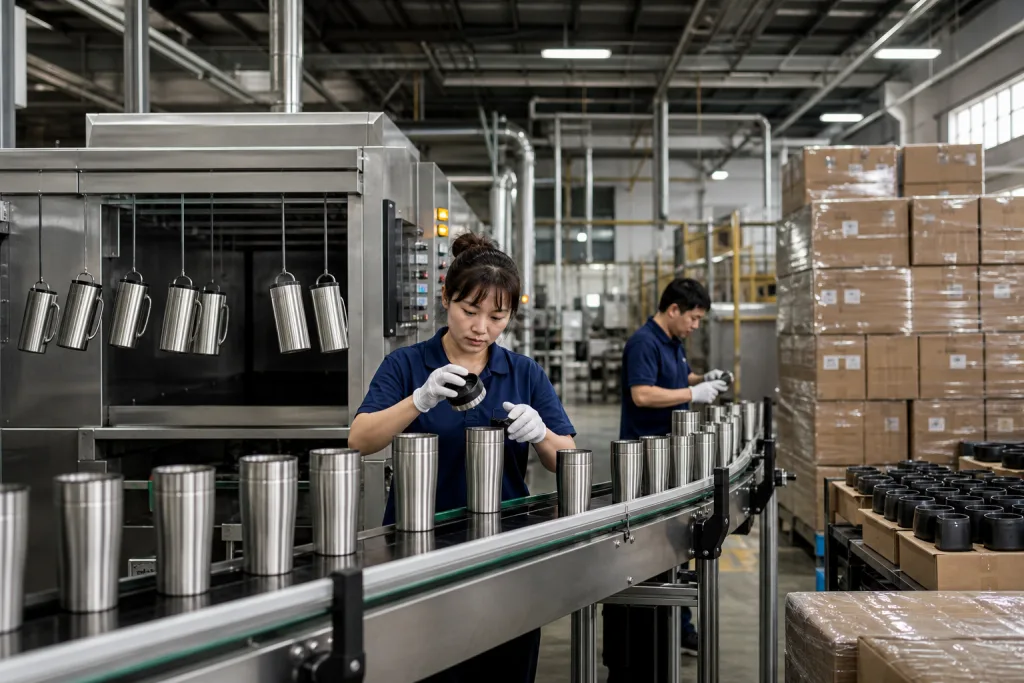
You need a supplier conversation that starts with structure, not slogans. Ask for the base unit price, decoration charge, carton spec, and production calendar separately. A serious coffee mug manufacturer will quote MOQs by decoration method and tell you what happens at 500 units, 1,000 units, and 5,000 units. We run this every week at the line in Hangzhou; QC pulled the sample at 500 ml fill test, then the buyer flagged a lid typo on the PO and we caught it before packing. Our monthly output exceeds 600,000 drinkware units, with standard lead time at 18 to 25 days after sample approval for repeat builds. That is the kind of fact pattern you should demand from any coffee mug factory direct quote in China.
What You Actually Pay For
When buyers ask for a bulk coffee mug quote, they often stare at the stainless shell and stop there. That is too narrow. A manufacturer coffee tumbler price usually comes from five parts: raw material, forming and welding, insulation structure, lid system, and decoration. On a basic 304 stainless single-wall promotional mug, material cost may sit at 20% to 30% of the unit price. On a double-wall vacuum bulk coffee travel mug, the weld bead and vacuum pull matter just as much as the steel. We run the line with a vacuum tester at -0.08 MPa, and when that number drifts, the cost and the reject rate both move.
Here is the practical split. A plain 12 oz model with no logo and a standard PP lid might FOB at USD 1.85 to 2.40 at 5,000 pcs. Add powder coating, and the price can rise by USD 0.18 to 0.35. Add laser engraving, another USD 0.10 to 0.25. Add a custom color lid or slide lock, and the increment can reach USD 0.20 to 0.60, depending on tooling and quantity. If you need a coffee mug custom made with a gift box, insert, and barcode label, packaging alone can add USD 0.35 to 1.20. The buyer flagged a PO once because the lid code said "PP" and the sample was actually Tritan; that typo cost two days. Coffee mug distributors who compare unit price without spec detail usually pay for it later.
Price is not the issue. Spec control is the issue.
For a buyer in North America or Europe, the real question is not whether a bulk travel mug is cheap. The question is whether the quote covers the exact lid type, coating standard, and packaging condition you need for retail or corporate distribution. We see this go sideways when the spec is vague and the inspector only gets involved after cartons are packed.
MOQ Tiers That Change Cost
MOQ is not a number pulled out of thin air by a coffee mug supplier. It follows the setup the line has to absorb. For plain decoration, a coffee mug manufacturer can often run 300 to 500 pcs. Once you add custom Pantone coating, full-wrap print, or coffee mug private label carton work, 1,000 pcs is the cleaner ask. New tooling changes the math fast. A unique lid or handle shape usually lands at 3,000 to 5,000 pcs in China, and we have seen buyers push back hard when the first sample already showed a new mold fee on page 2 of the quote.
Pricing drops in bands. A bulk coffee mug order of 500 pcs might sit at USD 3.60 each. At 1,000 pcs, it may drop to USD 2.95. At 3,000 pcs, you may see USD 2.45 to 2.70. At 10,000 pcs, a standard bulk coffee tumbler can go below USD 2.20 if the spec is simple. That is not magic. It is carton packing, fewer changeovers on the pad printer, and less scrap per run. QC pulled the sample on one job and found 8 broken lids in a 1,000-piece pack; that is why a cheap quote can turn expensive fast.
If you source for a coffee brand, ask the factory for three written tiers: 500, 1,000, and 3,000 pcs. That gives you the real marginal cost. If the price barely moves between 1,000 and 3,000 pcs, the factory has already loaded setup overhead into the unit price or is covering decoration risk. A strong coffee mug oem manufacturer will show the breakpoint without hiding behind one headline figure. The buyer flagged a PO typo once, and the carton count changed from 3,000 to 30,000; the extra zero was the whole margin. That is the wrong question to ask if you only look at the lowest unit price.
Lead Time by Build Type
Lead time is where a lot of bulk coffee travel mug programs bleed margin. We have seen buyers in Europe and North America budget 20 days, then the line still needs 12 days for sample sign-off, 7 days for carton approval, and another 15 days for production plus QC. For a repeat run, a China supplier should quote 18 to 25 days after sample confirmation. First order with custom artwork usually lands at 30 to 45 days. New tooling or a fresh mold pushes that to 45 to 60 days. That is the math.
The build drives the clock. A coffee mug factory direct order with a stock lid and stock body color moves fast because we run that setup every week. A coffee mug promotional products order with four PMS colors, retail cartons, and barcode stickers slows down because the buyer flagged the artwork twice and the proof was still off by 2 mm. Shipping is separate. From Zhejiang to a US West Coast port, ocean freight may take 18 to 28 days depending on sailings. To Northern Europe, plan 30 to 40 days on the water. A 25-day factory lead time can still become a 7- to 10-week door-to-door cycle.
- Repeat stock spec: 18-25 days production
- New logo only: 25-35 days
- New color or print layout: 30-45 days
- New mold or lid tooling: 45-60 days
If a coffee mug supplier promises a custom build in 10 days, ask what is really on the floor. QC pulled the sample, and most of the time that means stock goods with a sticker, not a real custom run. We have seen this go sideways when the PO typo changed the carton count and nobody caught it until packing.
Decoration Methods And Hidden Cost
Decoration is not just branding. It changes cost, MOQ, and how the tumbler survives transit. Laser engraving is usually the lowest-cost, toughest option for a manufacturer coffee tumbler when the buyer wants a clean industrial look. We usually see USD 0.10 to 0.25 per piece, and the price moves with coverage and run size. Silk screen still makes sense for a one-color logo on a bulk travel mug, often USD 0.12 to 0.30 per color per side. Heat transfer and full wrap printing can land at USD 0.35 to 0.80, especially when the art wraps most of the body. On one 5,000-piece run, the buyer flagged a typo in the PO artwork file and we had to stop the line for a day. That is the real cost.
Powder coat adds grip and gives a coffee mug customizable program a stronger shelf look, but the math does not work if you treat it like a free upgrade. Depending on the finish, expect USD 0.18 to 0.45 extra. If you want a coffee mug customized with metallic paint, UV print, or soft-touch coating, build in a higher reject allowance from the start. Good factories in Zhejiang will tell you the decoration yield before you place the order because they know how many pieces can fail visual inspection at AQL 2.5. QC pulled the sample on a 304 stainless run last month and rejected 37 pieces for color shift. That number matters more than the brochure does.
Packaging has its own cost curve. A plain brown carton is one number. A printed retail box with insert tray, warning label, and FNSKU sticker is another. For Amazon or retail-ready programs, packaging can add more than the logo itself. That matters for coffee mug bulk buyers comparing gift sets against shelf-ready SKUs. A coffee mug promotional order for a trade show can live with simple packing. A retail program usually will not. We ship a lot of these in 12 days versus 18 days once the buyer asks for a printed box and barcode label, because the packing line needs a separate setup and one extra carton test.
Material Choices That Move Price
The base material drives the quote, and buyers still underprice it. A standard 304 stainless inner and outer wall is the default for a bulk coffee tumbler. Move the inner wall to 316 stainless for acidic drinks or a premium line, and the material line jumps; on one order, the buyer flagged the MOQ at 3,000 pcs because the math stopped working. For lids, PP is the low-cost pick, Tritan or BPA-free copolyester sits in the middle, and stainless-accent lids add another step up. Silicon gasket quality matters too; QC pulled the sample after a 72-hour hot-water test because the seal relaxed at the rim.
Wall thickness changes both hand feel and landed cost. For travel tumblers, 0.4 mm to 0.5 mm is the range we run most often. Go thinner and dent claims show up fast. Go thicker and you add grams, not just cost, and freight follows. On a 500 ml cup, 25 to 40 grams sounds small until you load a carton of 24 and the carton weight shifts enough for the forwarder to re-rate it. If you're building a premium private label line, that extra metal can earn its keep. For a price-led catalog, it usually won't.
Ask for compliance papers by material, not by verbal assurance. For Europe, REACH files matter. For North America, BPA-free declarations and food-contact statements are the baseline. If your program needs ASTM or ISO references, ask before sample approval, because we have seen POs arrive with the wrong code in the remarks field and that wastes a week. A serious coffee mug supplier will know which documents come from China test partners and which ones need third-party lab work.
How To Quote Like A Buyer
Good sourcing starts with a clean RFQ. Do not send only a logo and a target price. Send capacity, use case, target market, pack style, and ship date. We run quote checks on the same sheet, because a 12 oz body and a 16 oz body are not the same job on the line. A coffee mug supplier list only helps if you can compare one spec against the next, line by line. Ask for material grade, vacuum structure, finish, lid type, print method, box style, and carton count. If you are buying coffee mug in bulk for a chain gift program, include the exact quantity split by color. If you are buying for ecommerce, include FNSKU placement and carton drop-test requirements.
Use these questions in the first round:
- What is the FOB price at 500, 1,000, and 3,000 pcs?
- What is the lead time after sample approval?
- What is the MOQ for each decoration method?
- Can you support AQL 2.5 final inspection?
- Do you have BSCI or equivalent factory audit records?
If the factory answers slowly or dodges the spec, that is the signal. The buyer flagged it on our side before for a reason. A real coffee mug manufacturer or coffee mug factory knows the gap between stock body production and true custom work, and the draft quote will show it in the carton count, the lid stack, and the print setup fee. In Zhejiang, the better plants are usually disciplined about this because export buyers push for exact numbers, not vague promises. China has plenty of capable suppliers, but only a subset can support repeat programs with defect control that holds month after month. That is the group you want for long-term coffee mug private labeling.
Request a factory quote with real specs
Send your volume, lid style, decoration method, and target market. We will quote the true cost and lead time, not a guess.
Frequently asked questions
What is a normal MOQ for a manufacturer coffee tumbler?
For a standard manufacturer coffee tumbler with stock body and simple logo, MOQ is often 500 pcs. For multi-color print, custom packaging, or coffee mug customizable options, 1,000 pcs is more typical. If you need new lid tooling or a unique shape, expect 3,000 to 5,000 pcs. On price, the jump from 500 to 1,000 pcs can cut unit cost by 15% to 25%, especially in Zhejiang factories that already run similar lines.
How much does a bulk coffee tumbler cost FOB China?
For a basic 12-20 oz bulk coffee tumbler, FOB China pricing usually sits around USD 2.10 to 4.80 depending on steel grade, lid, coating, and decoration. A simple laser logo may add USD 0.10 to 0.25. Powder coating can add USD 0.18 to 0.45. Gift packaging can add another USD 0.35 to 1.20. Freight, duty, and local distribution are separate, so compare quotes on the same spec sheet.
How long does production take for coffee mug custom made orders?
A repeat coffee mug custom made order normally takes 18 to 25 days after sample approval. First orders with new artwork often need 30 to 45 days. If you introduce new tooling, a different lid, or a special retail box, allow 45 to 60 days. Ocean freight adds another 18 to 40 days depending on destination, so your real door-to-door planning window is usually 6 to 10 weeks.
What documents should a coffee mug factory direct quote include?
A proper coffee mug factory direct quote should state material grade, capacity, finish, lid type, decoration method, carton spec, MOQ, lead time, and Incoterms such as FOB or EXW. For compliance, ask for REACH support if you sell in Europe, BPA-free declarations, food-contact testing, and if needed AQL inspection terms. If the supplier can also show BSCI or similar audit records, that is a useful signal for corporate-gift buyers.
Are coffee mug promotional products cheaper than retail tumblers?
Usually yes, but only because the spec is simpler. Coffee mug promotional products often use stock colors, single-color print, and basic cartons, which can keep FOB pricing near USD 2.00 to 3.00 at moderate volume. Retail tumblers cost more because they need stronger packaging, better decoration, stricter appearance control, and often barcode labeling. Once you add retail-ready box work and tighter AQL expectations, the price gap narrows quickly.