Key Takeaways
- 316 stainless steel costs about 8% to 15% more than 304, but it is the better call for premium bulk coffee tumbler programs
- A 500 ml bulk travel mug usually needs a 0.5 mm to 0.7 mm inner wall and a tested lid seal, not just a nice-looking shell
- Custom decoration changes cost fast: silk screen is cheaper at 1 color, laser engraving is cleaner for private label, and full-color wrap is best for promotional products
- For export, ask for REACH, food-contact declarations, and AQL inspection terms before you approve a coffee mug custom made sample
If you are buying a manufacturer coffee travel mug for retail, corporate gifting, or private label, the first mistake is treating every tumbler like a simple drink container. It is not. Lid geometry, coating, insulation method, and the decoration route all change the landed cost, the leak risk, and how the buyer feels after 30 days on the shelf or in the car.
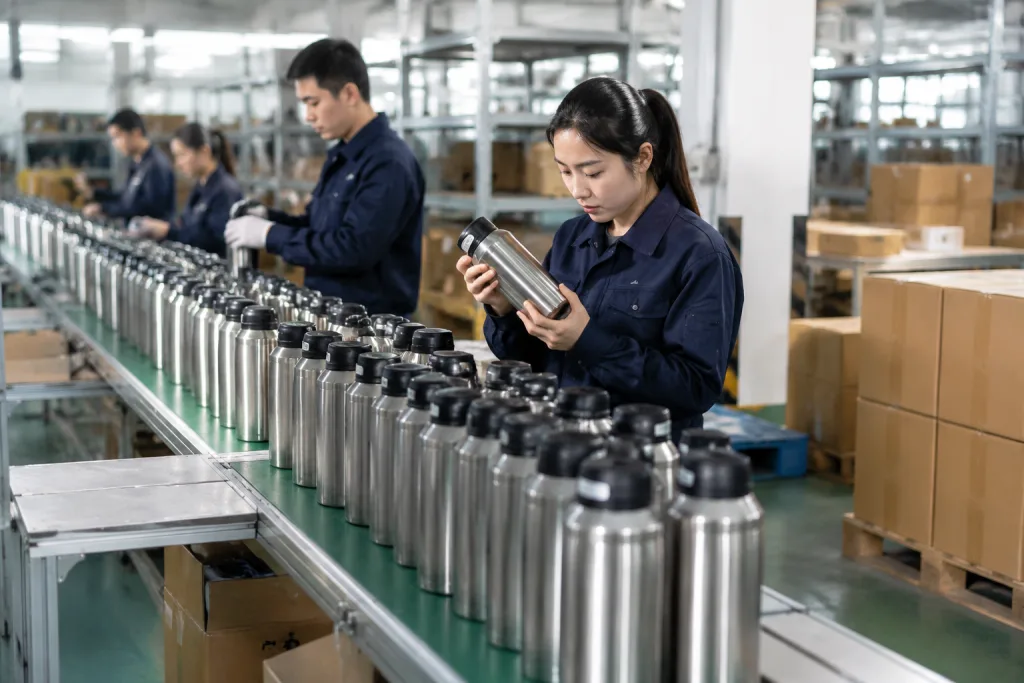
We see this every week in Zhejiang. A factory that can explain the trade-offs clearly usually gets the second order. Stainless grade, wall thickness, MOQ, packing method, and test standard all matter, and the wrong question is always "what is the lowest FOB." BottleForge Industrial in Hangzhou runs up to 600,000 units per month, with a standard MOQ from 3,000 pieces and typical lead times of 25 to 35 days for repeat builds. QC pulled a sample last month and found a lid torque issue at 1.8 N·m, which is the kind of detail that saves a buyer from a complaint run.
Start with the channel, not the tumbler
The right manufacturer coffee travel mug depends on where it will be sold and how it will be used. A coffee brand selling through retail shelves needs a different build than a company ordering coffee mug promotional products for an event. Retail buyers watch shelf appeal, Pantone color drift, and how the packed carton survives a 1.2 m drop test. Corporate-gift buyers care more about logo placement, delivery windows, and a price that stays under a budget ceiling.
Start with the channel. If the mug will sit in a bookstore or cafe, you may need a higher-end finish, a color box, and stronger drop resistance. If it is a bulk coffee mug for employee kits, cut the exterior spend and put the money into lid fit or insulation. We run this question on the line before quoting: target retail price, expected order size, and whether you need coffee mug private label or plain OEM production. A buyer once sent a PO with the wrong lid code, and that 8 mm mismatch burned a week.
That is where many buyers waste time. They ask for a coffee mug supplier list and compare quotes only on unit price. That tells you almost nothing. A coffee mug distributor may move mixed stock fast, but if you need exact branding, carton specs, and a tested lid, you need a coffee mug manufacturer or coffee mug OEM manufacturer with a stable production line. In Zhejiang, plenty of factories can run standard and custom orders, but the math changes fast once you ask for 5,000 pcs with print registration under 1 mm.
- Retail channel: prioritize appearance, repeat color control, and packaging.
- Gift channel: prioritize logo clarity, MOQ, and delivery date.
- Foodservice channel: prioritize durability, lid life, and dishwasher testing.
Choose the body material first
For a bulk coffee travel mug, body material sets the tier. We run a lot of 304 stainless steel because it gives a workable cost point and solid corrosion resistance. For buyers filling with acidic coffee drinks every day, 316 stainless steel buys more corrosion margin, and the raw material cost usually jumps 8% to 15% on export orders. That is the tradeoff.
Do not let a low quote hide a thin wall. A decent insulated cup usually sits around 0.5 mm to 0.7 mm on the inner wall, with the outer wall carrying stiffness and print quality. QC pulled a sample once at 0.42 mm, and the denting showed up fast; the vacuum seam also got less forgiving on the line. Go too thick and the mug gets heavy, which pushes freight up. For coffee mug bulk orders, 350 ml to 590 ml is the practical range because it fits cup holders and carton layouts.
Powder coating is still the best all-around finish for a coffee mug customizable product because it gives grip and hides handling marks. Gloss paint looks sharp on the first PO photo, then wear shows up sooner. Brushed metal works for a more industrial look, but logo contrast needs checking at the artwork stage. Ask your coffee mug supplier for a salt-spray or abrasion reference if the finish claim sounds too broad. If they cannot explain the coating system in plain terms, the math does not work.
Buyers who focus only on capacity miss the real cost driver: material grade, wall construction, and finish. That mix decides whether the product feels like a serious coffee mug custom made for brand use or just another commodity tumbler.
Insulation and lid decide the return rate
Most customer complaints on travel tumblers are not about the body. They come from heat loss and leaks. A double-wall vacuum build can hold coffee hot for 6 to 12 hours, depending on fill level, ambient temperature, and lid design. For cold drinks, the same structure usually stays cold for 18 to 24 hours. Those are working numbers, not lab poetry, and they are enough to decide a purchase.
The lid drives the return rate more than first-time buyers expect. A push-on lid is cheap and quick on the line, but it is the wrong call if buyers throw the mug into a backpack. A threaded lid with a silicone seal gives better leak resistance, though it takes longer to open and close and adds parts. Flip lids work for commuters, but the hinge can loosen after repeated use. For corporate gifting, a one-hand open lid often gets the order because users want speed over perfect sealing.
Ask for lid-cycle testing, not a product photo. A coffee mug factory that handles export work should quote a practical life test, such as 3,000 to 5,000 open-close cycles for basic validation. If the mug will be sold as leak-resistant, ask for upside-down leak checks and carton transit testing with a real filled sample. We saw a PO once with a typo on the lid code, and QC pulled the sample before shipping; that kind of error shows why the carton spec matters too. For North America and Europe, a wet outer carton turns into chargebacks fast.
Do not ignore cup-holder fit. A 500 ml tumbler with a wide base may look stronger on the shelf, but it fails in cars. That is the wrong question to ask if your users commute. In the field, this mistake creates more complaints than a small logo shift. If your buyer base includes drivers, keep the base diameter within a practical cup-holder range and confirm it with a physical sample, not a drawing. We run that check with a simple gauge, and the buyer usually stops arguing after the first test fit.
Decoration changes the economics fast
Your decoration choice can change the numbers fast. A plain laser logo, a one-color silk screen, and a full-wrap print are three different cost structures. We run this on the line every week. If you need coffee mug custom branding for a premium gift set, laser engraving is usually the cleaner route because it holds up under wear and looks deliberate. If you are buying coffee mug promotional stock for a campaign, screen printing is often faster and cheaper at scale.
A coffee mug private labeling project usually starts with one of four routes: laser engraving, silk screen, UV print, or decal transfer. Laser is best for metal visibility and long life. Silk screen works when you only need one or two colors. UV print handles complex logos, but it needs clean surface prep and consistent curing. Full-color wrap can work on a coffee mug promotional run, but QC pulled the sample and checked abrasion plus dishwasher exposure before we green-lit the order; we've seen that go sideways when the buyer skipped that step.
For a coffee mug custom made order, ask the factory for artwork limits in millimeters, not vague promises. A logo that looks fine on screen can fail on a curved tumbler if the safe area is too small. Good coffee mug manufacturers in Zhejiang will tell you the printable zone, the minimum line thickness, and the color tolerance. A buyer once sent a PO with the logo size typed as "as needed"; the math does not work. That is the kind of answer you want from a coffee mug factory direct supplier, because it shows the factory is measuring, not guessing.
If you are comparing coffee mug manufacturers, do not let decoration pricing sit separately from sample approval. The true cost is the full package: base mug, coating, print, insert card, and carton. We ship cases like this every day. Once those are combined, the cheapest quote on paper often stops being the cheapest order.
MOQ, pricing, and lead time together
For bulk coffee mug programs, MOQ and lead time sit on the same sheet because tooling, print setup, and packing work are tied together. A plain stock shape with one logo usually starts around 3,000 pieces at a serious coffee mug manufacturer. Ask for a new mold, a custom lid, or a printed gift box, and both the MOQ and the calendar move up. That is normal. We see the buyer flag this every week, then the PO still comes back with a typo on the carton spec.
Typical FOB pricing for a standard stainless bulk coffee mug sits in the USD 2.40 to 5.80 range per piece for mid-volume export orders, depending on steel grade, finish, and lid type. Add custom gift packaging and the number climbs fast. The wrong question is, “What is the cheapest mug?” The right one is, “What is the landed cost for the exact spec?” On the line, a 0.2 mm wall difference or a better lid insert can change the math more than a round of price haggling. That is the gap between a coffee mug supplier and a production partner.
Lead time matters too. A stable repeat order can move in 25 to 35 days from sample approval to shipment. A first order with new artwork, a new carton, and a new lid often needs 40 to 55 days. We have seen this go sideways when a buyer approves the sample, then changes the label copy after QC pulled the sample for drop testing. If you are sourcing for a retail launch, build buffer time for sample revisions, label sign-off, and pre-shipment inspection. AQL 2.5 is still a common inspection baseline for general consumer drinkware, but the defect list has to be fixed before production starts.
For buyers searching a coffee mug supplier directory or coffee mug supplier list, geography is only the first filter. You need factories that can show export cartons, test reports, and stable monthly output, not just a nice website. We run into this on 10,000-piece orders: the supplier looks fine until you ask for carton compression data or an actual packing photo from the line. Zhejiang is strong here because the region has dense stainless and packaging supply chains, which shortens the path from sample to shipment.
Check compliance before sample approval
Do not wait until the order is packed before asking for compliance files. For Europe and North America, food-contact declarations, REACH statements, and material traceability need to be on the table at quotation stage. If the mug uses silicone, check the seal compound too. If the coating is new, ask what solvent or curing system the line uses and whether the finish has passed repeated-wash tests; we have seen that part fail after 30 cycles on a 75 mm sample cup.
A serious coffee mug supplier knows the paperwork customs and retail onboarding will ask for. For Amazon or other marketplace programs, you may need barcode labeling, carton marks, and FNSKU application at unit level. That is not a small detail. We once had a buyer flag a PO typo on the barcode format, and the cartons sat in the warehouse for 11 days while the label issue got fixed. A coffee mug in bulk order without a scannable label can cost more in storage than in product.
When you buy from China, ask the compliance questions plainly. If your customer requires it, check whether the factory is audited to BSCI or a similar social compliance standard. Ask for test reports tied to the actual production lot, not a PDF from two years ago. Ask the lab name, the test standard, and the report number. If a coffee mug manufacturer cannot answer those three points, slow down. A low FOB price does not help when your importer rejects the file.
For private label buyers, compliance also covers artwork approval and carton language. Coffee mug private labeling usually breaks at the packaging stage, not the mug body itself. Keep the claims tight, cut anything you cannot prove, and match the carton copy to the real product. We run this check before the first pre-production sample leaves the line, because one wrong claim on a 5000 pcs carton run turns into a clean-up job nobody wants.
What a good factory response sounds like
You can usually tell a strong manufacturer coffee travel mug partner by how they answer a simple RFQ. A weak supplier says “yes” too fast and throws out a low price with no breakdown. A strong one names the 304 or 316 grade, the lid style, the finish options, and the exact cost swing when you change one spec. That is the gap between a transactional coffee mug distributor and a real coffee mug factory.
Here is the standard we run by. Ask for a bulk travel mug with logo, and the factory should tell you the mold status, the decoration method, the sample lead time, and whether a carton change needs retooling. Ask for coffee mug customized for a gift campaign, and they should give you the approval flow and the real print area in mm. Ask for coffee mug promotional products, and they should say whether the stock shape is good enough or whether the buyer is pushing them into a new build.
The better China suppliers do not hide the trade-offs. A wider mouth drinks easier, but it gives back a little heat retention. A matte coating looks clean on the shelf, but the line needs tighter control on dust and cure time. A custom lid adds MOQ and can move lead time by 7 to 10 days. That is not a sales speech. It is the math, and the math does not lie.
If you are sourcing from Zhejiang or anywhere else in China, treat the sample as a contract preview, not a keepsake. Check the threading, the gasket fit, the print alignment, the base stability, and the carton drop test at 1.2 m. We have seen a buyer approve a sample, then flag a PO typo on the lid code and blame the plant later. A supplier who welcomes that inspection is the one worth building around.
Get a quote from a real factory
Send your size, lid style, artwork, and target price. We will reply with MOQ, FOB pricing, and a production plan from Hangzhou, Zhejiang.
Frequently asked questions
What MOQ should I expect for a custom coffee travel mug order?
For a standard stainless bulk coffee travel mug, a realistic MOQ is often 3,000 pieces per design and color. If you need a new lid, a new mold, or special packaging, the MOQ can rise to 5,000 pieces or more. Some coffee mug manufacturers in China can sample below that, but production pricing usually improves only when you cross a few thousand units. For very simple coffee mug custom made orders, ask whether mixed colors count as one SKU or several. That detail changes cost and inventory risk.
Is 304 stainless steel enough for a manufacturer coffee travel mug?
Yes, 304 stainless steel is enough for most coffee mug bulk programs and is the standard choice for a good balance of price, corrosion resistance, and availability. If the mug will be positioned as a premium gift or exposed to harsher use, 316 stainless gives more corrosion resistance but usually costs 8% to 15% more in raw material. For a coffee mug factory direct order, the better decision is usually driven by channel and price point, not by the highest grade on paper.
How long does production usually take in China?
For repeat runs with approved artwork and packaging, a coffee mug manufacturer in China often needs 25 to 35 days. First orders, especially when you are creating coffee mug private label packaging or changing the lid, can take 40 to 55 days. Add time for sample review and freight booking. If your order is heading into retail or holiday gifting, build a buffer of at least two weeks. Zhejiang factories with mature supply chains can move faster, but only if approvals are clean.
What is a fair FOB price for a bulk travel mug?
A fair FOB price for a mid-volume bulk travel mug is often in the USD 2.40 to 5.80 range, depending on material grade, lid design, finish, and decoration. A plain bulk coffee mug with a simple one-color logo will sit at the lower end. A premium coffee mug custom made with laser engraving, gift box, and upgraded lid will move higher. Always compare on landed cost, not just unit price, because packaging and inspection can change the real number by 10% or more.
What documents should I ask a coffee mug supplier for?
Ask for material declarations, food-contact compliance, REACH information for Europe, and any third-party test reports tied to the actual product. If the order is for Amazon or retail distribution, request barcode and carton specifications too. A serious coffee mug supplier should also confirm inspection terms such as AQL 2.5 and provide photo approval before shipment. For coffee mug promotional products, keep the paperwork aligned with the exact color, logo, and packaging you approved, not a generic sample.