Key Takeaways
- For most school programs, MOQ starts at 3,000-5,000 pcs per color, while stock models with logo printing can start around 1,000 pcs
- Typical FOB China pricing is about USD 1.20-2.80 for PP or Tritan kids bottles and USD 2.80-4.90 for 18/8 stainless vacuum models
- Lead time is usually 7-12 days for samples and 30-45 days for bulk production after deposit and artwork approval
- Ask for REACH, LFGB or FDA material declarations, plus AQL 2.5 final inspection and leak testing at 100% before carton sealing
You are not buying a fashion accessory. You are buying a children water bottle that needs to survive backpacks, school buses, and drops on concrete. Then it has to survive parent complaints. Source the wrong bottle and the problems show up fast: leaks at the straw lid, odor from a bad silicone seal, failed compliance paperwork, and 2,000 pcs sitting in a warehouse with no repeat order. School district buyers and kids-product importers usually ask about the same points because the line tells the truth—materials, lids, safety, printing, and MOQ.
In Zhejiang, we run into the same pattern every month. A pretty sample is easy; stable mass production is the hard part. QC pulled one pilot sample last week with a 0.6 mm lid gap, and that small miss turns into a leak claim after transit. A capable children water bottle factory should answer with numbers, standards, and tolerances, not soft promises. If you are comparing a children water bottle manufacturer in China with other sourcing options, start with a checklist tied to landed cost, complaint rate, and reorder speed. This is the wrong question to ask: “Who has the cheapest sample?” The better question is who can ship the same bottle on order 1 and order 4.
What should you ask first?
Start with the use case, not the bottle shape. That sounds basic, but we’ve seen this go sideways when a buyer picks a trendy silhouette first and only later asks if it fits a Grade 2 lunch bag. A school district buying a bulk school water bottle for daily student use is not buying the same item as a children water bottle distributor pushing a 90-day promo run. Ask three things first: who uses it, how often, and what age band — 3-6 or 7-12?
For ages 3-6, we usually run a lighter body, rounded edges, and a simple one-hand or straw lid with fewer loose parts for QC to track. For ages 7-12, capacity usually shifts to 400-600 ml, and the buyer flagged weight less often than bottle height on the last 2 school programs. If the bottle is for school programs, hydration campaigns, museum gift shops, or children water bottle promotional use, ask where it has to fit: lunch bag, backpack side pocket, or cup holder. A 65-75 mm diameter usually works better than the wide-body styles because the math doesn’t work if kids can’t carry it on day 1.
Then ask the manufacturer children water bottle supplier direct questions. This is the right place to get specific, not after the sample carton is taped:
- Material: PP, Tritan, single-wall stainless, or double-wall 18/8 stainless?
- Capacity: 350 ml, 450 ml, 500 ml, or 600 ml?
- Leak standard: 100% water leak test or only sampling?
- Decoration: silk screen, heat transfer, UV print, laser, or molded logo?
- Compliance: REACH, LFGB, FDA, CPSIA-related substrate testing, ASTM where relevant?
- Order structure: one colorway in 5,000 pcs, or mixed colors across one carton program?
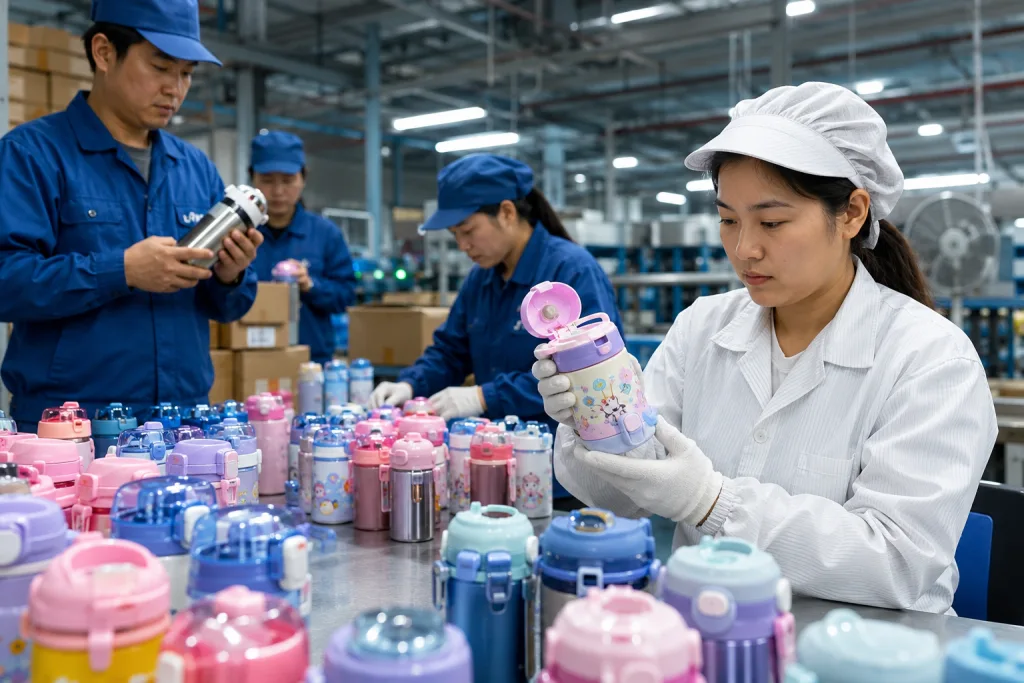
At BottleForge Industrial in Zhejiang, China, typical children bottle programs run from 3,000 pcs per model for standard customization, with monthly output above 400,000 units across drinkware lines. On the factory floor, that means separate packing schedules, lid assembly checks, and leak-test batches moving on time instead of piling up before booking. That number matters because a children water bottle manufacturer with real capacity is less likely to miss back-to-school shipping windows; 12 days vs 18 days can decide whether goods land before the school term.
A good factory does not start by asking what logo file you have. It starts by asking how the bottle will be used and what failure you cannot afford.
Which material fits the job?
If you are buying children water bottle bulk, material choice sets your unit cost, complaint rate, and freight weight. We see this on the line every week. There is no perfect option, only the option that fits the use, target price, and abuse level from kids aged 4 to 10.
PP and PE entry-level bottles
PP and PE are the budget picks for school events, sports days, and giveaway orders where MOQ starts at 5,000 pcs. FOB China pricing can start around USD 1.20-1.70 for basic 400-500 ml bottles at 5,000 pcs. They ship light, they mold fast, and the math works for mass distribution. The trade-off is simple: surface scratches show up sooner, hinge life is shorter on low-cost lids, and the bottle feels like a promo item, not a retail item. We have had buyers flag whitening marks near the cap thread after drop tests from 1.2 m. If your goal is a bulk kids bottle giveaway under a tight budget, PP is still practical.
Tritan bottles
Tritan is common for custom kids water bottle programs because the bottle body stays clearer after daily use, and the finish looks cleaner on shelf. A 450-500 ml Tritan bottle with flip straw lid and one-color print often lands around USD 1.80-2.80 FOB depending on lid complexity. For children water bottle customizable programs, Tritan gives you tighter color control on lids and better print presentation on the body. QC pulled the sample last month on a 480 ml item because the straw seat was leaking after 500 open-close cycles, so lid structure still matters more than resin buzzwords. Buyers often ask only about bottle body material; this is the wrong question to ask if the lid has 6 assembled parts.
Stainless steel
For premium school, outdoor, or retail use, 18/8 stainless is usually the safest long-term choice. Single-wall is cheaper and lighter. Double-wall vacuum keeps drinks cool longer but raises cost and carton weight. A 500 ml vacuum custom school water bottle often runs USD 2.80-4.90 FOB at normal volumes. Inner wall thickness is commonly 0.30-0.35 mm and outer wall 0.40-0.45 mm. We check wall thickness with an ultrasonic gauge, because 0.03 mm off spec shows up fast in dent rate and weight. Stainless sells well, but we have seen this go sideways when a buyer wants premium feel and still pushes for the lightest possible bottle.
What you should watch:
- Odor retention in low-grade plastics, especially after 48-hour sealed storage tests
- Impact resistance around handle and hinge areas, where QC usually finds the first crack
- Weight for younger children; a 500 ml vacuum bottle can feel too heavy once filled
- Whether replacement straws or spouts are available after the first PO ships
If a children water bottle supplier cannot explain why one resin or steel grade is better for your program, keep looking. Serious children water bottle manufacturers answer with drop-test height, wall thickness, and complaint data, not sales talk. We ship samples with that data for a reason.
How safe is safe enough?
This is where new importers burn 2 to 3 weeks. “Food safe” is not a purchasing standard; it is a loose sales phrase. You need document control, batch traceability, and a test plan that fits your market. For Europe, ask about REACH and LFGB alignment where applicable. For North America, ask for FDA material declarations and any relevant CPSIA or California Proposition 65 screening based on parts, coatings, and inks. If the bottle is sold for children, treat straws, print layers, and accessory parts as risk points. We’ve seen QC pull a sample and find the silicone straw spec on the PO did not match the approved BOM.
A children water bottle factory should be able to provide:
- Raw material declarations for bottle body, lid, straw, gasket, and paint
- Migration or food-contact test reports from recognized labs
- Colorant and ink information for logos and patterns
- Factory audit status such as BSCI, ISO 9001, or equivalent process control
- AQL standard for final inspection, commonly AQL 2.5 for major defects
Ask one more thing: how the factory controls small-part risk. This is the right question, and buyers skip it too often. If the bite valve, cap lock, or decorative charm can detach, you need the internal retention standard, test method, and pull-force record in N. On our line, QC checks cap-lock retention with a force gauge before mass production. School district buyers usually care less about novelty add-ons and more about easy cleaning, secure closure, and low breakage. That priority makes sense.
For a children water bottle customized project, insist on pre-production sample approval after artwork is applied. Paper proofs do not tell you enough. Some inks pass visual review, then fail dishwasher simulation, scratch testing, or tape adhesion on the printed area. We run cross-hatch tape checks on decorated samples, and the buyer has flagged logo fading after 12 wash cycles more than once. A solid checkpoint is a 24-hour leak test, 10-20 cycle open-close hinge test in sampling, and drop testing from 0.8-1.0 meter depending on model. Not every children water bottle vendor in China includes that by default, so put it in writing.
What customization actually works?
Most buyers ask for custom logo kids bottle options too early. That is the wrong question to ask. First decide which decoration method will still look acceptable after daily drops, backpack rub, and dish rack contact. A big front print can look clean on the quotation sheet, but if QC pulled the sample after a 50-cycle scratch test and the ink was already scuffed, the math does not work.
For custom children water bottle programs, the usual options are silk screen, heat transfer, digital UV print, laser marking on stainless, and molded logos on lids or sleeves. Each fits a different job, and we run them differently on the line:
- Silk screen: lowest cost, best for 1-2 spot colors, usually USD 0.05-0.12 per color per position; good for simple school logos, but fine outlines under 0.3 mm often fill in
- Heat transfer: works for full-wrap graphics; ask for adhesion and scratch test results, because we have seen large wrap designs chip at the bottle shoulder radius
- UV print: sharp detail for retail designs, usually higher cost and slower output; looks good on photos, but buyers often push back after seeing the lower pcs/day output
- Laser: durable on coated stainless, but only for metal surfaces; on 304 stainless bodies, the mark holds up well because there is no ink layer to scratch off
- Molded parts: higher tooling cost, best for long-run children water bottle custom programs; MOQ matters here, and below 3000 pcs the tooling charge usually feels heavy
If you need children water bottle customized for schools, keep the design simple. That is what ships cleanest. School mascots, district seals, color-coded grades, and student name windows usually do more work than oversized graphics stretched across a curved body. We have had buyers flag a mascot that looked centered on the flat artwork but wrapped into the handle zone on the sample. For retail importers, character-style artwork is common, but confirm licensing responsibility clearly. A factory in Zhejiang should not be expected to verify your IP rights for you.
For custom made kids bottle orders, ask for Pantone matching tolerance and print position tolerance. Put it on the PO. Reasonable production tolerance may be plus or minus 1.5-2.0 mm on manual print placement. If the logo crosses a curved surface or handle area, expect more variation. We have even seen a PO typo switch the logo height by 2 mm and start an argument no one needed. Good children water bottle suppliers will tell you your artwork is unrealistic before mass production. After we ship, that conversation is too late.
How do MOQ and pricing move?
MOQ is tied to setup cost on the line, not guesswork. We usually check 4 things first: mold status, resin color batching, decoration setup, and carton pack-out. For a stock custom kids bottle with one-color print, 1,000 pcs is common if the mold is already running and the lid color is a standard one on hand. We run that type of order with less waste. For a fully custom school water bottle with new mold parts, mixed silicone colors, and gift box packaging, MOQ usually moves to 3,000-5,000 pcs or higher because the math has to cover tooling adjustment, color change loss, and slower packing speed. One small factory-floor detail: a lid color change on PP or silicone can burn 15-25 kg of material before the shade is stable.
Typical FOB China price logic looks like this:
- Basic PP bottle, 400-500 ml: USD 1.20-1.70 at 5,000 pcs
- Tritan flip-straw bottle, 450-550 ml: USD 1.80-2.80 at 3,000-5,000 pcs
- Single-wall stainless bottle: USD 2.10-3.20 at 3,000 pcs
- Double-wall vacuum kids bottle: USD 2.80-4.90 at 3,000 pcs
- Color box packaging: add roughly USD 0.22-0.55 depending on structure
What changes the quote fastest?
- New mold or lid modification; even a hinge pin change by 0.3 mm can push sample cost and timing
- Number of print colors and positions; two-side pad print runs slower than one front logo, and the buyer often flags registration
- Special coatings, soft-touch paint, or powder coating; these add process steps and more QC checks for rub marks
- Individually packed accessories like extra straws or cleaning brushes; hand packing time goes up fast at 3,000 pcs
- Retail barcode stickers, FNSKU labels, or multilingual inserts; we have seen one PO typo on an FNSKU label hold shipment for 2 days
If you are dealing with children water bottle wholesalers or children water bottle distributors, ask whether the quote is for ex-stock mixed inventory or factory-fresh production. This is the right question. We have seen buyers compare a warehouse-picked bottle against a fresh production quote and think the factory is expensive. The unit price may look higher from a direct children water bottle manufacturer, but spec control is tighter because the line runs to your approved sample, packaging method, and carton marks. QC pulled the sample on one program last year because the straw hardness missed target by a small margin, and that kind of control matters more than saving USD 0.08 on the first order.
What should production control look like?
A dependable children water bottle vendor should show the control sheet, not give you nice words. For Europe and North America orders, the factories that ship steadily usually run the same sequence: approved sample, incoming material check, in-line inspection, leak test, final AQL inspection, and carton verification. On our side, QC pulled the sample at the line start and checks it against the signed master sample before mass production starts.
Ask for the exact checkpoints. This is the right question. A practical checklist looks like this:
- Before production: approved golden sample, Pantone references, packaging layout approval, carton mark confirmation
- During production: lid fit check, print adhesion check, vacuum test for insulated models, random drop test
- Before packing: 100% leak test, visual check for scratches, barcode scan verification if required
- Final inspection: AQL 2.5 major, 4.0 minor, quantity and assortment confirmation
Lead time matters here. Sample lead time is usually 7-12 days for existing models with artwork. Bulk production is commonly 30-45 days after deposit and final approval. From July to October, we have seen Zhejiang factories slip past 50 days on back-to-school and Christmas programs because printing capacity and assembly slots get tight fast. Build in a 10-15 day buffer if the ship date is fixed; otherwise, the math doesn't work. One common hold-up is simple: the buyer flagged a carton mark typo on the PO, and 3,000 boxes had to wait for correction before we could pack.
For school district tenders, ask whether the children water bottle supplier can support split shipments, mixed-color packing plans, or pallet label formats required by your warehouse. For online importers, carton dimensions, net weight, and master carton drop resistance drive claims and freight cost, so do not leave them to the last week. We have seen this go sideways when a buyer approved the bottle but missed a 2 kg carton weight limit from the warehouse, and the shipment had to be repacked.
Who is the right supplier type?
Not every buyer should source the same way. If you need 800 units in 7 days for a local school event, a children water bottle distributor or children water bottle wholesalers with domestic stock is often the better fit. Piece price runs higher, but you skip a 15 to 25 day production slot. If your program is 5,000 to 50,000 units with repeat POs every quarter, a direct children water bottle manufacturer or children water bottle factory in China is usually the better math. On our line, 304 stainless models at 5,000 pcs spread tooling, print setup, and carton cost a lot better than 800 pcs ever will.
The right supplier profile depends on your priorities:
- School districts: want safety paperwork, simple specs, durable lids, and on-time delivery; we often get asked for FDA or LFGB files and drop-test results from 1.2 m
- Importers: care about margin, repeatability, packaging flexibility, and freight planning; carton size in mm and container loading count usually matter on day one
- Promotional buyers: care about fast logo application and low landed cost; the buyer usually flags logo turnaround first, not bottle weight
- Retail brands: care about differentiation, tooling, and consistent finish quality; QC pulled the sample more than once for color shift between cap and body
When comparing children water bottle vendors, ask blunt questions. How many units per month can you produce on this model? What is your normal MOQ by model and by color? What percentage of orders ship on time in peak season, August through November? This is the right question set. We have seen polished brochures hide a 3,000 pcs MOQ, one slow screen-print station, or a PO typo that moved the lid spec from 55 mm to 53 mm.
A practical sourcing path is to shortlist one direct children water bottle manufacturer in Zhejiang, China and one backup children water bottle supplier with compatible tooling or similar stock designs. That gives you options on lead time without requalifying a different bottle every season. We have seen this go sideways when the backup supplier uses a different neck finish and the old straw lid no longer fits. If you want fewer surprises, buy from a factory that will push back on risky artwork, a 12 day deadline for a new mold, or weak export cartons below 5-ply. That is usually the supplier you keep for the second order.
Get a practical kids bottle quote fast
Send your target quantity, age group, material preference, logo file, and ship date. We will recommend the right spec, MOQ, testing path, and FOB China pricing.
Frequently asked questions
What is a normal MOQ for a custom kids water bottle order?
For existing models, a custom kids water bottle order usually starts at 1,000 pcs for simple logo printing, especially if you accept standard lid and body colors. For more typical factory production, MOQ is often 3,000 pcs per model or colorway. If you need a new lid mold, special silicone colors, or retail gift packaging, expect 5,000 pcs or higher. Some children water bottle manufacturers in China can allow mixed colors within one order, but they still need minimum quantities per color, often 500-1,000 pcs. If your volume is below that, a domestic children water bottle distributor may be more practical, even with a higher unit price.
Which material is best for school-age children bottles?
For most school programs, Tritan is the best balance of cost, durability, and appearance. It is lighter than stainless steel and usually more robust in daily use than very basic PP bottles. A 450-500 ml Tritan bottle with a simple straw or spout lid works well for ages 5-12. If you need a lower budget bulk school water bottle, PP is acceptable for events and short-cycle programs. If you want a premium bottle for resale or long-term use, 18/8 stainless steel is stronger and gives better temperature retention, but it costs more and adds weight. The right choice depends on whether your priority is price, lifespan, or premium feel.
What compliance documents should a children water bottle supplier provide?
At minimum, ask for material declarations for the body, lid, straw, gasket, and decoration layers. For Europe, request REACH-related information and LFGB-aligned food-contact reports where relevant. For North America, ask for FDA food-contact declarations and screening for coatings or inks if needed. If the bottle is sold as a children's product, also review whether CPSIA-related issues apply to accessible parts, paints, and packaging components. A capable children water bottle factory should also share its inspection standard, such as AQL 2.5 for major defects, plus audit status like BSCI or ISO 9001. Do not rely on a generic statement saying the product is 'food safe' without supporting reports.
How long does bulk production usually take from China?
For standard models from a children water bottle manufacturer in Zhejiang or other parts of China, sample time is usually 7-12 days after artwork and spec confirmation. Bulk production typically takes 30-45 days after deposit, sample approval, and packaging sign-off. If you order in peak season, especially from July to October, lead times can extend to 45-55 days. Ocean freight then adds several weeks depending on destination. If you have a hard launch date, build in at least 10-15 extra days for delays in artwork, carton approval, or port congestion. Buyers who wait until peak season to confirm packaging usually create their own delivery problem.
How can I reduce complaint rates on children water bottle customized orders?
Keep the spec simple and control the weak points. First, choose a lid with fewer moving parts and ask for 100% leak testing before packing. Second, use durable decoration methods instead of oversized prints on high-contact areas. Third, approve a fully decorated pre-production sample, not just a blank bottle. Fourth, define packaging clearly so bottles do not scratch in transit; individual polybags or dividers often cost less than replacing damaged stock. Finally, require a final inspection standard such as AQL 2.5 and ask for photo records before shipment. Most complaints on children water bottle wholesale orders come from leaks, print wear, odor, or transit damage, all of which can be reduced before production starts.