Key Takeaways
- A practical manufacturer canteen MOQ starts at 1,000 units for existing molds and 3,000-5,000 units for private color/logo programs
- Use 304 stainless steel at 0.45-0.55 mm wall thickness for most promotional and retail canteens
- Plan 7-10 days for sampling and 30-40 days for mass production after artwork and deposit approval
- Set AQL 2.5 for major defects and AQL 4.0 for minor defects before shipment
You are not buying one bottle. You are buying 3,000 or 30,000 units that must match within a 1 mm logo position tolerance, pass inspection, ship on the agreed vessel, and not create complaints from your sales team or canteen users. Simple on paper. Then the buyer flags the real questions: 304 or 316 stainless steel, powder coat or spray paint, silkscreen or laser logo, individual box or bulk pack, FOB Ningbo or DDP warehouse?
At BottleForge Industrial in Hangzhou, Zhejiang, we treat canteen custom projects like production engineering, not catalog shopping. China canteen manufacturers can make almost any shape, but the math does not work if the spec keeps changing after sampling. A clean order needs a locked specification, realistic MOQ, approved samples, and AQL inspection points before cartons leave Zhejiang; last month QC pulled a pre-shipment sample because the PO said “matte black” while the approved sample card read “black sand texture.”
Start with the real use case
The first mistake buyers make is asking a canteen supplier for “your best price” before saying where the bottle will be used. Wrong question. A distributor canteen for outdoor retail, a corporate onboarding gift, and a school sports bottle may look close in a photo, but the factory quote changes once we know the shelf life, user age, drop risk, and carton route. Last month QC pulled a 750 ml sample with a 0.7 mm body wall; fine for a desk gift, too soft for a hiking shop buyer who will squeeze-test it in the meeting room.
Use a real buying case: 5,000 pieces of a 750 ml stainless steel canteen for a North American outdoor brand. The bottle will be sold through regional distributors, not handed out once at a trade show. So the finish has to survive carton rubbing, the logo needs clean edges after 3M tape testing, and the color box must look ready for retail display. If you were buying a canteen promotional item for a one-week campaign, we would cut the retail box, use a simpler cap, and save USD 0.25-0.45 per unit. We have seen this go sideways when a buyer approved bulk packing, then the distributor asked for shelf packaging 12 days before shipment.
Write the intended channel on the RFQ. “Distributor drinkware for retail sale” makes the line quote a different product than “event giveaway.” For this 5,000-unit order, a sensible base spec is 304 stainless steel; single-wall for light carry or vacuum insulated if cold retention matters; food-grade PP cap with a silicone sealing ring; powder coating in one Pantone-matched color. The Pantone code matters. We once received a PO with “dark green” only, and the buyer flagged the first spray panel because our sample looked closer to 5605C than 5535C. If you need a custom growler or customizable growler later, keep the same coating and logo standard so the drinkware line looks like one family.
For Europe and North America, ask early about LFGB, FDA food-contact compliance, REACH for coatings, and CPSIA only if children are the target users. A good canteen manufacturer will not guess your market requirements. Put them in the quotation stage. Testing after production is the expensive way to find a problem, especially after 83 cartons are sealed and the inspector has already checked AQL 2.5 on the packed goods.
Lock the specification before pricing
Two canteens can look the same in a PDF and still differ by USD 1.20 in factory cost. We see it on the line: the caliper reads 0.42 mm instead of 0.50 mm, or QC pulls the carton and finds a 3-ply box where the buyer asked for 5-ply. The gap usually sits in metal thickness, cap structure, coating method, carton packing, or inspection level. Send the same specification sheet to each canteen manufacturer in China, or the price comparison is not clean.
For the 750 ml customized canteen order, we would build the RFQ around these points:
- Body: 304 stainless steel, 0.45-0.55 mm wall thickness for single-wall; 0.40-0.50 mm inner and outer walls for vacuum insulated models.
- Capacity tolerance: 750 ml nominal, with actual fill volume checked on the sample using a measuring cylinder, not guessed from the CAD drawing.
- Finish: matte powder coat, Pantone reference, 2H pencil hardness target, cross-hatch adhesion test after curing.
- Lid: screw cap with PP or stainless outer, silicone gasket, leak test at 45 degrees and inverted position.
- Logo: one-position laser engraving or one-color silkscreen, artwork in AI or PDF vector format.
- Packing: one unit per white box or printed retail box, 24 pieces per export carton, 5-ply K=A carton for sea freight.
A canteen customizable program can cover private molds, special handles, carabiner loops, color-matched lids, or retail sleeves. Good options. But if the buyer asks for all of them on a 1,000-piece trial order, the math doesn't work. Existing mold canteen custom orders often start at 1,000 units per color. New mold work is usually 3,000-5,000 units for a first run, plus tooling fees from about USD 800 to USD 3,500 depending on complexity; our mold room normally needs 12-18 days after the 2D drawing is signed.
Be careful with ultra-low quotes from a canteen vendor that skips wall thickness or packing details. We have seen this go sideways: the buyer flagged rust spots after salt-spray testing, then QC pulled the sample and found thinner steel and soft coating. You may receive weak cartons too, the kind that collapse after two weeks in an ocean container.
Price the order like a buyer
For a 5,000-piece manufacturer canteen order shipping from Zhejiang, ask for the quote in separate lines: product cost, mold or setup cost, sample charge, testing, packaging, and trade term. One bundled number is hard to audit. We see this go sideways when a buyer compares USD 5.10 against USD 5.35, then later finds the cheaper quote excluded color box and LFGB testing. On our quotation sheet, QC also checks the SKU, capacity, and Pantone code because one PO once had “750 mm” typed instead of “750 ml.”
As a working range, a 750 ml single-wall stainless custom canteen from an existing mold may land around USD 2.20-3.80 FOB Ningbo or Shanghai, based on cap type, coating, and logo method. A vacuum insulated version may be USD 4.20-7.50 FOB. A custom growler in 1.9 L or 2 L capacity can move higher, often USD 7.00-12.50 FOB, especially with a swing cap, wide-mouth tooling, or handle system. These are not fixed prices. They are guardrails for catching padded quotes or prices that will fail in production. If a supplier offers a 304 stainless vacuum bottle at USD 3.60 FOB with matte powder coating, ask for the wall thickness and net weight; the caliper and scale usually tell the truth.
For the buyer scenario, say you choose a 750 ml vacuum canteen with matte green powder coating, laser logo, and retail color box. At 5,000 units, a realistic FOB Ningbo price might be USD 5.35 per unit, with a USD 120 pre-production sample charge refunded after mass order. If you add a printed instruction insert and barcode label, budget another USD 0.05-0.12 per unit. Small labels cause big delays. If your distributor growler or canteen line needs Amazon routing, FNSKU labels and carton labels must be confirmed before packing, not after the cartons are sealed. Last month QC pulled the sample carton because the outer box showed 24 pcs/ctn while the packing list said 20 pcs/ctn.
Payment terms for new buyers are commonly 30% deposit and 70% before shipment after inspection. Established accounts can negotiate different terms, but most canteen manufacturers in China will not buy steel, coating powder, caps, and cartons for a private color order without deposit coverage. The math doesn't work. For a 5,000-unit matte color run, we usually place coating powder and carton orders 12-18 days before assembly, and the line will not hold an open slot on a promise.
Approve samples without shortcuts
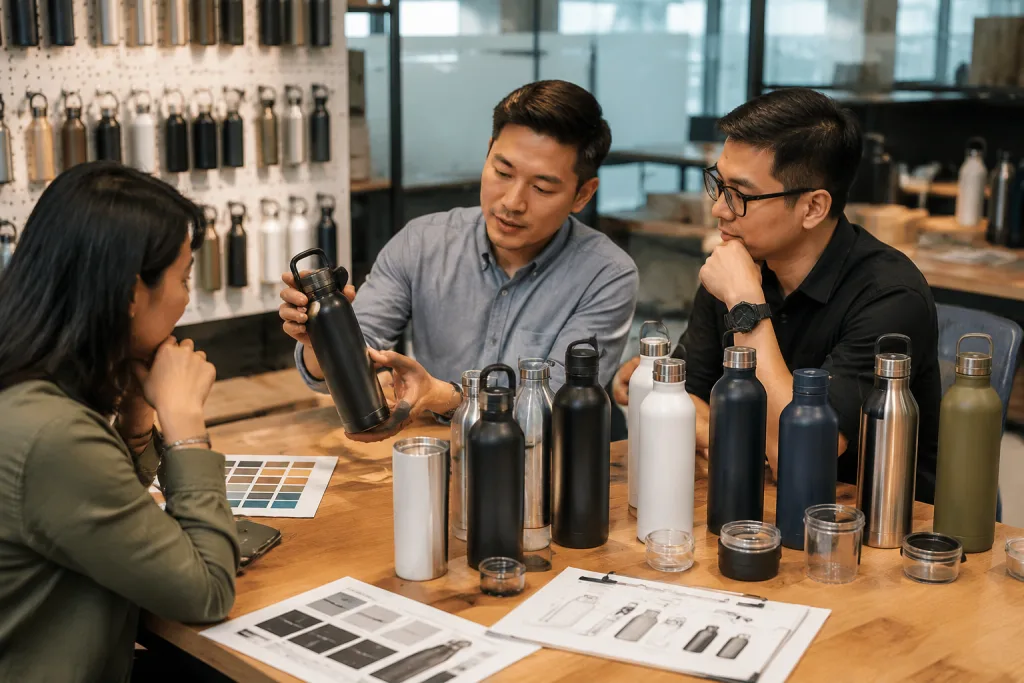
Sampling is where custom drinkware orders get rescued, or they get expensive. A photo approval is not enough for a canteen with matched color, logo, and retail box. We ask for at least one physical sample in your hand. For a distributor canteen program, we run two: one on your desk and one in our sample cabinet as the signed control sample, with the PO number written on masking tape. Skip this and the math does not work.
For BottleForge Industrial, standard sample lead time is 7-10 days for existing mold and basic logo work. New mold or special lid development can take 20-35 days before a reliable sample exists. Our Hangzhou, Zhejiang team checks color chips, logo placement drawings, and packaging dielines before metal sampling starts. Last month QC pulled a 750 ml body and found the logo area had a 6 mm curve across the print zone, which would have made a straight silkscreen logo look bent.
When you receive the sample, check it like a QC inspector, not like a marketing manager. Measure filled capacity with water in a measuring jug. Weigh the unit on a 0.1 g scale and compare it to the quoted gram weight. Inspect the seam, bottom welding, lid thread, gasket fit, coating thickness, and logo sharpness with a caliper and your fingernail. Fill it with water at room temperature, tighten the cap, invert it for 30 minutes, then shake it over white paper. Simple test. If it leaks in your office, it will leak in your customer’s backpack.
For laser logos, confirm depth and contrast under normal retail lighting, not under a phone flashlight. For silkscreen, rub the print with a damp cloth and then with 3M tape if you have it. A customizable drinkware sample should also include the final packaging structure. We have seen a good bottle fail because the E-flute box crushed at 12 kg stacking pressure, and the buyer flagged corner dents before opening the carton. A beautiful bottle in a weak box is still a bad shipment.
Do not approve mass production from a 3D rendering. Approve from a real sample, signed specification, and final artwork file.
Control production at the factory
After the deposit lands and the pre-production sample is signed, we run the order from a written production file, not from chat screenshots. For a 5,000-unit canteen order, BottleForge usually needs 30-40 days after approval, based on coating line space and the packaging print queue. Our partner lines can handle about 300,000 stainless drinkware units per month across bottles, tumblers, and growlers, but that number does not reserve your slot on line 3. Confirm the schedule before your purchase order is placed. We have seen a PO arrive with the delivery date typed as 6/18 instead of 8/18, and the math did not work.
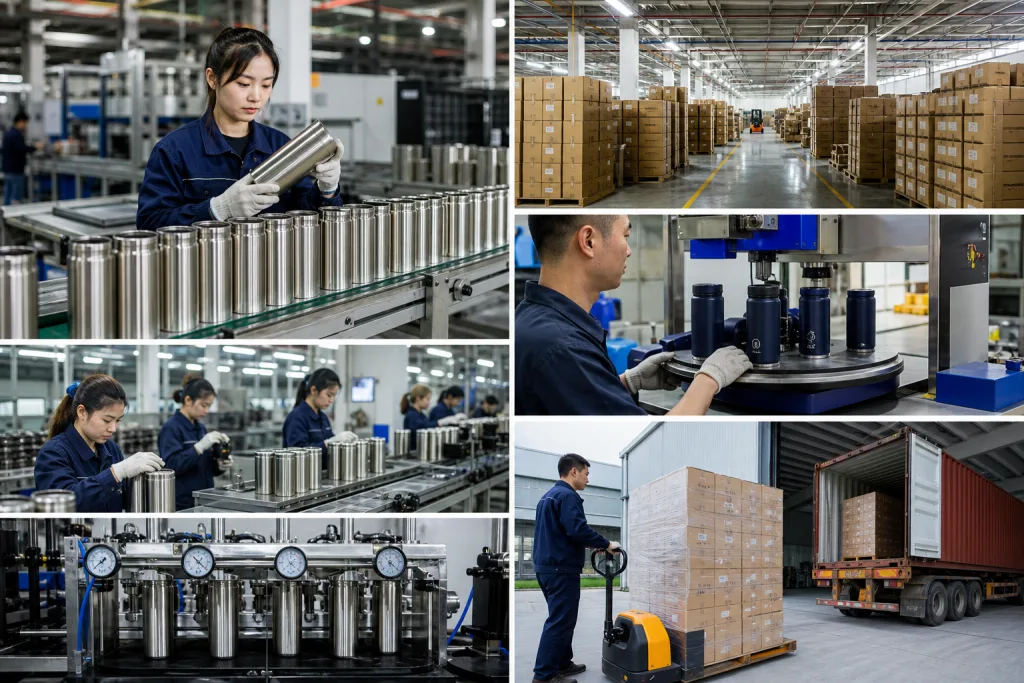
The production flow for a stainless manufacturer canteen usually starts with tube cutting and forming, then moves through welding, polishing, cleaning, vacuum processing if insulated, coating, curing, logo application, lid assembly, leak testing, packing, and carton sealing. Small misses matter. QC pulled one sample where a 0.4 mm weld shadow only showed after matte black powder coating. Powder coating may vary between batches. Silicone gaskets can be missed during assembly. Retail boxes can be printed with an old barcode.
Your purchase order should name the golden sample reference, Pantone code, artwork revision number, packing method, carton mark, inspection standard, and acceptable tolerances. Be specific. “Same as sample” is the wrong question to ask when a buyer later flags a 2 mm logo shift. If you are buying for canteen distributors in several markets, include separate carton labels by destination. Mixing Canadian bilingual packaging with U.S. packaging creates an expensive warehouse problem, and we have seen pallets held for relabeling at USD 0.18 per box.
A mid-production inspection makes sense for orders above 10,000 units or for a first-time canteen vendor. It checks whether the factory is building the approved product while there is still time to correct issues. The inspector can open 80 cartons, check coating thickness with a gauge, run a leak test, and compare the logo against the signed sample. For smaller 1,000-3,000 unit orders from a proven canteen supplier, a final random inspection may be enough.
Inspect with numbers, not opinions
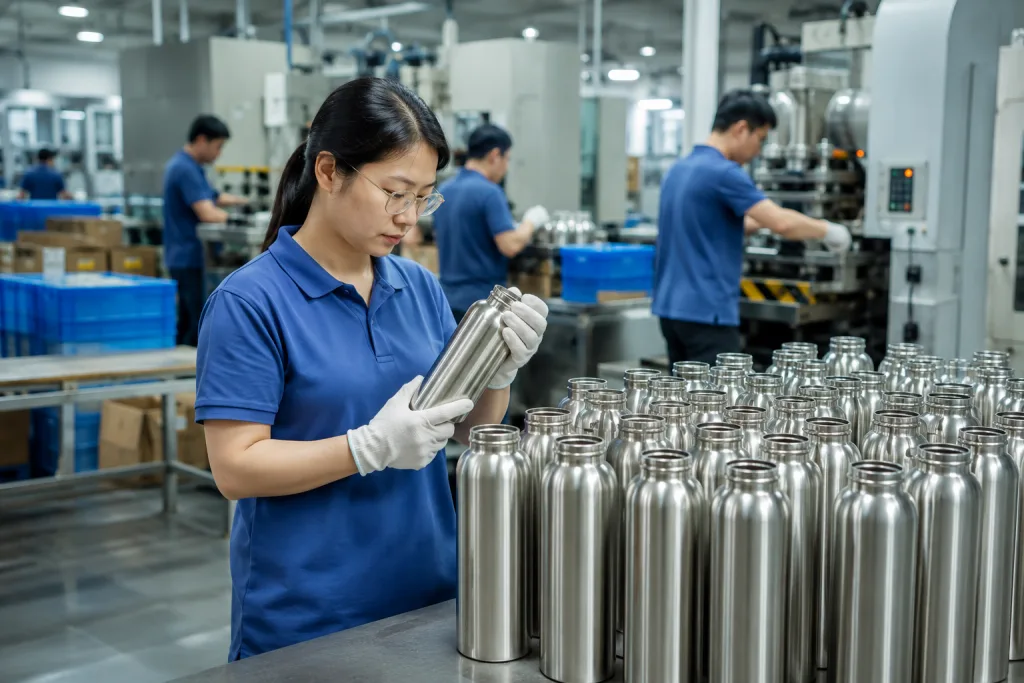
A final inspection should not be a beauty contest. Set the AQL and defect definitions before the inspector cuts the carton tape. For most customized drinkware orders, we run AQL 0 for critical defects, AQL 2.5 for major defects, and AQL 4.0 for minor defects. Critical defects mean unsafe sharp edges, black contamination inside the bottle, broken glass if applicable, or material that does not match the approved food-contact specification. Major defects mean leakage, wrong logo position by more than 2 mm, weak coating adhesion, heavy dents, incorrect packaging, or failed vacuum performance. Minor defects cover small cosmetic marks inside the signed limit sample range. We have seen this go sideways when a buyer calls a 0.8 mm speck “unacceptable” after QC pulled the sample; that argument should be settled on the defect sheet, not at 6 p.m. before loading.
For a 5,000-piece lot under ANSI/ASQ Z1.4 general inspection level II, the inspector may check 200 units depending on the sampling plan. The exact accept/reject number depends on the selected AQL table, but the point is consistency. No guessing. You should not argue case by case after defects are found. Define the standard before shipment, including photos of OK and NG samples, carton weight tolerance such as ±0.5 kg, and the approved logo file name. Last summer one PO had “matte balck” typed in the color line; the buyer flagged it only after the line had packed 37 cartons.
Useful tests for a canteen factory inspection include:
- Capacity check on selected samples using water and a measuring jug, with the reading written down in ml instead of “looks full.”
- Leak test, inverted and side-position, for at least 30 minutes; we place tissue under the cap so one slow drip cannot hide.
- Vacuum retention test for insulated canteens, often 95°C water measured after 6 hours or 12 hours depending on your claim, using the same probe thermometer for all samples.
- Coating adhesion cross-hatch test on spare samples or approved sacrificial units, then tape pull and photo record before the inspector leaves.
- Barcode scan test for retail and distributor drinkware programs, checked on phone scanner and warehouse scanner if the buyer provides the code format.
- Carton drop test if the order uses individual retail boxes, with corner, edge, and face drops recorded against the packed carton weight.
For European buyers, keep test reports and material declarations with the shipment file. For North American buyers, match the canteen manufacturer documentation to your retailer or distributor compliance checklist. Paperwork will not fix a leaking cap. Missing paperwork can still block sales, even when the bottles are clean, packed, and sitting in the forwarder’s warehouse. We ship plenty of repeat orders where the product passes, then one missing LFGB declaration or unsigned material sheet holds the release for 3 days.
Ship cleanly and protect reorders
Once inspection passes, shipping is the next place orders get hurt. For 5,000 units of 750 ml stainless canteens, sea freight is the normal move unless a launch date is already on fire. Air can cost more than the canteen itself. We usually run FOB Ningbo for Zhejiang production; the truck from our Hangzhou area packing site to Ningbo port is about 2.5 to 3.5 hours on a normal day, while Shanghai still works if your forwarder has better vessel space there. QC pulled the final cartons last month and found one pallet label with the old PO number, so we fixed it before the container arrived. Small miss. Big delay if it reaches the port.
Before balance payment, confirm the commercial invoice, packing list, HS code, carton count, gross weight, net weight, carton dimensions, and shipping marks. Match them line by line against the PO. For a typical 750 ml canteen, we may pack 24 pcs per carton, then your forwarder will ask why the carton says 23.8 kg while the packing list says 22.6 kg. If you need DDP delivery, request a separate logistics quote and lock down duties, VAT, customs bond responsibility, and delivery appointment fees. We have seen this go sideways: one buyer pushed hard on a USD 0.18 unit price saving, then paid more than USD 1,200 in unplanned destination charges. The math does not work.
For reorders, keep the production file alive. Save the approved sample, Pantone code, coating batch reference if the paint shop gives one, logo file, carton artwork, inspection report, and complaint notes. Put a dated sample in a box, not just a photo in WeChat. Six months later, the wrong question is “can you make something similar?” The right target is the same customizable canteen program, with the same lid fit, same logo position measured in mm, and a cost range that does not surprise your sales team. We keep golden samples on the shelf; when the line restarts, QC checks the first 20 pcs against that sample before mass packing.
At BottleForge Industrial in China, we push buyers to standardize parts across the line where it makes sense. Use the same lid thread on a custom canteen and customized growler, or pair the same silicone gasket with a sports bottle if the seal test passes. It is not a fancy topic. It saves reorders. One distributor buyer flagged this after receiving mixed spare lids in 3 cartons, and since then we mark lid bins with thread size and project code before assembly starts. Distributors care about fewer complaints, stable cartons, and stock that lands on the promised week.
Send your canteen spec for a factory quote
Share capacity, quantity, logo method, market, and packaging. We will return a practical Zhejiang production quote with MOQ, lead time, and QC notes.
Frequently asked questions
What MOQ should I expect for a manufacturer canteen order?
For an existing mold, a realistic MOQ is 1,000 units per color for basic logo customization. If you need a private Pantone coating, custom cap color, retail box, or special accessory set, 3,000 units is more practical. New mold canteen customized projects usually start at 3,000-5,000 units because tooling setup, sample trials, and production loss must be spread across enough pieces. Some canteen vendors will quote 300-500 units, but the unit price is usually high and color consistency may be harder to control.
Is 304 stainless steel enough, or do I need 316?
For most custom drinkware and manufacturer canteen orders, 304 stainless steel is the correct commercial choice. It is food-safe, widely available, and cost-effective. Use 316 stainless steel only when you have a clear reason, such as higher corrosion resistance for salty environments or a premium product claim. Expect 316 to add roughly 8-15% to the metal-related cost, depending on market pricing. For general water, coffee, tea, and promotional use, spend your budget on better coating, lid sealing, and QC instead of upgrading steel unnecessarily.
Which logo method is better for a customized canteen?
Laser engraving is durable, clean, and good for outdoor or distributor drinkware programs where the product will be used for months or years. It works best on powder coating or stainless surfaces and usually adds USD 0.10-0.35 per unit depending on logo size. Silkscreen is better for bright colors, large artwork, or canteen promotional orders, but it needs adhesion testing and careful curing. For multi-color branding, heat transfer or UV printing may work, but approve real samples because curved bottle bodies can distort artwork.
How long does a custom canteen order take from China?
For an existing mold custom canteen, plan 7-10 days for sample preparation after artwork approval, then 30-40 days for mass production after sample approval and deposit. Add ocean freight time based on destination: roughly 18-30 days to many North American west coast routes and 30-40 days to many European ports, plus customs and inland delivery. New mold work can add 20-35 days before the production sample is ready. If your launch date is fixed, build the schedule backward and include at least 10 days of buffer.
What should I check before paying the balance?
Before balance payment, ask for the final inspection report, production photos, carton marks, packing list, and confirmation that the approved sample was used as reference. For a 5,000-unit order, inspection should include leak testing, logo placement, coating defects, capacity checks, packaging accuracy, barcode scans, and carton condition. Use AQL 2.5 for major defects and AQL 4.0 for minor defects unless your retailer requires another standard. Also confirm FOB port, vessel schedule, gross weight, carton dimensions, and whether any testing documents are still pending.