Key Takeaways
- Typical MOQ for a borosilicate glass bottle custom order is 3,000-5,000 units, while stocked shapes can start at 1,000 units
- Reasonable lead time is 7-10 days for samples and 30-45 days for bulk production after deposit and artwork approval
- For most 500-550ml bottles, FOB China pricing often lands around USD 1.20-2.80 depending on sleeve, lid, print, and packaging
- Set inspection terms at AQL 2.5 major / 4.0 minor and define leak, logo adhesion, and carton drop standards before production
You do not need a pitch about why glass feels premium. You need to know if a manufacturer borosilicate glass bottle program will hold up in retail, pass compliance, and still leave margin after freight. That is where first orders break down. We have seen a clean pre-production sample turn into a leaking lid at 0.3 bar, a logo that failed after 50 rubs on the tape test, or a master carton that split in a 76 cm drop test.
For wellness brands and sustainable retailers buying from Zhejiang and across China, ask better questions before tooling, before artwork sign-off, and before deposit. A solid borosilicate glass bottle factory should reply with numbers, not showroom talk. Ask for wall thickness in mm, MOQ by lid type, AQL 2.5 or not, and lead time by decoration method—screen print is not the same schedule as decal firing. If a supplier cannot answer that on one spec sheet, the buyer flagged the wrong stage to rush, and you are not ready to place the PO.
What are you really buying?
When you source a custom glass water bottle, you are buying the full build, not just the bottle body. The quote covers glass tube grade, forming consistency on the line, lid torque fit, print adhesion, and how the cartons are packed for shipment. That is why two offers for a similar-looking bottle can differ by 25% to 40%. We have seen one sample look fine on the table, then QC pulled the sample again after a 1.2m drop check and found chipped rims from weak inner packing.
A proper borosilicate glass bottle manufacturer should first split the project into parts and price them one by one. This is the right question to ask.
- Body material: high borosilicate, usually with better thermal shock resistance than standard soda-lime glass
- Wall thickness: commonly 1.8mm to 2.5mm for mainstream retail bottles
- Capacity tolerance: usually within about plus or minus 3%
- Lid system: bamboo, PP, stainless steel, or hybrid lids with silicone seal
- Decoration: silkscreen, heat transfer, decal, sleeve, laser on coated parts
- Pack-out: egg-crate, dividers, mailer box, color box, PDQ, or e-commerce packaging
If a supplier gives you one photo and one unit price, that is guessing. We ship bottles every week, and the hand feel changes fast with small spec shifts: a 55mm mouth drinks differently from a 65mm mouth, and a 420g bottle feels more premium than a 360g one on the shelf. For wellness brands, surface clarity also matters; buyers have flagged faint flow marks near the shoulder even when the bottle passed function checks. Buyers asking for borosilicate glass bottle wholesale or bulk glass water bottle volumes often push cost too early and miss the bigger risk. Breakage rate and complaint rate after delivery decide whether the math works.
In Zhejiang, experienced factories usually keep 6 to 12 standard molds running to hold down startup cost. That matters if you want a borosilicate glass bottle customizable project without opening a full custom body mold. In practice, taking an existing bottle shape and changing the lid, logo, sleeve, and pack-out can cut development time by 15 to 20 days and avoid USD 800 to 2,500 in new mold cost. We have seen this go sideways when a buyer changed only the artwork but missed the lid thread spec on the PO, and the first pre-production sample leaked at the silicone seal test.
Which questions expose a weak supplier?
If you are comparing a borosilicate glass bottle supplier, ask questions that force shop-floor answers, not sales talk. If the reply comes back with “good quality” and no numbers, the line is probably thin. A solid supplier will answer with tolerances, test steps, and lead time by process. We ask for wall thickness in mm, lid torque range, and packing spec on day one. That is the right question to ask.
Ask these early
- What is the glass wall thickness on the exact SKU: 1.8mm, 2.0mm, or 2.2mm?
- Is the bottle hand-blown, semi-automatic, or machine-made?
- What is the standard leak test method for the lid and seal?
- What are the decoration adhesion standards after 3M tape test or dishwasher simulation?
- What is the MOQ by version: plain stock, logo-only, and fully customized glass water bottle?
- What is the normal breakage allowance in transit and how is master carton drop resistance validated?
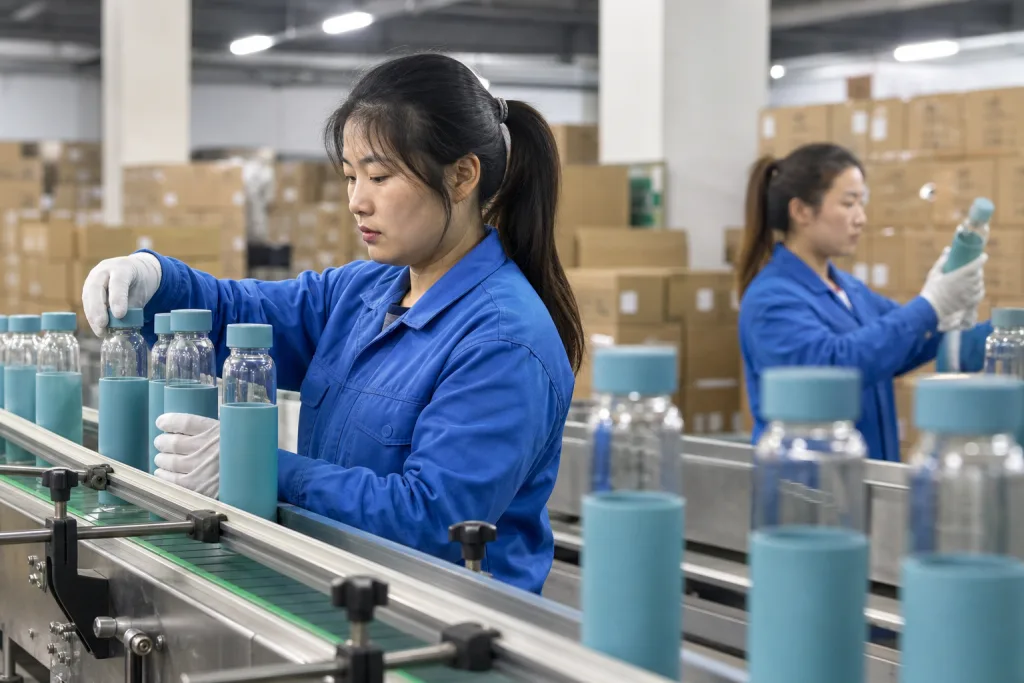
A reliable borosilicate glass bottle vendor or borosilicate glass bottle factory will also tell you where the yield drops. That saves weeks. We have seen buyers push for 0.3 mm metallic lines on curved glass, then flag broken edges in the print after the first run. Fine metallic lines on radius surfaces usually give lower print yield. Bamboo lids also vary lot to lot in grain and tone, even after sanding on the belt machine. Silicone sleeves can shift about 0.5 to 1 Pantone shade in mass production. If a factory acts like none of this happens, we have seen this go sideways.
You want a factory in China that tells you the risk before sampling, not after mass production.
For distributor programs, ask if the supplier already runs barcode labeling, FNSKU, multilingual inserts, and retail-ready cartons. QC pulled samples before where the buyer flagged one small PO typo on the French insert, and that held shipment for 3 days. A serious borosilicate glass bottle distributor or importer-facing factory should know these details without being coached. If you are working with borosilicate glass bottle distributors in Europe or North America, upstream control matters because each avoidable repack, relabel, or claim adds cost through the channel. The math does not work if the factory misses basics.
At BottleForge Industrial in Zhejiang, typical drinkware capacity is 400,000 units per month across categories, but glass programs are scheduled more carefully because decoration and protective packing often become the bottleneck, not the bottle forming itself. On glass orders, we usually block extra time for sleeve fitting, inner partition packing, and drop-test checks on 5-layer master cartons, because that stage decides whether 12 days stays 12 days or slips to 18.
How much customization is realistic?
Buyers ask for a borosilicate glass bottle custom project all the time, but they usually mean 1 of 3 jobs: logo decoration, component changes, or a new bottle body. The cost gap is real. So is the risk. On our side, the line setup for a silk-screen logo is one thing; opening a new mold drawing with a 1.8 mm wall target is a different project entirely.
Level 1: stock bottle plus logo. This is the fast lane for borosilicate glass bottle bulk orders. MOQ usually starts at 1,000 to 2,000 units, and sample time is often 5 to 7 days. We run this route for seasonal launches and borosilicate glass bottle promotional programs because the math works. A buyer flagged logo rub-off on one PO last year, so now QC pulls the sample after curing and checks adhesion before mass print.
Level 2: semi-customized. You keep the standard glass body and change the lid material, sleeve color, print position, base pad, or gift box. This is where most custom borosilicate glass bottle projects land. MOQ is usually 3,000 to 5,000 units, and tooling for a custom sleeve or insert often runs USD 100 to 400. We see common changes like a silicone sleeve hardness tweak from 50 to 60 Shore A, or moving the print 8 mm higher because the buyer wants the logo visible above a kraft box window.
Level 3: full custom body mold. This is a true customized borosilicate glass bottle or customized glass water bottle program. New mold development can take 20 to 35 days, sometimes longer if revisions keep coming. MOQ often starts at 10,000 units, and mold cost commonly ranges from USD 800 to USD 3,000 depending on shape complexity and cavity count. This is the wrong question to ask first, by the way. Ask instead what must be unique on shelf, because we have seen full-custom sketches go sideways after drop-test review or after the cap torque exposed a neck mismatch.
Be realistic about what your customer will notice first. A customizable glass water bottle does not need a new silhouette if the retail edge comes from a clean logo, a textured sleeve, and a better carton spec. We shipped one program with only a matte decal, Pantone-matched sleeve, and 2 mm EVA insert, and it looked more premium than another buyer’s new mold that arrived late and chipped at the base during inspection. Most sustainable retailers do better with lower complexity and steadier supply.
If you need a borosilicate glass bottle customized for wellness use, focus on the accessories that help sell through: tea infuser, carry loop, anti-slip sleeve, or measurement marks. Those changes usually bring more commercial value than an expensive custom mold. One buyer even had a PO typo on the mark scale from ml to mg, and we caught it before film output. Small details matter more than a fancy bottle outline.
Price, MOQ, and freight math
The honest answer on price: a glass bottle quote means nothing until the structure is locked. For a 550ml single-wall borosilicate bottle with a stainless steel lid and one-color print, we usually see USD 1.20 to USD 1.80 FOB China at 5,000 units. Add a silicone sleeve, bamboo cap insert, color box, and stricter drop-test packing, and that same bottle moves to USD 2.10 to USD 2.80 FOB. We see this on the line all the time. A 1.5mm wall and a 2.0mm wall do not price the same, and this is the wrong question to skip at quote stage.
Typical buying ranges look like this:
- Plain stock bottle: MOQ 1,000-2,000 units
- Logo print plus standard lid: MOQ 2,000-3,000 units
- Custom sleeve or gift box: MOQ 3,000-5,000 units
- New mold body: MOQ 10,000 units or higher
If you are speaking with several borosilicate glass bottle suppliers or borosilicate glass bottle vendors, compare the same build against the same trade term: FOB Ningbo or FOB Shanghai, same test requirements, same packing, same capacity, same lid. Zhejiang factories often ship through Ningbo because trucks from Hangzhou can reach port in about 3 hours, and the booking options are better for east China export. Freight is only one line on the sheet. We have seen buyers flag a cheaper offer, then find the PO showed a screw lid instead of the leakproof lid they asked for.
For a bulk borosilicate glass bottle order, packaging density drives the math. Glass is heavy. It breaks. A weak carton spec can wipe out the savings from a low unit price once QC pulled the sample and found crushed corners after a short vibration test. Ask for:
- Units per master carton
- Gross weight per carton, ideally under 18kg for easier handling
- Carton size and container loading quantity
- Inner protection method, such as paper dividers, pulp tray, or bubble bag
If a supplier quotes aggressively low, check what they left out. Common misses are sleeve cost, insert card, export carton upgrade, spare lids, or even 3% spare parts. We have seen this go sideways. A few first-time buyers of distributor glass water bottle programs learned after deposit that the low quote used a 5-ply carton, while the shipped spec needed a stronger 7-ply export carton.
Compliance and quality checkpoints
Glass drinkware looks easy until a batch fails. Then the claim hits fast. Your PO needs measurable checkpoints tied to the line, not a broad quality promise. We’ve seen one typo in a PO — “clear body” instead of “high borosilicate clear body” — turn into a full rework discussion after sample approval.
For Europe and North America, the compliance list is usually clear: REACH, LFGB for food-contact parts where applicable, and California Proposition 65 based on the sales market and the decoration materials. If the bottle is sold for children, ASTM or CPSIA may come into scope depending on the structure and the claims on pack. Retail buyers also ask about social audits. In 7 out of 10 chain-store inquiries we get, the buyer flags BSCI status for the China factory before they confirm the order.
On the production side, lock the inspection method before deposit. This is the right question to ask, not “Can you guarantee good quality?” QC pulled the sample at the annealing lehr exit on one recent run because the mouth diameter drifted 0.6mm and the lid torque went off.
- AQL: 2.5 major / 4.0 minor is common for final random inspection
- Leak test: 100% check for filled inversion or air-pressure method on assembly line
- Visual standard: define acceptable seed bubbles, scratches, black spots, and seam appearance
- Logo adhesion: tape test and rub test requirements
- Drop standard: carton drop test, usually 1 corner, 3 edges, 6 faces for outer packaging validation
A good borosilicate glass bottle manufacturer will say it straight: glass is not unbreakable. What you can control is process stability, wall thickness, and pack-out. For example, increasing wall thickness from 1.8mm to 2.2mm may improve robustness, but it also adds about 40g to 80g per bottle depending on size, and the freight math doesn’t work on every project. On our line, that change also affects cooling time and carton weight.
If you buy through a borosilicate glass bottle distributor model, ask for pre-shipment photos, inline QC records, and reserve samples from the exact lot shipped. Ask for lot code and packing date too. We ship retained samples for 60 days to 90 days on some programs because complaint tracing gets messy fast, especially when the buyer flagged “scratches” and the issue was actually scuffing from a divider change in the outer carton.
Lead times that buyers should expect
Lead time on a customizable borosilicate glass bottle project is usually driven by the parts around the bottle, not the bottle body itself. The slow points are lid sourcing, decoration slotting, gift box approval, and rework after QC pulled the sample for a print issue or a loose-fit cap. Buyers who ask only, "How fast can you ship?" often get the sales answer, not the production answer. Frankly, this is the wrong question to ask.
Better timing benchmarks we see on the line are:
- Stock sample: 2 to 5 days
- Pre-production sample with logo: 7 to 10 days
- Custom packaging sample: 7 to 12 days
- Mass production for repeat order: 25 to 35 days
- Mass production for new customized glass water bottle order: 30 to 45 days
- New mold development: add 20 to 35 days
Those numbers are standard for experienced suppliers in Zhejiang and other export areas in China. If a borosilicate glass bottle supplier offers 15-day mass production for a fully customized order with a gift box, extra components, and decoration, ask for the actual control points. We would ask how they lock sample approval, how many days the cap supplier needs, whether the silk-print line has open capacity, and when final inspection is booked at AQL 2.5. We have seen this go sideways over one PO typo on carton marks.
Ask one more practical question: what is the re-order lead time for the same SKU? That is where retail programs win or lose. First launch timing matters, but the second PO matters more. A capable borosilicate glass bottle manufacturers group should keep artwork files, carton specs, and incoming component limits on file, down to details like a 3 mm logo position tolerance, so repeat orders do not restart from zero each time. We run faster when the standards are already frozen.
Your short sourcing checklist
Before you approve any custom borosilicate glass bottle order, run this checklist line by line. Sounds basic. It saves a lot of rework. We have seen one PO miss a 2 mm wall-thickness callout, and the buyer only caught it after the production sample hit the table.
- Confirm exact capacity, finish, wall thickness, and unit weight with drawing values, not sales wording
- Confirm lid material, gasket material, and color reference; if the Pantone code is missing, the line will guess
- Approve logo size, print method, and adhesion standard after a real sample; QC pulled the sample once and found the silk print scratched off with 3 tape pulls
- Approve full packaging layout including barcode position and shipping marks; we still see outer-carton arrow marks printed on the wrong panel
- Set MOQ, unit price, mold fee if any, and spare parts policy in writing; 300 extra lids on a 3,000 pcs order should not become an argument later
- State compliance documents required: REACH, LFGB, test reports, audit records
- Define inspection standard: AQL, leak test, appearance standard, carton drop test; if you want AQL 2.5, write it on the PO
- Confirm lead time starts only after deposit and final artwork approval; 12 days vs 18 days usually comes down to artwork release, not factory speed
- Request production sample retention and pre-shipment photos; this is the wrong item to skip on a repeat order
- Confirm trade term: FOB, EXW, or DDP, plus port and payment schedule; we ship differently from Ningbo and Shanghai, and the math does not always work the same
If you are choosing between a borosilicate glass bottle supplier, a borosilicate glass bottle wholesale trader, or a direct manufacturer borosilicate glass bottle source, use this checklist to compare execution. Not promises. Ask who checks unit weight, who signs off packaging, who keeps the retained sample, and who answers when the buyer flagged a chipped rim at pre-shipment inspection. The right partner will answer fast and with detail. We have seen vague answers go sideways.
For wellness brands and sustainable retailers, the best bottle is rarely the one with the most add-ons. It is the bottle you can reorder on time, hold margin on, and receive with breakage under control. If 1,000 pcs arrive and 37 break in transit, the design was not smart enough.
Get a borosilicate bottle quote with real numbers
Send your target capacity, lid style, artwork, and packaging requirement. We will reply with MOQ, FOB pricing, sample timing, and practical production advice.
Frequently asked questions
What MOQ should I expect from a manufacturer borosilicate glass bottle supplier?
For a stocked body with simple logo decoration, MOQ usually starts at 1,000 to 2,000 units. For a semi-custom program with a custom sleeve, lid color, or gift box, 3,000 to 5,000 units is more typical. If you want a fully new bottle shape with new mold tooling, many factories in China will ask for 10,000 units or more. Always ask for MOQ by configuration, not one blanket number. A supplier may quote 1,000 units, but that may only apply to plain stock without packaging. Also confirm whether MOQ is per color, per print design, or per total order, because that changes your real buying requirement.
How do I compare borosilicate glass bottle manufacturers fairly?
Use one specification sheet and send it to every supplier. Keep capacity, wall thickness, lid type, decoration, packaging, and trade term identical. Ask each one to quote FOB Ningbo or FOB Shanghai, list sample charge, mold fee, MOQ, lead time, and testing scope. Then compare details like AQL standard, 100% leak testing, breakage protection, and whether they can support barcode labels or Amazon FNSKU. A quote that is USD 0.20 cheaper can become more expensive if the carton is weak or the logo fails adhesion. For Europe and North America, also compare their readiness on REACH, LFGB, and audit documents such as BSCI or ISO-related process controls.
Is borosilicate always the right choice for a custom glass water bottle?
Not automatically, but it is often the practical choice for premium drinkware. Borosilicate is valued for clarity and better thermal shock resistance, which helps if your brand promotes hot tea, warm lemon water, or alternating temperatures. A typical single-wall borosilicate bottle in 500ml to 600ml size can balance premium appearance with manageable weight. That said, borosilicate does not remove breakage risk, and it usually costs more than basic soda-lime options. If your retail model is high-volume promotion under USD 5.00 shelf price, the material premium may not work. If your brand positioning is wellness, gifting, or sustainable lifestyle retail, borosilicate usually makes more commercial sense.
What tests matter most before I place a bulk borosilicate glass bottle order?
Start with the tests that protect you from the most common complaints. First, require a 100% leak test on assembled bottles. Second, confirm logo adhesion with tape and rub testing. Third, validate carton performance with a standard drop test on the packed master carton. Fourth, review visual standards for scratches, bubbles, black specks, and print defects. Fifth, confirm food-contact compliance for lids, seals, and any printed areas as needed for your market. For production inspection, AQL 2.5 major and 4.0 minor is a common baseline. If you sell through distributors or large retailers, request reserve samples from the shipment lot so later claims can be checked against approved production standard.
How long does a borosilicate glass bottle custom project usually take?
For an existing bottle shape with standard lid and simple logo, you can often get a pre-production sample in 7 to 10 days and mass production in 30 to 35 days after deposit and final artwork approval. If the project includes a custom sleeve, color box, or several sourced components, plan on 35 to 45 days. A new mold can add 20 to 35 more days depending on complexity and revisions. Buyers in Europe and North America should also add transit time and customs planning. If you need a launch date, build in at least 2 extra weeks for sample corrections or packaging updates. Fast schedules are possible in Zhejiang, but only when specifications are frozen early.