Key Takeaways
- Most blender bottle failures come from cap torque, gasket fit, and thread mismatch, not the body itself.
- A practical MOQ for custom drinkware is often 3,000-5,000 units, with 25-35 day lead time after sample approval.
- Use REACH, LFGB, and AQL 2.5/4.0 in your spec if you sell into Europe and North America.
- A factory in Zhejiang with 200,000 units/month capacity can still ship bad product if you do not lock the QC points.
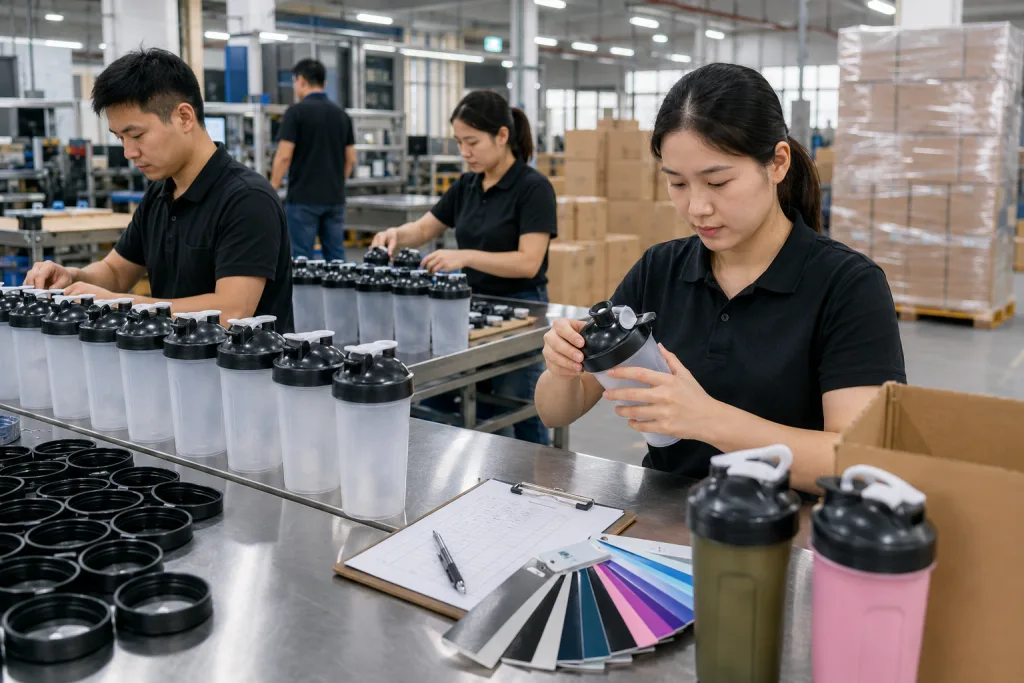
When you buy a manufacturer blender bottle, the sample on your desk is the easy part. The batch that lands 45 days later is where the trouble starts: a loose cap, a warped lid, a bad print, or a wire ball that passes customs and fails on the line. That is where margin gets eaten. A blender bottle looks simple, but production runs on small tolerances: thread fit, gasket compression, wall thickness, closure torque, and odor control. QC pulled a sample last week with a 0.4 mm thread mismatch, and that sort of miss turns into returns fast.
If you source from China or Zhejiang, think like a factory buyer, not a catalog buyer. The wrong question is, “Can you make this design?” The real question is, “What breaks first?” A serious canteen factory or canteen manufacturer will ask about resin grade, sealing structure, drop tests, and packing method before they talk about artwork. We see buyers push back on that order all the time, then the PO comes back with a typo on the carton mark and a complaint about leakage. That is how a 5,000-piece order goes sideways.
Where Blender Bottles Usually Fail
The body is the easy part. Failures start at the interface: lid-to-neck threads, gasket-to-seat contact, and the shaker insert that does not land the same way twice. On a bad run, we see three cases. First, the lid cross-threads because the thread pitch is loose or the mold has worn at the neck. Second, the bottle leaks after a few hot fills or one dishwasher cycle because the gasket shrinks or the cap warps. Third, the mixing insert breaks loose in transit because the carton had no internal restraint. QC pulled one sample last week and the insert had 4 mm of rattle. That is the line talking, not theory.
When you brief a canteen supplier or canteen vendor, do not stop at “leakproof.” Say what it means in the PO. For example: no visible leakage after 30 seconds of inversion with 300 mL water at room temperature, and no leakage after 10 open-close cycles at 1.2 N torque beyond the normal hand-tight range. The buyer flagged this on a 12,000-piece order because one missing word on the spec turned into a claim. This is the wrong question to ask: “Is it leakproof?” The math does not work unless you define the test.
A strong blender bottle spec usually includes:
- Body material: Tritan, PP, or stainless, tied to the target price and the dishwasher cycle count
- Wall thickness: 1.8-2.5 mm for plastic bodies, 0.4-0.6 mm for stainless liners
- Seal target: silicone gasket with compression set below 25%
- Closure test: 100% leak check on first article, AQL 2.5 on mass production
If you buy from a canteen factory in Zhejiang, ask for the mold maintenance record and the last three defect reports. We run into the same issue on the line: a worn cavity makes the cap feel fine by hand, then the thread gauge starts failing at 0.2 mm off spec. A real canteen manufacturer will know where their process drifts, and they will not need to guess.
Spec the Closure Before the Logo
Most buyers spend time on the logo first, then find out the closure is what the customer judges every day. That order is wrong. A weak logo still ships. A lid that leaks in a gym bag gets returned. Before you approve a custom canteen or customized drinkware order, freeze the closure build first. Call out the neck finish, gasket material, and cap type. If the design uses a flip cap, require cycle testing at 5,000 opens minimum. We usually run that on a bench-cycle rig, and weak hinge pins show up fast. If it uses a screw cap, define the torque window and thread engagement depth in mm.
For B2B buyers, treat the closure as an engineered part, not a styling detail. Ask for sectional drawings, not photo renders. You need gasket groove dimensions, thread profile, and mating tolerance. QC pulled the sample on one project last month because the groove was 0.3 mm shallow, and the seal rolled after hot fill. The factory should also state mold steel grade, usually P20 or H13 depending on volume, and expected tool life. A solid canteen manufacturer in China will answer that directly. If they dodge the drawing review, we've seen this go sideways on the line.
Use this as a practical checklist:
- Gasket material: food-grade silicone, hardness 50-60 Shore A
- Thread tolerance: enough engagement to survive repeated hand-tight use without galling
- Cap material: PP or ABS only if heat exposure is controlled
- Drop condition: 1 meter on concrete, 3 faces, no leak afterward
Custom drinkware buyers often ask if a canteen customizable order can handle color matching and closure changes at the same time. Yes, but not at low MOQ. This is the wrong question to ask. The better question is how many variables you are changing in one sample round. Once you change the lid, cap color, and body finish together, expect a 30-40% higher setup burden and sample timing closer to 12 days vs 18 days if the buyer flagged Pantone drift on the first pull. That is normal. It does not mean the factory is in trouble.
Material Choices That Bite Later
Material choice looks simple until it blows up the order. Plastic bodies warp when hot-fill hits 80°C, stainless dents in carton drop tests, and cheap coatings pick up smell after the first wash cycle. A custom growler program, a customized growler line, or a customizable growler project has the same trap at bigger scale: if the base material is wrong, decoration just hides the problem until QC opens the carton.
For a manufacturer blender bottle, Tritan works when you need clarity and impact resistance, but the resin paper has to match the spec. Ask for FDA-grade or equivalent food-contact documentation, and for Europe ask for REACH compliance plus LFGB where relevant. For stainless steel, 304 is the standard answer for mainstream orders, while 316 only earns its keep when corrosion exposure or premium positioning justifies the jump. We run this on the line all the time. China has cheap steel. That is not the same thing as usable steel.
Watch for these failure modes:
- Odor retention from recycled resin blended into a food-contact body
- Stress whitening at the neck from over-tightened caps on a 38 mm thread
- Paint or powder coat chipping on custom canteen promotional runs after a 1 m drop test
- Condensation staining caused by weak double-wall vacuum performance below 0.5 mm seal tolerance
If your customer is a canteen distributor or distributor drinkware reseller, a 2% odor complaint rate will cost more than the resin or steel upgrade. We’ve seen that go sideways on a 5,000-piece PO, and the buyer flagged it before the second shipment left the warehouse. One hidden defect can erase the margin on the whole order. Zhejiang factories know how to hit a price. The real question is where price is allowed to win and where it is not.
Prints Fail Faster Than Bodies
Decoration is where a lot of canteen vendors get lazy. They treat the bottle as the product and the print as a side job. Then the logo comes off in the carton, or the laser mark looks fine on day one and fades after three dishwasher runs. We have seen that go sideways on a 500-unit trial, and the buyer flagged it before the first carton left the line. If you are buying custom drinkware for retail, Amazon, or distributor channels, decoration needs a test plan.
Silkscreen is still the lowest-cost option for flat-color logos on a custom canteen or customized canteen run, but it needs proper cure time and surface prep. Laser engraving is cleaner on stainless, but it will not give every visual effect a brand team asks for. UV print carries more color, though it is more sensitive to abrasion. If you are sourcing from a canteen supplier or canteen suppliers in China, ask for the exact ink system, cure method, and adhesion test standard. A cross-hatch test to ASTM D3359 is standard practice, not a fancy extra. We run it on the bench with tape cut to 25 mm strips.
For distribution work, the question is durability, not glamour. A distributor canteen program that loses 10% of prints in shipping is a bad program. Define:
- Rub test: 50-100 double strokes with alcohol cloth, no visible failure
- Dishwasher check: 20 cycles if the product is claimed dishwasher-safe
- Laser depth: shallow enough to avoid corrosion issues, deep enough for visibility
One practical note: if your artwork has small text, do not approve it because it looks readable on a mockup. Ask for a 1:1 proof on the actual substrate. We had a PO once with a missing space in the logo name, and QC pulled the sample before packing started. A canteen distributor selling into North America will care about scuff resistance more than a designer does. That is the job.
QC That Catches Real Defects
Inspection plans fail when someone lifts them from a notebook instead of the product. A blender bottle is not a mug, and it is not a T-shirt. We run different checks for different risks. A leaking cap is critical. A light scratch can sit in minor. A label shift on a bulk pack may pass in one channel and fail in another. Good suppliers in Zhejiang know that, but only after you spell it out on the PO. We had one buyer flag a typo on the carton spec, and the line caught it before 3,000 boxes were packed.
For mass production, I usually push a 100% functional leak check on first-run samples, then in-line sampling under AQL 2.5 for critical defects and 4.0 for major defects. Ask for cap torque checks, flash and burr inspection at the mold parting line, and random drop tests from the shipping carton. On a 28 mm cap, torque drift shows up fast. This is not the wrong question to ask. It is the right one. For a weak canteen factory, the math does not work any other way.
Use a simple QC stack:
- Incoming inspection: resin, steel, silicone certificates
- In-process check: neck roundness, thread continuity, print alignment
- Final inspection: leak test, odor check, carton compression, barcode scan
- Packaging audit: FNSKU, polybag thickness, drop-corner integrity
If you are selling through Amazon or retail, packaging is part of the product. A warped carton can trigger damage claims even when the bottle is fine. QC pulled the sample on one run and found a 2 mm corner crush after the carton compression test. That is the kind of detail that saves chargebacks. It matters to canteen distributors and growler programs too. The shipment has to survive the channel, not just the bench.
MOQ, Lead Time, and Factory Reality
Buyers ask for low MOQ and fast lead time, then they add three materials, two decoration methods, and a new lid. That is not a small order. It is a crowded order. For a single body and one print method, a practical custom drinkware MOQ often sits at 3,000 units. Add mixed colors or mixed lids, and 5,000 units is where the math starts to make sense. For a custom canteen or canteen customized project, a Zhejiang factory with 200,000 units per month can still need 25-35 days after sample approval. Tooling, printing, curing, and packing all queue up. QC pulled the sample on a 50 mm lid once and found the print shift before packing. That saved a rework run.
Do not confuse monthly output with flexibility. A canteen supplier that makes 200,000 units a month may still run separate lines for vacuum bodies, plastic lids, and decoration. Ask what is actually holding the order. Injection molding? Vacuum welding? Laser engraving? If the vendor cannot answer that, they do not have a real schedule. We have seen buyers fixate on output and miss the bottleneck on the pad printer. That is the wrong question to ask.
Lead time control is mostly about decision speed. Slow artwork approval can add 5-7 days. Sample changes can add another 7-10 days. If you are working with canteen manufacturers in China, send the full brief on the first round: material, size, lid type, print method, carton spec, test requirements, and target Incoterms. FOB is still the clean baseline for many buyers because it keeps product cost separate from freight noise. One PO typo on lid color can burn a day before the line even starts.
The fastest programs are the ones with the least ambiguity. That is true whether you are buying a custom growler, a customizable canteen, or a distributor drinkware line. Complexity is not free. It shows up in time. We ship faster when the buyer locks the spec and stops revising the sample card on day 3.
Spec the bottle before the brand
Send your dimensions, lid type, and test targets. We will turn the failure points into a production-ready custom drinkware brief.
Frequently asked questions
How much time does a China factory need after sample approval?
For a straightforward order from a Zhejiang or other China factory, 25-35 days after sample approval is normal. If you change lid structure, decoration method, or carton spec, add 5-10 days. Complex customized drinkware programs with multiple SKUs or special packing can run longer. A factory with 200,000 units/month capacity is still limited by tooling, print curing, and inspection throughput. The fastest way to lose time is to approve artwork before you freeze the structure.