Key Takeaways
- A standard 20 oz double-wall 304 stainless manufacturer beer tumbler typically lands at USD 2.60-4.80 FOB China depending on coating, lid, and decoration
- Common MOQ starts at 500-1,000 units per color, but true price breaks usually appear at 3,000 and 10,000 units
- Normal lead time is 7-12 days for samples and 25-40 days for mass production after deposit and artwork approval
- Decoration, packaging, and test requirements can add 12%-35% to total project cost, often more than steel itself
You are not buying a beer tumbler shape. You are buying landed cost, a production slot, and a quality risk profile. That is why two quotes for a similar 20 oz stainless steel beer tumbler can be USD 0.80 to 1.50 apart per unit, and why one China factory says 15 days while another needs 40. We see this on the line all the time: same outline on the drawing, different steel weight, different spray process, different carton spec. The hidden variables decide the order.
For B2B buyers in Europe and North America, the right questions are direct: what drives unit price, where MOQ changes the math, and how long a custom drinkware order actually takes. We run into the same pushback every month—"why is your 3,000 pcs quote higher than the sample estimate?" Usually the answer sits in 304 stainless thickness, lid tooling, logo process, or a master carton that failed the 1.2 m drop test. If you are comparing a manufacturer beer tumbler project with a custom canteen, custom growler, or other canteen customizable SKUs from Zhejiang, you need numbers you can budget against, not soft factory talk.
What you are actually paying for
When you ask for pricing on a manufacturer beer tumbler, the steel body is only one line in the quote. A serious canteen manufacturer or canteen factory in Zhejiang will usually split it into five buckets: body material, lid assembly, surface finish, logo application, and packing. If the sheet lumps them together, push back. You need to see where the money goes, not guess.
For a standard 20 oz vacuum beer tumbler using 18/8 stainless steel, with a 0.4 mm inner wall and a 0.5 mm outer wall, the bare body often lands at about 45% to 55% of FOB cost. Lid and gasket can take 10% to 18%. Powder coating or spray finish may add USD 0.18 to 0.45. Logo decoration runs from USD 0.05 for one-color silk screen to USD 0.35 for wrap printing or special finishes. Retail color box, barcode labels, and inserts can add another USD 0.20 to 0.60. QC pulled the sample on a 0.5 mm wall check before we released this kind of quote.
If you are sourcing custom drinkware across adjacent categories, the same math applies to a custom canteen, customized canteen, customizable canteen, or customized growler. A custom growler with a leakproof lid and larger capacity uses more stainless steel, but decoration and packaging still move the margin. Buyers keep staring at body cost. That is the wrong question to ask.
- Low-complexity project: stock lid, one-color logo, white box
- Mid-complexity project: custom color, laser logo, printed carton
- Higher-complexity project: unique mold part, gift box, multi-pass print, compliance testing
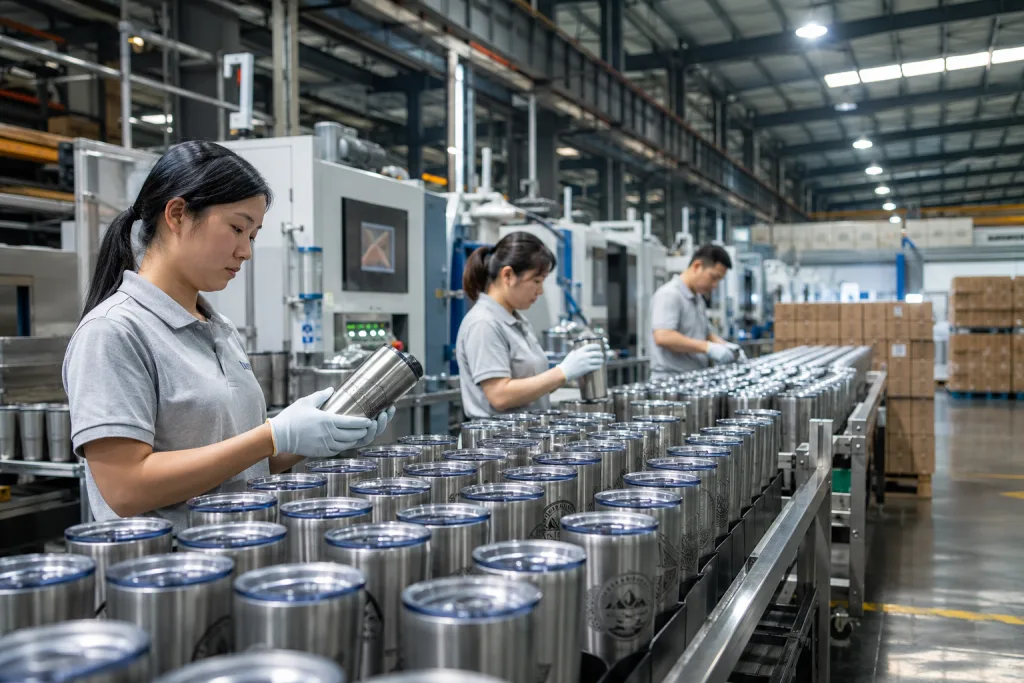
At BottleForge Industrial in Zhejiang, China, monthly output can reach 300,000 units across tumblers, bottles, and related drinkware. Capacity matters because a canteen supplier with steady throughput usually buys steel and coating at better rates and loses less line time on changeovers. We run the same 300,000-unit planning against a 7-day coating queue, and the math does not work if the line keeps stopping. It will not guarantee the lowest quote, but it usually means the quote is grounded.
MOQ tiers that change the math
MOQ is not a factory slogan. It is setup-cost recovery. For a manufacturer beer tumbler, 500 units versus 5,000 units does not scale in a straight line because screen setup, powder-coat booth cleaning, carton changes, and raw-material buys fall across the order in different ways. We run that math on the line every week.
Typical tiers from a canteen supplier or canteen vendors in China look like this:
- 500 units: workable for a stock shape and an existing lid, but the unit price stays high and color choices are narrow
- 1,000 units: a common starting point for a custom logo and standard powder coat
- 3,000 units: better carton loading, better coating yield, more room to push on price
- 10,000 units: where custom packaging, mixed colors, and tighter FOB pricing start to make sense
On a 20 oz tumbler, a 1,000-unit order may quote at USD 3.60 FOB Ningbo, while 3,000 units may drop to USD 3.15 and 10,000 units to USD 2.85, with the same spec sheet. That is why canteen distributors, distributor drinkware buyers, and distributor growler programs often combine colors or merge SKUs before they buy. The buyer flagged it correctly: the order structure matters as much as the unit count.
If you need a canteen customized with unique accessories, the MOQ can jump fast. A custom slider lid color may require 3,000 pieces. A new handle part or bottom silicone bumper may require 5,000 to 10,000 pieces, depending on tooling. The same applies to a customizable growler or customized growler project. We saw one PO typo that changed a lid color code from black to matte black; QC pulled the sample, and the whole batch had to be checked again. Tooling itself may cost USD 1,500 to 6,000 for a small plastic part and far more for a new steel body.
The practical lesson: ask every canteen vendor or canteen factory for pricing at 1,000, 3,000, and 5,000 units on one exact specification sheet. Compare the same foam insert, the same lid, the same print method, and the same carton count. If the assumptions differ, the quote comparison is junk.
Biggest drivers behind unit price
Most unit-price swings on a manufacturer beer tumbler come from choices you control. Lock the spec before you send the RFQ. We see buyers lose 8% to 15% just by leaving wall thickness or decoration open, and then the sample room has to guess. That is the wrong question to ask. Ask for one frozen spec, then price it.
Material and structure
304 stainless steel is the normal choice for both inner and outer wall. If you move to 316 on the inner wall, plan on about USD 0.20 to 0.50 more, depending on size and metal market moves. We ran one 16 oz job where the buyer flagged a 0.3 mm wall on the PO, and the line had to stop because the insulation test changed. Copper plating for heat retention can add USD 0.08 to 0.18. Thicker wall means better dent resistance, but it also adds grams, and freight does not care about your margin story.
Surface finish
Plain painted stainless is cheaper than fine powder coat. Soft-touch coating, gradient painting, electroplated bands, and textured finishes all add process time and scrap risk. QC pulled the sample on one matte lot because the gloss reading drifted outside the target by 3 units, and the rework bill was not small. A canteen promotional order for events can live with a simple satin finish; a premium retail launch usually cannot, and the buyer knows it the day the first case opens.
Decoration
Silk screen is usually the lowest-cost option for a simple spot logo. Laser engraving gives a durable premium look, but it needs coating uniformity or the mark goes patchy. Heat transfer or full-wrap printing looks strong on shelf, yet it often adds USD 0.12 to 0.35 per unit and needs tighter artwork control. We have seen a PO typo turn “one-color” into “four-color,” and the math does not work after that. If you run customized drinkware or customizable drinkware across several accounts, standardizing the decoration method saves money fast.
Packaging and compliance
Export cartons, drop-test mailer boxes, FNSKU labels, EAN stickers, and multilingual inserts all add cost. For Europe, you may need REACH-related material declarations. For North America, ASTM-related checks matter more on certain categories, especially kids items, though a beer tumbler itself is simpler. Independent lab testing can cost USD 300 to 800 per SKU, depending on scope. One shipment we packed in a 6-color mailer instead of a plain kraft box, and the packaging line spent an extra 18 minutes per 1,000 units. That is real labor.
A cheap quote usually hides one of three things: thinner steel, weaker coating control, or packaging that was never scoped.
That is why buyers sourcing from Zhejiang or broader China should compare a full BOM-level quote, not a headline unit price. We ship plenty of these orders, and the cleanest RFQs always win on less back-and-forth, not on the first number you see.
A realistic production calendar
Factories like to quote the clean number. The line tells a different story. For a stock-shape manufacturer beer tumbler out of Zhejiang, China, a realistic calendar usually looks like this.
- Day 1-3: RFQ clarification, artwork check, final quote revision
- Day 3-7: pre-production sample setup if color or logo changes are needed
- Day 7-12: sample approval and deposit receipt
- Day 12-30: raw material booking, body forming, vacuuming, coating, assembly
- Day 30-35: inspection, rework buffer, packing
- Day 35-40: final QC, balance payment, booking to port
That makes 25 to 40 days for mass production normal, not slow. We run a 12-cavity forming setup, and once the buyer flags a logo shift or a Pantone mismatch, the clock moves. If the project adds a custom canteen lid, customized canteen mold insert, or customized growler cap, plan another 10 to 20 days. Tooling trial and sign-off always takes longer than sales teams first say.
Peak season changes the schedule. Orders locked before summer outdoor promotions, back-to-school windows, and Q4 gifting can fill coating lines and print stations fast. A canteen distributor or canteen distributors group placing repeat orders in March usually gets cleaner timing than a buyer starting in August. Same story for distributor canteen and distributor growler programs tied to annual contracts. We saw one PO typo on a carton mark add a full day because QC pulled the sample and held the line.
If speed matters, ask a canteen supplier for three things on day one: stock color availability, standard lid options, and existing carton dielines. Open molds and proven packaging can shave 7 to 12 days. Our repeat drinkware orders usually land in 20 to 30 days after approval. First orders often need 30 to 40 days, because the approval loop, not the machine time, is what eats the calendar.
Where delays and overruns usually start
Most late shipments do not come from one big factory failure. They start with small changes made too late. We have seen a buyer approve a PMS color after coating started. The branding team moved the logo 8 mm. The importer added a barcode panel after cartons were already printed. Each change looks minor on paper. Together, they can push a manufacturer beer tumbler order back by 7 to 10 days.
The usual delay points for custom drinkware and custom canteen projects are:
- artwork files missing outlines, or fonts not converted to curves
- Pantone references left vague for matte powder coat
- lid leakage standard not locked before sampling
- carton size not checked against pallet or FBA rules
- compliance papers still missing from one sub-supplier
Ask your canteen vendors and canteen suppliers how they control each point. A serious canteen factory runs pre-production approval sheets, keeps physical color swatches on the line, and does sealing tests before mass production. We pull samples against the agreed AQL standard, usually AQL 2.5 for major defects and 4.0 for minor defects on promotional drinkware. On a 5000-piece order, that is the difference between a clean shipment and a messy rework.
If you buy customizable drinkware across several SKUs, freeze the parts that do not need to move. Use one lid family across tumblers and canteens. Keep one master carton size for two related items. Run the same logo process across the customized drinkware range. The math works. Standard parts cut cost and keep the schedule from slipping when the buyer flags a late PO typo or a 12 mm carton mismatch.
For buyers new to China sourcing, the blunt point is this: approval speed is part of your own lead time. Many factories in Zhejiang can move fast. We ship fast when the drawing is stable. They cannot build around delayed decisions from your side.
How to compare quotes without getting burned
A solid RFQ puts a canteen manufacturer, canteen supplier, canteen vendors, and a manufacturer beer tumbler specialist on the same footing. A weak RFQ turns price into noise. We run into this all the time on the line. You want every supplier in China quoting the same spec, the same Incoterm, and the same quality assumptions.
Your RFQ should spell out capacity, steel grade, wall thickness, insulation type, lid style, target colors, logo method, packaging, compliance needs, inspection level, and destination market. If you are comparing a custom growler, customizable growler, or distributor growler line against tumblers, separate the tooling assumptions in black and white. Otherwise one factory will roll tooling amortization into the unit price and another will leave it out. QC pulled the sample, checked a 0.35 mm wall callout, and the buyer flagged a PO typo on the carton count.
Ask for these numbers in writing:
- FOB port: usually Ningbo or Shanghai
- MOQ by color and by logo: not just total MOQ
- sample charge: refundable or not, usually USD 50 to 150 for decorated samples
- mass lead time: from deposit and artwork approval, not from PO date
- carton details: units per carton, gross weight, carton size
- quality terms: leak test, vacuum rate, AQL plan
Then look past the unit price. A canteen distributor or canteen promotional buyer may care more about low MOQ and a 12-day ship window than the lowest FOB. A retail importer may care more about coating consistency and packaging execution. We have seen this go sideways when a buyer chased a USD 0.08 saving and got hit with a 3 kg carton overage at dispatch. A supplier with ISO-oriented process discipline, BSCI social compliance, and clear rework procedures is often worth USD 0.10 to 0.20 more per unit if the order is brand-sensitive.
The right manufacturer beer tumbler partner is not the cheapest line in a spreadsheet. It is the quote that survives production, inspection, and delivery without surprises.
Get a clear beer tumbler quote with real numbers
Send your target capacity, logo method, MOQ, and packaging spec. We will reply with practical FOB pricing, lead time, and sampling options from Zhejiang, China.
Frequently asked questions
What is the normal MOQ for a custom manufacturer beer tumbler?
For a stock-shape stainless steel beer tumbler with custom logo, the normal MOQ is 500 to 1,000 units per design. In China, 1,000 units is the most common starting point because it covers coating, printing, and packing setup better. If you want a custom lid color, special finish, or retail gift box, expect 2,000 to 3,000 units. For fully new components or tooling, MOQ can move to 5,000 units or more. Always ask whether MOQ applies per color, per logo, or per total order. Many buyers think they are ordering 1,000 units total, then learn the factory means 1,000 per color. That changes both price and lead time immediately.
How much should I budget per unit from a China factory?
For a standard 20 oz double-wall 304 stainless manufacturer beer tumbler, a fair FOB China budget is usually USD 2.60 to 4.80 per unit. At the low end, you are looking at stock lids, simple powder coat, one-color print, and export carton packing. Mid-range pricing around USD 3.20 to 3.90 is common for better coating and laser logo. Premium builds with custom packaging, electroplated details, or more complex decoration can exceed USD 5.00. If you are comparing this to a custom canteen or customized growler, remember larger capacities use more steel and often heavier cartons. Ask each factory to separate tooling, sample fees, testing, and packaging so you can compare the real FOB price cleanly.
How long does production usually take after sample approval?
For a repeatable stock item, most factories in Zhejiang or wider China need 25 to 40 days after sample approval and deposit receipt. Decorated pre-production samples usually take 7 to 12 days first. If you add new mold parts, custom lids, or special packaging, add 10 to 20 more days. During peak season, especially late summer and Q4 gifting, coating and printing queues can push schedules longer. If you need faster delivery, use stock colors, existing lids, and standard cartons. That can shave about 7 to 12 days from the project. The key point is to count lead time from final artwork approval, not from your initial inquiry or even your PO date.
What quality checks should I require on custom drinkware orders?
At minimum, require leak testing, vacuum insulation checks, logo adhesion verification, coating appearance inspection, and carton drop-check review. For bulk inspection, many B2B buyers work with AQL 2.5 for major defects and AQL 4.0 for minor defects, though premium retail programs may require tighter limits. You should also confirm stainless grade, usually 18/8 or 304, and request declarations relevant to your market, such as REACH-related material information for Europe. If your project includes Amazon or retail packaging, verify barcode placement and carton markings before mass production. On a 1,000-unit order, one missed packaging detail can cost more than the product defect itself because relabeling and repacking are labor-heavy.
Should I choose one supplier for tumblers, canteens, and growlers?
Usually yes, if the supplier is genuinely strong across those categories. A capable canteen manufacturer or canteen factory can often supply manufacturer beer tumbler, custom canteen, and custom growler programs using shared coating, printing, and packaging systems. That helps with color matching, carton standardization, and shipment consolidation. It can also improve price once your combined volume reaches 3,000 to 10,000 units across related SKUs. The caution is technical fit. Ask for category-specific references, leak-test standards, and line capacity. Some suppliers are strong on tumblers but weak on large customized growler lids or narrow-mouth canteen accessories. One supplier is efficient only when their process is actually stable in all the categories you need.