Key Takeaways
- Typical factory pricing for a stainless beer growler runs about USD 2.80-6.50 per unit at 500-3,000 pcs, before freight and duties.
- Common MOQ tiers are 500 pcs for stock-style orders, 1,000 pcs for printed custom growler runs, and 3,000 pcs for full custom tooling.
- A realistic lead time is 20-30 days for existing molds and 45-60 days for customized growler projects with new packaging or special lids.
- Audit quality with AQL 2.5 for major defects and 4.0 for minor defects, and ask for REACH, LFGB, or food-contact documentation where needed.
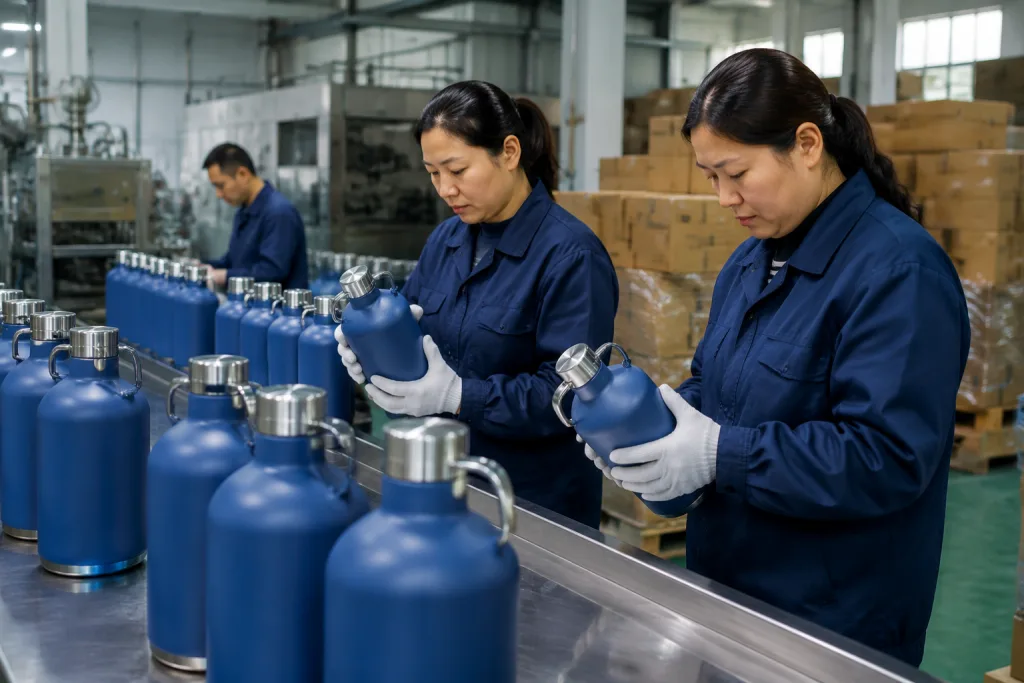
When you source a manufacturer beer growler, the unit price is the wrong place to start. We run orders this way every week in Hangzhou: landed cost, print method, and delivery window decide whether the program works. A growler for a brewery chain in Germany is not the same job as a North American promo run, even if both start with a 64 oz stainless bottle.
In Zhejiang and across China, the spread between a stock item and a custom growler is real. One line can ship in 20 days; another needs 45 to 60 days once the buyer asks for a custom lid, laser logo, or Pantone body color. MOQ may begin at 500 pieces for a standard finish, then jump to 2,000 or 3,000 pieces when the spec changes. QC pulled the sample on a 0.2 mm logo shift last week, and that is where the math either holds or falls apart.
What actually sets the price
The price of a manufacturer beer growler usually comes down to five items: material grade, wall construction, finish, closure system, and decoration. A 304 stainless steel growler with a brushed body costs less than a powder-coated version with a threaded cap, silicone base, and two-color pad print. Move to 316 stainless and the math changes again, usually by 12% to 20%, because the raw material costs more and the sourcing window is tighter.
For a plain 64 oz stainless growler from a canteen factory in Zhejiang, FOB China pricing often lands around USD 2.80 to 3.40 at 1,000 pcs. Add a matte powder coat and it usually moves to USD 3.60 to 4.50. Laser engraving is efficient for small logos and can add only USD 0.08 to 0.25 per piece, while full-color wrap print or complex artwork can add USD 0.30 to 0.80 depending on coverage. We run this on the line all the time; QC pulled a sample last week with a 0.2 mm overspray band at the base, and that sort of detail is what separates a clean quote from a messy one. Packaging counts too: a plain egg-crate carton is cheap; a printed box, barcode label, and retail sleeve can add another USD 0.20 to 0.60.
Do not ignore lid cost. A basic screw cap is one thing; a leak-resistant stainless lid with a silicone seal is another. That detail can change both price and failure rate. The buyer flagged it on a PO once because the cap spec was typed as “stainless led” instead of “lid,” and the sample approval was blocked until the wording matched. Ask for a line-by-line quote, not a single lump number. The cheap quote often hides the expensive parts in the closure, logo, or packaging line.
MOQ tiers and why they matter
MOQ is not a sales slogan. It is the line’s control point for resin loss, setup hours, and packing labor. On a standard custom beer growler job, the MOQ usually comes down to whether we are running an existing body or changing the finish. A stock body with logo-only branding can start at 500 pieces. Once the buyer asks for a new cap, special coating, or a color-matched body, the number usually moves to 1,000 or 3,000 pieces. We see that on the packing table every week.
Here is the split we run with on the floor:
- 500 pcs: standard model, one logo, plain carton pack
- 1,000 pcs: branded custom growler with one decoration method
- 3,000 pcs: customized growler, special color, or new packaging spec
Lower MOQ sounds cheap. It is not always cheap. A 500-piece distributor run can land 15% to 25% higher per unit than a 1,000-piece order because setup, QC, and inspection do not shrink with the order size. QC pulled the sample on one 500-piece batch and found a print shift of 1.2 mm, which still had to be checked part by part. If you are a growler distributor or growler vendor covering seasonal accounts, that premium can make sense. If the program repeats, the math usually does not.
One rule we give buyers: if you are testing a market, keep the decoration simple and the body standard. If the order is meant to repeat for six months or more, do not spend on new tooling or packaging until one batch has sold through. The buyer flagged a PO typo on carton count once, and the whole shipment had to be held while we reworked labels. That is the kind of mistake that ties up cash in dead stock instead of goods you can move.
Lead times you can plan around
Lead time on a manufacturer beer growler comes down to one thing: how much of the build you are changing. A stock body with laser logo and a standard carton usually runs in 20 to 25 days after sample approval. If you add powder coating, printing, and retail-ready packaging, plan 30 to 35 days. If the job includes a new lid, new mold insert, or a nonstandard finish, 45 to 60 days is normal in China. That includes trial runs and rework before shipment. We’ve seen first articles fail on a 0.3 mm lid-fit gap, and that correction takes time.
Be careful with any factory promising 12 days unless they show you what is already sitting in stock. This is the wrong question to ask if the spec is not fixed. In Zhejiang, good factories move fast on simple programs, but the line does not skip drying, leak testing, or carton drop checks just to win the PO. We run vacuum leak tests after sealing, and QC pulled the sample last month because the print shifted 1.5 mm off-center. A proper schedule should cover sample confirmation, raw material booking, production, inspection, and packing. For Europe or North America, add buffer for freight booking and customs, or the math doesn’t work.
Typical timing breakdown:
- Sample confirmation: 5-7 days
- Mass production: 15-30 days depending on process
- Inspection and packing: 2-4 days
- Ocean freight to major ports: 18-35 days
If you sell into retail, add another week for final labeling, FNSKU application, or warehouse prep. We ship plenty of distributor orders where one carton mark typo on the PO already costs a day. Miss the launch date and it is not a minor delay; it can blow the quarter. Build the schedule backward from the ship date, not forward from the PO date.
Material choice changes the landed cost
The cheapest growler on paper is not always the cheapest one at destination. We run the same check on the line all the time: a 0.4 mm wall can pass for promo orders, but a 0.6 mm or 0.7 mm wall usually lands better in hand and cuts dent claims. Stainless steel stays the base choice for a beer growler because it protects taste and survives repeat use. That extra metal can lift unit cost by 6% to 14%, and it often saves the buyer from return freight later.
Think in landed cost, not FOB. A USD 3.20 FOB bottle can end up at USD 5.10 to 6.40 after freight, duty, inland trucking, and compliance. QC pulled the sample here because a buyer flagged a carton size typo on the PO, and that kind of miss turns into wasted cube fast. On larger custom drinkware orders, ocean freight per unit drops, but carton volume and pallet fit start driving the bill. A heavy printed carton can cost more in freight than in packaging. The math does not work any other way.
Here is where materials intersect with market use:
- 304 stainless: the best balance for most custom growler programs
- 316 stainless: stronger corrosion resistance, higher cost, usually for premium lines
- Single-wall steel: lower cost, lighter, more temperature transfer
- Double-wall vacuum: higher price, better performance, slower assembly
If you are comparing custom canteen, customizable canteen, or customizable growler formats, ask whether one shell can cover multiple SKUs. A smart canteen manufacturer will often suggest a shared body with different caps or artwork, and that cuts tool cost without tying up inventory. We have seen this go sideways when buyers split the order too early and end up with three slow movers instead of one clean program.
What quality control should cost you
Quality costs money. It shows up in the line. A factory that skips leak testing or drops in-process checks is buying your problem, not saving you cash. For a manufacturer beer growler, the core checks are simple: cap torque, leak test, coating adhesion, logo abrasion, and carton compression. If a supplier cannot walk you through those five steps without hand-waving, the quote is missing real cost.
Use a hard inspection standard. We usually see buyers specify AQL 2.5 for critical and major defects, then AQL 4.0 for minor defects. That still allows a few cosmetic marks, not leaking caps or a logo shifted 3 mm off center. For export runs, ask for food-contact declarations, REACH where it applies, and the market-specific paperwork your channel needs. QC pulled the sample on one 500-unit job last month and found a carton crush issue at 12 kg compression; that is the kind of miss that turns into a chargeback.
Good QC usually costs 2% to 4% of order value. Cheap QC can cost the whole shipment.
For a canteen promotional run, some buyers accept lighter inspection because the life of the product is short. For a retail reusable bottle, that is the wrong question to ask. We have seen a weak seal and a soft print job turn into 18-day returns, then a buyer flagged the next PO for a tighter pre-shipment check. That bill lands on your account, not on the sample sheet.
How to compare suppliers without wasting time
Start with the factory, not the sales pitch. A real canteen factory or canteen manufacturer should answer production questions with dates, materials, and process details. Ask how many units per month they run, what their MOQ is per finish, and which decoration methods stay in-house. We’ve seen a Zhejiang plant quote 240,000 units per month across several drinkware lines, then miss the date because the laser line was already booked. The number only matters if the exact line you need has room.
When you compare canteen distributors, canteen vendors, and canteen suppliers, use one quote sheet for all of them. Same fields. Same order. You want comparable data:
- FOB price at 500, 1,000, and 3,000 pcs
- Sample lead time
- Mass production lead time
- Carton spec and packing quantity
- Inspection standard and warranty terms
If one canteen custom partner sends only a photo and a unit price, keep moving. A good canteen supplier will tell you whether the item is a stock model, a modified mold, or a true new tooling job. That changes the math fast. For one buyer, the PO had “5000pcs” typed as “500pcs,” and QC pulled the sample before anyone noticed; that kind of slip turns into a headache at packing. For buyers in Europe and North America, it also decides whether the program can be reordered at the same spec. A distributor canteen order that cannot be repeated is not a program. It is a one-off.
On the first order, keep the logo simple and the spec tight. On the second order, add the custom color, the custom lid, or the retail carton. We run that sequence for a reason. It gives cleaner pricing, cleaner timing, and less dead stock.
Request a growler quote with factory pricing
Send your target MOQ, finish, and delivery date. We will quote factory terms from Zhejiang with clear cost and lead-time breakdowns.
Frequently asked questions
What is a realistic FOB price for a manufacturer beer growler?
For a standard stainless manufacturer beer growler, a realistic FOB China range is USD 2.80 to 6.50 depending on wall thickness, finish, lid type, and decoration. At 500 pcs, the lower end is usually only for simple stock-style units. At 1,000 to 3,000 pcs, a powder-coated, logoed version often lands around USD 3.60 to 4.90. Double-wall vacuum builds, premium lids, or retail packaging can push higher. Freight and duty are separate, so always price landed cost, not just FOB.
What MOQ should I expect for custom growler orders?
Most factories in China will quote 500 pcs for a simple logo on an existing model, 1,000 pcs for a customized growler with a decorated finish, and 3,000 pcs for more specific changes such as special color, packaging, or lid tooling. If you want a true custom drinkware program, expect the MOQ to rise with each added process. A canteen manufacturer may flex slightly for repeat buyers, but the first order usually sets the commercial floor.
How long does production take?
For a stock body with laser logo, 20 to 25 days is normal after sample approval. Add powder coating, print, or special packaging and the lead time usually becomes 30 to 35 days. If you request new tooling, a unique lid, or custom carton inserts, plan on 45 to 60 days. That is before ocean freight. From a Zhejiang factory to a U.S. or EU port, shipping often adds 18 to 35 days depending on the route and season.
What quality checks should I require?
Ask for leak testing, cap torque checks, coating adhesion checks, print rub testing, and carton drop testing. For inspection, many buyers use AQL 2.5 for critical and major defects and AQL 4.0 for minor defects. If the growler is sold as food contact drinkware, ask for relevant compliance documents such as REACH or LFGB where needed. A canteen supplier that cannot explain its QC plan is not ready for export volume.
Can one supplier handle both promotional and retail orders?
Yes, if the factory has enough line capacity and controls both decoration and packing. A canteen promotional order may use a simpler carton and lower-cost finish, while retail orders need tighter cosmetic control and more consistent packaging. A good canteen distributor relationship often starts with one promotional run, then expands into customized drinkware once the first batch proves sell-through. Just keep the spec stable so the second order is repeatable.