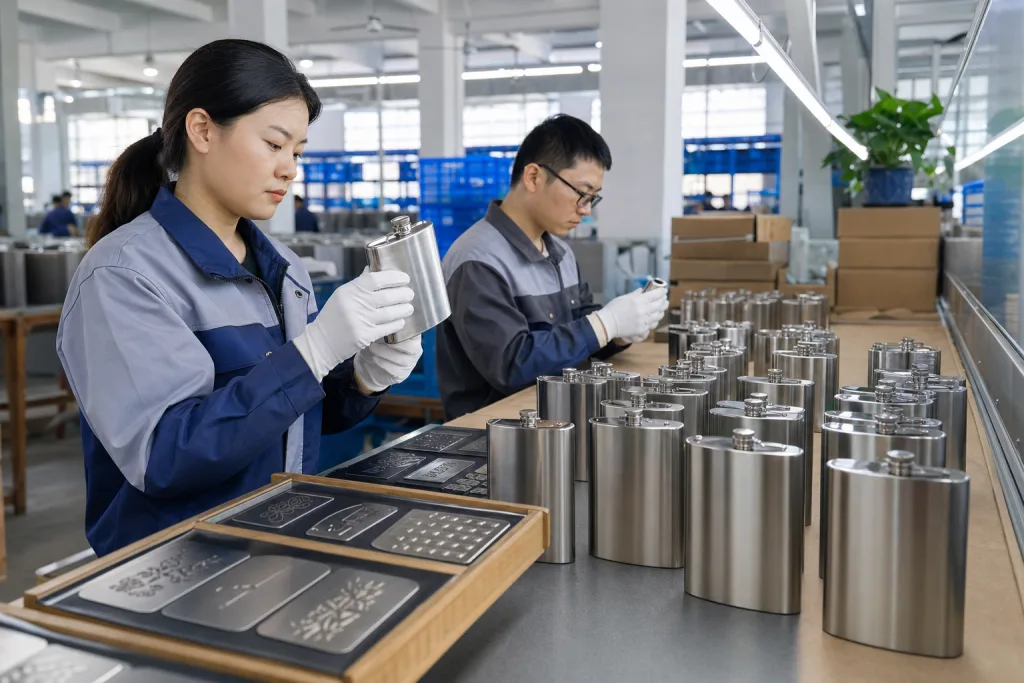
Key Takeaways
- A practical MOQ for a standard manufacturer alcohol flask is usually 1,000-3,000 pcs per SKU, while custom tooling for a new shape often starts near USD 800-2,500.
- 304 stainless steel with 0.5-0.6 mm body thickness is the common sweet spot for gift and promotional flasks; 201 steel saves cost but raises corrosion risk.
- Normal lead time from Zhejiang, China is about 25-35 days after sample approval, plus 3-7 days for pre-production samples and 7-12 days ocean booking buffer.
- For incoming inspection, many buyers use AQL 2.5 for major defects and AQL 4.0 for minor defects, with leak testing on 100% of packed units.
You are not buying an alcohol flask like a retail customer. You are buying risk, margin, compliance, and delivery performance. We have seen a showroom sample pass the eye test, then fail after 200 rub tests because the logo ink scuffed, or leak in a 1.2 m drop test because the cap seat was off by 0.3 mm. The importer asks for REACH reports 2 days before loading, QC pulls the sample, and the line stops. That is where first-time B2B buyers lose money.
If you source from a manufacturer alcohol flask program in Zhejiang, China, 6 oz versus 8 oz is the wrong question to ask. Check steel grade, wall thickness, seam construction, decoration method, MOQ, and carton efficiency against your market and price target. On our side, we run calipers on body thickness and check master carton count before the PO goes live, because the math does not work if freight adds $0.18 per unit. If you also buy custom canteen, custom growler, or other customizable drinkware, the same sourcing logic applies. The numbers matter.
Start with the buying brief
A manufacturer alcohol flask looks simple until the brief hits the line. We see this every week. Before you ask any canteen manufacturer or canteen supplier for pricing, lock five points: target market, capacity, finish, decoration method, and compliance file set. Miss one, and two quotes that look close on paper turn into different products at sample stage. QC pulled one 6 oz sample last month where the PO said “satin,” the artwork sheet said “mirror,” and the buyer flagged both.
For North America and Europe, the standard body material is food-contact 18/8 stainless steel, which is 304. Some canteen vendors will quote 201 stainless for a value program. On a 6 oz flask, that usually cuts ex-works price by roughly USD 0.08-0.20 per unit, but the math does not work if the product sits in humid retail stock or touches acidic mixers. We have seen rust start first around the weld seam and neck curl, where the polishing wheel already works the metal hard. That is the wrong place to save money.
If your project sits beside a broader custom drinkware line, treat the flask as one SKU in a family, not a one-off. A buyer running canteen custom, customized growler, or customizable canteen SKUs should keep decoration colors, carton marks, and QC standards aligned across all items. It cuts artwork errors, speeds approval, and keeps factory communication cleaner. On the floor, we run one carton mark file by PO and check it against a 3 mm barcode position tolerance before mass packing.
- Entry promo brief: 6 oz, 304 steel, satin finish, 1-color silk screen, MOQ 1,000 pcs.
- Retail gift brief: 8 oz, seamless rounded body, powder coat or leather wrap, laser logo, MOQ 2,000 pcs.
- Private label brief: new shoulder shape, gift box, barcode labels, MOQ 3,000 pcs plus tooling.
BottleForge Industrial in Zhejiang runs mixed drinkware programs up to 600,000 units per month across categories, so flask buyers often bundle with custom canteen or customizable drinkware projects to use container space better. A standalone flask order at 1,200 pcs is usually loose freight. If you combine it with a customized canteen or distributor growler order, the shipping math improves fast, and we can often build one inspection plan for the full load. We have seen 1 CBM programs go sideways when buyers split them too thin.
Spec table: what changes price
This is the comparison table most buyers ask for once the first quote lands. On our side, price moves on five items: steel grade, body build, cap style, finish, and pack-out. Shape has some effect, but this is the wrong question to ask unless you need new tooling, because a new mold is where the math changes fast.
Typical comparison points
- Material: 304 stainless is the standard export choice. 201 stainless is the budget option and buyers flag it more often for food-contact concerns. Copper-plated vacuum construction is rare for alcohol flasks; we almost never run it on the line because it adds process cost without giving the buyer much back.
- Wall thickness: 0.4 mm is the low-cost build. 0.5 mm is the standard we quote most. 0.6 mm feels heavier in hand and dents less in transit; QC pulled samples last month where 0.4 mm bodies showed corner dings after carton compression.
- Capacity: 4 oz, 6 oz, 8 oz, and 10 oz are the common export sizes. In carton loading, 6 oz usually packs cleaner than 8 oz, so freight math is often better at the same MOQ.
- Cap: A tethered screw cap cuts loss claims. A plain cap looks cleaner on shelf, but we have seen this go sideways after retail buyers report missing caps from returned units.
- Finish: Mirror polish shows scratches first, sometimes right after wipe-down with a rough cloth. Brushed satin hides handling marks better. Powder coat adds grip and color; on black powder coat, laser logos usually read sharper because the contrast is cleaner.
For a standard 6 oz flask in 304 stainless, 0.5 mm wall, brushed finish, and 1-color print, FOB Ningbo pricing often lands around USD 1.55-2.20 at 3,000 pcs. Add a rigid gift box and you can easily add USD 0.45-0.90.
Side by side, a 6 oz flask usually wins on carton efficiency and promo pricing. An 8 oz flask sells better on perceived value for retail and gifting. A leather-wrapped version can carry better margin if your market accepts the extra USD 0.60-1.20 cost, though buyers often push back on glue smell and edge wrap consistency within 1-2 mm. A black powder-coated version usually gives the cleanest logo result for laser engraving and shows fewer fingerprints than mirror steel.
The same quote logic applies if you are also working with canteen factory or canteen manufacturers on nearby categories. A custom growler needs heavier steel and tighter weld control, and we normally check the weld bead before polishing because pinholes are expensive to fix later. The structure is still familiar: raw material, finishing labor, logo process, and pack-out. Buyers who understand that can compare offers from canteen distributors and canteen suppliers with a clearer eye, instead of getting pulled in by a low opening price that leaves out inner trays, barcode labels, or drop-test-ready packaging. We have even seen a PO typo on barcode placement turn a clean quote into a week of rework.
Use-case fit beats generic specs
The right manufacturer alcohol flask for a hotel gift shop is usually the wrong pick for a promo drop or a hunting catalog. Match the build to the sales channel, not just the look. We have seen buyers approve a pretty sample, then reject the first bulk run because the shelf price or giveaway budget no longer worked.
Promotional use: For canteen promotional items with a flask added in, stay with 6 oz or 8 oz, brushed 304 steel, 1-color silk screen or laser logo, and a white box. Keep MOQ near 1,000-2,000 pcs per design. That setup runs clean on the line and repeats fast. QC pulled one promo sample last month where the buyer tried a mirror finish instead, and fingerprints showed before packing. For this channel, the wrong question is color trend; the real question is cost per handout.
Retail gifting: Go for 8 oz, 0.5-0.6 mm body, powder coat or synthetic leather wrap, and a better gift box with EVA or paper insert. Premium packaging does lift sell-through, but only if the flask body still feels solid in hand at around 180-200 g. A flask at USD 2.30 FOB supports a different shelf price than a USD 1.65 promo unit. We ship both, and buyers notice the gap the moment they open the lid.
Outdoor and heritage programs: Buyers sourcing custom canteen, customized canteen, or customizable growler products for camping or country lifestyle catalogs usually want one family look across 3-5 SKUs. Brushed steel with laser engraving holds up better than high-gloss finishes because field use leaves marks fast; we have seen buckle scratches show on sample panels after one drop test from 80 cm. Keep the tethered cap. Lose it, and the buyer flagged cap-loss complaints later.
Distributor programs: If you are a canteen distributor or distributor canteen buyer serving 20 or 30 small accounts, do not open too many body variants. Standardize one 6 oz shell and one 8 oz shell, then change decoration by account. The math works better. It cuts dead stock, makes replacement caps easier to manage, and gives your China factory the option to hold semi-finished inventory if volume supports it. We run this model often with shell stock in plain brushed finish before logo marking.
In Zhejiang, China, first orders are often over-customized. A buyer asks for a new flask silhouette, a molded box, two print positions, and three cap finishes, then asks why lead time jumps from 30 days to 55 days. We have seen this go sideways. One PO even had the cap finish code typed twice, and sample approval stalled for 4 days while the team sorted it out. If the market test is still unproven, start with a standard body and put the brand value into finish, logo placement, and the package story.
Decoration, packaging, and damage risk
On flasks, decoration is not only branding; it decides how the item looks after 30 days in a gift shop or a customer’s backpack. The cheapest logo option often turns into the expensive one once the buyer flags rub-off, edge chipping, or alcohol-wipe marks on a mirror finish. We usually ask buyers to compare logo methods after abrasion, handling, and 70% alcohol wipe checks before sign-off. This is the right question to ask early. On our line, QC pulled the sample after 50 rubs with a dry cloth, and weak prints showed up fast.
- Silk screen: low setup cost, good for simple logos, usually USD 0.05-0.12 per color; best on flat zones; weaker against heavy abrasion. Fine for promo orders at 3,000 pcs, but we have seen metallic ink fail tape test on curved shoulders.
- Laser engraving: clean and permanent on coated or brushed steel, usually USD 0.08-0.18; excellent for premium retail. No ink to scratch off, and the mark stays consistent if the coating thickness is controlled on the line.
- Pad print: useful for curved or small areas, but less common for larger flask faces. Best for tight logo zones under 30 mm where screen mesh does not sit clean.
- Embossed wrap or badge: high perceived value, but adds assembly steps and defect points. The buyer likes the look, then rejects 2 mm badge shift, and now rework starts.
Packaging drives claim rates more than first-time buyers expect. A mirror-finish flask in a thin tuck box can land with scuffs while the flask body is still structurally fine, and we have seen this go sideways on Amazon orders. If you ship to e-commerce fulfillment or Amazon prep, lock in polybag protection, tissue or foam isolation, and carton drop resistance from the start. We ship samples with 1 pc per polybag for this reason. For FNSKU labeling or retail barcode placement, define the panel position on the artwork sheet so your canteen vendor does not guess after someone types the PO note wrong.
A practical carton target for standard flasks is 60-100 pcs per export carton depending on gift box size. Ask for gross weight below 15 kg where possible. Warehouses in Europe and North America push back once cartons hit 16 kg to 18 kg, and the math does not work if handlers start dropping overloaded cases. If you source custom canteen or customized drinkware alongside flasks, match master carton dimensions early to get cleaner pallet stacks and fewer half-empty layers. We usually check carton size with a tape measure before mass pack-out, not after the container booking.
At BottleForge, our export team generally recommends abrasion checks, tape tests for coated surfaces, and 24-hour leak tests before packing. Boring checks. They stop the standard complaints: scratched logo, peeling coating, damp gift box. QC pulled the sample, ran the 24-hour leak test, and once caught a cap insert seated off-center by less than 1 mm. Good canteen suppliers in China should already run this routine. If they do not, you will end up writing the SOP for them.
Compliance is where buyers get exposed
An alcohol flask does not need a thick compliance file. It needs a complete one. For the EU, ask for REACH and food-contact test alignment tied to the exact bill of materials: body, cap liner, coating, and any adhesive under a badge or wrap. We have seen buyers approve a brushed flask, then switch to a rubber paint finish and assume the old report still covers it. It does not. For the US, buyers usually ask for California Proposition 65 screening where relevant, plus food-contact material declarations and test reports from recognized labs. If the cap liner changed from 1.5 mm silicone to another insert, QC should pull the sample and relink the file set before production starts.
If your flask program sits inside a larger customizable drinkware line, run one document checklist across all SKUs. Use the same pack for each item: supplier declaration, test report validity date, material breakdown, packaging material statement, and factory audit status such as BSCI or ISO 9001. This sounds basic, but we ship to buyers who still catch a typo on the PO or a missing carton statement 2 days before ETD. A canteen factory that runs clean welding and polishing is still a weak supplier if the documents land incomplete on every shipment. That is the wrong question to skip.
For QC, the normal production controls are straightforward:
- Appearance: dents, scratches, logo position, color deviation. On our line, QC checks logo offset against the approved artwork and flags anything drifting past 1 mm.
- Function: cap threading, hinge integrity, leak test. We run leak testing after assembly, and the buyer usually wants 30 minutes upside down with no seepage at the neck.
- Odor: no abnormal smell from liners, coatings, or gift boxes. This one gets missed; a gift box glue smell can fail the sample even when the flask body is fine.
- Packing: barcode accuracy, carton marks, assortment accuracy. We have had final inspection stop over one EAN label printed from the old revision.
Many B2B buyers in Europe use AQL 2.5 major and 4.0 minor at final random inspection. For higher-risk retail launches, tighten major defects to AQL 1.5 and require 100% leak testing in-line. The math does not work if you launch 5,000 gift-boxed units into chain retail and find cap seepage after delivery. If you are a canteen distributor, canteen distributors group, or distributor growler importer managing several accounts, those standards keep reorders stable across product families. We have seen 12 days of reorder approval with a clean FRI pack versus 18 days when the inspection report needed rework.
China has plenty of factories willing to say yes to any document request. The safer question is whether the report matches the exact SKU, finish, and liner you are buying now. We have seen this go sideways on a flask with a new metallic coating and an old liner declaration attached from the previous PO. Same shape, wrong file. That is the line between paperwork and compliance.
How to compare factories fairly
Send the same RFQ to 5 flask factories and you can still get 5 different prices. That is normal. One shop quotes 0.4 mm body thickness, another builds in 0.5 mm, and a third assumes plain white box packing because the PO forgot the insert card. If you want a fair comparison, force every assumption onto the sheet.
Ask each supplier to split the quote line by line: body material, wall thickness, logo method, packaging type, sample charge, tooling charge, MOQ, lead time, and FOB port. Then ask what is excluded. We usually see buyers miss spare caps, barcode labels, carton marks, and export testing support, and QC pulled the sample once only to find the logo was laser when the buyer expected screen print. The cheapest quote often stops looking cheap after that. We have seen this go sideways.
For a standard project from Zhejiang, a realistic benchmark looks like this:
- Sample time: 5-7 days for stock sample, 7-12 days for pre-production sample.
- MOQ: 1,000 pcs for standard flask, 3,000 pcs for deep customization.
- Lead time: 25-35 days after deposit and artwork approval.
- Payment: 30% deposit, 70% before shipment is still common.
- Port: FOB Ningbo or Shanghai for most Zhejiang shipments.
If you also source custom canteen, canteen customizable products, customizable growler, or customized growler items, use one supplier scorecard across categories. Score response speed in hours, document accuracy by PO error count, sample consistency against the signed sample, and on-time shipment percentage over the last 6 months. We run this check with buyers all the time. A distributor drinkware buyer usually cares more about 96% on-time shipment than saving USD 0.06 per piece, and this is the right math.
The best suppliers in China are not always the ones offering the lowest MOQ or the fastest lead time. The stronger factory is the one that tells you your target price does not match the finish, gift box, or compliance requirement. We had one buyer flag a quote as “too high,” then the line found his cap color was Pantone-matched and his inner tray was EVA, not paper pulp. That is the wrong question to ask. Ask which spec is driving the cost.
Compare your flask specs with a factory engineer
Send your target capacity, finish, logo method, MOQ, and market. We will review feasibility, quote honestly, and flag cost or compliance risks before sampling.
Frequently asked questions
What MOQ should I expect for a custom alcohol flask order?
For a standard flask body using existing tooling, expect MOQ around 1,000 pcs per size or finish, sometimes 500 pcs if the factory is filling capacity. For a truly customized canteen-style flask with new shape, custom cap parts, or gift box development, 3,000 pcs is a more realistic starting point. Tooling for a new shell commonly runs from USD 800 to USD 2,500 depending on complexity. If you are buying other custom drinkware from the same canteen factory in China, you can sometimes negotiate a mixed-container MOQ by combining flask units with custom canteen or customizable growler items under one production plan.
Is 201 stainless acceptable for alcohol flasks, or should I insist on 304?
If your market is price-driven promo and the flask is a short-cycle giveaway, 201 stainless may be acceptable, but you should go in knowing the tradeoff. 201 usually saves about USD 0.08-0.20 per unit on common sizes, yet it is less corrosion-resistant than 304, especially around welds, necks, and threaded areas. For Europe and North America, most serious B2B buyers specify 304 for body and food-contact surfaces. If your flask sits beside customized drinkware, custom growler, or custom canteen products positioned as retail goods, 304 is the safer long-term standard. Ask the China supplier to confirm grade on the PI and on the test documentation.
Which logo method works best on a manufacturer alcohol flask?
For low-cost canteen promotional programs, 1-color silk screen is still the standard because setup is simple and the unit cost is usually only USD 0.05-0.12. For gift and retail channels, laser engraving is usually better. It costs a bit more, around USD 0.08-0.18, but it holds up well to rubbing and gives a cleaner premium look on brushed or powder-coated surfaces. If you want a very tactile brand effect, a wrap, badge, or embossed panel can work, but expect more assembly labor and more QC checkpoints. Most canteen manufacturers in Zhejiang will recommend laser if your complaint risk on print durability is high.
How do I inspect alcohol flasks before shipment?
Use a short but strict checklist. First, inspect appearance for dents, scratches, coating defects, and logo position. Second, test function: cap threading, hinge performance, and leak resistance. Many buyers require 100% leak testing in production plus random recheck at final inspection. Third, verify odor because liners, coatings, and even gift boxes can create complaints. Fourth, confirm packing details such as barcode placement, carton marks, and unit counts. For final random inspection, AQL 2.5 for major defects and AQL 4.0 for minor is common. If you are a canteen distributor or distributor drinkware importer, set the same standard across flask, canteen customized, and growler lines.
Can I bundle flasks with other drinkware to improve freight and MOQ efficiency?
Yes, and for many buyers it is the smartest move. If your alcohol flask order is only 1,000-2,000 pcs, freight per unit can look ugly on its own. Combining it with custom canteen, customized canteen, customizable drinkware, or distributor growler products often gives better carton utilization and helps you reach a more efficient LCL or FCL plan. Factories in Zhejiang, China that produce multiple categories can also align decoration approvals, packaging specs, and compliance documents across the shipment. The practical benefit is not only freight savings. You also reduce admin time because one canteen supplier manages fewer POs, fewer inspection visits, and one shipping document set.