Key Takeaways
- 18/8 inner + outer stainless is the default for reliable wholesale thermos projects; 201 outer steel can trim unit cost by about USD 0.12-0.30 on high-volume orders
- A typical custom stainless thermos MOQ is 500-1,000 pcs per color, while laser logo runs can start from 300 pcs on selected stock molds
- Vacuum retention claims should be tied to test conditions; 12 hours hot at 58-65°C from 95°C fill is a practical benchmark for 500 ml bottles
- Standard lead time in Zhejiang, China is usually 25-35 days after sample approval, with mass output commonly reaching 300,000 units/month
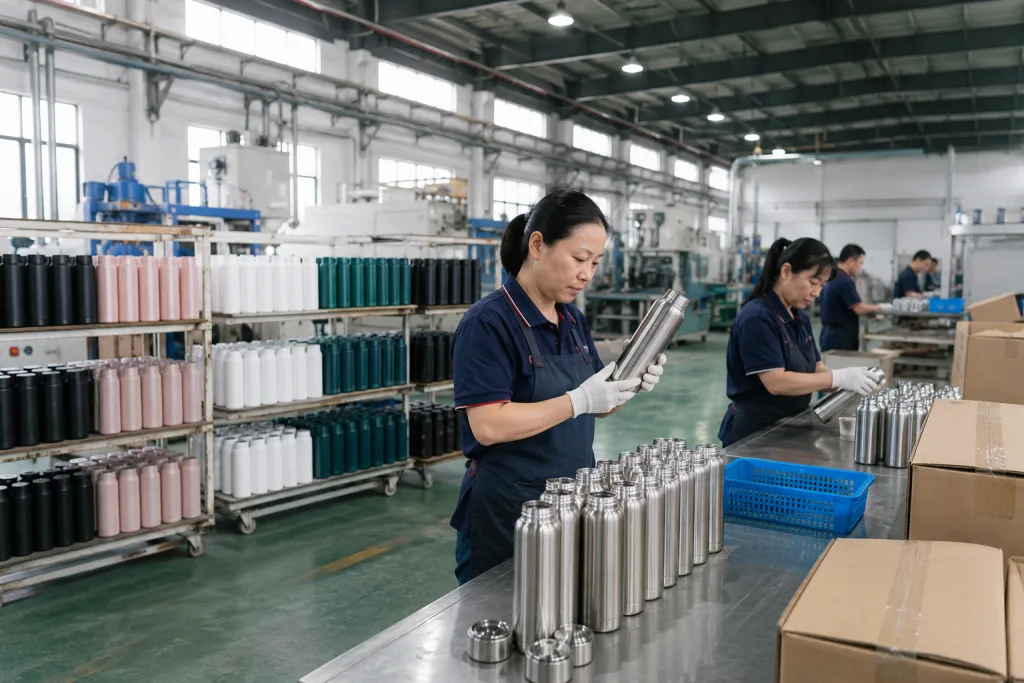
You can buy a stainless thermos from almost anywhere in China. Easy part. The hard part is buying one that lasts through a retail season, passes compliance, prints cleanly on the line, and still fits your target margin. That is where first-time buyers get stuck. A factory quote looks simple, but the real cost sits in the spec: steel grade, vacuum structure, lid fit, coating method, and packing detail. We have seen a 0.3 mm wall change push cost and dent rate in the same order, and this is the wrong place to guess.
If you source for outdoor retail or promotional programs, read a custom thermos spec sheet like a production sheet, not a catalog page. In Zhejiang, China, we see 7 out of 10 new buyers lock color and logo first, then get slowed down by MOQ, leak testing, REACH paperwork, or carton drop risk. Last month, a buyer flagged a clean-looking PO after QC pulled the sample and found the master carton spec missing. That is how orders slip from 12 days to 18 days. A sound manufacture thermos wholesale order starts with the lines that control performance, compliance, and replenishment speed.
Start with steel grade
The first line on a manufacturer thermos sheet should list the body material. Skip the vague wording. For stainless vacuum bottles, the standard commercial build is 18/8 stainless steel, also called SUS304, on the inner wall where the drink touches metal. On stronger retail programs, buyers often ask for SUS304 on the outer wall too. On price-driven promo orders, we still see quotes with SUS201 outside and SUS304 inside, and that difference needs to be written clearly on the sheet.
This choice changes corrosion performance, dent response, and where the bottle fits in the market. For outdoor retail, SUS304 inside and outside is the safer build because the bottle gets knocked around, cleaned hard, and expected to sit on shelf for 12 months or more. For giveaway volume, SUS304 inner plus SUS201 outer can work if the coating passes adhesion checks and the item is meant for short-cycle distribution. We have seen this go sideways in coastal markets where the buyer flagged rust spots after salt-air exposure on the outer shell.
- SUS304: better corrosion resistance, stronger premium story, standard for food contact.
- SUS201: lower cost, usually acceptable for outer wall only, less forgiving in humid or coastal markets.
- Wall thickness: common range is 0.35-0.50 mm inner and 0.45-0.55 mm outer.
Ask your thermos supplier to list the steel grade separately for inner, outer, and lid metal parts. Some customizable thermos quotes show only “stainless steel” with no breakdown. That is not enough. This is the wrong question to ask if you only ask for the lowest price. Ask what grade goes where, and ask for the material cert to match the incoming lot record. On our line, QC pulled a sample last month where the PO said “304 body,” but the outer shell was not split out by grade. If you are comparing thermos manufacturers in Zhejiang, China, the quote should also state whether the material certificate can be tied back to PO or batch number. Serious factory thermos production keeps that traceability on file.
You are not buying “stainless” in general. You are buying a defined grade, defined thickness, and defined risk level.
Vacuum structure and heat retention
The insulation spec is where the product starts to separate. A solid manufacture thermos wholesale item is double-wall vacuum, with the air gap evacuated after body welding on the line. Some distributors thermos programs still write “keeps hot and cold” on the PO. That is the wrong question to ask. Without fill temperature, hold time, and room temperature, the claim is empty.
For a 500 ml stainless bottle, we usually set the production check at 95°C hot water, filled to rated capacity, then measured at 6 hours and 12 hours under ambient 20-25°C. In normal OEM work, 58-65°C after 12 hours is a workable target for a standard bottle. Premium narrow-mouth models can beat that by a few degrees. Large-mouth food jars usually lag because the lid area dumps heat faster. QC pulled the sample more than once where the body was fine but the lid insert was the weak point.
What changes performance?
- Mouth diameter: a 44 mm opening usually loses heat faster than a 32 mm mouth on the same 500 ml body.
- Copper coating: some thermos factory lines add a copper layer on the vacuum wall to cut radiant heat loss; we see this more on higher-spec SKUs.
- Stopper design: screw cap, flip lid, and straw lid do not insulate the same. A buyer flagged this on one outdoor order after comparing a straw lid sample against a plain cap and expecting the same 12-hour result.
- Vacuum pass rate: good factories check 100% or close to 100% for vacuum leakage before packing, often with a vacuum tester right after polishing and assembly.
If you are sourcing custom thermos for outdoor channels, ask for the retention result and the exact test method. If you are sourcing a customized thermos for brand merchandise, the target may be lower, but returns still cost money. We ship both types, and we’ve seen this go sideways when the sales sample passed but the bulk lid structure changed by 1 mm. A thermos vendor should tell you if the model is built for all-day carry, commuter use, or 2-4 hour beverage service.
At BottleForge-type production scale, you should expect inline vacuum checks plus final random inspection under AQL 2.5 or AQL 1.5, based on the quality agreement. That matters more than a printed hour claim. Among manufacturers thermos offers, the bottles quoting 24 hours are not always the most consistent lot to lot. The math doesn't work if 3 out of 500 units lose vacuum after transit.
Lid details decide complaint rates
About 7 out of 10 after-sales complaints we see start at the lid, not the bottle body. The stainless shell can pass drop, weld, and vacuum checks, then fail after shipment because the seal ring rolls in the groove, the hinge pin backs off, or the thread fit is loose by 0.2 mm. On our line, QC pulled a sample last month where the bottle was fine but the lid cross-threaded after 14 turns. If you are reviewing a custom thermos or thermos custom program, lid construction needs real time, not a quick signoff.
What to check on the lid spec
- Material: PP is the standard choice for most lid bodies; Tritan fits clear parts where buyers want to see water level or tea color; silicone is the normal gasket material. We usually confirm resin grade at PO stage because one buyer once typed “silicon” instead of “silicone” on the spec.
- Leakproof level: specify the upside-down leak test time, usually 30 minutes to 2 hours. Better yet, write the water-fill level and test angle into the spec, because this is where arguments start.
- Dishwasher claim: make this claim only after all components have been validated. We have seen lids pass on PP but fail when the printed logo softened after 20 wash cycles.
- Spare gasket policy: set this early for distributor thermos and thermos distributor programs. A common spare ratio is 1% to 3% per order, and it saves trouble on 5,000-piece shipments.
- Handle strength: this matters on 750 ml and 1,000 ml outdoor bottles. We normally run a pull gauge on the handle point because the buyer flagged strap breakage on a 1,000 ml sample before mass production.
A promotional thermos for office gifting can use a simple screw lid. An outdoor retail SKU usually needs one-hand use or a tethered cap, and each extra part adds another failure point. The line gets slower too: more parts to fit, more incoming checks, more replacement claims later. This is the wrong place to chase features for the sake of features. We have seen experienced thermos distributors stay with a plain screw cap and a 2.5 mm silicone ring because the complaint math works better.
Ask for cycle testing. A normal request is 3,000 open-close cycles on a flip lid or a 5 kg pull test on a carry loop, and we run those before final packaging signoff. A reliable thermos manufacturer in China should also run silicone aging checks and odor migration tests for food-contact plastics. If the quote shows a clean rendering but no lid spec, no torque range, and no gasket detail, you are too early to approve the project.
Surface finish changes the economics
Surface treatment is where margin gets won or lost. We can run the same bottle body as a plain bulk thermos, a powder-coated outdoor SKU, or a gift-set item with a rigid box, but the finish changes scrap rate, logo process, and carton loading. Last month QC pulled a sample with a 1.2 mm chip at the shoulder, and that single defect pushed a metallic color lot from smooth to annoying fast.
Common finishes include spray paint, powder coating, brushed stainless, rubber paint, electroplating, and special textures. Powder coating is the standard choice for outdoor retailers because it gives better scratch resistance and grip, and we usually control film build at 60-90 microns with a coating thickness gauge on the line. Brushed or painted finishes can save cost, but buyers often flag them as less premium once they compare samples side by side under warehouse lighting. This is the wrong question to ask: “Which finish is cheapest?” Ask which finish survives handling, packing, and store display.
Logo decoration also needs to match the finish:
- Silkscreen: low setup cost, good for 1-2 spot colors, typical logo area around 40 x 80 mm. We use it a lot on MOQ 3,000 pcs runs.
- Heat transfer: suitable for more complex graphics, but adhesion testing matters. We normally check with a cross-hatch cutter before mass production.
- Laser engraving: durable and clean, common on powder-coated thermos customizable programs. A 20W fiber laser gives a sharp mark if the coating is stable.
- Digital print: useful for small campaigns, usually higher unit cost. Good for short promos, not for every wholesale program.
If you buy thermos promotional quantities, decoration cost can swing more than buyers expect. A one-color screen print may add only USD 0.08-0.18 per unit at 3,000 pcs. Multi-color wrap graphics or custom gift packaging can add USD 0.50-1.50 quickly. We have seen POs where the buyer compared body-only pricing against a full decorated sample, and the math doesn't work. Match the finish spec, logo method, and packaging before you compare thermos quotes.
Factories in Zhejiang, China, usually quote the body and decoration separately for good reason. One scratch-prone metallic finish can increase rework rate by several percentage points, and on a 10,000 pcs order that is not a small number. We have seen this go sideways after a PO typo changed matte black to metallic black. Ask the thermos factory whether color matching follows Pantone reference, whether cross-hatch adhesion testing is done, and whether salt-spray testing is relevant for your market.
Capacity, size, and carton math
Capacity looks simple on a spec sheet. It drives freight, shelf fit, and complaint rate. Standard stainless vacuum bottle sizes are 350 ml, 500 ml, 750 ml, and 1,000 ml. In our line, 500 ml and 750 ml are the safer opening bet for outdoor retail because they sit well in the hand and do not push packed weight too far. For promotional thermos orders, 350 ml and 500 ml usually move faster since they fit laptop bags, office desks, and tighter giveaway budgets. We check this on the bench with a 1 ml graduated cylinder and a digital scale, not by eyeballing the CAD.
Confirm four measurements early: net capacity, overflow capacity, unit size, and packed carton size. Some thermos supplier quotes show only “500 ml,” which is where trouble starts. In production, capacity tolerance of plus or minus about 3% is common depending on internal geometry, shoulder shape, and bottom dome height. QC pulled the sample last month and found a PO typo where “500 ml” was approved, but overflow was 540 ml and the buyer expected a fuller body.
- 500 ml bottle weight: often 260-340 g depending on steel gauge and lid type.
- Carton quantity: usually 24 or 30 pcs for standard packs.
- Master carton limit: many buyers prefer under 15 kg for easier warehouse handling.
- Container loading: a 500 ml bottle may load roughly 10,000-18,000 pcs per 40HQ depending on box style.
This is where manufacturer thermos sourcing meets freight math. The math does not work if the bottle is compact but the gift box is oversized. We have seen a magnetic rigid box add 18 mm in width and drop 40HQ loading hard enough that the buyer flagged the freight line before sample approval. If you are supplying thermos distributors or a thermos vendor network, a plain white box with a master carton label is usually the smarter first shipment. Retail-ready packaging can wait until sales are proven.
Ask the thermos manufacturers for both product dimensions and carton cube before sampling is approved. This is not a small detail. Buyers often pick a bottle silhouette first, then find out it misses FNSKU labeling workflow, retail shelf depth, or common e-commerce carton sizes. We have seen this go sideways after mold polishing started and artwork was already on the line. One missed 5 mm shelf-depth limit can turn a clean launch into a repack job.
Compliance, QC, and order mechanics
The last block on the spec sheet is where projects usually get won or lost: compliance papers, inspection terms, MOQ, and lead time. We have seen orders stall over one missing LFGB report or a PO typo on the gift box barcode. If you buy manufacture thermos wholesale for Europe or North America, the bottle is only half the deal. The other half is proving the item is safe, stable on the line, and ready to ship on the date promised.
For food-contact stainless drinkware, buyers usually ask for REACH, LFGB, FDA-related migration references, or California Proposition 65 review based on the sales market. For kids-oriented items or accessory parts, ASTM references can land on the checklist too. On social compliance, BSCI audit status gets asked for by promotional brands and chain retailers. ISO 9001 helps keep process control in place, but this is the wrong question to ask if no one has current product test reports in hand. QC pulled the sample last month and found a silicone straw odor issue after 48 hours in a sealed bag, even though the paperwork file looked complete.
Your QC terms should be written before deposit payment. Not after. A practical setup looks like this:
- MOQ: 500 pcs per color for existing mold, 3,000 pcs+ for new shape depending on tooling.
- Sampling: 5-7 days for logo sample, 10-15 days for color + packaging set.
- Production: 25-35 days after sample approval and deposit.
- Inspection: AQL 2.5 for major defects, customized checks for vacuum and leakproof function.
- Capacity: stronger thermos factory operations can reach 300,000 units/month on standard models.
If you are comparing thermos suppliers in China, ask them to write FOB Ningbo or FOB Shanghai on the quote, not just “FOB China.” We ship most Zhejiang drinkware cargo through Ningbo, and the truck run from Hangzhou is usually cleaner on timing. Also confirm whether spare parts, barcode application, inner carton labels, and pallet rules are included. One buyer flagged a quote gap after booking because the pallet height limit was 1.6 m and no one wrote it into the PO. A low supplier thermos price stops looking low once those export basics get added back.
For outdoor retailers and promotional brands, the best custom thermos program is rarely the one with the lowest unit price. It is the one with fewer surprises in receiving, fewer compliance gaps before shipment, and fewer complaints after sale. We have seen the math go sideways over a $0.12 saving when the line had to rework 2,000 lids for leak risk.
Send your target spec and get a usable quote
Share capacity, finish, logo method, packaging, and compliance market. We will review feasibility, MOQ, lead time, and FOB pricing before sampling.
Frequently asked questions
What is a realistic MOQ for custom stainless thermos orders?
For an existing bottle mold, a realistic MOQ is usually 500 to 1,000 pcs per color per size. If you want a stock body with laser engraving only, some thermos suppliers can support 300 pcs. For powder coating plus printed logo plus custom box, 1,000 pcs is more common because setup waste and packaging procurement need volume. A fully new customized thermos shape normally starts around 3,000 to 5,000 pcs, sometimes higher if new lid tooling is involved. In Zhejiang, China, the key issue is not just body MOQ. You also need to ask for decoration MOQ, carton MOQ, and whether mixed colors in one order are allowed.
How much does a manufacture thermos wholesale bottle usually cost?
For a standard 500 ml stainless vacuum bottle, FOB China pricing often lands around USD 2.20 to 4.80 depending on steel grade, lid complexity, coating, and packaging. A plain bulk thermos with stock color and white box stays near the lower end. A custom thermos with SUS304 inside and outside, powder coat, laser logo, and retail gift box can move above USD 4.00 quickly. Large 750 ml to 1,000 ml outdoor models usually add USD 0.50 to 1.50 over 500 ml versions. Always compare prices at the same spec level: material, finish, logo method, testing scope, and packaging. Otherwise, one quote can look cheaper while actually removing features you assumed were included.
What tests should I require before approving mass production?
At minimum, ask for vacuum retention test, leakproof test, coating adhesion test, dishwasher claim validation if relevant, and food-contact compliance documents for your market. For a serious thermos manufacturer, 100% vacuum check during production is normal. For finished goods, you should define AQL sampling, often AQL 2.5, and include functional checks like 30-minute upside-down leak test and basic drop review on packed cartons. If the bottle has a handle or flip spout, ask for cycle testing such as 3,000 opens or a pull test around 5 kg. For Europe, REACH-related screening and LFGB-style food-contact review may be needed. For North America, request the relevant migration and chemical declarations before shipment.
Should I choose laser engraving or silkscreen for logo decoration?
If durability matters most, laser engraving is usually the better choice, especially on powder-coated stainless bottles. It does not chip like surface ink and works well for outdoor retail, brand merchandise, and long-use distributor thermos programs. Silkscreen is cheaper for simple one-color logos and can add only about USD 0.08 to 0.18 per unit on larger runs, so it makes sense for promotional thermos campaigns with tight budgets. The tradeoff is wear resistance. For dishwasher exposure or heavy abrasion, screen print will fail sooner. If your brand identity depends on a specific Pantone color, screen print may reproduce it better than laser. Many buyers in China sample both methods before locking artwork.
How long does production and shipment usually take from China?
For a standard custom stainless thermos order, allow 5 to 7 days for a logo sample, around 10 to 15 days for a full pre-production sample with color and packaging, and 25 to 35 days for mass production after approval. In peak season, especially from August to November, some thermos factories in Zhejiang, China, stretch toward 40 days. Ocean transit then depends on destination, but many North America shipments take roughly 20 to 35 days on water, while Europe often runs around 25 to 40 days depending on port and service. If you need barcode labeling, pallet rules, or Amazon FBA prep, add several extra days because those steps usually happen after final packing.