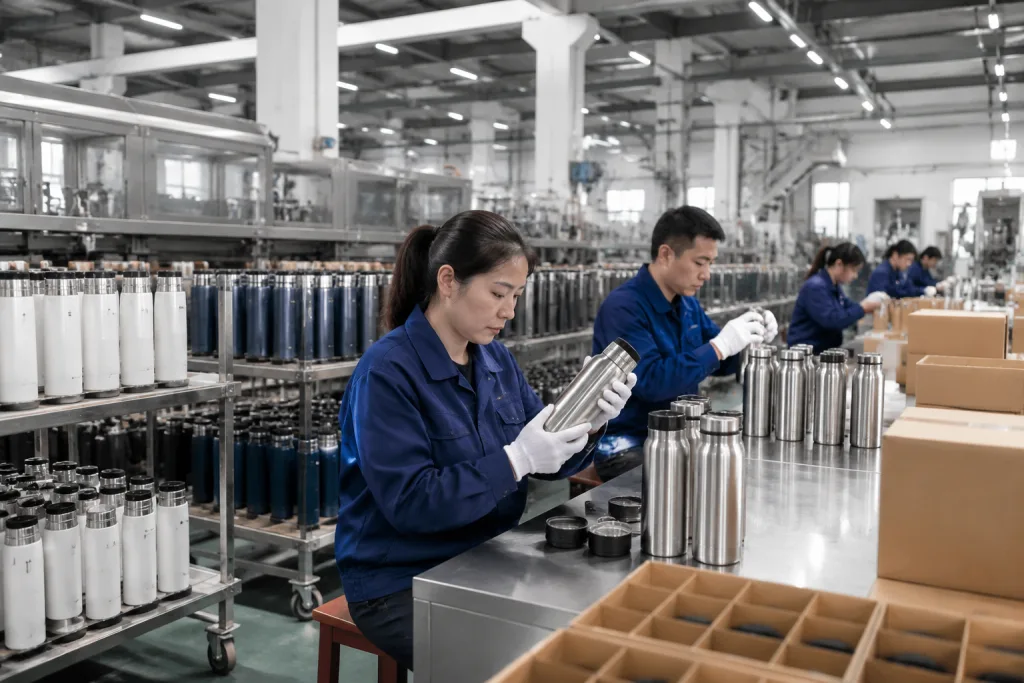
Key Takeaways
- A 500 ml stainless thermos typically starts around USD 3.20 to 5.80 FOB China at 1,000 to 3,000 pcs depending on steel grade, coating, and lid structure
- Changing body wall from 0.4 mm to 0.5 mm can raise unit cost 5% to 9% but usually improves dent resistance and premium feel
- Vacuum retention claims should be tied to a test method, such as 95°C fill and 6-hour or 12-hour temperature result, not marketing words
- A practical MOQ for custom thermos projects is often 500 to 1,000 pcs per color, with 35 to 45 days lead time after sample approval
If you buy a stainless thermos from a photo and unit price alone, you usually pay later in claims, rework, or one 40HQ of slow stock. The drawing is not the main risk. The spec sheet is. A 0.1 mm wall change, one stopper swap, or a different powder coating can move landed cost by 8% to 20%, change carton drop results from 76 cm, and decide whether the flask holds up in winter retail or just survives a short promo run. We’ve seen this go sideways after QC pulled the sample and found the finish looked fine, but the base dented too fast on the line.
If you source manufacture thermos flask wholesale from Zhejiang, China, read the spec line by line and tie each point to buyer impact. Outdoor retailers usually ask about heat retention hours, dent resistance, and spare parts for a 5,000-piece MOQ. Promotional brands push on logo yield, MOQ, and price breaks, and the buyer flagged one PO last month because the lid color code was typed wrong. In both cases, you need a thermos manufacturer that explains the trade-offs plainly. Catalog talk is the wrong answer to this question.
Start with the body specification
The first line to check on a manufacture thermos flask wholesale quote is the body spec: capacity, diameter, height, net weight, steel grade, and wall thickness. Those numbers tell you more than the hero photo. On a standard 500 ml flask, we usually run inner 304 stainless and outer 201 or 304 stainless, with about 0.4 mm on the outer wall and 0.35 to 0.4 mm on the inner. QC pulled one sample last month that looked fine in photos, but the caliper showed the outer wall was short by 0.03 mm. If your channel is outdoor retail, ask for 304/304, not 304/201. It costs more. The corrosion claim is cleaner, and your sales team in Europe and North America will have an easier time defending the price.
Wall thickness changes the feel fast. A 0.5 mm outer wall feels firmer in hand and takes fewer dents during transit drop tests, but the math does not always work because weight goes up and freight can jump a bracket. We have seen buyers push for a stronger body, then flag the shipping cost once the packed weight crosses target. For promo thermos orders, the lighter spec is common because the target FOB is tight, often under USD 4.00. For a premium custom thermos going into specialty outdoor shops, the heavier body usually supports the shelf price better.
- 350 ml: works well for gift sets, cuts steel cost, and fits a smaller logo wrap area; we often pack 24 pcs per carton on this size
- 500 ml: the cleanest balance for price and heat retention, with better carton efficiency on the line
- 750 ml to 1 L: a good fit for camping and distributor thermos programs, but MOQ risk is higher if demand is still untested; this is where buyers most often over-order the first PO
At BottleForge Industrial in Zhejiang, China, a normal MOQ for a customized thermos is 1,000 pcs per model and color, with monthly capacity around 300,000 units across vacuum drinkware lines. If a supplier cannot state the exact wall thickness and steel mix, that is a warning sign. This is the wrong question to dodge. In our factory, the line sheet shows the spec before production starts, and the buyer will usually ask for it again after the first sample. If they cannot answer, you are likely buying a catalog item through a trading layer, not from a true thermos factory with process control.
Vacuum layer and heat retention claims
Heat retention is where 7 out of 10 thermos suppliers start talking loose. You hear “12-hour hot” all the time, but if the supplier cannot show fill temperature, ambient temperature, and the exact check point, the claim does not mean much. Ask for the test condition on paper. For a 500 ml manufacturer thermos, a usable commercial spec is hot water filled at 95°C, then checked at 6 hours and 12 hours in a 20°C room. We usually log this on the line with a digital probe thermometer, not a hand feel. Better units may show above 68°C at 6 hours and above 55°C at 12 hours, depending on lid design and neck opening.
The vacuum layer alone does not decide the result. Neck structure and stopper leakage rate carry the same weight. A narrow-mouth stainless thermos with a screw stopper usually holds heat better than a wide-mouth tumbler style, even if both are sold as insulated. We have seen buyers flag this after comparing samples side by side at 12 hours. If you source thermos bulk for outdoor retail, ask whether the vacuum is checked 100% by vacuum testing or by sampling only. This is the right question. On our side, QC pulled the sample, then the line checks every vessel for vacuum integrity before packing if the order spec requires it.
Ask for these three retention details
- Initial fill temperature, usually 95°C for hot test
- Measurement point, such as 6, 12, and 24 hours
- Pass standard tied to the exact SKU, not a generic catalog statement
You are not buying a promise. You are buying a repeatable performance level that your returns team can live with.
If your program is a promotional thermos rather than a retail thermos custom launch, do not over-spec the bottle. Better retention usually means a more complex lid, 2 or 3 extra silicone parts, and tighter process control at the assembly bench. The math does not work for every project. If the bottle is for event gifting, that extra performance may not matter. We ship plenty of promo orders where the buyer accepted a simpler stopper after seeing the cost delta on 3,000 pcs. The right custom thermos is not the one with the highest claim. It is the one with the right claim for your channel, at a return rate you can accept.
Lid system, stopper, and leak risk
Most buyer claims start at the cap, not the bottle body. On a spec sheet, 2 thermos options can look the same. On the line, a one-piece screw cap, a push-button pour stopper, and a cup-cap assembly fail in different ways: seepage at the silicone seat, sticky buttons after 800 cycles, or thread mismatch from a 0.3 mm tolerance drift. For manufacture thermos flask wholesale, this is the section to slow down on. If a supplier only talks about body material and vacuum time, the wrong question is being asked.
A classic screw stopper with PP inner and food-grade silicone ring is still the safest choice for bulk thermos programs. Fewer parts. Fewer leak paths. We run incoming checks with a thread gauge and a simple torque test, and QC pulled the sample more than once because the gasket was seated unevenly after assembly. A push-button lid looks more premium and sells well in retail, but now you add springs, seal stacks, and tighter fit control. We have seen this go sideways when buyers approved the look and skipped cycle data. If you need a customizable thermos for an outdoor retailer, ask for cycle testing data. A practical target is 3,000 to 5,000 open-close cycles without functional failure.
Cap material changes compliance, smell, and complaint rate. PP is the standard because the math works on cost and molding stability. Tritan gives a cleaner window if you want the liquid level visible, but buyers push back once they see the lid cost jump by 12% to 18% at a 3,000 pcs MOQ. For North America and Europe, ask your thermos supplier for REACH and food-contact compliance declarations. For kids-related items, ask about ASTM or LFGB based on the target market. We also check for odor after hot-water filling at 85°C, because that issue does not show up on a drawing.
- Cup-cap style: still common for traditional thermos distributor orders, and the extra outer cup gives a stronger gift-set look on shelf
- Direct drink lid: more modern, but the line has more assembly points, more tooling inserts, and more chances for a leak complaint
- Wide-mouth lid: easier to clean with a standard sponge brush, but heat retention is weaker than a narrow-neck design
Write the leak test standard into the PO. Example: filled bottle, inverted for 30 minutes, no visible leakage. Better thermos suppliers in China run 100% leak check on assembled units, often with an air-pressure fixture before packing. If your thermos vendor only offers AQL final inspection without in-line cap testing, expect more field issues. We ship to distributors who rebrand one SKU into 4 or 5 markets, and one small cap issue multiplies fast. The buyer flagged this before on a PO where "leakproof" was written but the test method was missing.
Coating, color, and logo decoration
Decoration is where thermos margin gets made or lost. We see it on the line. A stainless body can take spray paint, powder coating, water transfer, laser engraving, silk screen, heat transfer, or UV print, and each one affects abrasion resistance, logo consistency, output speed, and MOQ in a different way. Last month a buyer flagged a wrap logo shift of 1.5 mm on a 750 ml bottle; the steel was fine, but the decoration caused the claim. If you buy thermos customized for a promotional brand, decoration usually creates more complaints than the steel build.
Powder coating is the practical finish for outdoor retail. It gives better scratch resistance and grip, hides minor handling marks, and supports a premium matte look. Typical added FOB cost versus plain spray can be USD 0.25 to 0.55 per unit depending on bottle size and color. We run a cross-hatch adhesion test before packing, and powder usually holds up better after carton rub. For a manufacturer thermos sold as a premium item, that cost is usually justified. Standard spray paint still works for thermos promotional volume if the target is a lower price point and a smooth gloss finish.
For logos, silk screen is the budget pick for 1 or 2 colors on flatter surfaces, but yield drops fast when artwork gets large and the bottle shoulder is too round. Laser engraving looks cleaner on stainless or powder-coated surfaces and lasts longer in daily use. UV print handles gradients and photo-style graphics, but the rub resistance is weaker unless you add protection. This is the right question to ask: what is the decoration rejection rate by method? A real producer should tell you if a large wraparound logo slows output from 1,200 pcs to 900 pcs per shift or pushes scrap higher. QC pulled the sample once because the PO said “Panton blue” instead of Pantone blue, and that small typo delayed approval by a day.
Typical custom rules in Zhejiang, China look like this:
- Silk screen setup: low tooling cost, MOQ often 500 to 1,000 pcs per artwork
- Laser engraving: no ink color matching issues, better for smaller logos
- Pantone custom color: usually needs 7 to 10 extra days for sample approval
If your brand sells through distributors thermos channels, pick logo methods that stay repeatable over reorders. We have seen this go sideways. A custom color that looks right on the first lot but drifts on the second lot will hurt your resellers first, and the math does not work if they have to hold mixed inventory. Before mass production, ask for a retained color chip and a signed master sample from the factory shelf.
Testing, compliance, and inspection points
Good thermos suppliers do not wait until final inspection to find trouble. We run control from incoming 304 stainless and PP checks through vacuuming, polishing, powder coating, assembly, and packing. On the line, QC pulled the sample every 2 hours on one recent order because the buyer flagged lid fit on a 0.3 mm thread tolerance before mass production. For you, this is the right question to ask: which tests are standard in the quoted price, and which ones show up later as extra charges?
For stainless thermos wholesale, the base package should cover raw material verification, in-line vacuum check, leak test, coating adhesion or scratch check where applicable, and final AQL inspection. A common export level is AQL 2.5 for major defects and 4.0 for minor defects, and that should be written on the PO, not left in email chat. For retail-ready custom thermos programs, we have seen buyers tighten visual limits after first shipment because one dented rim in a store set off complaints. If you ship to Amazon or another high-return channel, stricter visual standards make sense. The math does not work if you save $0.08 on inspection and lose stock to returns.
Compliance should match your market, not a generic certificate folder. Ask for food-contact declarations for the full bill of materials: stainless steel, PP, silicone, paint, and any glue. REACH is common for Europe. If the item targets children, additional standards may apply. If your customer asks for social compliance, check whether the plant has BSCI or equivalent audit status, and verify the scope and valid date. We have seen this go sideways when a buyer assumed the audit covered the drinkware workshop, but the certificate was issued for another product line in the same group.
Inspection points buyers often miss
- Thread smoothness between cap and neck after coating; we usually check this after curing because paint buildup on the first 2 turns can cause cross-threading
- Odor after 24-hour hot water soak; silicone seal smell is a common pushback on new molds
- Base wobble on flat table; a 1 mm wobble is enough for a retailer to reject the lot
- Barcode, FNSKU, and carton marking accuracy for FBA programs; one wrong digit on a master carton label can hold the shipment
A thermos factory in China should also state its packaging drop standard. For example, 1A carton drop from specified height based on packed weight. If you are buying thermos bulk for 32 to 38 days of ocean transit from Zhejiang to Europe or the US, this matters more than a showroom finish. A clean-looking bottle is easy. The real test is whether the unit still passes leak check after the carton takes hits at port, in container loading, and at the destination warehouse. We ship plenty of orders where outer carton strength matters more than glossy photos.
MOQ, price breaks, and lead time reality
Manufacture thermos flask wholesale pricing moves fast because the build details move fast. For a basic 500 ml stainless vacuum flask with standard screw cap, 304 inner and 201 outer, plain finish, and export carton, a rough FOB China range might be USD 3.20 to 4.10 at 3,000 pcs. Move to 304/304, powder coating, custom color box, and laser logo, and you may land at USD 4.60 to 5.80. Add a more complex lid and smaller order quantity, and the number goes up again. We see this on the line all the time: a lid with 2 extra silicone parts and a wider PP handle can add USD 0.35 to 0.60 before packing is touched.
MOQ should be discussed by model, color, and decoration, not by total order alone. This is the wrong question to ask. A thermos supplier may say MOQ 500 pcs, but then require 500 pcs per color plus separate decoration minimums. We usually tell buyers to ask for the true commercial MOQ in one sheet: body color, lid color, logo process, and box style. One buyer flagged a 3-color PO at 1,200 pcs total, then found out the spray line needed 400 pcs per color and the laser logo vendor wanted 500 pcs per artwork. For a customized thermos program, outdoor retailers usually do better with 2 colors on the first run and deeper quantity per SKU. Promotional thermos buyers often split into 4 or 5 colors to hit campaign themes, and we’ve seen this go sideways on lead time and carton balance.
Lead time needs real numbers. A realistic schedule from Zhejiang, China is 3 to 7 days for stock sample, 7 to 12 days for pre-production sample with logo, then 35 to 45 days for mass production after sample approval and deposit. Peak season can extend this to 50 days if the powder coat booth and vacuum furnace are fully booked. If your supplier thermos quote says 20 days for a fully custom build in high season, ask how they are doing it. Sometimes the answer is honest line availability. Sometimes QC pulled the sample and found they were compressing curing time or skipping buffer stock for caps and color boxes. The math doesn't work if tooling, coating, printing, assembly, and AQL inspection all need to fit inside 20 days.
- Sample phase: lock color, logo size, packaging, and barcode before deposit; we check logo position with a mm ruler on the wrapped sample, not from artwork only
- Mass production: confirm approved sample number or signed golden sample; if the PO says “mat black” and the sample says “sand black,” fix it before the line starts
- Reorder: ask whether components are common or custom-tooled; a common stopper can cut repeat lead time to 25 to 30 days, while a custom lid keeps you in the 35-day range
The best thermos custom buying plan is usually conservative on first order and aggressive on reorder. We usually suggest 1 or 2 proven SKUs, 2 colors, and one packaging style for the first 3,000 pcs. Then negotiate better breaks once the SKU is stable and your thermos manufacturer has real consumption data from reorders, reject rate, and cap inventory. That is how we ship faster on the second PO.
Packaging spec is part of the product
Buyers push packaging to the end. We’ve seen this go sideways. In manufacture thermos flask wholesale, the pack spec changes line labor, breakage, pallet count, and landed cost. A plain white box with an EPE divider is not exciting, but it often protects margin better than a rigid gift box that looked sharp on Zoom and reached the warehouse with 18 mm corner crush.
For outdoor retail, carton strength and barcode accuracy matter more than fancy inserts. Ask for carton dimensions, gross weight, and units per carton at sampling stage, not after the PO typo is already on the print file. Once a carton gets past 15 kg gross, warehouse teams start pushing back and the buyer flags handling claims. For promo brands, a color box may be needed, but this is the wrong question to ask if nobody checked sell-through first. Typical color box addition can be USD 0.20 to 0.60 per unit depending on print coverage and insert structure.
If you work with thermos distributors or a thermos distributor network, ask for flexible pack-out options: blank box, logo box, PDQ display, or a mailer-ready set with corner drop protection. We run this off the same bottle all the time, but the dieline and carton count have to be locked early. For e-commerce and Amazon programs, include suffocation warning if required, FNSKU placement, carton labels, and drop-test logic before production starts. QC pulled a sample last month where the FNSKU sat across the lid seam; that kind of miss costs time.
A reliable manufacturers thermos partner should give you a packing spec sheet with:
- Unit pack dimensions and net weight
- Master carton dimensions and gross weight
- Pallet loading estimate for 20GP and 40HQ
- Marking layout for shipping and retail compliance
The bottle, cap, logo, and box are one commercial unit. Full stop. If one piece is under-specified, the project is under-specified. That is why experienced thermos manufacturers push buyers to approve the whole pack, not only the bottle body, and why we ship signed packing artwork before mass production starts.
Send your thermos spec for a real factory review
Share capacity, steel grade, lid type, logo method, and target price. We will check MOQ, compliance, and lead time from our Zhejiang production team.
Frequently asked questions
What is a normal MOQ for a custom stainless thermos order?
For a true custom thermos, a normal MOQ is 500 to 1,000 pcs per model per color, but the real answer depends on decoration and packaging. A plain logo on an existing 500 ml flask may start at 500 pcs. A Pantone body color plus custom box is more often 1,000 pcs or higher. Some thermos suppliers quote a low total MOQ but then add separate minimums for silk screen, laser, or gift box. Ask for the commercial MOQ by SKU, color, and artwork. If you are testing a new market, it is better to launch 1 or 2 colors at 1,000 pcs each than 4 colors at 250 pcs each. That improves coating consistency, output speed, and reorder planning.
How much does a wholesale stainless thermos usually cost?
A common FOB China range for a 500 ml vacuum flask is USD 3.20 to 5.80 depending on steel grade, wall thickness, cap structure, finish, and packaging. Basic 304 inner plus 201 outer, plain finish, and standard white box sits at the lower end. 304/304 construction, powder coating, laser logo, and a custom color box can add USD 1.00 to 1.70 per unit. If you buy thermos bulk above 3,000 pcs, you usually get a better bracket. Below 1,000 pcs, decoration and setup costs have a bigger effect. Always compare quotes on the same spec lines: steel, thickness, cap, coating, packaging, and test standard.
What tests should I require before shipment?
At minimum, require leak test, vacuum retention verification, visual inspection, and carton drop review. For export programs, final inspection is often done to AQL 2.5 major and 4.0 minor, though you can tighten this for premium retail. Ask the thermos factory to define the leak test, such as filled and inverted for 30 minutes with zero visible leakage. For retention, request the actual condition, for example 95°C fill and 6-hour or 12-hour reading. If the bottle has powder coating, ask for adhesion or abrasion checks. For Europe, request REACH-related material declarations where applicable. If units go to Amazon, confirm FNSKU and carton labeling accuracy before sealing export cartons.
Which lid style is safest for outdoor retail use?
For low return risk, a screw stopper or simple screw cap is still the safest choice. It has fewer components than a push-button mechanism and usually performs better on leakage over time. For a 500 ml or 750 ml stainless thermos sold through outdoor retailers, a narrow-mouth screw system gives the best balance of heat retention, durability, and serviceability. Push-button lids can sell well, but you should ask for 3,000 to 5,000 cycle testing and a clear spare-part policy. If your customer values easy cleaning, wide-mouth styles help, but they usually give up some heat retention. Match the lid to the selling channel, not just to the photo trend.
How long does production take from sample to shipment?
A practical timeline is 7 to 12 days for a pre-production sample with logo, then 35 to 45 days for mass production after sample approval and deposit. Stock samples can be faster, often 3 to 7 days. If you need a custom color, special coating, or gift box, add several days for proofing and approval. Peak season can stretch the factory lead time, especially before major holidays and the fourth quarter shipping rush. If the supplier promises full custom production in 20 days, ask whether they control the plant directly and whether all components are standard. In Zhejiang and other China manufacturing clusters, honest scheduling is a better sign than aggressive scheduling.