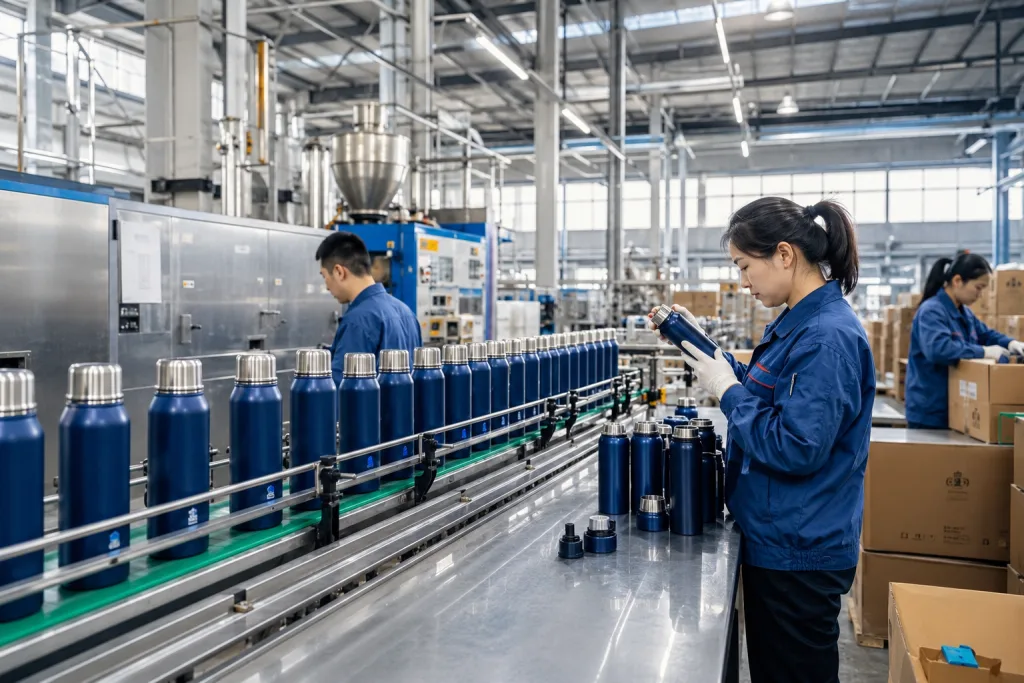
Key Takeaways
- A 500ml stainless steel bulk thermos typically lands at USD 3.20-5.60 FOB China at 1,000-5,000 units depending on steel, coating, and lid
- Most customized thermos projects start at 500-1,000 units per color, while new molds usually need 3,000-5,000 units to make sense
- Repeat orders often ship in 25-35 days, but first orders with sample approval usually take 35-55 days from deposit
- Common cost adders include copper lining, powder coating, gift box packing, and logo methods that can add USD 0.08-0.90 per unit
You are not buying a consumer flask. You are booking a production slot, locking a material spec, and confirming a packaging plan that still has to protect margin after freight, duty, and claims. This is why manufacture thermos bottle wholesale gets messy fast. We have seen one 500ml bottle quote move from USD 3.10 to USD 6.80 because the buyer flagged 304 stainless on the body, changed to a double-spray powder coat, switched the lid to a 3-part structure, and cut the master carton pack from 24 pcs to 12 pcs after the first costing sheet.
Outdoor retailers and promo brands usually ask the same three things, though this is the wrong question to ask if you want a clean quote first: unit price, true MOQ, and lead time. On our side in Zhejiang, buyers lose more days on artwork, pre-production samples, and carton mark revisions than on bottle forming at the line. Last month QC pulled the sample because the PO typo showed matte black, while the approved file was satin navy, and that alone cost 4 days. If you want a custom thermos program that runs smoothly, get the cost breakdown and timing numbers before you sign off the first drawing.
What actually moves the price
Ask for a manufacture thermos bottle wholesale quote and the shape only gets you in the door. The real number comes from BOM and process route. A straight 500ml factory thermos in 18/8 stainless steel with a standard PP lid, spray finish, one-color silkscreen logo, and white box may quote at USD 3.20-3.80 FOB Ningbo at 3,000 units. Change only three items: powder coating, laser engraving, and a leakproof carry lid. The same volume moves to USD 4.20-4.90. We see this on the line all the time. Same capacity, different tooling hours, different reject risk.
The biggest cost drivers are usually these:
- Steel grade and weight: 304 inner and outer is standard for most manufacturer thermos programs. A 500ml body using 0.4mm outer wall and 0.35mm inner wall costs less than a heavier shell built for outdoor use, and QC checks that thickness with a micrometer before the body goes to vacuum.
- Vacuum structure: Double-wall vacuum is the baseline. Add copper coating on the inner wall and heat retention improves, but it usually adds around USD 0.12-0.25 per unit. If a buyer asks only about hold time and not the added piece cost, this is the wrong question to ask.
- Lid complexity: Screw cap is simple. Flip lids, tea filter lids, handle lids, and magnetic caps add assembly steps, more silicone parts, and more leak-test failures at 0.03 MPa air pressure.
- Surface finish: Brushed steel is cheaper. Spray paint sits in the middle. Powder coating, rubber paint, and gradient colors cost more because the coating line runs slower and reject rate climbs fast if the edge build is uneven.
- Decoration: Silkscreen can add USD 0.05-0.12 per color. Laser is often USD 0.08-0.20. Full-wrap heat transfer or digital print goes higher, and the buyer flagged one order last month because the logo on the PO was 2mm off-center from the approved artwork.
- Packaging: Egg-crate bulk pack is the cheapest route. PDQ, gift box, and e-commerce drop-test packaging can add USD 0.35-0.90, and for some 3,000-unit projects the box costs more than the lid upgrade. The math doesn't work if the retail pack is doing all the damage.
In Zhejiang, China, serious suppliers thermos buyers ask for gross weight, carton size, and loading quantity at the same time as unit price. They should. A bottle that is cheaper by USD 0.10 can still lose after freight if the carton size is bloated and loading drops from 6,800 pcs in a 40HQ to 5,900. We ship by container math, not piece-price math. For promotional thermos orders, packaging is where margin gets hit first: the logo bottle looks cheap on paper, but the retail box, barcode label, and drop-test insert change the whole quote.
MOQ tiers that make commercial sense
MOQ on paper and MOQ on the line are usually two different numbers. A catalog may show 300 units for a thermos bottle, but that price normally assumes an existing mold, 2-3 stock colors, standard inner box, and one simple one-color logo. Once a buyer asks for a customized thermos with repeatable Pantone matching, retail-ready packing, and stable replenishment for a seasonal outdoor program, 300 stops making commercial sense. We have seen this go sideways when the PO says “same as last order” but the carton spec was never locked.
A practical MOQ structure for stainless steel thermos bulk orders looks like this:
- 300-500 units: Existing bottle only, limited stock colors, one simple logo, no custom box. Good for testing a promotional thermos design, but the factory usually runs this on open capacity, not as a priority slot.
- 500-1,000 units: Most realistic starting point for custom thermos projects using existing molds and one body color. This is where buyers start to get cleaner cost control on silk screen setup and carton count.
- 1,000-3,000 units: Better tier for outdoor retail because coating cost, logo setup, and packing labor spread out properly. On our side, this is also where QC pulled the sample and carton drop test costs stop hurting the unit price.
- 3,000-5,000 units: Where you usually get the strongest FOB price and more flexibility on accessory mixing. The line runs smoother here, especially if the lid, base pad, and strap are fixed before mass production.
- 5,000+ units: Suitable for private label launches, distributor thermos programs, and more aggressive packaging customization. This is the tier where a 20GP loading plan and barcode label position start to matter more than the first sample photo.
If you need a new lid or new body tooling, the economics change fast. New body mold costs can range from USD 3,000 to USD 12,000 depending on complexity. New plastic lid tooling may be USD 2,500-8,000. The wrong question to ask is “Can you make 500 pcs with new tooling?” Usually the math does not work. Most manufacturers thermos projects start from an existing platform, then change the finish, lid insert, logo, and box first. That cuts risk before anyone opens a new mold at 0.2 mm tolerance.
At BottleForge Industrial in Hangzhou, Zhejiang, a normal MOQ for an existing stainless thermos is 1,000 units, while monthly capacity can reach 300,000 units across standard vacuum bottle lines. That matters if you are a thermos distributor or thermos vendor planning replenishment. A low MOQ helps on the first order. Stable capacity helps on the third and fourth orders, when the buyer flagged lead time and wants 12 days vs 18 days on repeat SKUs. We ship first orders with caution; repeat orders are where a factory proves itself.
Unit cost by common thermos spec
You do not need exact pricing before sampling. You do need a budget range that matches factory reality. Below are workable FOB China numbers we use for wholesale planning, based on standard bottle structures and normal line output at 3,000 units. They are not universal market prices, and this is the wrong question to ask anyway. The useful question is whether your target spec can be built inside margin before we cut the first sample on the spin welder.
Typical FOB ranges
- 350ml vacuum bottle, simple screw lid: USD 2.80-3.60 at 3,000 units
- 500ml vacuum bottle, standard sports or screw lid: USD 3.20-4.60 at 3,000 units
- 750ml outdoor thermos with handle lid: USD 4.20-5.80 at 3,000 units
- 1L heavy-duty stainless thermos: USD 5.20-7.40 at 2,000 units
Then add the usual options. This is where buyers often miss the math, especially after they ask for one more finish, one more insert, and one more print position on the same PO.
- Powder coating: plus USD 0.18-0.35
- Copper insulation layer: plus USD 0.12-0.25
- Tea infuser or strainer: plus USD 0.20-0.45
- Two-position logo print: plus USD 0.08-0.22
- Individual color gift box: plus USD 0.35-0.70
- E-commerce protective insert: plus USD 0.15-0.40
For bulk thermos programs aimed at outdoor retail, the best-selling range is usually a 500ml or 750ml bottle with 304/304 stainless, powder coating, laser logo, and a standard export box. We run that spec every month because the cost stays under control and the line stays stable. A 0.4 mm inner wall and standard carton pack usually make more sense than paying for retail-style packaging your dealer channel will throw away. Promotional programs flip the priority. The buyer flagged this more than once: shave USD 0.20 off the bottle, then spend it on the gift box because shelf look and unboxing win the order faster than 2 extra hours on the heat test.
You can save 6-12% by simplifying one expensive feature, but you can lose 20% margin if the bottle comes back for leaks, coating chips, or failed carton drops.
This is why the supplier thermos discussion needs AQL levels on the table, not only price. AQL 2.5/4.0 is common for finished drinkware inspections, and QC pulled the sample for issues as small as logo shift over 1.5 mm or a chip at the bottle base after drop check. If your custom logo thermos is going into retail chains, ask for tighter appearance limits on visible coating defects and logo position tolerance. We have seen this go sideways when a buyer approved the price first and only later added stricter visual standards.
Lead times buyers should really expect
Buyers fixate on the ex-factory date and miss the approval chain that eats the calendar first. For a first-time custom thermos or customizable thermos order, we usually break the job into five stages, and yes, the buyer flagged this more than once after the PO was already stamped.
- Quotation and spec confirmation: 2-5 days
- Pre-production sample: 7-12 days using existing mold; 20-35 days with new tooling
- Artwork and packaging approval: 3-7 days if your team responds quickly
- Mass production: 25-35 days for 1,000-5,000 units; 35-45 days for larger or more complex orders
- Inspection and booking: 3-7 days depending on booking window and final QC
So the real first-order timeline is about 35-55 days for most thermos custom programs on existing molds. Repeat orders often move in 25-35 days if color, packaging, and accessory parts stay unchanged. Peak season is different. Before August outdoor launches or Q4 promo buys, we tell customers to add 7-15 days, because the line gets packed and booking space tightens fast.
China production timing is not just line speed. Coating queues and packaging material lead times decide plenty of orders. In Zhejiang, the outside carton printer or color box supplier is often the choke point on customized thermos projects. We’ve seen this go sideways when a buyer changes a barcode or adds multilingual compliance marks after sample sign-off, and then the carton file has to be reopened at 3 mm text size checks.
If you are buying for Amazon FBA, add extra days for FNSKU labeling, carton marking, and drop-test packaging checks. QC pulled the sample more than once because the carton mark was 12 mm off center. If you are buying for Canada, the US, or Europe retail, leave time for lab testing when the product construction is new. This is the wrong question to ask if you wait until production is finished. REACH and LFGB are manageable, but the calendar does not care.
How to avoid expensive timeline slips
Most delays are preventable. They usually start with sloppy specs, not because the plant forgot how to run 304 stainless on the line. If you buy from thermos suppliers in China, send one final approved spec sheet before deposit. One file. We have seen POs held 3 days because the buyer sent two different mouth diameters in the same email thread: 55 mm in the artwork file and 58 mm in the packing note.
Your spec pack should cover:
- Capacity and overflow capacity
- Body size and mouth diameter
- Steel requirement, usually 18/8 or 304
- Coating color by Pantone reference
- Logo method, size, and position
- Lid style and material
- Packaging layout, barcode, and shipping marks
- Testing or compliance requirement such as REACH, LFGB, ASTM, or BPA-free declarations
For outdoor retailers, add working performance points, not marketing language. Spell out the leak test standard, target heat retention like 12 hours hot at 95°C fill, scratch resistance, and whether the bottle must fit a 74 mm cup holder or a common backpack side pocket. For distributor thermos programs, ask early if parts will be shared across SKUs. Shared lids and shared cartons sound simple, but they save reorder headaches later; we ship faster when 2 or 3 models run the same stopper and inner tray.
A good thermos factory should also tell you what will fail. This is the right pushback. Matte light colors pick up glove marks and tray rub during assembly, and QC pulled the sample more than once for this on cream-white powder coat. Large wrap logos on textured powder coating often distort at the edges after printing. Narrow-neck bottles look premium, but buyers have flagged them after sampling because a standard 38 mm cleaning brush would not pass through. Honest feedback saves 1 round of sampling and keeps mass production yield stable instead of going sideways at 60% through the run.
Use a simple QC structure: pre-production sample approval, in-line inspection, and final inspection by AQL before balance payment. We normally check critical dimensions with a digital caliper and pull sealing tests during production, not only at the end. If social compliance matters to your account, ask for BSCI or equivalent audit status before you place the PO. After goods are finished, the math doesn't work.
Best fit for outdoor and promo channels
Outdoor retailers and promotional brands both buy stainless steel bottles, but the buying logic is different. Mix the two channels together and the math doesn’t work. We’ve seen buyers ask for the same quote logic on a shelf item and an event giveaway, then push back when the margin disappears after transit claims or rush freight.
Outdoor retail cares about how the bottle holds up after 6 months on the shelf and 3 weekends in use. Finish consistency matters. Repeat orders matter more. We run this line with tighter checks on coating thickness, gasket fit, and vacuum hold time, and QC pulled the sample more than once over a 0.4mm paint edge issue. Spend on the bottle, not a fancy carton: stronger coating, a gasket design that seals cleanly, stable vacuum performance, and transit packaging that protects the finish without adding dead cost. A 750ml custom thermos for outdoor shelves may justify a USD 0.20 higher body cost if returns drop by 2-3%.
Promotional thermos buying is usually driven by a hard date and a landed-price target. The buyer flagged this last spring on a PO with the event date typed wrong by 10 days, and that kind of mistake can kill the job. Here the priorities are logo impact, landed cost, and schedule certainty. A 500ml promotional thermos with existing mold, stock color, one-position logo, and standard box is often the better call than a heavily customized thermos that misses the event date. If the campaign is under 1,000 units, stock-accessory programs from a China supplier thermos line are often safer than over-customizing.
For either channel, ask the commercial question that actually matters: is this a one-shot order or the start of a platform? This is the right question. If it is a platform, choose a thermos customizable structure that can expand into 350ml, 500ml, and 750ml with shared visual language, shared lids where possible, and the same QC standard. On our side, that usually means checking whether one cap set can run across 2 or 3 bodies before tooling starts. That is how a manufacturers thermos relationship becomes more profitable over time.
The buyers who do well in China are not the ones chasing the lowest first quote. They lock the right spec early, work with realistic MOQ tiers like 500 / 1,000 / 3,000 pcs, and leave enough time for sampling, packaging, and inspection before the vessel cutoff. Short lead times sound good until the line is waiting on inserts or the inspection finds logo position drift at 2mm. We ship smoother jobs when the spec is fixed first.
Get your thermos cost and lead-time quote
Send your target capacity, logo file, packaging idea, and order quantity. We will reply with a practical FOB range, MOQ, and production schedule.
Frequently asked questions
What is a realistic starting MOQ for manufacture thermos bottle wholesale?
For an existing stainless vacuum bottle, 500-1,000 units is the most realistic entry point if you want your own logo and one body color. Some thermos suppliers in China may offer 300 units, but that usually means limited stock colors, basic white box packing, and fewer customization options. If you want a customized thermos with custom color box, multiple logo positions, or accessory changes, 1,000-3,000 units is the better commercial range. For new body molds or new lid tooling, you should usually plan around 3,000-5,000 units minimum to absorb tooling cost. Anything lower can still be done, but the unit price rises fast and repeat pricing becomes harder to keep stable.
How much does a custom stainless thermos usually cost wholesale?
A common 500ml double-wall 304 stainless thermos bulk order usually runs about USD 3.20-4.60 FOB China at 3,000 units using an existing mold. If you add powder coating, a premium lid, copper insulation, and gift box packaging, the same bottle can move to USD 4.50-5.60. Larger 750ml and 1L outdoor bottles often sit in the USD 4.20-7.40 range depending on gauge, lid structure, and finish. Logo printing is usually a small part of the total, often USD 0.05-0.20 per unit, while packaging can add USD 0.35-0.90. Ask your thermos manufacturer for carton size and gross weight too, because freight efficiency affects your true landed cost.
How long does a first custom thermos order take from China?
Using an existing mold, a first custom thermos order usually needs 35-55 days from deposit to shipment. That often breaks down into 7-12 days for sample making, 3-7 days for artwork and packaging approval, 25-35 days for mass production, and another 3-7 days for final inspection and booking. If you need new tooling, add roughly 20-35 days. Repeat orders are faster, often 25-35 days, as long as the color, lid, logo method, and box remain unchanged. In peak periods in Zhejiang or other China production hubs, it is smart to add a 7-15 day buffer for coating lines, carton suppliers, and vessel booking.
What tests or compliance documents should I ask for?
For Europe and North America, ask for the documents that match your channel instead of requesting everything. For stainless drinkware, buyers commonly ask for REACH-related material declarations, LFGB for food-contact expectations in Europe, and BPA-free statements for plastic components. If the item is for children or a special retail channel, ASTM-related checks may also come up depending on the accessory design. Beyond lab reports, ask your thermos factory about AQL inspection standard, leak testing, vacuum retention checks, and coating adhesion checks. AQL 2.5/4.0 is common for final inspection. If social compliance matters, confirm BSCI or equivalent audit status before placing the PO, not after production starts.
How can I reduce cost without hurting quality too much?
Start with the parts customers notice least. Keep 304 stainless inner and outer if possible, but simplify the lid, decoration, or packaging. Switching from custom gift box to a clean standard box can save USD 0.30-0.70 per unit. Moving from two-position print to one laser mark can save another USD 0.05-0.15. Using an existing mold instead of new tooling saves thousands upfront and shortens lead time. For many outdoor or promotional thermos orders, the best value setup is existing bottle shape, one powder-coated body color, one logo position, and standard export carton. Do not cut cost by using poor gaskets or unstable coating, because a 1-3% return rate will usually erase the savings faster than any small FOB reduction.