Key Takeaways
- Most custom bulk drinkware programs start at 1,000-3,000 pcs per SKU, while stocked models can begin around 500 pcs.
- A realistic lead time is 7-10 days for samples and 30-45 days for mass production after approval.
- 304 stainless steel is standard for bottle bodies; verify REACH, LFGB, FDA, or ASTM needs before PO release.
- Use an AQL plan such as 2.5 major and 4.0 minor, not a vague promise of 100% good quality.
You are not buying 12 sample bottles for a photo shoot. You are lining up supply, pricing, compliance, decoration, and delivery so nothing blows up 6 weeks later. This is where bulk drinkware orders fail. We see it on the line: the quote looks fine, then the logo process is wrong, the master carton comes out 8 mm over the pallet plan, or QC pulled the sample and found the factory has no report set for your market.
For bulk drinkware, the main job is risk control. If you source from Zhejiang, China, ask straight about MOQ, wall thickness, insulation performance, AQL, lead time, and what FOB pricing actually covers. This is the wrong question to skip. BottleForge Industrial in Hangzhou, Zhejiang runs OEM and ODM programs with capacity around 300,000 units per month, and the buyers who move fastest usually send sharper RFQs early—one buyer even flagged a PO typo on lid color before sampling, which saved 12 days versus fixing it after tool approval.
What are you really buying?
Procurement managers usually ask for unit price first. That is the wrong question. “Manufacture drinkware in bulk” might mean a 500 ml vacuum bottle, a 64 oz growler, a beer tumbler promo run for bar service, or an alcohol flask project with a gift box and insert card. On a spreadsheet they all sit under drinkware. On the line, they are 4 different jobs with different tooling, labor, and QC points.
The cost moves with material grade, body construction, decoration method, and pack-out. A single-wall canteen in 18/8 stainless is a simpler build. A double-wall copper-coated bottle with powder coat, laser engraving, and an individual barcode label goes through more stations, and QC pulled the sample more than once on engraving position tolerance at 2 mm. A growler with a swing cap needs leak testing and a straight talk about pressure use. A kids bottle needs extra attention on small parts and the applicable ASTM requirements. Skip these details and the math doesn’t work, because you end up comparing quotes built on different assumptions.
- Material: 304 stainless steel is common for inner and outer walls; some budgets use 201 on non-food-contact outer parts.
- Structure: single-wall, double-wall vacuum, or double-wall non-vacuum.
- Capacity: common ranges are 350 ml to 1,900 ml for wholesale canteen and thermos lines; growler wholesale programs often run 32 oz, 64 oz, and 128 oz.
- Decoration: silkscreen, heat transfer, UV print, powder coat, laser engraving, embossed logo, or decal.
- Packaging: egg-crate bulk pack, white box, color box, PDQ, or Amazon FNSKU-ready units.
Factories in China, including shops across Zhejiang, quote faster when you send a full spec sheet instead of a mood board. We usually turn a clear RFQ in 12 days vs 18 days once details are locked, especially if the PO shows bottle size, lid style, print location, pack method, and MOQ in one file. If you want the best wholesale drink bottle for your channel, define the exact use case first: retail shelf, e-commerce, corporate gift, gym chain, brewery merchandise, or seasonal promotion. We’ve seen this go sideways when a buyer flagged “retail pack” on the email, but the PO typo showed bulk pack.
How do MOQ and pricing move?
MOQ is where new buyers burn 12 days instead of 3. We get the same ask every month: canteen wholesale at 300 pieces with custom color, laser logo, and gift box, then the buyer flags the price. The math doesn’t work. On the factory side, MOQ is set by setup scrap, powder coating batch size, master carton fill, and line changeover; on one 500ml bottle, QC pulled 26 sleeves of wasted labels just from color switch.
For a practical benchmark in China, stocked colors with one-color print may start around 500 pieces. A fully custom wholesale drinkware program is more often 1,000 to 3,000 pieces per SKU per color. New mold projects can go higher depending on cap complexity. At BottleForge Industrial in Zhejiang, a standard vacuum bottle often runs from 1,000 pcs MOQ, while custom packaging or unique lid tooling can push the commercial minimum upward. One common pushback is “Why not 500 pcs with a new lid?” Because a single tooling trial can eat 18 to 25 kg of resin before the line is stable.
Unit price also moves in predictable ways:
- Below 1,000 pcs: decoration and carton costs are spread over too few units; we still run the same screen, same fixture, same drop-test carton.
- At 3,000-5,000 pcs: color coating and print setup become more efficient, and carton packing usually lands cleaner on the line with less idle time.
- At 10,000+ pcs: you may reduce cost by 5% to 12%, depending on model and pack-out; this is usually where full-pallet planning starts to help.
A rough FOB China range for standard stainless items can look like this: a single-wall canteen bulk bottle at USD 1.80-3.20, a basic vacuum bottle at USD 3.20-6.80, a 64 oz beer growler wholesale bulk model at USD 6.50-11.50, and an alcohol flask wholesale item at USD 1.20-2.80. These are not promises. They are planning numbers. We have seen a PO jump fast after a buyer switched from spray paint to dishwasher-safe powder coat, or added a gift box that was 12 mm too tall for the master carton.
Serious factories do not hide MOQ to be difficult. MOQ is usually the point where your design stops losing money in setup and scrap.
If you are comparing drinkware bulk quotes, ask every supplier to quote the same Incoterm, same decoration method, same test standard, and same master carton spec. This is the right question to ask. Otherwise the “cheapest” offer usually gets expensive later; we have seen freight, testing, and repack charges wipe out a USD 0.18 unit saving.
Which factory questions matter most?
You do not need 40 questions on the first factory call. You need 10 that expose execution risk fast. We see this with wholesale canteen, growler bulk, beer tumbler wholesale bulk, and alcohol flask in bulk orders from China, especially once the PO moves from quotation to the line.
Ask these before sample approval
- What is your normal lead time? A solid answer is 7-10 days for pre-production samples and 30-45 days for mass production after deposit and artwork approval. If a factory says “fast” but will not split sample timing from bulk timing, the buyer should push back right there.
- What is your monthly capacity? Ask for a number like 300,000 units per month, not “large capacity.” We run into this every month: the buyer asks for peak output, but the better question is stable output on one SKU.
- What steel grade and thickness do you use? For example, 304 inner wall at 0.4 mm and outer wall at 0.45 mm. QC pulled the sample more than once and found the wall thickness off by 0.03 mm from the spec sheet.
- What vacuum retention target do you guarantee? For a 500 ml bottle, factories often quote hot retention around 8-12 hours depending on design and lab method. Ask what test method they run, because the math does not work if one side tests at 95°C fill and the other uses a lower start point.
- Which audits and systems do you have? ISO 9001, BSCI, Sedex, or internal SOPs matter if you sell to larger retail chains. Ask for the latest report date, not just the logo on a slide deck.
- What compliance reports can you support? REACH, LFGB, FDA-related food-contact declarations, or California Proposition 65 depending on the market. One buyer flagged this after sample approval, then the lid ink had to be retested and shipment lost 12 days.
- What is your inspection standard? Ask for AQL levels, not generic “strict QC.” A factory that can state AQL 2.5 in writing usually has a cleaner outgoing report than one that talks big and sends blurry photos.
Then ask one commercial question buyers miss: what is excluded from the quote? Mold charge, printing plate, color matching, drop test standard, replacement policy, and destination port fees often sit outside an FOB price. We have even seen a PO with the port code typed wrong, and nobody caught it until booking.
In Zhejiang and other major manufacturing regions in China, the stronger suppliers answer these points directly and put them in writing. If the sales contact avoids thickness, test scope, or the production schedule, assume the factory is trading capacity instead of controlling it. We have seen this go sideways.
How should you check samples?
Samples are not for looks alone. They are a small production audit. If you buy drinkware wholesale, canteen wholesale, or beer growler in bulk, the sample stage needs to answer four plain questions: does it match the drawing, does it work, does it pack correctly, and will the line repeat it on 5,000 pcs without drift. We usually put a digital caliper and a 0.01 kg scale on the bench before anything else.
Build your sample checklist around measurable points:
- Dimensions and weight: confirm height, diameter, mouth opening, and net weight against drawing tolerance; QC pulled one sample last month that was 1.8 mm short at the neck, and the lid still looked fine until we gauged it.
- Leak test: turn filled samples upside down for at least 30 minutes; for screw-cap units, also check after vibration, because buyers flag seepage at the thread start more than obvious leaks.
- Insulation: request the factory’s temperature test method and actual data, not only a claim; if they cannot show the start and end readings, the math does not work.
- Coating adhesion: ask for cross-hatch or tape adhesion result on painted surfaces; on our line, we check it right after curing, not after the sample has been cleaned up by hand.
- Odor and taste: perform a simple sensory check after hot water holding; 20 minutes with hot water will expose liner smell fast.
- Decoration accuracy: logo position, Pantone match, engraving depth, and registration; we have seen POs with one digit wrong in the Pantone callout, and that goes sideways fast.
- Packaging fit: barcode location, carton drop resistance, insert protection, and pallet count; ask for the actual outer carton size and stack test result, not a sketch.
If you are sourcing alcohol flask bulk, watch cap threading, hinge fit, and weld finish closely. This is where complaints start. We have had buyers push back on a hinge pin with 0.3 mm play even though the flask body was fine. If you are sourcing wholesale growler or beer tumbler bulk models, focus on lid sealing, handle strength where applicable, and base stability. For Amazon or DTC programs, ask whether the supplier can apply FNSKU labels, suffocation warnings, and master carton marks exactly to your routing guide; a 10 mm label shift is enough for the buyer to flag it.
One practical rule: do not approve a hand-finished hero sample by itself. That is the wrong sample to trust. Ask for a pre-production sample made with actual mass-production decoration, actual packaging, and final artwork. We run this before bulk order release for a reason. The extra 5 to 7 days in China often saves one full rework cycle, and we have seen that choice cut a correction loop from 18 days to 6.
What quality controls reduce claims?
Most drinkware claims are predictable and expensive: scratches on the shell, weak insulation, color mismatch, leaking lids, dented bases, and mixed accessories in the same carton. We cut those claims with process control on the line, not with back-and-forth emails after the container leaves Ningbo. On one 20 oz tumbler order, QC pulled the sample and found a 1.2 mm logo shift that the buyer would have rejected at arrival.
A buyer checklist should start with an agreed inspection standard. For many programs, AQL 2.5 major and 4.0 minor is a solid starting point; premium retail orders often go tighter, and that needs to be set before mass production. Define critical, major, and minor defects before the first pilot run. This is the wrong question to ask after 30,000 pcs are packed. We have seen claims start from one vague PO line with no defect photos attached.
Typical control points
- Incoming material control: verify stainless grade, trace plastic resin by lot number, check gasket hardness with a Shore A durometer, and keep coating batch records. If the silicone ring reads 58 instead of the approved 65 Shore A, the buyer flagged it before assembly for good reason.
- In-process control: run vacuum testing, check neck threading with go/no-go gauges, compare powder coat color to the sealed sample, and confirm logo position with a jig. On the line, a 2 mm print drift is enough to turn a usable bottle into claim stock.
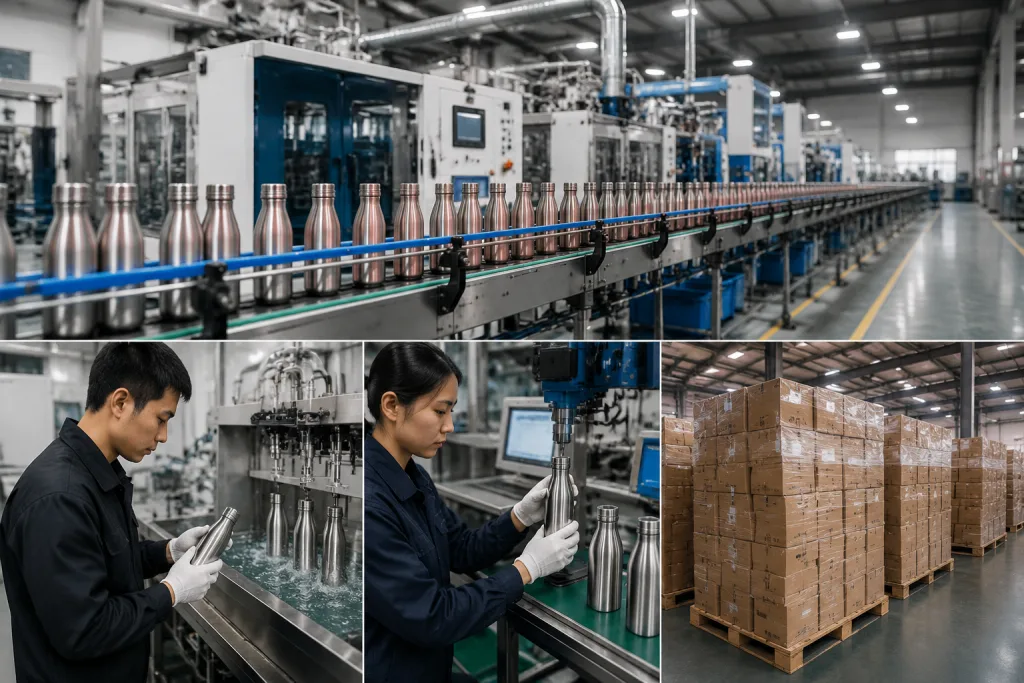
- Final inspection: check appearance, leak test, carton marks, barcode scan, drop test, and assortment count. QC usually opens packed cartons by ratio, and mixed lids still show up more often than buyers expect on gift-set orders.
- Pre-shipment review: confirm production quantity, spare parts ratio, pallet stability, and container loading photos. We ship with pallet wrap tension checked and carton labels matched against the PO, because one typo in an item code can create the wrong customs paperwork.
If you are buying growler wholesale or beer growler wholesale bulk for beverage programs, discuss actual usage limits. Many stainless growlers are fine for carrying beverages but are not built as long-term pressure vessels. We have seen this go sideways when marketing called a standard growler "carbonation safe" without a pressure spec or test record. The product was fine; the claim was not.
Ask how the factory handles rework and replacement. A serious manufacturer in Zhejiang should say clearly whether the remedy is remake, credit note, or replacement in the next order if verified defects exceed the agreed threshold. Put that into the PO terms, with a response window like 7 days for claim notice and photo evidence by carton number. Good sourcing in China comes down to clear acceptance rules, not promises. The math does not work if the supplier and buyer use different defect standards after shipment.
When does bulk sourcing actually run smoothly?
Bulk sourcing runs smoothly when the handoff between your buying team and the factory is clean. Not friendly. Clean. We need one approved spec sheet, one released artwork file, one packing standard, one inspection plan, and one shipping plan. On the line, one old PDF with a 0.5 mm dimension error is enough to hold sampling for a day. This applies whether you buy wholesale drinkware, bulk canteen styles, growler bulk assortments, or alcohol flask wholesale bulk units.
Use this procurement checklist before deposit:
- Product spec locked: SKU, size, material, wall thickness, finish, and lid parts confirmed.
- Compliance scope locked: REACH, LFGB, FDA-related declaration, ASTM, CPSIA, or Prop 65 as applicable.
- Commercial terms locked: FOB Ningbo or Shanghai, payment term, tooling ownership, and claim window.
- Artwork locked: vector file, Pantone code, print position, and tolerance.
- Packing locked: unit box, carton size, gross weight, pallet pattern, barcode labels, FNSKU if needed.
- Inspection locked: AQL, sample size, test points, and third-party inspection timing.
- Timeline locked: sample approval date, production start, booking window, ETD, and buffer days.
For buyers in Europe and North America, the best results usually come from narrowing choices early. Frankly, asking for 12 bottle shapes, 8 cap options, and 6 finishes at RFQ stage is the wrong question to ask unless your annual volume supports it. We have seen buyers flag lead time later after mixing 3 lid platforms that do not share molds or silicone rings. Standardizing components can cut replenishment timing by 10 to 20 days across a season; we see runs land in 12 days instead of 18 days once the cap set and deco method stay fixed.
Factories in Zhejiang, China move fast when the brief is disciplined. We run quicker with a clean BOM, a signed golden sample, and one carton spec taped at packing than with the lowest ex-factory target on paper. The buyer often pushes for a cheaper number, then QC pulled the sample and found color drift above tolerance on the fourth reorder. If you want the best wholesale drink bottle for long-term margin, do not chase the lowest ex-factory number. Chase repeatability, claim control, and a factory that can still deliver the same spec on the fourth reorder, not just the first PO.
Get a clear bulk drinkware quote fast
Send your target SKU, quantity, logo file, and market requirements. We will review MOQ, compliance, pricing, and lead time before you place a risky PO.
Frequently asked questions
What MOQ should I expect if I want to manufacture drinkware in bulk with my logo?
For a standard stainless model with custom logo, expect 1,000 to 3,000 pieces per SKU per color as a normal range. If you choose a stocked body color and simple silkscreen or laser marking, some factories in China can start near 500 pieces. If you need a new lid mold, special Pantone powder coat, or custom gift box, MOQ usually rises because setup waste and tooling cost have to be absorbed. For wholesale canteen, beer tumbler wholesale, or alcohol flask bulk programs, always ask MOQ by SKU, by color, and by decoration method. Those are often different numbers, and that is where quote confusion starts.
How long does production usually take for bulk drinkware orders from China?
A realistic schedule is 7 to 10 days for sample preparation, then 30 to 45 days for mass production after sample approval, deposit, and final artwork sign-off. If the order includes new tooling, add roughly 15 to 25 days depending on mold complexity. During peak season, especially before Q4 promotions, some factories in Zhejiang may extend to 50 days or more. Shipping time is separate, so your procurement plan should include buffer for inspection, booking, and port congestion. If you need drinkware bulk for Amazon FBA or retail resets, work backward from in-warehouse date, not from ex-factory date.
What tests or certificates should I ask for on wholesale drinkware?
That depends on your market and product type, but common requirements include REACH for Europe, LFGB for food-contact expectations in some EU channels, and FDA-related food-contact declarations for the US market. Larger retailers may also ask for BSCI or Sedex social compliance, plus ISO 9001 quality management. For children’s items, ASTM or CPSIA-related checks may apply depending on the design. For insulated bottles, ask for leak and thermal retention data, not only certificates. If you are buying growler wholesale, beer growler bulk, or alcohol flask wholesale, confirm that the test scope matches actual materials, lids, gaskets, and coatings used in your final production spec.
How can I compare prices fairly between different drinkware suppliers?
Force every supplier to quote the same specification. That means identical capacity, steel grade, wall thickness, finish, decoration, packaging, MOQ, and Incoterm such as FOB Ningbo or FOB Shanghai. Also ask what is excluded: mold fee, printing plate, barcode labels, test cost, third-party inspection, and spare parts. A bottle quoted at USD 3.40 can easily become USD 4.10 if the cheaper supplier left out the gift box and carton upgrades. For canteen bulk, growler wholesale, or beer tumbler bulk, the lid and packaging often create the biggest hidden differences. Ask for carton dimensions and gross weight too, because freight cost can erase an apparent unit-price advantage.
What are the most common mistakes when placing a first bulk drinkware order?
The biggest mistakes are approving a sample that is not production-representative, accepting a vague quality promise instead of an AQL standard, and leaving packaging decisions until the end. Buyers also underestimate how much decoration method affects yield and lead time. Another common error is failing to define the claim policy before mass production. If defects exceed the agreed limit, you need a written remedy such as replacement, credit, or remake. In China, especially when sourcing from Zhejiang, the cleanest projects come from buyers who issue one final specification pack with artwork, test requirements, carton marks, and timeline. That discipline matters more than squeezing the last USD 0.10 out of the quote.