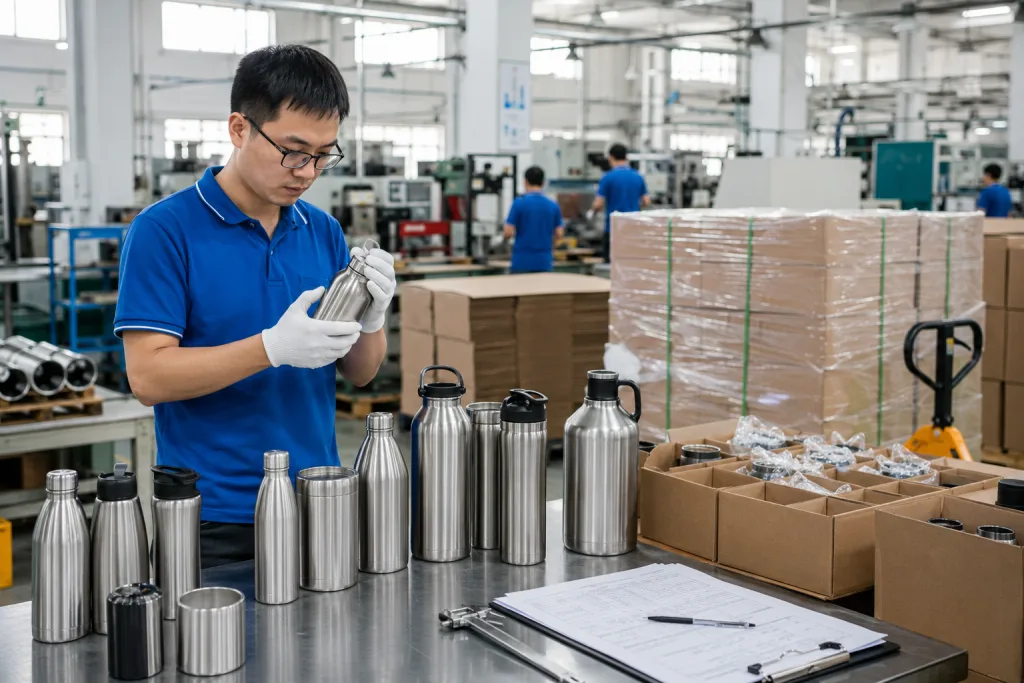
Key Takeaways
- Most avoidable drinkware defects start with incomplete specs; a 1.5 mm wall and ±5% capacity tolerance should be written, not assumed.
- For custom wholesale drinkware, pre-production approval usually takes 7-12 days, while mass production for 3,000-10,000 pcs often needs 25-35 days in China.
- AQL 2.5 for major defects and AQL 4.0 for minor defects is a practical inspection baseline for bulk canteen and growler wholesale orders.
- Low MOQ pricing can mislead you; a stainless bottle at USD 2.80 FOB may rise above USD 3.20 once upgraded lids, coating, and testing are added.
You usually do not lose money on a wholesale drinkware project because the quote was 3% too high. You lose it after the golden sample passes, then mass production lands with color drift of 1.5 Delta E, lids leaking at 0.03 MPa, print adhesion failing the tape test, or master cartons going soft after one wet week in transit. We have seen QC pull that sample on day 18 and the launch date is already gone.
If you are buying bulk drinkware, wholesale canteen models, beer tumbler bulk SKUs, bulk growler lines, or alcohol flask wholesale bulk programs from China, the job is not just finding a factory. The job is writing a spec the line can run without guessing. In Zhejiang, where stainless and plastic bottle factories sit 40 to 90 km apart, buyers with stable results lock down failure points early; chasing the last USD 0.08 is the wrong question to ask.
Where projects actually go wrong
Buyers new to make water bottles wholesale usually start with what they can see: shape, logo, and unit cost. Normal enough. That is also the wrong question to ask first. Most claims do not start there. On our line, trouble starts in the gap between the idea and mass production: tolerance not defined in mm, material spec missing, carton drop standard left open, and approved samples never converted into controlled production paperwork.
One sample can look excellent on the sales table. Then mass production tells the truth. We have seen a 1 pc sample pass, but nobody locked 304 stainless vs 201, vacuum hold time, powder coat thickness, or stopper torque range on the spec. Then 5,000 pcs later, the order lands with three navy shades, 2% seepage in inversion test, and logo position drifting 3-4 mm after screen printing setup. QC pulled the sample and the result was not surprising. In Zhejiang factories, these are routine failure modes when the buyer brief is loose.
If you are sourcing canteen wholesale, bulk growler, beer growler wholesale bulk, or alcohol flask in bulk, think like the engineer who sets the jig, not the merchandiser who approves the photo. Ask what can drift from tool setup to final packing. Ask what an operator can misread on a rush order. Ask what changes at subcontract decoration, especially when the PO has one typo in the finish code. A factory with 300,000 to 500,000 units/month capacity can move fast, but speed only works when the spec is tight enough to repeat lot after lot. We have seen this go sideways.
- Common blind spot: approving a golden sample without a signed spec sheet, color standard, and carton mark layout.
- Common result: the factory copies the silhouette, but lid fit, insulation, or print position shifts outside what your market accepts.
- Better approach: tie every approval to material, finish, test method, carton standard, and defect criteria, then have QC check against that file at inline and final inspection.
When buyers say, "The sample was good but the order was bad," the root problem is usually document control, not bad luck.
Material specs that stop hidden defects
The first mistake on the line is treating all stainless or all plastic as the same. They are not. If you buy wholesale drinkware without exact material callouts, the factory has room to substitute, and we have seen buyers flag this only after the first pre-production sample. For stainless insulated bottles, write 18/8 stainless steel on the PO, which means SUS 304 for inner and outer unless you approve a lower-cost outer wall on purpose. For a wholesale growler or beer tumbler wholesale SKU used for acidic drinks, 304 on all contact surfaces should be the floor. Some premium programs ask for 316 inner walls, but only if the shelf price supports it; otherwise the math does not work.
Thickness is not a side detail. A 500-750 ml vacuum bottle often runs at 0.4 mm inner wall and 0.5 mm outer wall, and QC checks this with a micrometer after forming. Bigger bodies and dent-sensitive shapes usually need more steel. If your spec sheet only says "good quality stainless," you may get a lighter gauge that feels weak in hand and dents faster in carton drop tests. Same story for Tritan, PP, silicone, and the seals inside sports lids and straws. For Europe, ask for REACH-compliant materials. For the US or EU retail channel, match testing to FDA or LFGB based on the market you ship into.
What to lock before sampling
- Steel grade: SUS 304, 201, or 316 where relevant
- Wall thickness: for example 0.5 mm outer, 0.4 mm inner
- Plastic resin: Tritan, PP, or PE by component
- Seal material and color: food-grade silicone, Shore hardness if critical
- Surface finish: powder coat, spray paint, electro-polish, PVD, or brushed
- Compliance list: REACH, LFGB, FDA, CA Prop 65 if requested
For alcohol flask bulk and alcohol flask wholesale projects, spell out whether the cap lining and weld areas need odor-transfer testing. We had one PO where the buyer typed "odor test" on the body but forgot the cap insert, and that gap turned into a remake argument. For growler bulk and beer growler in bulk orders, state carbonation limits in plain words. This is the wrong question to ask late. A lot of stainless growlers work for short-term beverage transport, but they are not long-term pressure vessels. If the use case is vague, the factory will not test for the retail claim your market expects.
Most solid factories in Zhejiang will accept these points if you raise them before sampling. We run into cost blowups when buyers add them after tooling, after artwork approval, or after 2,000 kg of raw material is already on the floor.
Lids leak when tolerances stay vague
If one defect kills trust fast, it is leakage. Buyers building best wholesale drink bottle programs often miss how many leak paths sit in one lid: thread mismatch, silicone seal compression, straw plug fit, vent hole geometry, hinge flatness, and assembly torque drifting off spec. We see the same pattern on the line. The bottle body gets most of the review time, then the claim comes back on the cap.
For canteen bulk, drinkware wholesale, and bulk drinkware orders, define the test method instead of writing “no leak” on the PO. That line is too vague. A workable baseline is a full-fill inversion test for 30 minutes, then a sideways lay-down test for another 30 minutes. For flip straw or spout lids, add a shaking test at a set fill level. For vacuum bottles with screw caps, lock the torque range in kgf·cm or N·m, especially if your brand wants easy-open performance for kids or older users. We have had buyers type “tight enough” on a PO, and that is the wrong question to ask.
Leak control also lives in tolerance stack-up. A lid from cavity 2 can pass while cavity 6 starts weeping, even though both look fine at first glance. A seal that is 0.3 mm off can turn into field complaints once you ship cartons, not samples. If your order is 5,000 pcs, even a 2% leak rate means 100 problem units. The math does not work. You do not save money by cutting USD 0.05 from the quote if QC pulled the sample and found seepage at the rim after 20 minutes.
Useful lid spec points
- Leak test method and sample size
- Assembly torque range
- Drop test height: commonly 80-100 cm depending on item class
- Dishwasher claim: yes or no by component
- Straw brush or spare seal inclusion if applicable
- Replacement lid interchangeability across SKUs
This hits harder on wholesale canteen and canteen wholesale lines sold through retail chains. Retail returns on leakers are rarely repaired; they are credited. If you source from China, ask for in-process checks during lid assembly, not only final random inspection. We run torque checks with a digital torque meter every 1 hour on some programs because we have seen this go sideways. AQL alone will not protect you if the assembly process is unstable.
Decoration fails before the bottle does
Decoration failure shows up before the bottle fails. In make water bottles wholesale programs, the bottle still holds water, but the print looks off and the buyer flags it. That is the complaint we hear first. On stainless bottles, the common misses are weak powder adhesion after curing at 180°C, uneven coating build, dust nibs trapped on the line, color shift between lots, scratched finish from packing, crooked silk screen, and laser marks drifting 2 mm off center.
If you are developing wholesale drinkware, canteen wholesale, or beer tumbler in bulk items under a private label, screen artwork approval is the wrong question to ask. Approve one decorated pre-production sample from the actual line and lock measurable limits on the PO. For example, logo position tolerance within ±1.5 mm, Pantone match under daylight standard, and no exposed base metal on visible surfaces. If the bottle is powder coated, ask for a cross-hatch adhesion test standard and a simple abrasion test routine. We usually run a 3M tape pull check after curing, and QC pulled the sample twice last month because the edge squares lifted.
Decoration method has to match the program. Silk screen works for 5,000 pcs with a simple 1-color logo and the math usually works. Heat transfer covers full-wrap art, but registration can go sideways on tapered bodies, especially when the artwork seam is obvious. Laser engraving lasts, but the look changes on 304 stainless depending on bead-blast, polish, or powder coat underlayer. For gift-boxed wholesale growler, growler wholesale, or alcohol flask wholesale products, buyers usually care more about decoration consistency than saving $0.08 per unit.
Color drift across production lots is where repeat orders get messy. We have seen an approved navy turn almost black on one line and dusty blue on another line from a powder code change and a 10-minute cure-time shift. Ask whether the factory mixes coating in-house or buys finished powder by code, and ask to see the batch record. Also confirm whether decoration is done in one facility or outsourced. In China, outsourcing is common; we ship plenty of stable programs that way. The key is control: incoming QC, outgoing QC, and a signed sample at each handoff.
If your brand sells on shelf or online, customers forgive a 10 ml capacity variance sooner than a crooked logo.
Packaging specs often trigger claims
Buyers often leave packaging to the last round. We’ve seen this go sideways. A good bottle passes final inspection, then the carton fails a clamp move, the barcode does not scan, or the inner tray lets units knock together in transit. For export programs out of Zhejiang, packaging has to take real abuse: warehouse handling, container loading, and sometimes parcel drops from 76 cm. This hits glass items first, then beer growler bulk packs and gift-style wholesale growler sets where the insert fit is off by 2 mm.
At minimum, lock down the inner pack configuration, master carton size limit, gross weight limit, drop standard, barcode placement, and carton marking language. We usually run export cartons under 15 kg gross because the line handles faster and claim rates stay lower, even though some importers ask to push higher. If the item has a powder-coated body, call for a polybag or tissue wrap that will not scuff the finish; QC pulled samples before with rub marks at the shoulder. If lids ship separately to avoid thread marks, put that on the packing instruction sheet, not just on the PO email.
For Amazon or DTC fulfillment, the tolerance gets tighter. FNSKU labels, suffocation warnings, carton label format, and scan readability need to be right before we ship; one buyer flagged a 3 mm label drift and the warehouse rejected the lot. If you are buying drinkware bulk for retail clubs or chain stores, ask for transit-tested packaging or at least a documented carton drop test. A bottle that passes final QC but lands with 6% carton damage is still your cost, and this is the wrong question to ask late in production.
Packaging controls worth adding
- ISTA-style drop expectation or your own internal drop sequence with pass/fail photos
- Barcode grade and scan test requirement, checked before carton sealing
- Moisture protection for sea shipment, such as PE liner bags or desiccant count per carton
- Divider or honeycomb protection for painted bodies where buyers often flag rub points
- Spare parts ratio, such as 1% extra lids or seals
- Carton burst strength if your channel stacks pallets high, for example 5-layer export cartons
MOQ changes how far packaging can be customized. A standard color box often works from 1,000 pcs, but custom inserts, multilingual manuals, or retail-ready PDQ displays usually start at 3,000 pcs or more because the math does not work below that. If a factory promises all of it at a 500 pc MOQ, double-check whether those packaging materials are actually booked; we’ve seen approved artwork sitting still because the insert supplier wanted 3,000 sets.
Inspection plans must match the risk
A common failure point is lazy inspection wording. “Please inspect before shipment” is not a quality plan. It tells nobody what to check, at which stage, or what pass/fail level applies on the line. For most wholesale drinkware orders, we usually set a third-party final inspection baseline at AQL 2.5 for major defects and AQL 4.0 for minor defects. Critical defects stay at zero acceptance. That part should be written on the PO, not left in a chat thread with a typo two weeks later.
Final inspection alone misses too much on higher-risk items such as wholesale growler, beer growler wholesale, glass bottle lines, or complex lid assemblies. Add one in-line inspection in early production, then another at the 20-50% packing stage if the order value supports it. We’ve seen this go sideways. QC pulled the sample after decoration and found Pantone drift on 8,000 pcs before sealing, which is painful but still cheaper than reworking packed cartons.
Your defect list needs plain language. Major defects usually include leakage, vacuum loss, sharp edges, wrong logo, wrong barcode, severe dents, missing parts, or failed function. Minor defects may include slight print specks, small color variance on hidden areas, or carton scuffs that do not affect saleability. On our side, leakage usually gets checked with a vacuum hold test and lid fit gets checked with a torque gauge. If your end customer is premium retail, some “minor” issues should move to major. This is the right call.
Lock the commercial terms around defects before production starts. Ask what happens if inspection fails: rework time, replacement timing, who pays for reinspection, and whether the shipment can be split. A factory with solid process control will answer directly, and if they dodge the question, that is the signal. Typical lead times from approved sample to shipment are 25-35 days for 3,000-10,000 pcs. Rush jobs can compress if stock components are used, but the math doesn’t work if you also add custom color lids, drop-test packaging, and pre-shipment lab checks in the same window. If you need BSCI-audited production, ISO-managed records, or specific lab testing before shipment, build those days into the plan.
For procurement managers buying canteen bulk, wholesale canteen, alcohol flask wholesale, or beer tumbler wholesale bulk ranges, the best approach is simple: buy a controlled process, not just a bottle. We ship smoother projects when the spec sheet is locked, the QC checkpoints are measurable, and the transit pack has already passed carton drop testing. One missed cap liner at 3 mm can trigger leakage claims across a whole batch. Predictable orders are built that way.
Get your drinkware spec reviewed before production starts
Send your target SKU, artwork, quantity, and market requirements. We will flag likely QC risks, realistic MOQ, and lead time before you place the order.
Frequently asked questions
What MOQ should I expect when I want to make water bottles wholesale with custom branding?
For a standard stainless steel bottle with one-color logo, MOQ is often 1,000 pcs per color or size. If you need a fully custom mold, expect 3,000-10,000 pcs depending on complexity. Custom color boxes, special lids, or unique powder coat finishes can push practical MOQ higher. In Zhejiang and other China production hubs, many factories advertise 500 pcs, but that often applies only to stock shapes with minimal customization. Ask for MOQ by body, lid, finish, and packaging separately. That gives you a real purchasing picture instead of a headline number that changes after sampling.
How do I compare quotes for wholesale drinkware without being misled by a low FOB price?
Break the quote into body, lid, decoration, packaging, testing, and freight terms. A bottle quoted at USD 2.85 FOB China may exclude upgraded seal material, individual polybag, drop-tested cartons, or LFGB testing. Another supplier at USD 3.12 may already include those items. Also check steel grade, wall thickness, and accessory count. For growler wholesale, beer tumbler wholesale, or alcohol flask bulk orders, small omissions create big claim risk. Ask each factory to quote the same specification sheet line by line. If the quote format is vague, the comparison is not real.
What tests matter most before I place a bulk canteen or growler order?
Start with leak testing, vacuum performance for insulated items, coating adhesion, logo durability, and carton drop testing. For food-contact compliance, confirm REACH, LFGB, FDA, or other market-specific requirements before mass production. If you are buying beer growler in bulk or wholesale growler formats, clarify whether the product is for short-term beverage transport or pressure retention, because that changes test expectations. On custom programs, I would also ask for a pre-production sample sign-off and then a final inspection against AQL 2.5 major and AQL 4.0 minor before balance payment.
How long does a custom wholesale drinkware order usually take from sample to shipment?
For stock-body projects with custom logo, sampling usually takes 5-7 days. If you need custom color confirmation, packaging mockups, or multiple lid tests, allow 7-12 days. After approval, mass production for 3,000-10,000 pcs often takes 25-35 days. New tooling can add 20-35 days depending on mold complexity. Lab testing, BSCI documentation, or peak season congestion in China can stretch the schedule further. If a factory promises 10 days for a fully custom bottle, custom box, and mixed-size assortment, you should check whether they are skipping approval steps or planning outsourced shortcuts.
What is the safest way to control quality on alcohol flask wholesale bulk and other mixed drinkware orders?
Use one master specification sheet per SKU, then one consolidated inspection checklist for the whole PO. Mixed orders fail when each item is treated casually. For alcohol flask wholesale, define weld quality, cap fit, odor check, and print adhesion. For beer tumbler bulk or canteen wholesale items, define leak testing, coating standards, and packing details. Require pre-production approval, in-line checks, and final inspection with clear defect categories. If the order is large, ask for 1% spare accessories such as seals or lids. That small buffer can save expensive after-sales problems once goods land in Europe or North America.