Key Takeaways
- A standard 500 ml stainless vacuum flask usually starts at MOQ 1,000 pcs per color, with FOB China pricing around USD 3.20-5.80 depending on steel, lid, and finish.
- 18/8 inner and outer steel is safer for long-term brand use than 18/0 outside; wall thickness around 0.4 mm inner and 0.5 mm outer is a practical baseline.
- Lead time is typically 7-12 days for samples and 30-45 days for mass production in Zhejiang, China, if artwork and packaging are confirmed early.
- AQL 2.5, leak testing, vacuum retention checks, and REACH or LFGB material review should be written into the PO before bulk thermos production starts.
You can buy a stainless thermos from almost any supplier in China. Easy enough. The hard part is matching the spec sheet to the way you need to sell it. Outdoor retailers usually care about heat retention hours, dent resistance after a 1.2 m drop, and thread fit with no metal dust on the cap. Promotional brands push on decoration yield, tighter color tolerance, and a landed cost that still holds after freight and compliance. We hear this on calls every week, and the wrong question is often “what’s your best price?”
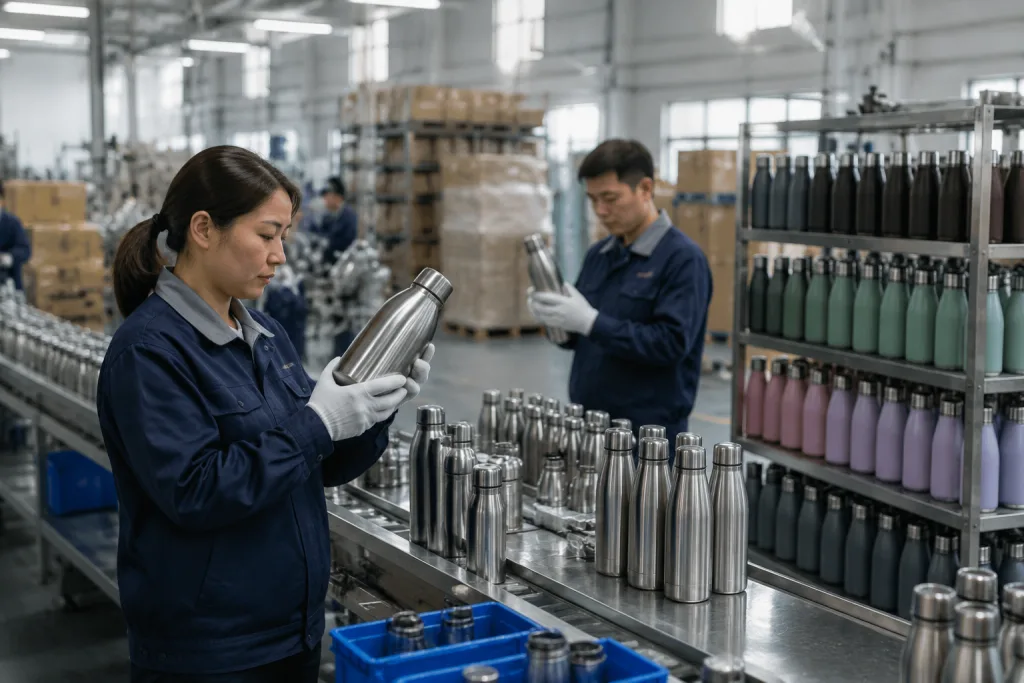
When you ask for make vacuum flask wholesale quotes, you are buying a stack of factory decisions: steel grade, wall structure, lid design, coating, carton count, test standard, and packaging method. On our line in Zhejiang, a 500 ml custom thermos that looks almost the same on screen can move from USD 1.20 to 2.80 FOB China based on those choices. QC pulled two samples last month with the same body drawing but different spray thickness, and the cost shift was not small. That gap matters when your MOQ is 1,000 to 3,000 units. We’ve seen this go sideways when a buyer approves the render but misses one PO typo on packing style.
Start with capacity and use case
The first line on a spec sheet is capacity, and buyers still treat it like a styling pick. That is the wrong question to ask. Capacity changes tooling fit, carton count, heat-retention result, and how your custom thermos sells once it hits the shelf. On our line, the fast runners for outdoor retail are usually 500 ml, 750 ml, and 1,000 ml. For promotional thermos programs, 350 ml to 500 ml moves faster because FOB stays tighter and the logo panel still works on a standard screen-print fixture.
A typical 500 ml factory thermos weighs around 280-360 g depending on wall thickness and lid type. A 1,000 ml version can reach 520-700 g. That hits freight cost right away. We ship those two sizes in the same month, and the carton loading difference shows up fast, especially once the buyer flags a wider food-jar profile instead of a slim body. If you supply distributor thermos programs across Europe or North America, a 40HQ will load a different quantity based on body diameter, sometimes enough to break the freight math.
- 350-500 ml: best for promotional thermos programs, commuter use, gift-with-purchase, and FBA-friendly packs where buyers watch carton weight closely
- 600-750 ml: best for hiking and gym programs, and for outdoor retail shelves where a 45-50 mm mouth is easier to sell
- 1,000 ml+: better for campsite and worksite demand, plus winter outdoor channels where all-day holding time matters more than unit weight
If you ask a thermos manufacturer for a quote, do not send only a volume number. Send the target use: office commute, trail, ski, school, or event giveaway. The same manufacturer thermos body can be tuned for different channels by changing the lid, mouth diameter, and finish. We have seen POs marked only “500ML VACUUM BOTTLE” go sideways because the buyer wanted a tea filter lid and a wider drinking mouth. That is where a workable make vacuum flask wholesale project starts.
Steel grade, wall thickness, and vacuum build
This is where first-time buyers usually give away margin. One flask quote can hide 201, 304, or a mixed build, and the buyer only spots it after samples hit the table. If you need a durable customized thermos for outdoor retail or a branded SKU with fewer after-sales headaches, call out 304 stainless, also called 18/8, for the inner wall. For the outer wall, some supplier quotes switch to 201 or 18/0 and trim USD 0.15-0.35 per unit. We ship that spec on price-driven promo orders at 3,000 pcs MOQ, but for long-term retail goods, the math often does not work.
Ask for the actual wall thickness. “Premium steel” means nothing on a PO. A solid baseline for bulk thermos production is 0.4 mm inner wall and 0.5 mm outer wall. Some low-price quotes drop to 0.3 mm, and QC pulled samples like that with shoulder dents after a 60 cm drop check. You save weight and cost, but dent resistance falls fast, especially at the shoulder and bottom. For outdoor use, ask for 0.5/0.5 mm or a reinforced base ring. This is the wrong question to ask: “Can you make it lighter?” Ask how thin the line can run before damage claims go up.
What to specify clearly
- Inner material: SUS304
- Outer material: SUS304 or SUS201 based on target price
- Construction: double wall vacuum insulated
- Copper coating: yes or no on the outer side of inner wall
- Thickness: for example 0.4 mm inner / 0.5 mm outer
Copper coating improves heat retention and adds a small cost. On a 500 ml thermos factory model, it can shift hot performance from 8-10 hours to 10-12 hours under the same internal test method. We run this test with 95°C fill water, room temp around 23°C, and the bottle standing for the full cycle. If a thermos supplier promises 24 hours hot on a standard bottle, ask for the test conditions and the starting fill temperature. We have seen this go sideways when the headline looked good but the method was buried in fine print. Honest thermos teams should give you the method, not just the claim.
For most custom thermos programs, the safest practical spec is SUS304 inside, 0.4/0.5 mm walls, copper-coated vacuum, and a leak-tested PP or stainless lid.
Heat retention numbers that actually matter
Buyers fixate on one line: 12 hours hot, 24 hours cold, sometimes 48 hours cold. That line means little unless the test method is written into the quote. A proper thermos custom quote should state fill temperature, ambient temperature, fill rate, and the pass point. If not, two suppliers can print the same claim while one is running a softer test. We have seen this go sideways when a buyer flagged “12h hot” on a PO, but the vendor had tested at a lower start temperature.
A practical reference for a 500 ml stainless vacuum flask is this: fill with water at 95 degrees C, keep at room temperature around 20 degrees C, and measure after 6 and 12 hours. On our line, good custom thermos units usually hold above 60 degrees C at 6 hours and 45-55 degrees C at 12 hours. Cold retention is normally checked with ice water, and 24 hours below 10 degrees C is achievable in a standard slim bottle. QC pulled the sample at 12 hours more than once and found the weak point was not the body vacuum, but a loose stopper seal by 0.3 mm.
Outdoor retailers should also check usability, not just heat retention. This is the wrong question to ask if the lid system is poor. A bottle can hold temperature well and still create returns because the stopper pours badly or the thread drips after two turns. For distributor thermos orders, request these tests before approval:
- 100% vacuum test during production
- Leak test upside down for 30 minutes
- Thread engagement check on at least 32 pieces per lot
- Drop test from 80-100 cm depending on packaging standard
If you are buying thermos bulk for promotional campaigns, decide early whether your claim will be conservative or aggressive. Conservative claims cut dispute risk. Aggressive claims put more pressure on production consistency, and the math does not work if the order is rushed across 2 lid vendors with different silicone hardness. In Zhejiang, China, we usually advise customers to print a lower consumer-facing claim than the lab maximum, especially on customizable thermos orders with multiple lid vendors and rush shipping dates. We ship more smoothly that way.
Lids, mouths, coatings, and decoration limits
The lid choice hits complaint rate fast. On our line, most vacuum flask lids land in three buckets: screw cap with cup lid, plain screw lid, and push-button pour stopper. For promo orders, the plain screw lid usually wins on cost and fewer leak claims. The push-button stopper is handy in the field, but this is where orders go sideways: more silicone rings, 2-3 extra assembly points, and leak risk if the thread fit drifts by even 0.2 mm.
Mouth diameter changes daily use more than some buyers expect. A 35-45 mm mouth is the standard on classic flasks we ship every week. A 55-65 mm wide mouth is easier to fill with ice and easier to clean with a bottle brush, but heat loss is more obvious after repeated opening. For a distributor catalog SKU, a medium mouth is usually the safer call. We had one buyer ask for the widest opening possible, then flagged temperature drop in testing; that is the wrong question to ask.
Exterior coating affects looks and logo pass rate. Powder coating wears better and helps hide light draw marks from forming. Spray paint gives tighter color matching, especially when the buyer sends a Pantone chip, but it scratches faster in carton rub tests. On one 5,000-piece run, QC pulled the sample and found dust nibs under metallic spray on 14 bottles. Common options are matte powder, glossy spray, rubber finish, and metallic coating, but the math does not work if you want a soft-touch feel and the lowest unit cost. For North American or European promo programs, confirm the coating passes your scratch, tape, and migration checks before mass production.
Decoration choices and typical cost impact
- Silkscreen: low cost, good for 1-2 colors, around USD 0.05-0.18 each
- Laser engraving: premium look, durable, around USD 0.08-0.25 each
- Heat transfer or water decal: better for full-wrap graphics, higher reject risk
- Embossed or debossed lid parts: tooling cost applies
Logo area is smaller than most buyers expect because the shoulder curves and the side seam steals space. We often mark the print-safe zone on a template in mm, including bleed, seam gap, and taper, before the PO is approved. That saves rework. One PO last month even said "full wrap no gap," and the buyer flagged the seam only after sample review. If your thermos customized design needs wrap graphics, ask the factory for the template first, not after artwork is finished.
MOQ, packaging, and landed-cost math
Most buyers ask for unit price first. That is the wrong question to ask. On make vacuum flask wholesale orders, the margin usually moves on the small lines: MOQ, carton spec, labeling, and how many setups we run on the line. MOQ usually follows body color, lid style, and packaging. At a China thermos factory, 1,000 pcs per model per color is common for existing shapes. Once you add a custom color box, paper inserts, or mixed decoration on the same SKU, the practical MOQ often moves to 2,000 or 3,000 pcs. We have seen POs delayed over one lid-gasket change that looked minor on paper.
FOB pricing for a standard 500 ml custom thermos in Zhejiang often looks like this:
- Entry-level 304 inner / 201 outer, plain box: USD 3.20-3.80
- 304 inner / 304 outer, powder coat, logo print: USD 4.00-4.90
- Higher-spec stopper lid, gift box, upgraded coating: USD 5.00-5.80
Packaging cost climbs fast. Faster than a lot of buyers expect. A plain white box may cost USD 0.12-0.18. A printed color box with E-flute insert can land at USD 0.35-0.65. Add barcode stickers, FNSKU labeling, multilingual manuals, or master carton drop compliance before you compare suppliers thermos quotes, or the math does not work. We ship projects where a 3 mm E-flute insert fixed more damage than a nicer outside print ever did.
Carton quantity also changes the claim rate. For example, 24 pcs per master carton may improve cube efficiency, but if the bottle is tall and heavy, 12 pcs can reduce bottom crush and transit claims. QC pulled the sample on one 24-pack drop test because the bottom panel started to soften after the second corner hit. Ask your thermos supplier for carton dimensions, gross weight, and loading quantity for 20GP, 40GP, and 40HQ. A good thermos manufacturer should give you landed-cost inputs, not just a cheap FOB line.
For promotional brands, it is often smarter to save USD 0.08 on packaging and spend USD 0.10 on a better coating or logo method. We have seen this go sideways when the buyer flagged scuffs on arrival and no one cared that the inner box looked glossy. End users remember scratches and leaks more than they remember a glossy inner box.
Compliance, inspection, and production control
If you sell into Europe or North America, the spec sheet is not finished until compliance and inspection are written in. 304 stainless alone does not clear the job. We check every food-contact part on the BOM: PP lids, silicone seals, paint, ink, and any straw or stopper piece. EU buyers usually ask for REACH review plus LFGB or EU food-contact testing. Some US accounts add California Proposition 65 screening. For outdoor retail in North America, we also see requests for ASTM-related packaging safety checks and drop testing from 1.2 m. If a supplier only talks about the bottle body, this is the wrong question to ask.
Do not leave quality terms loose. Put them in the PO. We have seen one typo on a PO turn “2 mm” into “2 cm,” and the buyer flagged the logo position after mass production. A solid structure for bulk thermos orders is:
- AQL: Critical 0, Major 2.5, Minor 4.0
- Leakage: 0 tolerance on inspected sample
- Vacuum failure: 0 tolerance on inspected sample
- Logo position tolerance: plus or minus 2 mm
- Color tolerance: approved against signed sample under D65 light source
Lead time in Zhejiang, China is usually 30-45 days after deposit, sample approval, and packaging confirmation. Sampling often takes 7-12 days for existing shapes and 20-30 days if you need new tooling. On the floor, we see this split all the time: 12 days for an existing 500 ml flask with a standard lid, 26 days when a new handle mold is still on the CNC machine. A factory with 300,000 to 500,000 units monthly capacity can still miss your date if your box artwork is late or your lid component comes from a secondary vendor. We ship late on paper for small things like a barcode change on the gift box. That is normal supply-chain reality, and buyers who ignore it usually get burned.
Ask whether the factory runs inline checks, final random inspection, and aging tests. Ask whether vacuum retention is checked per lot or per day. Ask whether they have BSCI or ISO-based process control if your brand requires social or quality system review. QC pulled the sample is what you want to hear, not just “looks good.” We have seen this go sideways when the line skipped a lid torque check and leakage showed up only at final random inspection. Good thermos manufacturers answer with records, shift sheets, and test frequency. Weak ones send sample photos.
How to brief a factory without rework
The fastest way to burn 3 weeks is sending a quote request with one reference photo and a target price. We see this every month. If you want an accurate custom thermos quotation, send a short buyer brief that covers the commercial points and the build spec in one page. That is how you get comparable offers from thermos suppliers instead of five numbers built on five different assumptions.
Your brief should include capacity, body style, steel grade, target retention, lid type, finish, logo method, packaging, quantity by color, compliance market, and ship term. Put the capacity in ml, not “medium size,” and call out details like a 0.4 mm outer wall if you already know the target build. If you are comparing a thermos distributor program against a direct factory thermos order, include your 12-month forecast. A manufacturer can cut pricing by consolidating 4 colors into 2 or by running one common lid across SKUs. We ship this way often, and the math works.
Minimum useful RFQ checklist
- SKU size and target channel: outdoor retail, promo, e-commerce
- Material spec: SUS304/SUS304 or mixed grade if acceptable
- Decoration: print color count, artwork file type, position
- Packaging: white box, color box, gift set, PDQ, FNSKU
- Compliance: REACH, LFGB, Prop 65, retailer protocol if any
- Quantity: trial order and annual volume estimate
- Trade term: FOB Ningbo or Shanghai, or DDP if requested
If your target is a customized thermos for promotions, tell the supplier whether your order is price-led or quality-led. These are different builds on the line. A promo bottle might take a simpler lid set and single-color print, while a retail program may need tighter color control and drop-test packaging. We had one buyer flag a 2 mm logo shift on a matte black bottle; for promo, that passed, for retail, QC pulled the sample. Across Zhejiang sourcing, you can usually hit the target if the brief is honest. If the brief is vague, the cheapest quote often turns into the most expensive shipment after claims, delays, and repacking.
That is the real meaning of make vacuum flask wholesale. It is not just chasing a low FOB cost. It is locking the spec lines early so your margin survives after the goods leave the factory.
Send your thermos spec sheet for a direct factory quote
Tell us capacity, steel grade, finish, packaging, and target quantity. We will reply with practical MOQ, FOB pricing, lead time, and risk points.
Frequently asked questions
What is a normal MOQ for custom stainless thermos orders?
For an existing bottle shape, the normal MOQ is 1,000 pcs per color per size. If you need a standard logo print and white box, some thermos suppliers can work at that level without issue. If you add a custom color box, molded insert, or multiple lid colors, practical MOQ often rises to 2,000-3,000 pcs because packaging vendors and coating lines need larger runs. For fully new tooling, MOQ can be higher and a mold charge may apply. If you are testing a new outdoor retail SKU, ask whether the factory can split 1,000 pcs into 2 colors of 500 each with the same carton and lid. That is not always possible, but in Zhejiang it can sometimes be arranged during off-peak production.
How much does a 500 ml vacuum flask usually cost wholesale from China?
A standard 500 ml stainless vacuum flask usually lands around USD 3.20-5.80 FOB China, depending on steel grade, lid complexity, coating, and packaging. Entry level is often 304 inner with 201 outer, plain box, and a simple screw lid. Mid-range custom thermos builds with 304 inside and outside, powder coat, and one-color logo tend to be USD 4.00-4.90. Add a push-button stopper, gift box, laser logo, or premium finish and the price moves above USD 5.00. Freight, duty, and testing are separate. If one supplier is USD 0.70 below the market, check wall thickness, vacuum test method, and lid material before assuming it is a real saving.
Which stainless steel grade should I specify for a branded thermos?
For most branded programs, specify SUS304 for the inner wall. That is the safest mainstream choice for corrosion resistance, taste neutrality, and buyer confidence in Europe and North America. For the outer wall, SUS304 is ideal, while SUS201 is used on lower-cost builds to save roughly USD 0.15-0.35 per bottle. If your project is a long-term outdoor retail line, go 304/304 if the margin allows it. If it is a short-run promotional thermos where price is critical, 304 inner with 201 outer may be acceptable. Also specify actual thickness, such as 0.4 mm inner and 0.5 mm outer, because steel grade alone does not tell you how the bottle will handle dents and shipping stress.
What tests should I require before approving mass production?
At minimum, require a leak test, vacuum retention test, logo adhesion check, and packaging drop review. For food-contact items, also confirm material compliance for lids, seals, paint, and inks based on your market, such as REACH or LFGB-related review. On the quality side, many buyers use AQL 2.5 for major defects and 4.0 for minor defects, with zero tolerance for leakage and vacuum loss in the inspection sample. For a 500 ml thermos, ask for heat-retention data taken from 95 degrees C fill at around 20 degrees C ambient, with readings at 6 and 12 hours. If the supplier cannot explain the method, the claim is not strong enough to rely on.
How long does production take for a customized thermos order?
For existing models, sampling usually takes 7-12 days after artwork and color details are confirmed. Mass production is commonly 30-45 days after deposit, pre-production sample approval, and packaging sign-off. If you need a new mold, special stopper, or custom gift box structure, add 15-30 days depending on tooling and vendor coordination. Peak season can stretch lead time, especially before major holiday shipping windows. A factory may have 300,000 units monthly capacity and still be delayed by one small component such as a stopper spring or silicone ring. The practical way to protect your date is to freeze artwork early, approve packaging before steel production finishes, and book inspection 5-7 days before ex-factory.