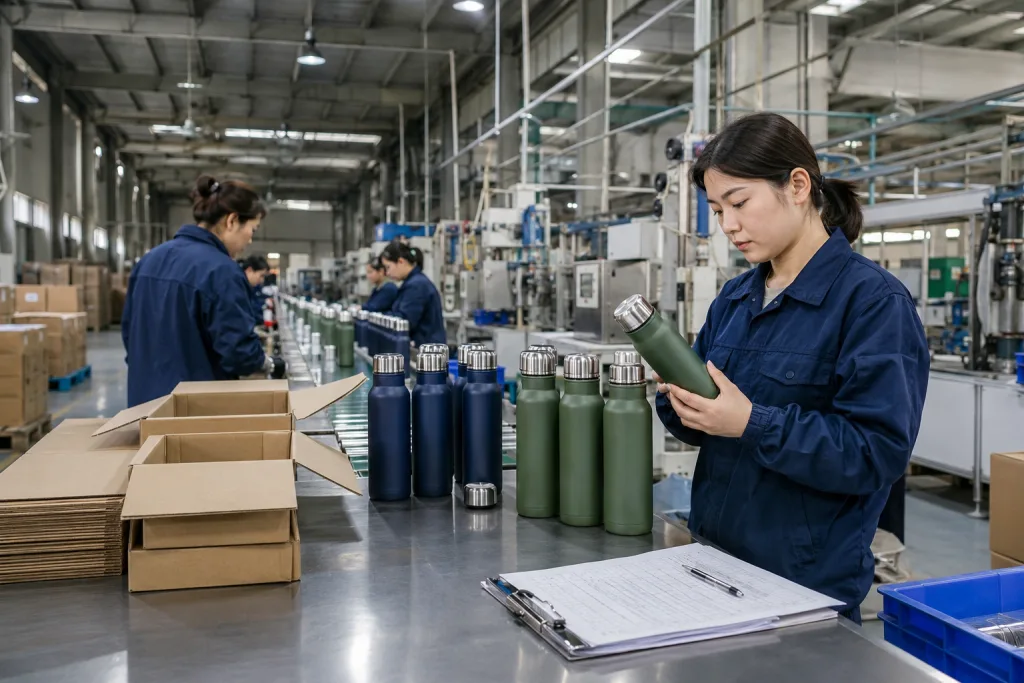
Key Takeaways
- For a 500ml double-wall 304 bottle, typical MOQ starts at 1,000 pcs per color, with FOB China pricing around USD 3.20-5.80 depending on lid and finish.
- Real vacuum hold time should be specified by hours at a test condition, not vague claims; 12-24 hour hot retention is a practical commercial range.
- Decoration choice changes defect risk: one-color silkscreen is usually cheaper by USD 0.08-0.20 per unit than laser marking, but scratch visibility is higher.
- A stable Zhejiang, China supplier should confirm lead time, AQL standard, and in-line inspection points before deposit; 30-45 days is common for custom thermos production.
If you source drinkware for outdoor retail or promo campaigns, stainless vacuum bottles look standard until the first quote hits your inbox. Two 500ml bottles can both use 304 stainless and still land at USD 2.80 versus USD 7.50. Lead time can shift from 20 to 55 days. We see this on the line all the time. A pre-production sample with a clean powder coat and straight logo also tells you little about mass production yield, because the real cost sits in weld consistency, vacuum pass rate, decoration loss, and whether QC pulled the sample from the same setup the factory will run for 10,000 pcs.
The right question is not “Who has the lowest bottle price?” The right question is whether the supplier can hold the spec once the PO is live. In Zhejiang, we’ve seen buyers do well when they lock four points early: bottle structure, performance target, branding method, and supply plan. This is where orders stay on track or go sideways. Get those four set before sampling, and a bulk thermos order is easier to control on cost, leakage risk, and ship date. Miss one, and even a good customized thermos can end up in chargebacks, failed drop tests, or a 12-day slip because the buyer flagged the carton mark after production started.
Start with four buying decisions
Most buyers asking for make vacuum bottle wholesale start with unit price. That is the wrong question to ask. Lock the four decisions that change cost, performance, and claim risk first, or the quote sheet turns messy fast. On our side, sales usually marks these points on a 2 mm bottle sketch before the line prices anything. For outdoor retailers and promotional brands, four decisions come first.
- Structure: bottle size, mouth type, lid style, base diameter, and whether you need a tea filter, handle, strap, or cup lid.
- Performance: steel grade, vacuum quality, copper coating, leak resistance, and target temperature retention.
- Branding: powder coating, spray paint, silkscreen, heat transfer, laser engraving, embossing, gift box, barcode label, and retail insert.
- Supply plan: MOQ, replenishment cycle, Incoterms, test standards, AQL, and packaging for retail, distributor thermos channels, or FBA.
Skip those four, and you get apples-to-oranges quotes from thermos manufacturers. We have seen one RFQ priced on 201 inner steel and another on 304 stainless for the same 500ml outline; one included individual white boxes, another was master carton only at 24 pcs per carton; one ran a stock lid, another needed new tooling after the buyer flagged the thread fit. Then the factory with the right spec looks expensive. It is not expensive. It is quoting the actual job.
At BottleForge Industrial in Hangzhou, Zhejiang, we usually see first-time buyers narrow down to two commercial paths. One is a promotional thermos program: lower unit value, simpler body, one or two logo colors, and a target FOB around USD 3.20-4.20 for 500ml at 3,000 units. The other is an outdoor retail program: tougher powder coat, better lid feel, stricter leak testing, and often USD 4.80-6.80 FOB for the same capacity. QC pulled the sample on one retail order last month because the lid torque was under spec after a 1-meter drop test. That is the gap. Neither path is wrong, but the math does not work if you ask for retail-grade performance at campaign-grade pricing.
You do not need the most expensive bottle. You need the bottle whose specification matches the channel you sell into.
Choose bottle structure before price talks
Structure moves cost more than most buyers expect. On the line, body shape changes forming difficulty, scrap rate, spray consistency, and carton loading. A straight cylindrical 500ml bottle is the safe starting point for most OEM jobs. We run it fast, it packs cleanly in standard export cartons, and it works for both thermos distributor and retail projects.
Common structure choices
- Capacity: 350ml, 500ml, 750ml, and 1,000ml are standard. Promotional brands usually land on 500ml because shelf fit is easier and freight math works better on a 24pcs carton.
- Mouth: narrow mouth holds heat better and spills less outdoors; wide mouth is easier to clean and takes ice cubes, but lid cost usually goes up after the opening gets larger.
- Lid: simple screw cap is the lowest-risk choice; flip lids and carry-handle lids sell well, but QC pulled samples before for leak at the hinge area after cycle testing.
- Bottom: silicone base pad improves grip and cuts table noise, but it adds one more assembly step and about USD 0.10-0.18.
If you are buying thermos bulk for outdoor retailers, ask whether the model survives drop tests from 80 to 100cm when packed as shipped. This is the right question. A bottle can pass vacuum retention and still fail transit because the lid cracks after a corner drop. We have seen buyers flag this after one ISTA-style check with the master carton on its edge. For distributors thermos programs, standardizing one body with multiple lid options usually gives the best balance. You can build a customizable thermos line without opening full body tooling for every customer.
Watch the weight. Many buyers ask for a heavier bottle because it feels premium, and we usually push back on that point. A 500ml body with outer wall around 0.45mm and inner wall around 0.35mm is already workable for many projects. Going thicker can raise steel cost, lower forming yield, and stretch lead time to 18 days instead of 12 days if the draw goes unstable. The math doesn't work on a lot of mid-market orders. A good thermos factory should tell you where extra weight helps and where it is just expensive comfort.
Set realistic insulation and material specs
The backbone of any thermos quote is steel grade and vacuum performance. Asking for 304 stainless only is too loose. We need the inner and outer steel grades, the heat-retention target, the coating requirement, and the test method written down before the line starts.
For most custom thermos orders, 18/8 stainless steel, commonly called SUS304, is the standard choice for the inner wall. It gives solid corrosion resistance, food-contact safety, and a workable cost base. The outer wall can also be 304, or SUS201 on cost-driven programs. We ship both. The issue is not whether 201 is "bad"; the issue is whether the quote matches the build. Last month a buyer flagged a mixed-grade bottle quoted at full 304 pricing, and that is exactly where sourcing goes sideways.
Specification points worth writing into the PO
- Steel: inner SUS304, outer SUS304 or SUS201, lid contact parts PP or Tritan, silicone gasket LFGB or FDA-compliant grade.
- Insulation: for example, 12 hours hot above 55°C and 24 hours cold below 10°C from a standard fill condition.
- Process: double-wall vacuum, optional copper coating on the inner vacuum layer for improved heat reflection.
- Leak test: 100% inverted leak inspection after assembly.
Outdoor retail buyers usually need tighter batch consistency than event-driven promotional thermos programs. This is the right question to ask. On our side, QC pulled the sample and checks whether vacuum performance is controlled by line sampling only or backed by in-line vacuum detection. Ask if low-vacuum bodies are rejected before powder coating, not after. Brochure claims do not tell you that. AQL 2.5 on finish means little if the bottle misses the retention spec.
In China, especially with experienced thermos suppliers in Zhejiang, the better factories will explain the trade-off in plain terms: stronger retention means stricter process control, slower line speed, and a higher unit cost. The math does not work any other way. On one 35,000-piece order, the buyer pushed for top insulation at the lowest price, and the line had to slow from 1,200 pcs/hour to 900 pcs/hour to hold the target. If a vendor offers best insulation, lowest price, and no test data, treat that quote as sales talk, not sourcing reality.
Decoration decides margin and defect rate
Branding is where a customized thermos starts making money or starts bleeding on defects. We’ve seen outdoor buyers push back after a 1 m drop test left edge chips that turned into return claims. For retail programs, finish durability hits review scores fast. For promo orders, logo sharpness and repeat consistency decide whether the campaign looks cheap. Decoration is not just about looks; it changes line speed, scrap rate, and how much rework the line has to eat.
Powder coating is still the mainstream choice for stainless bottles because it hides light tube marks well and feels tougher in hand than basic spray paint. On our line, pretreatment and oven curve do the heavy lifting, not the color card. Matte textures sell well, but weak pretreatment shows up fast as oil marks or patchy gloss. QC pulled samples last month with a 3-5% gloss swing on dark navy, and the buyer flagged it right away. A smooth satin powder is usually the safer finish for thermos custom programs.
Common decoration trade-offs
- Silkscreen: low setup cost for simple logos, usually the right fit for 1-2 colors, but it scratches sooner than engraving if cartons are packed too tight.
- Laser engraving: clean and permanent, works well for premium positioning, usually adds about USD 0.08-0.20 depending on logo size and placement.
- Heat transfer or UV print: good for multicolor graphics, but alignment needs tighter control and abrasion failures show up faster in tape tests.
- Embossed or special mold effects: strong shelf impact, but the math doesn’t work on small runs because tooling cost and MOQ go up together.
If you need a customizable thermos assortment for multiple clients, standardize the bottle body and keep branding methods tight. This is the right question to ask. We run shared bodies first, then add decoration late, which keeps stock usable across more than 6 customer programs. For example, you can hold neutral powder-coated bodies in stock and add customer-specific laser marking later, reducing replenishment risk. We ship this model often because it cuts dead inventory when one PO has a logo typo or a forecast misses by 2,000 pcs.
Ask about color matching tolerance early. A custom thermos in Pantone black is easy. A muted outdoor green across bottle body, lid ring, and hangtag is where projects go sideways. Powder-coated steel and plastic lid parts do not read color the same way, even if the Pantone reference is the same. We usually check delta and visual match under the light box before mass production, and a 0.5 shade gap on plastic is common. A professional suppliers thermos partner should tell you plainly where exact matching is realistic and where it is not.
MOQ, lead time, and stock logic
In make vacuum bottle wholesale, planning drives margin. MOQ is not a random number pulled from sales chat. It comes from steel buying, line changeover time, powder coating batch size, and carton count per master case. If a factory quotes 1,000 pcs MOQ for a standard 500ml bottle and 3,000 pcs for a custom lid color, the body usually runs on an existing mold, while the lid color needs a separate batch on the line to make the math work. We see this on the floor all the time: one Pantone lid can hold up an entire injection run.
Typical numbers for China sourcing are straightforward. For standard models, MOQ is often 1,000 pcs per size or color. For full custom packaging plus custom bottle color and logo, 2,000-3,000 pcs is more common. Lead time for a repeat order may be 25-35 days after deposit and artwork approval; a first customized thermos order with sample confirmation, packaging, and test signoff is often 35-45 days. During peak season, 50 days is not unusual. Buyer pushback usually starts at day 30, but if the carton proof, logo file, and pre-production sample are not locked, that target is not realistic.
Our Zhejiang operation plans around monthly capacity, not brochure capacity. If a plant says it can make 300,000 units per month, ask how many are vacuum bottles versus single-wall items, and how much is already booked. This is the right question. A vacuum bottle line with auto welding and vacuuming runs differently from a single-wall mug line, and one delayed silicone stopper can throw off the whole schedule by 4 days. Buyers who give a rolling 60-day forecast usually ship more smoothly than buyers who wait until stock is down to one container.
- For promotional brands: keep colors simple, use standard white boxes, and approve artwork within 24-48 hours if the campaign date is fixed.
- For outdoor retailers: split the first launch quantity from the replenishment quantity, then hold safety stock on proven colors like black or navy in 500ml and 750ml.
- For thermos distributors: build neutral stock and add the logo late on selected SKUs; we run this with laser marking after QC pulled the sample and cleared the finish.
If you need FNSKU labels, retail sleeves, or multilingual inserts, put them into the quote from day one. Last-minute packaging changes often add 5-7 days and create carton mark errors. We have seen this go sideways over one PO typo—SKU code printed on 12 master cartons, then the buyer flagged it after booking.
Audit quality before you scale
A clean sample proves one thing: the sample room did its job. It does not prove the line will hold the same standard on 10,000 pcs. We check control points, not polished displays. On stainless vacuum bottles, trouble usually starts in four spots: unstable welds, vacuum loss after bottom sealing, lids that seep after torque, and decoration defects that QC pulled under a 6000K light box.
Ask your thermos manufacturer for the inspection plan and read the checkpoints, not just the cover page. At minimum, you want incoming material verification, in-line body and coating checks, 100% leak testing after assembly, and a final AQL inspection before shipment. AQL 2.5 for major defects and 4.0 for minor defects is a common baseline for general consumer goods, though some retail programs go tighter. If your market is children or food-contact sensitive, document the chemical and migration requirements clearly. We have seen POs that said “food safe” and nothing else; that is the wrong question to ask.
Documents and tests that matter
- Food-contact compliance: FDA, LFGB, REACH relevant declarations depending on destination market.
- Factory systems: ISO 9001 is useful; BSCI or Sedex may matter if your customers audit social compliance.
- Performance checks: leak test, retention test, coating adhesion, dishwasher claim if applicable, carton drop test.
- Pre-shipment control: barcode scan, assortment count, carton weight, and shipping mark verification.
If you are working with a supplier thermos partner in Zhejiang or elsewhere in China, ask for production photos from the actual line, not staged sample-room images. Ask how nonconforming units are separated; on our floor, red-tagged cartons go to a hold area before recheck. Ask whether the lids are sourced in-house or from outside vendors, because the buyer flagged more lid issues than bottle body issues on two of our last export projects. A reliable thermos suppliers relationship is built on boring evidence: records, checklists, and repeatable process. Promises are cheap.
For larger orders, third-party inspection before balance payment is still money well spent. The math works. It is cheaper to catch a 6% logo misprint rate in Ningbo or Shanghai before shipment than after arrival in Hamburg or Los Angeles, especially once relabeling, warehouse handling, and claims start stacking up.
Pick a supplier you can grow with
The right thermos supplier is not always the cheapest or the biggest. Pick one built for the way you buy. Outdoor retail programs usually need tight SKU control, carton markings that stay the same season to season, and repeat color matching within a small Delta E range. Promotional buyers push the other way. They ask for fast turns, flexible artwork, and a landed cost that does not move when the PO typo gets fixed at midnight. A factory can serve both, but this is the wrong question to ask if you only compare capacity on paper. Ask where the line is tight and where it is not.
When you compare suppliers thermos offers, use a short scorecard:
- Quote clarity: does the FOB price state steel grade, finish, logo method, packaging, and test basis?
- Response quality: do they answer technical questions directly or dodge specifics like wall thickness in mm or insulation test conditions?
- Sampling process: how many days for plain sample, pre-production sample, and packaging mockup, and who signs off after QC pulled the sample?
- Production discipline: can they commit to MOQ, lead time, and defect handling in writing, not just in a WeChat message?
- Channel fit: do they understand retailer packaging, distributor thermos bulk orders, or promotional rush projects that need split packing by store?
At BottleForge Industrial in Zhejiang, China, a typical plain sample takes 3-5 days, a custom logo sample 7-10 days, and first-order lead time 35-45 days. MOQ on standard stainless models starts at 1,000 pcs, while annual volume clients often combine colors or packaging programs to improve flexibility. We run those schedules off actual line speed, not sales talk. On the floor, the laser marking station and vacuum test bench set the pace. Those numbers are not magic. They reflect a factory that knows how many units it can ship in a day and does not overpromise.
If a manufacturers thermos shortlist gives you similar pricing, choose the one that is more precise. We have seen this go sideways: two factories were only USD 0.12 apart, but one quote missed inner polybag spec and drop-test basis, and the buyer flagged it after approval. Precision in communication usually predicts precision in production. That matters more than squeezing the last USD 0.12 from a bottle you plan to reorder for the next two years.
Get a workable vacuum bottle quote fast
Send your target size, lid type, logo method, quantity, and ship date. We will reply with a practical MOQ, FOB price, and lead time.
Frequently asked questions
What is a realistic MOQ for custom stainless vacuum bottles?
For a standard 500ml stainless vacuum bottle using an existing mold, a realistic MOQ is usually 1,000 pcs per color with one logo design. If you want custom packaging, special lid colors, or a new mold detail, MOQ often moves to 2,000-3,000 pcs. For a full retail gift box with inserts and barcode labels, factories in China may ask for 3,000 pcs to keep packing material efficient. If a supplier offers 200 pcs for a fully custom thermos, check whether they are adding a high surcharge or simply reselling from another factory. Low MOQ is possible, but the unit price can increase by 15-35%.
How much should I expect to pay for bulk thermos orders?
For FOB China pricing, a common range for a 500ml double-wall stainless bottle is USD 3.20-5.80 at 1,000-3,000 pcs, depending on steel grade, lid style, coating, and packaging. A simpler promotional thermos with standard screw lid and white box sits near the lower end. A retail-ready bottle with powder coat, laser logo, carry handle, and printed color box lands higher, often USD 4.80-6.80. If you add copper insulation layer, silicone base, or premium lid components, price rises further. Always compare quotes on the same basis: steel, finish, logo, packaging, and Incoterm.
How do I verify insulation performance on a custom thermos?
Ask the factory to state a measurable target, not a vague claim like long-lasting heat. A practical spec is something like hot retention above 55°C after 12 hours from a defined fill temperature, and cold retention below 10°C after 24 hours. You should also ask how they test it: sample size, starting water temperature, room temperature, and whether they use copper coating in the vacuum layer. For larger orders, request pre-production testing plus in-line vacuum checks. A reliable thermos manufacturer should explain the method and provide records, not only marketing text. Performance without a test condition is not a real specification.
Which logo method is best for outdoor retail and promotional use?
For outdoor retail, laser engraving and durable powder coating are usually the safest combination because the logo remains permanent and the finish handles abrasion better. For promotional use, one-color silkscreen is often the most economical, usually saving around USD 0.08-0.20 per unit compared with laser depending on logo size. If your design uses multiple colors or full-wrap graphics, heat transfer or UV print can work, but you need stronger approval on color tolerance and scratch resistance. The right method depends on your channel. Retail favors durability. Promotions often favor cost and speed.
What quality checks should I require before shipment?
At minimum, require 100% leak testing after final assembly, visual finish inspection, barcode and carton mark verification, and a final inspection to an agreed AQL standard such as 2.5 major and 4.0 minor. For retail orders, also ask for carton drop testing, coating adhesion checks, and random insulation verification from the finished lot. If your products go to Europe, confirm REACH-relevant compliance and food-contact declarations; North America may require FDA-related material documentation. For first orders over about 5,000 pcs, a third-party pre-shipment inspection in China is a practical safeguard before you release the balance payment.