Key Takeaways
- For most outdoor and promotional programs, 304 inner + 201 outer cuts unit cost by about 8% to 15% versus full 304 while keeping food-contact safety where it matters
- A workable MOQ for customized thermos is usually 1,000 pcs per color per size, with sampling in 7-10 days and mass production in 30-45 days
- Powder coating plus laser engraving gives better scratch resistance than silk screen, but usually adds USD 0.18-0.35 per unit at 5,000 pcs
- Ask for AQL 2.5, a 24-hour salt spray check on logos, and heat-retention data such as 12 hours above 55°C for a 500 ml factory thermos
If you buy stainless drinkware for outdoor retail or branded campaigns, the hard part is rarely finding a thermos factory in China. Zhejiang alone has 200-plus active drinkware suppliers. The hard part starts before you lock the PO: picking the right spec. A 500 ml bottle that looks fine on page 12 of a catalog can miss your margin, slip a 45-day campaign date, or fail a heat-retention check after 8 hours once goods land in Europe or North America. We see this on the line all the time—same shape, different vacuum rate, different result.
When you source make thermos bottle wholesale from Zhejiang, you are making four decisions: body construction, decoration method, compliance package, and order plan. This is the part buyers often rush, and it is the wrong place to rush. Get those four right and the project runs clean. Get them wrong and you pay in rework, claims, and dead stock. QC pulled a sample last month because the PO had the logo size typed as 18 mm instead of 28 mm; that one typo would have cost a full carton of pre-production pieces. This is the practical approach we use in Zhejiang, China when buyers ask for a stainless thermos that must sell, not just sample well.
Start with the four buying decisions
Most problems in make thermos bottle wholesale show up before production starts. The approved sample is not the main decision. The spec is. We’ve seen a buyer sign off on a clean pre-production sample, then flag mass goods because the PO said 0.4 mm outer wall while the sample room built it from 0.5 mm. For outdoor retailers and promotional brands, the safer way to buy is to lock four decisions in order.
- First, body construction: set the steel grade, vacuum structure, capacity, mouth diameter, and the lid setup first. That means 304 stainless or another grade, copper-coated vacuum or standard vacuum, 500 ml or 750 ml, 45 mm mouth or 55 mm mouth, plus handle, tea filter, or leakproof sport lid.
- Second, decoration: choose the finish after the body is fixed. Powder coat runs differently from spray paint on the line, and silk screen artwork has different limits from heat transfer or laser engraving. Mixed process is fine, but QC needs a signed color panel before we run bulk.
- Third, compliance: decide the tests and documents for your market, not the files a thermos supplier already has in a folder. FDA, LFGB, migration testing, drop test, dishwasher test, carton marks—this is where buyers lose 7 days if the request comes after sampling.
- Fourth, order plan: lock MOQ, carton pack, shipment split, and replenishment timing. A 24 pcs master carton lands differently from a 12 pcs carton, and the math doesn’t work if your first order is packed for e-commerce but your replenishment goes to wholesale pallets.
If you reverse the order, costs drift fast. A promotional thermos buyer often starts with logo size. An outdoor buyer often starts with color chips from Pantone books. This is the wrong question to ask. Start with use case. Will the bottle sit on a retail shelf at USD 24.99, ship as a premium gift, or be handed out in a winter campaign? That answer changes wall thickness, finish choice, carton standard, and even whether we run a simple PP lid or a more expensive leakproof assembly with a silicone seal checked by torque test.
At BottleForge Industrial in Zhejiang, China, we usually see 3 workable order shapes. Retail launch: 2,000 to 5,000 pcs across 2 or 3 colors, often with shelf-ready packaging and barcode placement confirmed on the artwork file. Promotional run: 1,000 to 3,000 pcs with 1 logo and 1 body color, usually packed fast because the buyer flagged event dates on the PO. Distributor thermos stocking order: 5,000 to 20,000 pcs with repeatable packaging and staggered shipments, often 1x40HQ split into two ETDs 12 days apart. Our monthly output on stainless vacuum drinkware is around 300,000 units. Still, capacity is not the first issue. Repeatability is. If the line cannot hold your powder coat texture, logo position within 1.5 mm, and lid fit from lot to lot, the shipment will go sideways.
You are not buying a bottle. You are buying a repeatable manufacturing recipe.
Choose the steel and insulation level
The main trade-off in a custom thermos is cost against insulation and service life. On stainless vacuum bottles, most projects come down to 18/8 stainless, usually called 304, or a mixed build such as 304 inner with 201 outer. If the bottle touches tea, coffee, or water every day, 304 on the inner wall is the standard choice. We check inner tube material with an XRF gun on the line. Full 304 inside and outside gives better corrosion resistance, which matters for outdoor SKUs, salted environments, and long retail cycles, but the unit cost goes up.
A practical guide for thermos manufacturers thermos projects looks like this:
- 304 inner + 201 outer: standard for cost-driven promotional thermos and thermos bulk orders. The math works best when the outer shell gets powder coating, since buyers will not see the base steel finish.
- 304 inner + 304 outer: a better fit for retail, long-life outdoor use, and premium customized thermos programs. We ship this structure often for brands that want fewer rust complaints after 2 winters.
- 316 inner: used for higher-end models, or for tea, coffee, and stronger corrosion resistance demands. Expect a clear cost jump. Buyers ask for 316 “just in case,” but this is often the wrong question to ask if the drink is plain water.
Wall thickness matters. A common setup is 0.4 mm inner and 0.5 mm outer. If you want a heavier hand feel, some thermos factory options move to 0.5/0.5 mm. That feels better in the hand. It also pushes up bottle weight and sea freight. For a 500 ml bottle, that usually adds 25 to 45 grams per unit. QC pulled a sample last month where the PO said 0.5/0.5 mm, but the approved drawing showed 0.4/0.5 mm. We've seen this go sideways.
Then there is insulation. A true vacuum thermos manufacturer runs double-wall vacuum construction, often with copper coating on the inner vacuum layer to reflect heat back in. Ask for actual retention data, not “12 hours hot, 24 hours cold” on a sales sheet. We test with 95°C water at room temperature and log the result by hour. For a 500 ml bottle, many reliable thermos suppliers can hold above 55°C after 12 hours. If your outdoor customer sells into winter markets, ask for 24-hour data and ask whether the sample was tested with the final lid, because lid structure changes the result fast.
Do not ignore mouth design. A narrow mouth holds heat better and gives cleaner drinking control. A wide mouth makes ice filling and brush cleaning easier, though heat loss is faster. The difference is not huge, but it shows up in testing. On one 500 ml sample set, the wide-mouth version dropped 3°C more at the 6-hour point with the same vacuum body. For a distributor thermos range, carrying both 500 ml narrow-mouth and 750 ml wide-mouth usually covers most demand without making inventory messy.
Match decoration to the sales channel
Decoration is where buyers burn margin fast. We see both mistakes on the same PO: overspending on finish, then leaving the logo spec vague. A thermos custom order for retail and a thermos promotional order for a campaign should use different decoration methods. The wrong question is “what looks best on the sample?” Ask what still looks saleable after carton rub, hand carry, and 30 days on shelf at the target price. Last month QC pulled a sample with a clean logo and a chipped shoulder ring after a 1A carton drop.
What usually works
- Powder coating: better scratch resistance, better grip, stronger retail hand feel. Typical extra cost at 5,000 pcs: USD 0.15-0.28 versus plain spray finish.
- Silk screen: low-cost choice for 1-color logos on smooth surfaces. Fits promotional thermos projects, but it wears faster than engraving. On the line, curved bodies need tighter jig setup or the buyer flags logo skew.
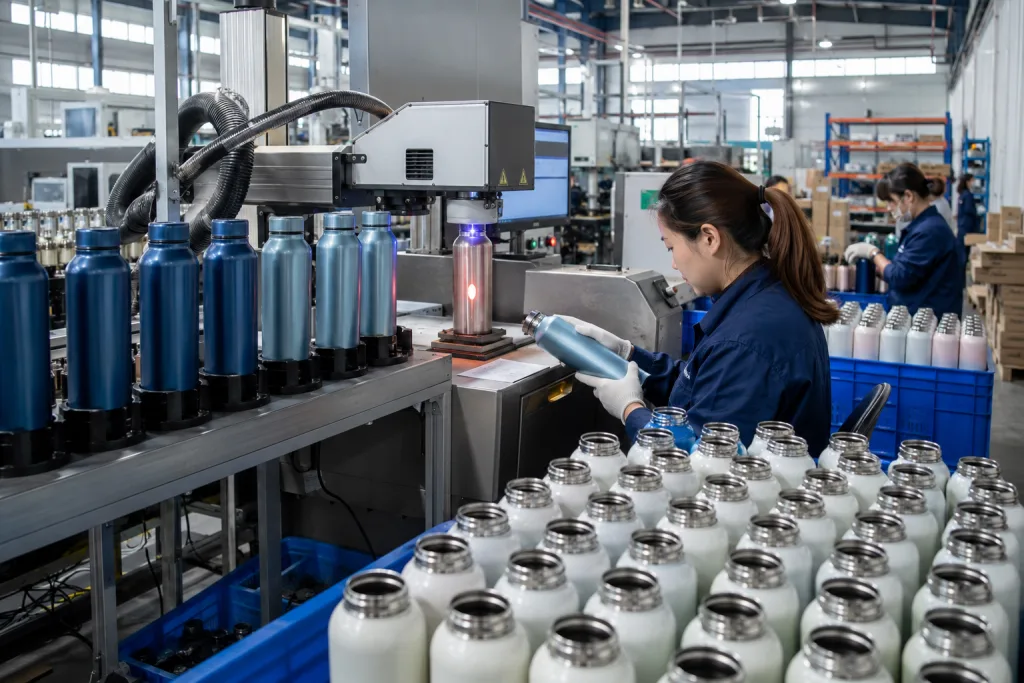
- Laser engraving: durable, sharp, and clean on stainless or coated surfaces. Often adds USD 0.03-0.08 for simple marks and more for larger engraved areas. We usually check mark depth and edge burn on the first 20 pcs.
- Heat transfer or wrap print: good for multi-color graphics, but check adhesion and dishwasher claims before approval. We’ve seen this go sideways when artwork covers the bottle radius too aggressively.
If you are a thermos distributor supplying outdoor retail, powder coat plus laser is usually the safe middle path. You pay more up front than silk screen. You also cut claim risk on scratched logos and get a better shelf look. The math works. For a custom thermos ordered as branded merchandise, silk screen on powder-coated bodies still works when the campaign life is short and budget is tight. Typical buyer pushback is “can we get engraving look at screen-print cost?” No, not on a 5,000 pcs run.
Ask your supplier thermos partner how they manage color matching. Pantone matching on powder coat is possible, but not every coating line holds dark matte tones batch to batch, especially on low-gloss black and deep navy. On larger thermos customized programs, request a sealed color panel and keep it with the approved sample. Do not skip this step. We run color checks under D65 light, and shade drift shows up fast on wide-body bottles. Also ask about logo position tolerance. A professional thermos vendor should define placement tolerance, often within plus or minus 2 mm for laser and slightly wider for screen print. We once got a PO with “centered logo” only; that wording caused a 3 mm argument nobody enjoyed.
Packaging belongs in decoration planning too. A white box is cheapest. A color gift box can add USD 0.25-0.80 depending on structure and print coverage. For Amazon or e-commerce, ask for drop-test-compatible packaging and barcode labeling such as FNSKU if needed. We ship plenty of plain white cartons for offline promos, but e-commerce is less forgiving. If the bottle finish is matte powder coat, add a PE bag or tissue wrap inside the box, or carton dust will mark the body before it reaches the end user.
Set compliance before you discuss price
First-time buyers often ask for a quote before the spec is settled. That is too early. If your make thermos bottle wholesale project ships to Europe or North America, set the compliance line first, then talk price. Otherwise you are comparing offers built on different risk levels, and the math doesn't work. We see this on the factory floor all the time: one buyer prices a 500ml flask with no migration test, another wants full paperwork, and the gap looks like 0.18 to 0.35 USD per unit before anyone even discusses packaging.
For stainless thermos sourcing from China, the usual document set may include REACH-related declarations for Europe, LFGB or food-contact migration testing where applicable, and for North America, material safety support depending on the customer channel. If the product is aimed at kids, ASTM and CPSIA-related considerations matter more. For social compliance, larger buyers often ask for BSCI or similar audit records from the manufacturer thermos plant. One practical detail: the buyer flagged a PO last month marked "adult promo bottle," then changed the color box copy to a kids' gift set. That one wording change triggered a different compliance review.
You also need a quality control plan. A quotation without an inspection standard is half a quotation. This is the wrong question to ask: "What's your best price?" Ask what standard the line will run against. The basic framework many buyers use is:
- AQL: major 2.5, minor 4.0 for final random inspection.
- Leak test: 100% line check.
- Vacuum test: line sampling plus finished-goods verification.
- Coating adhesion: cross-hatch or tape test on decorated parts.
- Salt spray: often 24 hours for logo/coating check on selected samples.
For outdoor retailers, ask for practical abuse checks too: handle pull test, lid thread cycling, base stability, plus carton drop test with a defined height like 76 cm. We run these checks with simple fixtures on the line, and QC pulled the sample more than once after a thread wore down before 500 cycles. Lab paperwork will not catch that. A solid thermos supplier will not push back on this unless they already know the weak point.
In Zhejiang, China, we see buyers save USD 0.10 per bottle by trimming controls, then lose far more in claims when lids seep after sea transit. We've seen this go sideways. The goal is not more testing for the sake of it. Test the failure points that show up most in claims: sealing, vacuum retention, logo adhesion, carton strength. On one 40HQ shipment, the issue was not the bottle at all; it was a soft 5-ply outer carton that crushed at the bottom layer. If you source through thermos distributors or distributors thermos programs, ask for the original test basis, not only a trading summary sheet.
Build the order around MOQ and freight
The right bottle still turns into the wrong buy if the order is built badly. MOQ, assortment, and freight decide whether you keep margin or give it away. In a standard stainless thermos factory in Zhejiang, a realistic MOQ is 1,000 pcs per model per color for custom color and logo. Some stock-color bodies with simple laser marking start at 500 pcs. Do not build a launch around that exception. We have seen buyers write 6 colors on one PO, then cut back after the first carton-calc sheet because the math doesn't work.
This is the part buyers usually underestimate. More colors can lift sell-through, but every extra color means slower cartons, extra changeover on the line, and leftover stock if one shade stalls. On our side, a color switch is not just a click; the spraying fixtures and silk-screen plates have to be reset, and QC pulled the sample more than once because Pantone drift showed up after the first run. For a first custom thermos retail launch, two body colors and one lid style is usually enough. For promotional thermos campaigns, one body color and one logo position keeps cost down and lead time stable.
Lead time should be discussed in three parts, not one number:
- Sampling: 7-10 days for an existing mold with custom finish.
- Mass production: 30-45 days after sample approval and deposit.
- Transit: roughly 30-40 days by sea to Europe, 20-30 days to the US West Coast, depending on routing and season.
If the schedule is tight, ask whether your thermos manufacturers thermos partner can split shipments. A common fix is air shipping 300 pcs for marketing, then sea shipping the balance. It costs more. It also saves launch dates. We ship this way when the buyer flagged a late approval or the outer carton mark was revised after packing had started. Check carton dimensions early too. A 750 ml bottle with a wide handle may look better on screen, but if the master carton loses 8-10 pcs because the handle adds 12 mm on the packed width, freight per unit climbs fast, often by 5% to 12% against a tighter design.
Price terms matter. FOB Ningbo or FOB Shanghai is still the clean benchmark for comparing thermos suppliers in China. EXW can look cheaper on paper, then your side picks up inland trucking, export handling, and the usual small charges that show up later. We have had buyers send a PO with “FOB” typed in the header and EXW in the body; that typo alone held booking for a day. If you buy as a thermos distributor or thermos wholesalers program with repeat POs, ask for a raw-material adjustment method instead of pushing for one fixed price too long. Stainless cost moves. Serious suppliers thermos partners say that plainly.
Pick a partner you can reorder from
Plenty of factories can make one sample. Fewer than 20 can hold the same spec on a repeat PO. The last call in make thermos bottle wholesale is picking a thermos manufacturer you can reorder from six months later without getting a different lid fit, a shifted logo, or a vacuum complaint. Ask for process control, not a polished showroom. On our line, the approved sample cabinet is tagged by SKU and date, not by memory.
Start with the basic checks. Does the factory keep approved samples and color panels? Are there SOPs for lid assembly torque, vacuum testing, and logo position? Can they show lot traceability from steel input to finished cartons? Ask to see the torque record from the digital torque meter, not just hear “we control it.” If the reply is loose, your second order will not match the first. We’ve seen this go sideways over a 1.5 mm logo shift that the buyer flagged only after 8,000 pcs were packed.
For outdoor retail, ask how many similar stainless vacuum bottles they make each month—30,000 pcs tells you more than “we do a lot”—and whether they run in-house or coordinated testing for heat retention and seal performance. For promotional brands, ask how they handle fast repeat artwork, carton mark changes, and mixed-carton labeling for 12 SKUs in one shipment. Not glamorous. Still the right questions. Last year one PO had a barcode suffix typo, and QC pulled the sample before the line ran; that saved a full relabel job.
A useful shortlist for evaluating a factory thermos partner is:
- Capacity: enough to support your peak months, not just annual average volume. Ask what they ship in October, not only their yearly total, and check whether MOQ is 3,000 or 10,000 pcs per color.
- Documentation: REACH, food-contact support, audit reports, inspection records. Ask for the latest file set and one actual AQL report, not a promise to send it later.
- Communication: clear approval points for artwork, sample, pre-production, and final inspection. We run a signed artwork sheet and pre-production sample check because verbal approval is where orders go wrong.
- Reorder discipline: archived BOM, packaging standard, barcode setup, and carton marks. This is the wrong question to skip; one missing gasket spec can turn a repeat order into a new development job.
If you work with thermos distributors, manufacturer thermos plants, or thermos supplier networks in China, keep one rule: the approved sample must match the production BOM. Do not accept a hand-built sample with different steel, lid gasket, or coating thickness. QC should be able to pull the BOM and match it to the sample in 2 minutes. If the sample used 304 stainless and the production plan shifts to another grade or the coating drops from 45μm to 25μm, your customizable thermos project is already drifting off spec.
Good sourcing from Zhejiang is not about chasing the absolute lowest quote. The math doesn’t work if you save $0.18 per unit and lose 12 days on rework or replacement. Look for the lowest-risk quote that still leaves room for margin. If your custom thermos can be reordered on the same spec, same lead time, and same inspection basis, you have a supply line. Not a one-off buy.
Build your stainless thermos program with fewer surprises
Send your target price, capacity, logo method, and market requirements. We will recommend a workable spec, MOQ, and lead time from our Zhejiang, China production base.
Frequently asked questions
What is a normal MOQ for custom stainless thermos wholesale?
For a standard vacuum stainless model, 1,000 pcs per color per size is a common MOQ in China. If you use a stock body color and only add a laser logo, some thermos suppliers can go down to 500 pcs. New molds, special lids, or gift boxes usually push MOQ higher, often 2,000-3,000 pcs. If you need three colors on a first order, check whether the factory allows color splitting under one total order quantity. Many will, but each color still needs enough units to run coating and packing efficiently. For outdoor retail, start with two colors and one capacity. That usually gives you better stock turn than stretching a 2,000-piece order across too many variants.
Should I choose 304 or 316 stainless for a custom thermos?
For most bulk thermos orders, 304 stainless is the right starting point. A 304 inner wall is standard for food contact and covers coffee, tea, water, and most daily use. A full 304 inside and outside body is better for premium retail and outdoor channels because corrosion resistance is stronger than 201 outer construction. 316 inner steel is a higher-grade option if your market specifically asks for it or you want extra corrosion resistance, but it increases unit cost noticeably, often by 10% or more depending on bottle size. If you are trying to balance margin and quality, 304 inner plus 304 outer is the safest general-purpose spec for a thermos custom program.
How long does production take for a customized thermos order?
If you use an existing bottle mold, sampling is typically 7-10 days after artwork and Pantone confirmation. Mass production is usually 30-45 days after sample approval and deposit. During peak season from August to November, some factories in Zhejiang, China may need 45-55 days, especially for powder coating in multiple colors. Sea transit then adds roughly 20-30 days to the US West Coast or 30-40 days to major European ports. If your promotional thermos project has a fixed event date, work backward from the in-warehouse deadline, not the ship date. A safe buying calendar is approval by day 10, production by day 45, and a 7-day buffer for inspection and document release.
Which logo method is best for outdoor retail thermos bottles?
For outdoor retail, powder coating plus laser engraving is usually the best balance of durability, appearance, and claim control. The finish feels better in hand, resists scratches better than plain spray paint, and the engraved mark will not rub off like a surface print can. The added cost is usually modest at volume, often USD 0.18-0.35 per unit compared with simpler decoration, depending on bottle size and artwork coverage. If the order is purely promotional and budget-driven, silk screen on a powder-coated bottle can still work well, especially for one-color logos. Ask the factory for adhesion test results and a 24-hour salt spray check if the bottle will be used outdoors.
What quality checks matter most before I approve a thermos shipment?
Focus on the failure points that create real claims. First, require a 100% leak test on the line. Second, set a final inspection standard such as AQL 2.5 for major defects and 4.0 for minor defects. Third, check vacuum retention with a defined method, for example 95°C water and target temperature after 6, 12, or 24 hours. Fourth, review logo adhesion and coating consistency, especially on matte powder-coated bodies. Fifth, confirm carton strength and drop performance for your channel. For e-commerce or distributor thermos orders, barcode accuracy and carton marking are also critical. A reliable thermos factory should provide photos, inspection records, and retained samples tied to the production lot.