Key Takeaways
- A practical MOQ for custom thermal bottles is usually 1,000-3,000 pcs per SKU, with 35-45 day production after sample approval
- 304 inner + 201 outer can cut FOB cost by $0.18-$0.35 per unit versus full 304, but it changes corrosion and positioning
- AQL 2.5/4.0 final inspection plus 100% vacuum and leak checks reduces the main complaint categories before shipment
- For a 500 ml powder-coated bottle, decoration and packaging often add 12%-28% of total unit cost, more than many new buyers expect
You need a thermal bottle that sells, ships on time, and does not come back with leaks, odor claims, or logo peel. Sounds basic. Still, 8 out of 10 first orders that go bad start with a loose brief. A buyer asks for "best wholesale drink bottle," gets five quotes from China, and lines up numbers built on different steel grades, different vacuum hold times, different coating lines, and even different carton specs. We’ve seen this go sideways over a 0.2 mm wall difference and a PO typo that changed an egg-crate insert to a plain polybag pack.
The better way is to run make thermal bottle wholesale as one controlled project from concept to final inspection. If you also source bulk canteen, wholesale drinkware, bulk growler, or alcohol flask wholesale bulk lines, the logic does not change. At our Zhejiang factory in China, we see the same pattern on the line: buyers who lock 6 or 7 core specs early usually cut rework by 80% later. This is the wrong question to ask: “What’s your lowest price?” Ask what steel, what vacuum standard, what logo test, and what packing method we ship against. QC pulled the sample more than once because the color chip matched, but the powder coat thickness was off by 15 μm.
Start with the buyer brief
Picture the order the way it lands on our desk in Hangzhou. You are the procurement manager for a mid-market outdoor brand in Europe. Sales needs a 500 ml thermal bottle for an autumn launch. Marketing wants a matching canteen wholesale line and a beer tumbler wholesale bulk offer for gift sets. Your landed-cost target is tight, the brand color has to hit the Pantone chip, and the first shipment is due in eight weeks. We see this setup every season. Last month a buyer even typed the PO shade as “Panton 5483C,” and the line stopped until we confirmed the code.
The first mistake is a one-line RFQ: "Please quote make thermal bottle wholesale." That gets you random numbers, not a real comparison. A usable brief should lock these points before you treat any quote seriously:
- Capacity: 500 ml actual fill, not nominal only
- Body structure: double-wall vacuum, straight bottle or tapered shoulder
- Material: SUS304 inside, SUS304 or SUS201 outside, lid PP or Tritan, silicone gasket LFGB grade
- Wall thickness: inner 0.4 mm, outer 0.5 mm is a common baseline for balanced cost and dent resistance
- Performance: keep hot above 55°C after 12 hours from 95°C fill, or your own protocol
- Decoration: powder coat Pantone match, one-color silk screen, or laser engraving
- Packing: egg-crate bulk, white box, or retail color box with barcode
- Compliance: REACH for EU, California Proposition 65 review if selling in North America, and food-contact test plan
Buyers in Zhejiang who send this level of detail usually get clean pricing back in 2 days instead of 5. Without it, one factory quotes full 304 steel, another quotes 201 outside, and a third skips the drop-test requirement. QC pulled one sample last quarter at 612 g against a quoted 565 g body weight, which told us the factories were not building to the same spec. The cheapest number then wins for the wrong reason. This is the wrong question to ask: “Who is lowest?” Ask who is quoting the same bottle.
For us in Zhejiang, China, a standard custom MOQ is 1,000 pcs per color per size for existing molds. That sounds simple until the buyer flags three colors across two capacities. Now you need to ask whether the MOQ is per SKU, per print, or pooled across the order. That one line can move your commitment by 2,000 units. We run this check before sampling because we’ve seen it go sideways after artwork approval, especially when the silk-screen mesh count and carton mark are already locked.
Build the spec before price
Once the brief is set, you can spec the bottle instead of buying a photo. In make thermal bottle wholesale, the big cost drivers are steel grade, body weight, lid construction, coating process, and packing. A 500 ml bottle can look the same on Alibaba and still run 260 g or 340 g on our scale. That gap shows up in hand feel and freight.
Typical cost structure for a 500 ml thermal bottle
For a straightforward order from China at 3,000 pcs, FOB Zhejiang pricing often falls into these bands:
- Entry level: $2.10-$2.55 with 304 inner, 201 outer, plain spray finish, simple screw lid
- Mainstream retail: $2.65-$3.40 with 304/304, powder coating, screen print, standard white box
- Premium: $3.60-$4.80 with special lid, electro-polished inner, metallic finish, retail pack inserts
If you are also sourcing drinkware bulk collections like growler wholesale or beer growler in bulk, larger-capacity items are not just bottles scaled up. A 64 oz growler bulk SKU often needs thicker steel, tighter control at the neck weld, and stronger outer cartons after the drop test. We have seen this go sideways. Cost per ounce can rise, and the math does not always work the way buyers expect.
You do not control cost by forcing the supplier down 5%. You control cost by deciding what buyers will notice and what they will not.
Here is where we usually push back. Full 304 outside on a painted bottle is often the wrong question to ask, because the customer never sees that metal. A powder coat at 60-80 microns usually matters more, and QC pulled the sample more than once for thin coating around the base ring. Packing can save money too. Switching from a generic PE bag plus divider to a proper white box often cuts transit scuffs enough to cover the extra cost. For alcohol flask bulk or alcohol flask in bulk projects, hinge cycle life and cap thread fit matter more than fancy packout.
Ask each factory to list quoted net weight, gross weight, carton size, and pcs per carton. We ship by carton math. On export orders from Zhejiang, freight surprises usually come from carton design, not bottle cost, and we have even seen a PO typo on carton size throw off the booking. A quote without carton data is incomplete.
Sampling without losing two weeks
Sampling looks easy until the second revision lands. In a normal buyer case, we run 3 sample stages. Skip one, and the delay shows up later on the line.
- Reference sample: an existing shape to check hand feel, size, and lid style before anyone touches artwork
- Pre-production sample: the actual color, logo, and packing made from approved artwork, often checked with a Pantone book and a logo positioning jig
- Golden sample: the signed final standard kept by both buyer and factory, then used by QC for side-by-side comparison during mass production
For existing shapes, a plain sample can ship in 2-5 days. That usually means stock body, stock lid, no print, packed after a quick leak test on the bench. A custom color and print sample usually takes 7-12 days. If you need a new mold, add 20-30 days and tool cost that can range from $1,500 for a simple plastic lid change to $8,000 or more for a full body mold family.
Most lost time comes from indecision on finish. This is the wrong question to ask late. Matte powder coat, rubber paint, pearl paint, UV print, laser mark, and embossing change both lead time and defect limits, and we’ve seen this go sideways after a buyer approved only a flat PDF. A logo that looks clean on a white digital mockup may fill in or blur on textured powder coat. QC pulled the sample once because a 0.25 mm fine line closed up after baking. If your project includes wholesale canteen and wholesale growler items in one family, approve decoration on each body type, not just one. Curvature changes print registration.
Make the sample approval form usable on the factory floor. Put in the Pantone reference, logo position tolerance in mm, print adhesion standard, and whether slight color shift on curved steel is acceptable. We usually add one plain sentence: "Color variation within Delta E agreed visual range against signed sample under D65 light". That line saves arguments. Even if you do not measure every lot instrumentally, the standard gives QC a target instead of a debate.
At BottleForge scale, one line can run roughly 120,000-150,000 units per month on standard vacuum bottles, but sample approval still controls the schedule. The math doesn't work if artwork sits in someone's inbox for 4 days. Every day you delay artwork sign-off usually costs one day in ship readiness because cartons, labels, and bottle printing are tied together. Last month, the buyer flagged a PO typo on a carton mark at the final sample stage, and that alone pushed booking by 3 days.
What to inspect during production
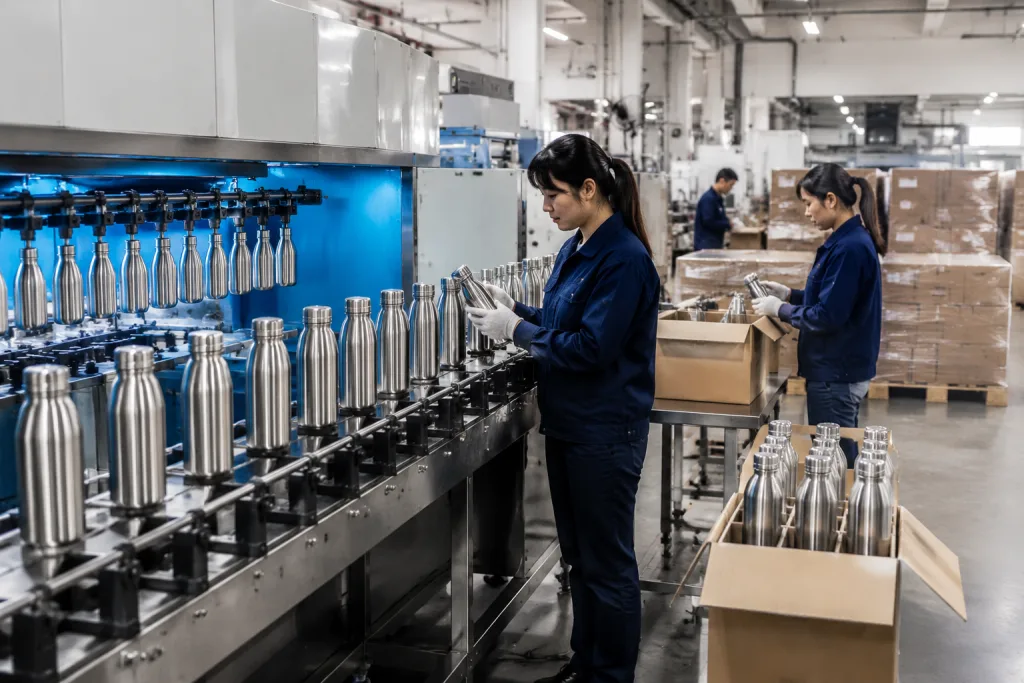
QC on thermal bottles does not start at final inspection. If you wait until packing is done, you pay to find defects after welding, coating, printing, and labor are already in the part. We run three checkpoints on the line: incoming material, in-line production, and final random inspection.
Incoming material should confirm steel grade, lid resin, gasket hardness, coating raw material, and carton board. Mill certs matter where relevant, but paper alone is not enough. We also check with tools on the floor: ultrasonic wall-thickness gauge, Shore A durometer for silicone, and body-weight check against the approved tolerance, typically plus or minus 3%. Last month QC pulled a sample where the PO said 304 stainless, but the supplier mixed in off-spec lid resin on one lot, so this step is not paperwork.
In-line control is where most problems show up, especially at vacuuming, powder coating, and printing. This is the wrong place to save labor. Common failure points we see on production:
- Pinholes or weak vacuum that kill heat retention
- Thread mismatch between cap and neck, then cross-thread leaks show up in leak test
- Orange peel or thin coating at the shoulder radius, often easy to spot under a 6000K light box
- Logo rub-off after cure because the oven setting was right but line speed was too high
- Base wobble after welding or polishing; if the bottom rocks more than 1 mm, the buyer will flag it
For functional QC, require 100% leak testing and 100% vacuum check. Then lock the random inspection protocol before mass production, not after the first complaint. Many buyers use AQL 2.5 major / 4.0 minor for finished drinkware. That is a workable commercial standard for wholesale drinkware and drinkware wholesale programs. For premium launch orders, some buyers ask for tighter appearance limits, and we've seen this go sideways if the approved sample never defined what counts as a minor print defect.
Practical test list
- Leak test with inverted bottle for 30 minutes
- Vacuum retention sample test based on agreed fill and ambient conditions
- Coating adhesion cross-hatch and tape test
- Dishwasher disclaimer verification if product is marked hand wash only
- Carton drop test, often 1 corner, 3 edges, 6 faces from 76 cm
- Barcode and FNSKU scan check if sending to Amazon FBA
If your assortment also includes canteen bulk, beer tumbler in bulk, or alcohol flask wholesale, keep separate checklists. The math doesn't work if one sheet tries to cover every SKU. A tumbler lid with slider does not get judged the same way as a screw-cap bottle, and a hip flask hinge pin has a different wear point than a growler bulk closure. We ship these as different product families for a reason; one broad "drinkware bulk QC sheet" usually misses the actual risk.
Lead time, shipping, and paperwork
Assume the sample is approved on Monday. The next steps should be clear on paper and on the line. For an existing 500 ml bottle, normal production lead time from deposit and artwork approval is 35-45 days in Zhejiang, China. In peak season, from August to November, 45-60 days is the safer call, especially on mixed orders with thermal bottles, wholesale growler, and beer tumbler wholesale items running on different lines. We usually confirm this after the first capacity check, not by guesswork.
Break the timeline into blocks you can track:
- Day 1-3: PI confirmation, deposit, artwork release
- Day 4-10: raw material booking, carton proof, print plate prep
- Day 11-28: body forming, welding, vacuuming, coating
- Day 29-36: printing, assembly, packing
- Day 37-40: final inspection and booking
That schedule only works if each handoff is clean. A 0.5 mm logo shift on the carton proof or one wrong Pantone note on the PO will push printing back a day or two, and then the whole booking gets tight.
If the order is FOB Ningbo or Shanghai, ask who books the trucking, who pays local charges, and when the ship date becomes the ex-factory target. This is the wrong question to ask last. We have seen buyers fight for a $0.08 unit-price cut, then lose 12 days after missing a vessel cutoff. The math doesn't work. On our side, we ship better when the trucking slot is fixed 3-5 days before cargo ready, not the night before.
For Europe and North America, the paperwork has to match the sales channel. At minimum, expect packing list, commercial invoice, and bill of lading details. Depending on the product and market, you may also need test reports for food-contact materials, BSCI or social compliance records for customer onboarding, and a declaration regarding REACH substances. If you sell on Amazon, carton labels and FNSKU timing must be locked before packing. Not after. QC pulled one shipment last year because the outer carton label version did not match the final FNSKU file.
One practical point on consolidation: if you load several SKUs such as canteen bulk, growler wholesale, and alcohol flask in bulk in one container, write carton marks clearly by SKU and color. Use large marks, not tiny text buried near the tape line. We have seen 4 SKUs in one 40HQ with near-identical kraft cartons, and the buyer flagged the warehouse mix-up two days after arrival. Mixed pallets save freight. They also create receiving errors if the packaging looks too similar.
Where first orders usually fail
Most first-order failures are not factory disasters. They are costly small misses: 6% logo misalignment, 3% scuffed coating, unlabeled lids, cartons that fail a parcel drop, or a heat-retention test nobody defined on paper. We’ve seen QC pull a sample at final inspection and find the print 2 mm off the approved position. A short pre-production checklist stops most of this.
Before the full run, lock these points in one email and one signed sheet. No loose chat records.
- Approved sample photos plus courier tracking record
- Final artwork in vector format with dimensions in mm
- Packaging layout, barcode type, carton marks, and country of origin statement
- Inspection plan with critical, major, and minor defect definitions
- Heat retention test method, not just a claim like "12 hours hot"
- Spare parts policy for lids and gaskets, usually 0.3%-1.0% extra
Buyers on best wholesale drink bottle projects often miss the after-sales part, and this is the wrong question to ask late in the order. Don’t ask about replacement lids after shipment. Ask before deposit. A lid program can decide whether the item survives in the market, especially in sports and travel channels where the buyer flagged broken carry loops more than once. If your annual volume could exceed 50,000 pcs, ask the factory to hold 1%-2% lid inventory or confirm repeat lid production for 12 months.
Be realistic about MOQ. Custom logo on an existing bottle may start at 1,000 pcs, but the color box supplier may ask 3,000 pcs, the custom lid color may need its own masterbatch minimum, and the silicone ring color often gets held up on a 25 kg material lot. We run into this every month. For drinkware wholesale ranges, the cleaner launch is usually one bottle body in two colors, not four bodies in six colors. The math doesn’t work on small first orders. More SKUs give the line more chances to mix caps, miss carton marks, or pack the wrong gasket.
Factories in Zhejiang and across China can make strong private-label thermal bottles, wholesale canteen products, and beer growler wholesale bulk lines at scale. We ship these every week. The difference between a smooth order and a painful one is project control: measurable specs, signed samples, and inspection checkpoints. Hopeful emails are where first orders go sideways.
Send your bottle spec, get a workable factory quote
Share your target price, volume, artwork, and market. We will review the build, MOQ, lead time, and QC points before you place the order.
Frequently asked questions
What MOQ should I expect for make thermal bottle wholesale?
For an existing bottle mold, a realistic MOQ is 1,000 pcs per size and color, sometimes 500 pcs if you accept stock finishes and a simple one-color logo. For a fully custom project with new lid parts, expect 3,000-5,000 pcs per SKU plus tooling cost. Packaging can raise the real MOQ: a custom color box may start at 2,000-3,000 pcs, and a custom Pantone powder coat may need at least 1,000 pcs per color. Always ask if MOQ is counted per SKU, per print, or for the total order. That single detail can change your commitment by thousands of units.
How do I compare prices from different China factories fairly?
Use one fixed RFQ sheet and force every supplier to quote against the same structure: capacity, steel grade, wall thickness, body weight, lid material, coating, print process, packing, carton size, and Incoterm. Ask for FOB price, sample charge, tooling if any, lead time, and defect policy. A bottle quoted at $2.35 and another at $2.75 may not be comparable if one uses 201 outer steel, thinner walls, or bulk packing. Request net weight and carton gross weight too. On thermal bottles, freight and damage risk can wipe out a cheaper unit price fast. Fair comparison starts with identical specs.
What quality tests matter most before shipment?
For thermal bottles, the non-negotiable checks are 100% leak test and 100% vacuum check. Then run random inspection under an agreed AQL, commonly 2.5 major and 4.0 minor. Functional tests should include heat retention based on a written method, coating adhesion, logo rub resistance, cap threading, and base stability. For retail or e-commerce channels, add carton drop testing and barcode scans. If the product is for EU or North America, confirm food-contact compliance documents as well. A nice-looking bottle can still fail commercially if the lid leaks, the print peels, or the carton collapses in transit.
How long does a custom thermal bottle order usually take?
If you use an existing mold and approve artwork quickly, sample time is often 7-12 days and mass production is 35-45 days after deposit and final approval. In peak season, plan 45-60 days. New mold development can add 20-30 days, sometimes longer if several lid parts need validation. Shipping is separate: ocean transit to Europe may take around 30-40 days depending on route, while North America can vary widely by coast and port congestion. The hidden delay is usually not production itself. It is late artwork sign-off, packaging changes, or waiting on compliance documents.
Can I combine thermal bottles with growlers, tumblers, or flasks in one order?
Yes, and many buyers do, especially when building a seasonal wholesale drinkware range. You can combine thermal bottles with bulk growler, beer tumbler bulk, canteen bulk, or alcohol flask wholesale programs in one shipment, but plan the complexity. Different products may run on different lines, have different MOQ rules, and need different QC checklists. A tumbler lid with a slider, a growler closure, and a flask hinge are not inspected the same way. Mixed orders also need very clear carton marks and SKU segregation. Combining products can improve container utilization, but only if the timeline and packing plan are managed carefully.