Key Takeaways
- Typical MOQ is 1,000 pcs per color for stock molds, but custom lids or new molds can push MOQ to 3,000-5,000 pcs
- For stainless steel drinkware, sample time is often 7-12 days and mass production 25-40 days after deposit and artwork approval
- AQL 2.5 for major defects and 4.0 for minor defects is a practical baseline for wholesale drinkware inspection
- FOB China prices can range from about USD 1.80 for simple single-wall items to USD 6.50+ for insulated growlers with custom packaging
You are not buying a sample to sit on a trade show shelf. You are buying a supply line you need to repeat for 6 months or 18 months. That changes the whole job. If you search for make drinkware wholesale, get straight answers on MOQ, tooling cost, food-contact compliance, packaging spec, and whether the factory can hold the same quality when the order jumps from 500 samples to 20,000 units. We run into this every week. A bottle that looks good in a showroom means nothing if the lid leaks at 0.03 MPa air test, the logo fails after 100 dishwasher cycles, or the outer carton crushes because the drop test spec was never confirmed.
Most sourcing problems show up before production starts, not after the line begins. We have seen POs with a logo size typo from 35 mm to 53 mm, drawings with no wall-thickness note, buyers assuming 304 stainless on the body and lid while the quote covered only the body, and target prices that do not match the packing standard. This is the wrong question to ask: “Who is cheapest?” Ask who can quote against a clear spec and hold it under inspection. In Zhejiang, China, the better factories usually sort these issues fast if the buyer sends usable files and agrees the inspection standard up front. The weak ones hide behind a low unit price and push the argument to pre-shipment day. This guide is built around the questions real buyers ask for bulk drinkware, canteen wholesale programs, wholesale growler lines, and alcohol flask bulk orders from China.
What are you really buying?
Most procurement teams start with a photo and a target price. Wrong starting point. For make drinkware wholesale, you are buying a spec stack, not just a bottle shape. If your RFQ only says 500ml stainless bottle, black, custom logo, you will get 10 quotes for 10 different builds, and we have seen weight gaps of 40g on samples that looked the same in photos.
Start by locking down the commercial and technical basics. This saves time on the line and cuts the back-and-forth after QC pulled the sample:
- Material: 18/8 stainless steel, 18/0 stainless, Tritan, soda-lime glass, borosilicate, PP, silicone
- Construction: single-wall, double-wall vacuum, copper-coated vacuum, powder-coated exterior
- Capacity tolerance: for example 500ml nominal, plus or minus 3%
- Wall thickness: common body thickness is 0.4mm to 0.5mm for stainless bottles; heavier growlers may go 0.5mm to 0.6mm
- Finish: spray paint, powder coating, silkscreen, heat transfer, laser engraving
- Packaging: polybag, egg-crate divider, white box, color box, PDQ, master carton drop-test requirement
If you buy drinkware bulk for retail, the vessel and the shelf presentation carry equal weight. A buyer will flag a weak logo edge or a soft color box fast. If you buy for hospitality, ask about stackability, scratch resistance, and replacement rate in hard numbers, like 3-month breakage data or rim thickness in mm. A bulk canteen project for outdoor brands is built for different abuse than a beer tumbler wholesale bulk order for brewery merchandise, and this is where generic quoting goes sideways.
You do not need the cheapest quote. You need the cheapest quote that still matches your exact specification, test requirements, and delivery window.
In Zhejiang, China, you can find 20 factories offering a similar silhouette. The wrong question is price first. The gap is consistency from sample to mass run: same steel grade, same net weight, same carton count, same logo position checked with a caliper, often within 1.5mm. Ask for a full quotation sheet with material grade, weight, packing ratio, carton size, and logo process listed line by line. If the supplier cannot send that, or there is a typo on the PO and nobody catches it, your sourcing risk is already on the table.
How low can MOQ go?
This is usually the first real negotiation, and buyers often ask the wrong question. For stock shapes, a lot of China factories quote 500 to 1,000 pcs per SKU, but the line does not run on that number alone. The real MOQ gets set by decoration method, lid color, insert options, and packing details; a single gift box insert at 2 mm thickness can push the number up fast.
Practical MOQ ranges
- Stock stainless bottle: 500-1,000 pcs per size per color
- Canteen bulk order with custom powder color: 1,000-3,000 pcs
- Wholesale growler with custom cap assembly: 2,000-3,000 pcs
- Alcohol flask wholesale bulk with gift box: 1,000-2,000 sets
- New mold or custom lid: often 3,000-5,000 pcs plus tooling cost
If your program includes multiple SKUs, ask about combined MOQ. A factory with 600,000 units monthly capacity may accept 3 colors x 500 pcs if the same body and same decoration line are used. We run this way for launch orders all the time: same bottle, same screen, 3 Pantone colors, one master carton. That matters for a wholesale canteen launch where you need assortment without sitting on 5,000 extra units in month one.
There is a cost tradeoff. Lower MOQ usually means higher unit cost, fewer color choices, simpler packaging, or slower delivery because your order gets slotted behind bigger runs. We have seen a 12-day plan turn into 18 days just because the buyer wanted 4 lid colors at 300 pcs each, and the math doesn't work.
For buyers in Europe and North America, the better move is usually to simplify the first PO instead of pushing for an MOQ the factory will only accept on paper. Keep one body, two lid colors, one print position, and one standard carton. QC pulled the sample on one project where the PO mixed matte black and rubber paint black in the same line item, and that kind of mistake burns time. Scale into bulk drinkware variants after sell-through data comes back.
If you are sourcing growler bulk, beer growler in bulk, or alcohol flask in bulk, do not forget accessory MOQ. Caps, straws, silicone boots, and gift boxes may each carry their own minimums even when the vessel body does not. The buyer flagged this on a flask set after the body MOQ was approved at 1,000 pcs, but the foam insert supplier would not run less than 2,000.
Where price breaks usually hide
A low ex-factory price often hides the expensive parts. For drinkware wholesale, ask for a cost breakdown by range, even if the supplier will not open the full sheet. We usually break it into body, lid, finish, decoration, packing, and freight term. That shows what changed the quote, not just the final number.
Typical FOB China pricing for standard projects might look like this:
- Single-wall 500ml stainless bottle: USD 1.80-2.60
- Double-wall vacuum 500ml bottle: USD 3.20-4.80
- Beer tumbler bulk 20oz vacuum cup: USD 2.70-4.20
- Wholesale growler 64oz insulated: USD 5.20-6.80
- Alcohol flask bulk 6oz basic set: USD 1.20-2.20
The main price drivers are simple:
- Stainless grade and body weight, such as 304 stainless with a 0.4mm wall versus 0.5mm
- Vacuum yield rate and reject rate on the line; QC pulled samples last month with 3 pinhole failures in one shift
- Coating quality, including powder thickness and adhesion after tape test
- Decoration method and print colors, especially screen print versus laser or full-wrap transfer
- Lid complexity and sealing parts, from a simple PP cap to a lid with 3 silicone pieces
- Packaging style, plain white box versus color box with insert
- Order quantity by SKU; 10,000 pcs on one color prices better than 2,000 pcs across 5 colors
For example, a matte powder coating can add USD 0.18-0.35 compared with plain spray paint. A premium color box with EVA insert can add USD 0.60-1.20. Copper-lined vacuum insulation for better heat retention can add around USD 0.20-0.40. At 30,000 pcs, the math gets loud fast. This is the wrong place to act surprised after sampling.
If you need the best wholesale drink bottle program for a brand launch, do not cut cost on the lid seal or coating adhesion. We have seen this go sideways. One buyer pushed for a cheaper seal ring, saved less than USD 0.05 per pc, then flagged leak complaints in the first batch. Cut cost on the gift box, extra straw, or second print position first. End users notice leaks and chipped coating on day one. Almost nobody thanks you for a thicker insert card.
Factories in Zhejiang and other parts of China also quote differently on freight terms. Compare EXW, FOB Ningbo, or FOB Shanghai on the same basis and on the same PO quantity. We ship from both Ningbo and Shanghai, and the delta is sometimes only USD 80 per shipment, sometimes USD 280, depending on trucking, port fees, and carton count. If one quote says FOB and another is EXW, you are not comparing prices. You are comparing two different cost structures.
Which compliance points matter first?
This is where buyers cut through trading noise and see who actually runs a factory. If you sell into Europe or North America, compliance is a gate, not a decoration, for wholesale drinkware, wholesale growler, or canteen wholesale programs. On our side, QC usually asks for the contact-material BOM on day 1, down to the silicone ring hardness if it is 60 Shore A or 70.
For stainless steel and plastic drinkware, start with these questions:
- Can the supplier support REACH screening for EU projects?
- Can they provide LFGB or food-contact migration testing where required?
- For the US, can they support FDA-related food-contact declarations and California Proposition 65 screening if needed?
- For children’s products, do they understand CPSIA and ASTM requirements?
- Do they have BSCI, Sedex, or similar social audit records if your brand requires them?
- Do they run production under ISO-style documented procedures, even if not fully certified?
Do not ask for every test on the list just to feel safe. This is the wrong question to ask. Ask for the tests tied to the material, sales market, and actual use. A beer growler wholesale bulk order for adult use does not carry the same risk as a kids bottle, and we have seen this go sideways when a buyer copied the same checklist onto both POs. A glass item needs impact and thermal shock checks; an alcohol flask wholesale stainless set needs weld, odor, and coating attention. On the line, one pinhole at the shoulder weld is enough for QC to hold 500 pcs.
Then lock the inspection rule before production starts. A practical baseline is AQL 2.5 major / 4.0 minor with leak testing, logo position check, coating adhesion check, and carton drop check. We usually run a 30-minute inverted leak test and a 3M tape pull for painted bodies. If your order is Amazon-bound, add barcode scan confirmation and packaging dimension tolerances; we have had buyers flag a 4 mm oversize mailer. If your distributor needs retail-ready goods, confirm carton marks, inner pack count, and pallet pattern early, because a simple PO typo like 24 pcs/ctn versus 20 pcs/ctn will waste a day.
The better factories in China do not act like testing is a burden. They will tell you which report is transferable, which one needs your brand name and lab rerun, and whether that adds 3 days or 7 days. We ship faster when this is clear up front. A thin opening quote looks nice, but the math does not work if the buyer flagged missing compliance after mass production.
How do you check factory reliability?
You do not need a full audit on every supplier, but you do need evidence you can check. For make drinkware wholesale, ask the questions that show whether the supplier runs the line or just forwards WeChat messages. One fast test: ask who signs off rework on a dented 500 ml body after welding. A trading company usually goes vague here.
Useful checks include:
- Monthly output capacity, for example 500,000 to 800,000 pcs, and whether that number comes from actual line loading or a sales estimate
- Main categories produced in-house, such as vacuum bottles, tumblers, or flasks, not a broad "all drinkware" answer
- Vacuum line count, polishing line count, and coating outsourcing or in-house status, down to how many stations they run per shift
- Standard lead time in low season and peak season, with a clear number like 28 days in March versus 38 days in October
- Defect handling process and rework authority, including whether QC pulled the sample and who can stop packing
- Export ratio to Europe and North America, plus which market drives their spec level and carton standard
If a factory says lead time is always 15 days for everything, be careful. We have seen this go sideways. Realistic lead time for most drinkware bulk orders is 25-40 days after deposit, sample confirmation, and artwork approval. For complex beer tumbler in bulk or growler wholesale projects with custom packaging, 40-50 days is more believable. This is the wrong question to ask if you only want one number; ask for each step instead—body production, painting, printing, and packing.
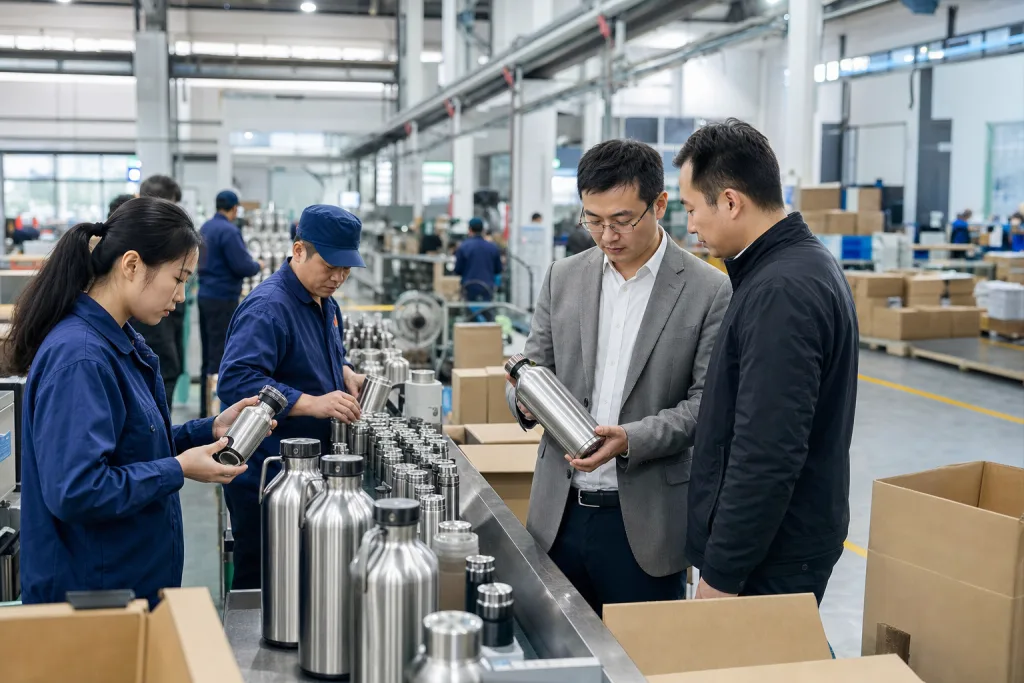
Ask for production photos that show tube cutting, body forming, welding, vacuuming, polishing, coating, printing, assembly, and packing. Better yet, ask for a short video from the line with the vacuum chamber gauge visible. We usually send photos of neck trimming, laser welding, and carton drop-test setup because those are harder to fake than a clean showroom shot. Ask whether critical parts such as lids are made in-house or sourced from partner factories in Zhejiang, China. Outsourced parts are not automatically bad, but they need incoming inspection, such as thread gauge checks and a 1.2 m drop test on assembled samples.
A small but important signal: can the supplier explain common failure modes? Good answers mention pinholes in vacuum welds, powder coating adhesion, silicone odor, thread mismatch, condensation from vacuum failure, and print rub-off. A solid factory will tell you what QC found last month, not recite a brochure. We had a buyer flag lid leakage once, and the root cause was a 0.3 mm thread mismatch from a lid vendor, not the bottle body.
If you are buying canteen bulk, bulk growler, or alcohol flask wholesale bulk for repeated seasonal orders, ask for a retained golden sample and signed specification sheet. Put the PO number and revision date on both. One typo on a color code can waste 2,000 pcs. That is how you stop quality drift between POs.
What should your buying checklist include?
Most sourcing mistakes start the same way: the team signs off the quote before the checklist is finished. We see this on the line every month. Use this working list before you place any PO for bulk drinkware or wholesale canteen supply, or you will be fixing avoidable problems after deposit.
- Product spec: capacity, dimensions, unit weight, material grade, wall thickness in mm, insulation type
- Lid spec: resin type, gasket material, leakproof level, straw or no straw, carry handle pull strength in kg
- Decoration: artwork file, Pantone reference, print size, location tolerance in mm, adhesion requirement
- Compliance: target market, required reports, labeling language, warning text
- Packing: inner pack, barcode, FNSKU if Amazon, carton marks, pallet rule, carton gross weight limit
- Inspection: AQL level, test points, sample size, third-party inspection timing
- Commercials: tooling fee, sample charge, payment term, FOB port, delivery date, claim window
Then confirm two points in writing: who signs the pre-production sample, and what the factory must do if mass production differs. This is not paperwork for its own sake. QC pulled the sample on one order last season, and the logo sat 3 mm low against the approved file. The buyer flagged it after 8,000 pcs were packed. Without written responsibility, arguments get expensive fast.
For Amazon or e-commerce buyers, add carton weight limit and scan label position. We ship cartons every week that must stay under 15 kg because the warehouse rejects anything heavier. For breweries buying beer growler bulk or beer tumbler wholesale, add a carbonation-use warning if the vessel is not designed for pressure retention. Ask this early. We have seen POs marked "for cold brew" while the sales team on the buyer side expected sparkling fill, and that is the wrong question to leave vague. For gift-channel buyers ordering alcohol flask in bulk, add plating, hinge smoothness, funnel fit, and gift box transit protection; on flask sets, our drop test usually starts from 76 cm.
If you want to source from China efficiently, keep one habit: turn every verbal promise into one line on the PI or approved spec sheet. No exceptions. We run fast in Zhejiang, and a clean brief can cut correction time to 12 days vs 18 days. Last month we even caught a PO typo where 500 ml became 550 ml before tooling release. Speed helps only when the spec is tight.
Send your RFQ and get a usable quote fast
Share your capacity, material, logo method, target market, and quantity. We will review MOQ, compliance points, and lead time before you place the wrong PO.
Frequently asked questions
What MOQ should I expect for custom logo wholesale drinkware?
For stock molds, a realistic starting point is 500 to 1,000 pcs per size and color, especially for simple silkscreen or laser logo work. If you want custom powder coating, retail box packaging, or special lid colors, MOQ usually moves to 1,000 to 3,000 pcs. A fully custom body or lid often needs 3,000 to 5,000 pcs plus tooling. Ask whether the supplier allows combined MOQ across colors or sizes. Many China factories will accept, for example, 2 colors x 500 pcs if the body and packaging stay the same. Also confirm accessory MOQ separately because lids, straws, silicone boots, and gift boxes often have their own minimums.
How do I compare quotes for canteen wholesale or growler wholesale fairly?
Put every quote on the same basis: FOB port, material grade, body weight, coating method, logo process, packaging, and quantity per SKU. A 64oz wholesale growler quoted at USD 5.40 may use thinner steel or simpler insulation than one quoted at USD 6.10. Ask for net weight, wall thickness, carton spec, and whether the lid seal is food-grade silicone. For canteen bulk projects, confirm if the finish is spray paint or powder coating because that can change cost by USD 0.20 to 0.35 per piece. If one supplier includes a white box and another includes a color box, the comparison is already broken. Standardize the RFQ first, then negotiate.
What lead time is normal for bulk drinkware from China?
For repeat stock styles with standard packaging, 25 to 35 days after deposit and sample approval is common. If you need new print plates, custom packaging, or sourced lid parts, 35 to 45 days is more realistic. Pre-production samples usually take 7 to 12 days. New mold development can add 20 to 30 days before sampling. In peak periods, especially before major holiday shipping windows, lead time can extend by 7 to 15 days. Ask the factory to split timing into sampling, material purchasing, production, and inspection so you can see where risk sits. Reliable Zhejiang factories usually give stage-by-stage timing instead of one vague promise.
Which tests should I require for alcohol flask bulk or beer tumbler bulk orders?
Start with the market you sell into. For EU sales, REACH-related screening and food-contact testing are common starting points. For US projects, ask about food-contact declarations and Proposition 65 screening if your compliance team requires it. For stainless products such as alcohol flask wholesale bulk or beer tumbler wholesale bulk, add leak testing, coating adhesion, logo rub test, and basic corrosion review. If the item is insulated, add vacuum performance checks and condensation checks. For retail packaging, require carton drop testing, usually with a filled or simulated packed carton. If you are buying for children, requirements become stricter and may involve ASTM or CPSIA-related checks.
How can I reduce risk on my first make drinkware wholesale order?
Keep the first PO simple. Use one proven body shape, one standard lid, one decoration method, and standard export packaging. Target 1,000 to 3,000 pcs rather than too many low-volume variants. Ask for a signed specification sheet, approved pre-production sample, and AQL standard in writing before mass production starts. AQL 2.5 major and 4.0 minor is a workable baseline for many drinkware orders. Hold 30% deposit and 70% against inspection and shipping documents if the supplier accepts that structure. If the order is important, book a third-party inspection in China after at least 80% of units are packed. That usually costs far less than one failed container.