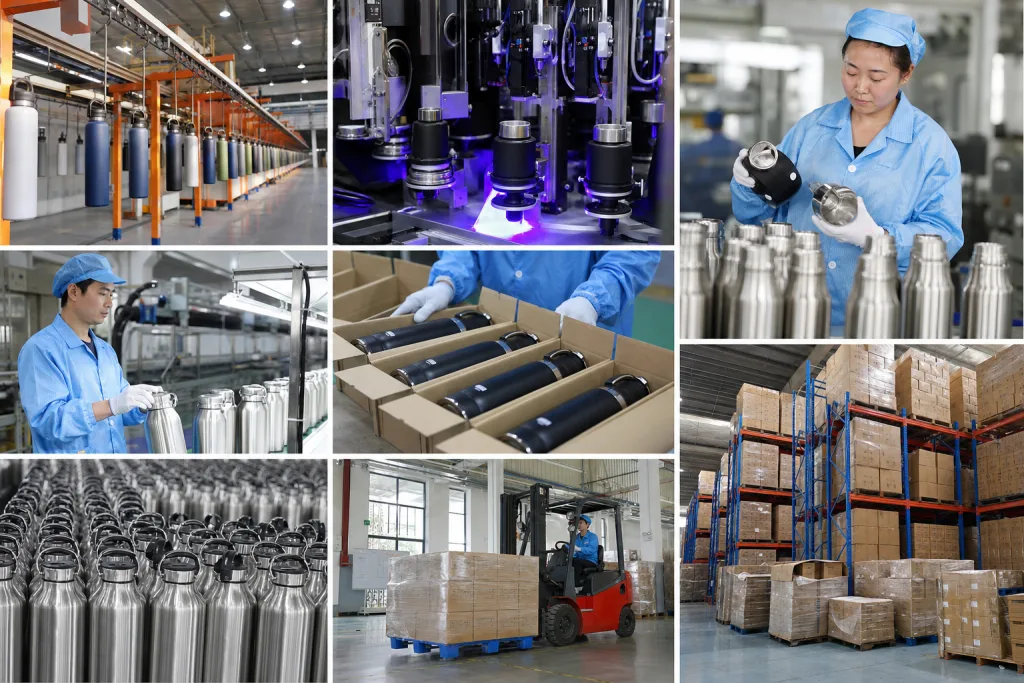
Key Takeaways
- Set measurable specs early: wall thickness ±0.05 mm, logo position ±1.0 mm, and AQL 2.5/4.0 before mass production.
- Most custom bulk drinkware orders in China need 25-35 days production after sample approval, with MOQs from 500 to 3,000 units per SKU.
- Vacuum retention, leak rate, coating adhesion, and carton drop performance cause more claims than visible cosmetic defects.
- FOB cost gaps of just USD 0.20-0.60 per unit often come from steel grade, lid tooling, packaging, and inspection depth.
You can make drinkware in bulk from almost any factory directory listing. Easy part. The hard part is getting 3,000 to 30,000 units that match your approved sample, pass compliance in Europe or North America, survive a 1.2 m drop test in transit packaging, and do not turn into claims six weeks after arrival. Most bulk drinkware failures are not dramatic. They come from small, repeatable misses on the line: a lid thread with drag on the torque gauge, a logo shifted 1.5 mm, a vacuum bottle that drops below the heat-retention target, or a coating that shows scratch marks after carton rub before the goods even reach retail shelves.
From Zhejiang, China, we see the same pattern every month. Buyers lead with shape and price, then the buyer flagged the real cost later: rework, missed vessel cutoffs, and marketplace complaints. We had one PO last season with the color code typed wrong by one digit, and 5,000 pieces had to be held for relabel review. If you are buying wholesale drinkware, bulk canteen, wholesale growler, or alcohol flask bulk, the safest move is to write the failure points into the spec before production starts. This is the right place to protect margin. Asking only for the lowest unit price is the wrong question.
Cheap quotes hide the wrong build
The first failure doesn't start on the line. It starts at quote stage. You ask for a best wholesale drink bottle, beer tumbler bulk, or canteen wholesale quote, and 3 factories come back spread by USD 0.35 to USD 1.20 per unit. Buyers often read that as factory efficiency. Most of the time, it's a spec gap nobody wrote down. We see this on the floor after the PO lands, sometimes with a lid code typo or a missing carton drop-test requirement.
For stainless items, cost moves on steel grade, wall construction, and part count—but don't leave those as shorthand. A 304 inner and 201 outer body is cheaper than full 304, and that changes corrosion resistance and whether the buyer accepts it for the EU shelf. A single-wall wholesale canteen may be USD 1.20-2.50 FOB, while a double-wall vacuum bottle of similar size may be USD 2.80-5.80 FOB depending on lid complexity, powder coat, and packaging. For growler bulk or beer growler wholesale bulk, handle welding and neck finish move cost fast; on our TIG welding station, a rough handle joint is usually the first thing QC pulled the sample for.
You should lock the build sheet before comparing prices. This is the right question to ask.
- Body material: SS304, SS316, tritan, borosilicate, or aluminum
- Wall construction: single wall, double wall, copper-coated vacuum
- Body thickness: for example 0.40 mm outer, 0.35 mm inner
- Lid material and seal: PP, Tritan, stainless cap, food-grade silicone
- Finish: spray paint, powder coat, silk screen, laser, UV print
- Packaging: polybag, egg-crate divider, color box, PDQ, master carton spec
If you send only a reference photo, the factory will fill the blanks to hit your target price. In Zhejiang, China, that often means lighter gauge steel, simpler polishing, or a stock lid swapped in for the one you thought you were pricing. BottleForge Industrial runs around 600,000 units/month across bottles, tumblers, flasks, and growlers, and the orders with the fewest claims are the ones with a signed spec sheet. Not just a sample photo. We've seen this go sideways when the buyer flagged pinholes in powder coat after mass production, and the quote had never stated coating thickness or gloss target.
Leaks start with vague lid specs
Leakage is the No. 1 post-arrival complaint we see in drinkware wholesale. It shows up on sports bottles, canteen bulk, alcohol flask wholesale bulk, and beer tumbler in bulk with slide lids. The cause is usually not one big defect. It is stack-up: thread fit, gasket compression, and sealing-surface flatness drifting at the same time. On the line, QC pulled one sample last month with a sealing lip out by 0.18 mm, and that was enough to start returns.
If you want to make drinkware in bulk without leakage claims, stop writing only “leakproof.” That is the wrong question to ask. Write the test method. For screw-cap bottles, ask for an inverted leak test for 30 minutes and a random sample hot-water test at 70-80°C to catch seal distortion. For straws and flip lids, state clearly if “leak-resistant” is acceptable. We ship a lot to North America, and plenty of those lids will not stay dry if a buyer throws the bottle in a bag and it gets shaken for 20 minutes.
What to include on the tech pack
- Cap torque range, such as 8-12 kgf·cm for child-resistant or standard screw caps
- Silicone gasket hardness, for example Shore A 50-60
- Thread standard based on approved tooling sample
- Flatness tolerance on sealing lip
- 100% air-pressure or vacuum leak test requirement where practical
For bulk growler and beer growler in bulk, closure style matters more than some buyers expect. Swing-top hardware looks good in the photo, but we have seen it go sideways after 500 to 800 open-close cycles if the wire gauge shifts or the ceramic seat is not consistent batch to batch. Stainless growlers with screw tops are easier to control at scale. For alcohol flask in bulk, the common nuisance failures are loose hinge pins and weak cap-chain attachment. Cheap fix. We check both during in-line inspection with a pull check, and the buyer flagged this before on a PO that only said “lid secure” with no force standard.
You do not buy a lid design. You buy a lid process capability.
That is why a pre-production sample and a golden sample should be held at both your office and the China factory. If not, each assembly team reads “tight enough” its own way. We usually mark the approved sample with torque, gasket spec, and date, then keep it by the torque meter for the line to follow.
Vacuum and thermal claims go bad
Double-wall vacuum bottles create the biggest gap between promise and complaint. We see it on the line. A buyer asks for wholesale drinkware with “12-hour hot,” the sample was tested once under clean lab conditions, then mass production shifts after cup No. 3,000 and the base weld or lid fit is not the same. Your end customer puts it beside a premium retail bottle, runs a side-by-side kitchen test, and the one-star review lands fast.
Vacuum alone means little. Inner wall thickness, copper plating, weld quality at the vacuum bottom, and lid insulation decide the result. QC pulled a sample last month that passed a basic vacuum check, but heat retention was still 10-20% short because the silicone ring on the lid was 0.4 mm under spec. This is the wrong question to ask: “Is it vacuum?” Ask how long it holds under a stated test method.
For vacuum canteen wholesale or beer tumbler wholesale bulk, write the method into the PO: fill with 95°C water, ambient 20°C, cap closed, measure after 6 and 12 hours. Then set the pass line, for example not less than 55°C after 12 hours for a 500 ml bottle. Keep it plain. For cold retention, use ice-water and check surface condensation too if your market cares about wet desks, bar counters, or car cup holders.
Ask how the factory checks vacuum integrity in production and at tooling stage. We’ve seen this go sideways.
- Temperature retention spot checks by lot, such as 5 pcs per 1,000 pcs
- Vacuum chamber or helium-based checks on new tooling validation
- Boiling water observation around the vacuum bottom area
- Pull-force checks on the bottom cap after sealing, often recorded in kg force
A factory in Zhejiang may quote the same SKU at two prices because one version has copper coating between the walls and one does not. On a 500 ml bottle, that gap is often USD 0.12-0.25. On 10,000 units, the math usually favors the better spec over one retail returns cycle. We ship both versions, but if you plan to sell as best wholesale drink bottle or premium drinkware bulk, thermal retention belongs on the purchase order, not just in sales copy. We even saw one PO typed as “vacum” with no test standard attached, and the buyer flagged the claim only after receiving bulk cargo.
Surface finish fails in transit
Too often, buyers sign off appearance from 1 hand-picked sample. Then we run 5,000 units, pack them 24 pcs per carton, truck them from Zhejiang to Ningbo port, and QC starts seeing ring marks, rub points, or chipped powder coat on arrival. This is where bulk canteen, beer tumbler wholesale, and wholesale growler orders lose margin. Quietly. We’ve seen this go sideways after cartons were packed with only 2 mm clearance between bodies.
Powder coat looks tough on the table, but the result depends on pretreatment, oven temperature, and film build. On our line, a 10°C curing swing is enough to change scratch performance. Spray paint gives more color options and lower cost, but it marks faster under carton friction. Electroplated and mirror-polished finishes show fingerprints fast, and carton rub shows up even faster. If the order is for gifting, set cosmetic AQL tighter than promo goods. This is the right question to ask early, not after the buyer flagged scuffing on the top shoulder.
Useful specs include:
- Coating adhesion by cross-hatch or tape test
- Salt spray requirement if relevant for outdoor use
- Color tolerance by Pantone reference and approved drawdown
- Film thickness target, such as 60-80 μm for powder coat
- Individual polybag or tissue wrap requirement for glossy finishes
Print durability matters. Silk screen on a smooth single-wall bottle works well for wholesale canteen programs, but on textured powder coat it can chip if the ink system and curing cycle do not match. We usually check this with a 3M tape pull after full cure, and QC pulled the sample more than once on a recent black matte order. Laser engraving is cleaner for premium stainless items. UV print fits multi-color artwork, but it needs abrasion testing before approval. For drinkware wholesale into Europe, ask for REACH-friendly coatings and inks. For North America, confirm food-contact components meet FDA or relevant state requirements where applicable.
Packaging is quality control, full stop. A perfect production run still gets damaged if the master carton dividers are weak or the insert die-cut is loose by 5 mm. Specify carton burst strength, drop test expectations, and palletization if the goods will go to Amazon FBA with FNSKU labeling. The cheapest color box is often the most expensive choice after ocean freight vibration starts. The math doesn't work.
Compliance misses stop shipments cold
Some failures surface late, after the forwarder booking is locked and the launch date is printed on the retail carton. Compliance gaps stop shipments faster than a scratch or color shade issue. We see this most on kids bottles, glass items, alcohol flask wholesale, and any drinkware bulk program going into chain retail. Last month a buyer flagged a missing lid-migration report 48 hours before loading. Container stayed put.
Split compliance into two buckets, not three: material declaration and product testing. Social compliance matters, but it does not clear a product through customs, and this is the wrong question to ask first. A supplier can show ISO files and still have no valid migration test for your exact lid assembly with the silicone straw and PP bite valve. We’ve seen this go sideways. One factory passed BSCI, then outsourced logo printing to a small shop using ink that failed the buyer’s standard at 0.8 mm logo edge rub.
For Europe, ask early about REACH, LFGB where relevant, and packaging rules. Do it before sampling is approved, not after the mold polishing starts on the line. For North America, common requests include FDA food-contact declarations, California Proposition 65 screening, and ASTM or CPSIA considerations for children’s products. If your mixed drinkware wholesale order includes glass or ceramic accessories, lead and cadmium release testing may apply. For growler wholesale used with beer, check that the closure and liner are rated for repeated food-contact use, not one-time filling. A cap that holds for 24 hours on a sample means nothing if the liner swells after 12 refill cycles.
Your purchase order should identify:
- Required test standards by market and SKU
- Who pays for lab testing and retest if the first result fails
- Whether tests are on raw material, finished goods, or both
- Whether mass production can start before reports are complete
At the factory level, AQL inspection is only one control point. We usually ask buyers to run an in-line inspection on day 1 of production, then a final random inspection at AQL 2.5 major / 4.0 minor before balance payment. QC pulled the sample at 200 pcs once and found the wrong carton mark because the PO had “stainess steel” typed into the shipping line. Small error, big delay. On large wholesale drinkware programs from China, a USD 300-500 third-party inspection is cheaper than one customs hold or retailer rejection. The math works.
Lead times slip for boring reasons
Most delays do not start with steel shortages or port issues. They start on a desk. We see the same problems on the line: logo method still open, carton artwork changed after die-line approval, lid color switched after resin purchase, or insert text edited after plates are on press. Last month a buyer changed one French sentence after the print plate was made, and that alone cost 3 days. If you make drinkware in bulk, timing discipline matters more than chasing the factory by phone.
China lead times are simple if the project is locked early. Existing mold, standard export carton, and a one-color logo usually run 20-30 days. A custom color wholesale growler or canteen bulk order with mold modification and a retail box usually runs 30-45 days. New tooling for a special lid or body adds 15-25 days before mass production starts. We cut sample checks with a digital caliper at 0.2 mm tolerance, and that step cannot be skipped just because the buyer wants a faster vessel date. MOQ is usually 500-1,000 units for stocked shapes, and 2,000-3,000 units for fully custom vacuum bottles or alcohol flask bulk with unique embossing.
To keep schedule risk visible, ask for a critical path with dates for:
- Artwork approval
- Pre-production sample signoff
- Raw material arrival
- First article inspection
- Mass production start
- Final inspection and booking ready date
If a supplier will not put that in writing, the lead time is a guess. That is the wrong question to dodge. The same issue shows up on canteen wholesale and beer growler wholesale orders with mixed SKUs, where the body is made in-house but lids, straws, silicone boots, or gift boxes come from outside vendors. QC pulled one sample last season because the silicone boot color was 1 shade off the signed PMS chip, and the outside vendor needed 4 more days. We have seen this go sideways fast.
Good buyers do not ask, “Can you ship by the 25th?” They ask, “What must be frozen by the 5th to make FOB Ningbo on the 25th?” That is how procurement teams avoid paying for airfreight later. We ship on dates, not promises.
A workable spec beats endless chasing
The best protection against failure is not more chasing on WeChat or longer email threads. It is a PO package that leaves little room for argument. If you are sourcing drinkware wholesale, wholesale canteen, growler bulk, beer tumbler in bulk, or alcohol flask wholesale bulk, the factory should not be guessing what “good” means. We have seen this go sideways: buyer says “match last order,” but the old lid knurling was 0.3 mm different and QC pulled the sample only after mass production started.
A workable control file should include approved sample photos, the material list, Pantone references, a print position drawing, packaging layout, barcode placement, carton marks, test requirements, and defect criteria. Put in the small items buyers miss: net weight tolerance, capacity tolerance, logo orientation, and whether light polishing lines are acceptable inside the mouth area. On a 750 ml bottle, even a 10-15 ml capacity deviation can break the look if the fill-line graphic is fixed. We usually ask for a marked drawing with logo centerline and print height in mm because “same as sample” is the wrong instruction to run on the line.
For repeat orders, require a retained golden sample and lot traceability. Each master carton should link back to a production date or line code, often stamped on the carton side with a 6 mm date wheel. If a problem shows up 45 days later, you isolate 1 lot instead of arguing over 12,000 pcs. That matters when you reorder the same best wholesale drink bottle every quarter from China and your distributor expects the shelf presentation to stay the same.
The goal is not to slow sourcing down. It is to cut avoidable surprises before deposit and before production booking. Buyers in Europe and North America sourcing from Zhejiang usually do better with factories that pin down wall thickness, AQL, test methods, and packaging details early, not the ones replying “no problem” in 8 minutes. We run faster after the spec is locked. That is how you make drinkware in bulk and still sleep during production week.
Send your spec and we will stress-test it
Share your target SKU, market, MOQ, and price band. We will flag the likely failure points before sampling or production starts in China.
Frequently asked questions
What MOQ should I expect if I want to make drinkware in bulk with my logo?
For existing bottle and tumbler shapes, MOQ is commonly 500-1,000 units per color per SKU. For fully custom vacuum bottles, wholesale growler shapes, or alcohol flask bulk with new tooling, expect 2,000-3,000 units and sometimes higher if the lid is unique. If you mix colors on one body shape, some factories in China will accept 300 units per color once the total reaches 1,000-3,000 units. Packaging also affects MOQ. A standard export carton is easier at low volume; a custom gift box may require 1,000-2,000 boxes. Always confirm whether MOQ is based on finished units, body color, lid color, or print design, because those are not the same thing operationally.
How do I compare prices across suppliers for bulk drinkware fairly?
Compare on a matched build sheet, not just by photo and capacity. Ask every supplier to quote the same steel grade, wall thickness, lid material, seal type, coating, print process, packaging, and inspection level. A 500 ml bottle can vary by USD 0.40-0.90 simply from changing 304 outer to 201 outer, removing copper coating, or downgrading the carton. For beer tumbler wholesale bulk or beer growler wholesale, closure hardware and inner polishing quality also move the number. Request FOB pricing, sample cost, tooling cost, production lead time, and defect policy in one table. If one quote is far below the rest, ask what was excluded. In Zhejiang and wider China sourcing, the cheapest quote often assumes the loosest spec.
Which quality tests matter most for wholesale drinkware orders?
Four tests catch most expensive failures: leak testing, vacuum or thermal retention testing, coating adhesion, and packaging drop performance. For vacuum bottles, define a hot-water retention test, such as 95°C fill and a minimum temperature after 6 or 12 hours. For lids, specify inverted leak testing for at least 30 minutes and separate standards for shake-proof versus leakproof designs. For coatings, use cross-hatch or tape adhesion tests and visual rub checks after packing simulation. For export cartons, ask for at least a basic drop test and confirm divider protection. Then control shipment quality with final random inspection at AQL 2.5 major and 4.0 minor. If children’s drinkware is involved, add market-specific compliance testing early.
How long does production usually take for canteen wholesale or growler bulk orders?
If the factory uses an existing mold and standard packaging, 20-30 days after deposit and artwork approval is normal. A more customized wholesale canteen, bulk growler, or alcohol flask wholesale order with special color, gift box, or mixed lids usually needs 30-45 days. New tooling can add 15-25 days for sampling and validation before mass production. The real clock starts only when artwork, sample, and packaging are frozen. In China, many delays come from late logo changes or packaging revisions, not from body production. If your booking date matters, ask the supplier for a written timeline covering raw materials, sample approval, in-line inspection, final inspection, and FOB readiness.
What documents should I ask for before paying the balance?
Before balance payment, ask for the final inspection report, packing list, commercial invoice, carton photos, product photos from the finished lot, and any required test reports or declarations for your market. If you need Amazon FBA readiness, request FNSKU labeling photos and carton dimension confirmation. For Europe and North America, also confirm compliance paperwork such as REACH-related declarations, FDA food-contact statements where relevant, and any third-party lab results tied to your exact SKU. If the order includes custom packaging, ask for barcode scans and shipping mark photos. On larger wholesale drinkware orders, it is smart to hold payment until a third-party inspection confirms quantity, workmanship, packaging, and key function tests against the approved sample.