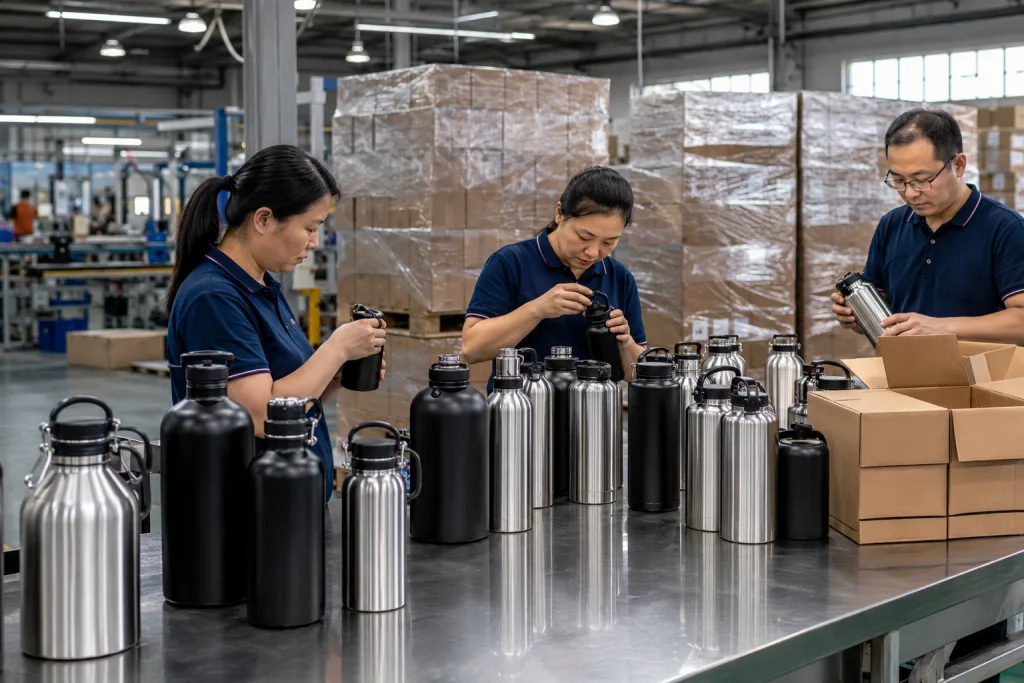
Key Takeaways
- 304 stainless is fine for most wholesale drinkware, but 316 adds corrosion resistance and usually raises unit cost by 8% to 15%
- For vacuum bottles, a 0.4 mm inner wall and 0.5 mm outer wall often balance dent resistance, weight, and FOB price better than thicker builds
- Most custom logo orders start at 1,000 pcs per colorway, with sample approval in 5 to 7 days and mass production in 25 to 35 days
- Use AQL 2.5/4.0, 24-hour leak testing, and carton drop testing from 76 cm to cut claims on bulk canteen and growler wholesale orders
If you buy drinkware on looks alone, the problems show up after shipment: leakage claims, logos rubbing off in the tape test, crushed master cartons, or a reorder price that no longer works. The safer way to buy make drink bottle wholesale is to read the spec sheet like the line will read it. Every line affects output. Steel grade matters. So does wall thickness in mm, lid resin, coating, print method, carton drop standard, and the AQL plan. We have seen this go sideways over one PO typo on wall thickness.
This matters even more in Zhejiang, China, where capability can shift fast from one factory to the next in the same cluster. A serious buyer should ask what each spec changes in cost, lead time, compliance, and defect risk; this is the right question, not just “what’s your best price?” At BottleForge Industrial in Hangzhou, Zhejiang, our working benchmark is 500,000 units per month capacity, MOQ from 1,000 pieces per SKU, and typical production in 25 to 35 days. QC pulled the sample more than once because the lid fit was out by 0.3 mm, and that small miss is enough to turn a clean order into claims.
Start with material grade
The first line to question is the material grade. In make drink bottle wholesale, we mostly run 18/8 stainless steel marked SUS304, and SUS316 where the product claim needs more corrosion resistance. For general hydration bottles, sports bottles, and travel tumblers, 304 is usually the right buy. The math works. It covers what most buyers ask for and keeps FOB under control. On a 500 ml vacuum bottle, shifting from 304 to 316 can add roughly USD 0.25 to 0.60 per unit, depending on steel swings and whether the MOQ is 3,000 pcs or 30,000 pcs.
For a bulk growler, beer tumbler bulk program, or alcohol flask wholesale bulk project, the use case decides it. Acid drinks, coastal exposure, and repeated dishwasher cycles can justify 316 on a premium line. We have seen buyers ask for 316, then back off after salt-spray and cost review. That is common. Not every wholesale growler needs 316. Match the grade to the claim printed on the box, the channel, and the market standard, or the buyer will flag it later when QC pulls the sample.
- 304 stainless: standard for most wholesale drinkware and best wholesale drink bottle programs; this is the grade we ship most on double-wall bottles
- 316 stainless: better corrosion resistance for premium SKUs and harder use; common on coffee, tea, and outdoor lines with tighter complaint targets
- Tritan or PP: common for lids, straws, and lightweight bodies; check food-contact declarations and confirm which resin is on the BOM
- Borosilicate glass: good for glass bottles, less suitable for rough retail channels unless packaging is upgraded; a 1.2 mm divider often is not enough for drop risk
If your supplier in China cannot provide REACH and LFGB or FDA food-contact documentation by material family, treat that as a red flag. Ask for it by family, not one mixed file. This is the wrong question to ask too late. The same issue applies if they cannot confirm whether exposed parts include BPA-free PP, Tritan, food-grade silicone, or 201 stainless in hidden areas like a filter base or under a welded cap insert. We have seen this go sideways over one PO typo and one swapped lid component. You do not want mixed specs between the approved sample and the shipment.
Wall thickness decides weight and dents
Wall thickness is where the quote gets real. Buyers often ask for a heavier bottle because it feels premium in hand, and we get that pushback on 3 out of 10 new RFQs. The problem is simple: heavy does not always sell better, and it does not always ship better. A standard vacuum bottle body often uses a 0.4 mm inner wall and a 0.5 mm outer wall. Some factories push down to 0.35 mm to hit an aggressive target price. Others go up to 0.6 mm or even 0.7 mm for a tank-like feel. On the line, even a 0.1 mm change shows up fast in forming pressure, dent rate, and carton weight.
Thinner material cuts steel cost and shipping weight, but dent risk goes up, especially for canteen bulk orders moving through Amazon FBA or parcel delivery. We have seen 0.35 mm bodies pass factory inspection and still come back with shoulder dents after a 76 cm drop test. Thicker material does improve hand feel, but the math often does not work once freight is added. For many drinkware bulk projects in Europe and North America, the right target is not the thickest bottle. It is the thickness that survives normal abuse without pushing landed cost out of range. After basic insulation is in place, wall thickness changes dent resistance more than hold time.
What this means on a PO
- A 750 ml single-wall canteen wholesale model in 0.5 mm may weigh 20% to 30% more than a 0.4 mm version, which also means more kg per master carton
- For vacuum bottles, thickness affects dent resistance more than hold time after basic insulation standards are met, so this is the wrong question to ask if you only want longer temperature retention
- Heavier units increase sea freight and can trigger higher parcel costs for e-commerce; we have shipped projects where the parcel tier changed by just 18 g
You should ask for bottle weight tolerance on the spec sheet, not just nominal capacity. A +/-3% weight range is more useful than a sales photo.
For wholesale canteen and bulk drinkware orders, ask for neck gauge, base design, and whether the bottom cap is glued or mechanically fitted. QC pulled the sample on one order last month because the bottom cap rattled after vibration testing, even though the body looked fine. These details drive drop performance, noise complaints, and returns. In Zhejiang and wider China supply chains, two bottles can look identical online and perform like different products after 60 days in market.
Insulation and leak specs that matter
Thermal claims get stretched fast, and they mean little unless the test method is printed on the sheet. For vacuum bottles, ask for the exact fill-and-hold setup: starting water temperature, room temperature, fill volume, and the reading points at 6, 12, and 24 hours. A normal factory standard for a 500 ml stainless vacuum bottle is 95 degrees C fill, 20 degrees C ambient, with a 12-hour retained temperature target around 55 to 60 degrees C. We run this with a digital probe after the sample sits on the rack, not straight off the line. If a quote only says hot 24h, that is not a spec. It is sales wording.
Leakage is the claim buyers feel first because one bad lid turns into a refund fast. On a bulk canteen or wholesale growler program, 1 leaking piece can trigger a customer service ticket, a replacement shipment, and a bad review that stays online. Require a 24-hour inverted leak test on assembled goods and a defined torque range for screw lids; on our line, QC pulled the sample after cap tightening and rechecked it the next day. Silicone gasket hardness matters too. Typical Shore A values land around 50 to 70 depending on closure design. Buyers sometimes ask only for "leakproof," but this is the wrong question to ask unless the lid torque and gasket spec are tied down.
- Vacuum rate: ask whether the bottle body is 100% vacuum tested; some factories only spot-check 32 pcs per batch, and that is a different risk level
- Leak test: 24-hour inverted test is stronger than a quick line check done in 3 to 5 minutes
- Coating bake cure: under-cured powder coat can chip early and hide body defects; we usually confirm with an oven record and a cross-hatch tape check
- Copper lining: improves heat retention on some models, but the added cost and extra process step need to make sense for the selling price
For beer growler wholesale bulk and beer tumbler wholesale bulk, do not skip the lid venting and opening diameter. We have seen a 38 mm mouth get buyer pushback because cleaning brushes would not fit well, while a wider opening cut complaint rates after shipment. If the lid geometry is weak, carbonation handling becomes a risk, and we have seen this go sideways during transit testing. A growler bulk order for cold beverages needs a different spec discussion from a standard office flask. The body can still be stainless steel, but the closure spec and use claim must match.
Decoration drives defect rates
Most buyers lock the bottle body first and leave color and logo for later. That is the wrong question to ask. Decoration changes yield, line speed, and claim rates. On our line, a body that runs 92% first-pass before coating can drop to 84% after a difficult finish. Powder coating is the safer choice for drinkware wholesale and the cost math usually works, but exact Pantone matching can drift across steel lots and oven cycles at 180°C. Wet paint gives you rubber touch, metallic, or gradient effects, but it is less forgiving—QC pulled samples before for dust nibs under 0.3 mm and edge shadow on the shoulder. For logos, silkscreen, heat transfer, laser engraving, and UV print are not interchangeable; each one fits a different bottle shape, coating, and abuse level.
A one-color silkscreen logo on a straight-wall bottle is usually the lowest-risk option for wholesale drinkware. We run this setup every week because it is stable and setup loss stays under control. Laser engraving lasts longer, but only if the substrate and coating stack are matched right; on some matte powders, the buyer flagged a brownish burn mark around the logo. Heat transfer handles complex graphics, though registration and abrasion have to be tested on the actual body, not just a flat panel. If you are buying alcohol flask bulk, the small curved body cuts print area fast and setup scrap goes up—we have seen a 38 mm logo approved on artwork but fail on the jig.
Questions you should ask before approving artwork
- What is the max print area in mm for this body shape?
- Is the logo position tolerance within +/-2 mm or +/-3 mm?
- Will the logo pass tape test and dishwasher simulation?
- How many approved color standards are held on the line?
MOQ also changes by decoration. A plain stock-color bottle might start at 500 to 1,000 pieces. A custom body color with logo commonly starts at 1,000 pieces per SKU. A custom mold cap, retail box, and insert can push MOQ to 3,000 to 5,000 pieces. This is where buyers get bad answers. The line does not treat a plain bottle and a decorated gift-box SKU as the same job. We ship some stock-color programs at 500 pieces, but once you add a custom carton with a corrected PO barcode and logo screen, the setup hours and scrap allowance change. If your supplier gives you one blanket MOQ for everything, they are probably hiding the real setup economics.
At factory level in China, decoration is where rework quietly kills lead time. We have seen 12 days turn into 18 days because coating dust, off-position print, and weak adhesion were found too late. Ask whether your supplier inspects before coating, after coating, and after printing. Our QC uses a cross-hatch cutter, 3M tape, and a light box at final cosmetic check. If those gates are missing, defects move downstream and land on your final inspection report instead.
Packaging is part of the product
Buyers often leave packaging until after bottle approval. We’ve seen this go sideways. For make drink bottle wholesale, the unit box, divider design, master carton spec, and pallet pattern decide what arrives saleable and what shows up scratched, crushed, or rejected at the DC. On our line, QC pulled a sample where the handle rubbed through the white box after a 300 km truck run because the side wall board was too soft.
For standard export packing, ask for 5-ply master cartons, confirmed carton dimensions, gross weight under 15 to 18 kg where possible, and actual drop-test records. A workable baseline is a 76 cm carton drop on faces, edges, and corners with the packed goods inside, not an empty box test. If you sell into club retail or e-commerce, tighten the spec: barcode position, FNSKU labels, suffocation warnings, and scan readability at receiving. This is the wrong question to ask if the buyer only says, “Can you make the box nicer?” First lock the transit standard.
- Individual box: protects the finish and supports shelf presentation; we often add a 1 mm EPE bag or tissue sleeve for coated bottles
- Inner dividers: matter for glass and painted surfaces; a 24-cell divider that fits loosely will still let parts knock together
- Master carton: should match pallet efficiency, not just squeeze in more units; the math doesn’t work if carton overhang causes crush risk
- Palletization: ask for carton count per pallet and height limit; 1.6 m is a common ceiling the buyer flagged on one PO last month
This matters more on canteen bulk, beer growler in bulk, and beer tumbler in bulk projects because shape changes packing density fast. A base that grows by 8 mm can cut carton count and 40HQ loading, which pushes freight up even if FOB barely moves. Before you approve a new mold, ask for the units-per-40HQ estimate and pallet layout. We ship plenty of orders where a bottle priced USD 0.12 lower at FOB ends up costing more landed because the packing ratio is bad.
Compliance, QC, and delivery discipline
A clean sample proves one piece. It does not prove the system. The real question is how the order stays under control when 10,000 or 50,000 units are running on the line. For export drinkware, the baseline should cover incoming material checks, in-process inspection, final random inspection, and traceability by date or lot. We usually mark cartons with a lot code tied back to the polishing batch and lid assembly date, and QC pulled the sample against that record more than once after finding a 0.8 mm logo shift. AQL 2.5 for major defects and 4.0 for minor defects is the common third-party benchmark, though some premium buyers ask for tighter limits.
For Europe, ask about REACH and LFGB where relevant. For North America, FDA food-contact expectations and California Proposition 65 screening may matter based on material set and sales channel. If the bottle is for kids, ASTM and CPSIA checks move up the list, especially for small parts and coatings. We have seen buyers miss this on a straw lid with a loose bite valve, then flag it late at pre-shipment. Social compliance such as BSCI is not a legal product test, but brand owners still put it on the supplier approval checklist. This is the wrong question to ask if you have not cleared the product-compliance side first.
Lead time discipline matters as much as test reports. In our Zhejiang operation, normal sample lead time is 5 to 7 days for standard bottle bodies with simple logo proofing. Mass production is usually 25 to 35 days after deposit and artwork approval. During peak season, custom color programs can stretch to 40 days, especially when the line is waiting on powder coating cards and carton confirmation. If a factory promises 15 days on a new decorated SKU with custom packaging, ask what process they are skipping. We have seen this go sideways on POs where even the insert card typo was fixed too late.
- MOQ: 1,000 pcs per SKU is normal for decorated stainless items
- Payment: 30% deposit, 70% before shipment is still the quote structure from a lot of China suppliers, and buyers push back on this most often when the order is under 3,000 pcs
- Inspection: book final inspection when 80% to 100% packed, not when 20 cartons are ready and the rest are still sealing on the tape machine
- Incoterms: compare FOB Ningbo or Shanghai against delivered options carefully; the math does not work if the forwarder quote is missing duty, pallet size, or peak-season truck fees
The best wholesale drink bottle supplier is not the one with the lowest opening quote. It is the one whose spec sheet, QC records, and delivery window match your sales channel. We ship repeat programs more smoothly when the buyer signs off on carton marks, barcode position, and master carton drop test standard before production starts. That is what keeps a reorder program healthy, whether you are buying drinkware wholesale, wholesale growler, or alcohol flask in bulk for a private-label launch.
Send your spec sheet for a factory-level review
We will check material, MOQ, packaging, compliance, and realistic lead time before you place a wholesale drinkware order from Zhejiang, China.
Frequently asked questions
What MOQ should I expect for make drink bottle wholesale orders?
For standard stainless steel bottles with a custom logo, 1,000 pieces per SKU is a realistic MOQ in China. If you choose a stock color and one-color silkscreen, some factories can work at 500 pieces, but pricing will be less efficient. If you need a custom lid color, gift box, or new mold part, MOQ usually rises to 3,000 to 5,000 pieces. For alcohol flask wholesale, beer tumbler wholesale, or bulk growler projects, MOQ also depends on whether the body is an existing mold. Always ask for MOQ by bottle, by lid, by decoration, and by packaging separately. One single MOQ number can hide extra setup charges later.
How do I compare prices across wholesale drinkware suppliers fairly?
Use a same-spec comparison sheet. Match capacity, steel grade, wall thickness, lid material, gasket type, coating method, logo process, packaging, and Incoterm. A 600 ml bottle quoted at USD 2.85 FOB Ningbo is not comparable to a USD 2.55 quote if one uses 304/304 stainless, 0.4/0.5 mm walls, powder coat, and individual box while the other uses thinner steel and bulk pack. Ask for unit weight, carton dimensions, pieces per carton, and estimated 40HQ loading. Freight efficiency can swing your landed cost by 5% to 12%. Also ask whether the quote includes testing, replacement policy, and spare parts such as extra gaskets or straws.
What tests should I require for canteen wholesale and growler wholesale orders?
At minimum, require a 24-hour leak test, vacuum performance verification for insulated items, coating adhesion check, and a final AQL inspection. For European programs, request REACH and, where needed, LFGB food-contact declarations. For North American channels, ask for FDA-related material declarations and review Prop 65 risk if coatings or accessories are involved. For growler bulk and beer growler wholesale bulk, closure fit and pressure-related use claims must be handled carefully; do not promise carbonation retention unless the product was designed and tested for it. Carton drop testing from 76 cm and barcode scan verification are also practical requirements if your goods go to retail distribution or FBA.
How long does production usually take for bulk drinkware?
For existing molds, plan 5 to 7 days for pre-production samples and 25 to 35 days for mass production after artwork approval and deposit. During peak season in Zhejiang, China, custom powder colors or complex heat transfer graphics can add 5 to 10 days. If your order includes new packaging with insert changes, add another 3 to 7 days for proofing and carton print approval. Tooling for a new lid or body mold can take 20 to 35 days before samples. If a supplier promises a very short lead time, ask whether they control coating and printing in-house or outsource them. Outsourced decoration is a common reason delivery dates slip.
Which products are best for private label: canteen bulk, tumbler, growler, or flask?
For a first private-label launch, simple vacuum bottles and travel tumblers are usually the safest because demand is broad, specs are familiar, and packaging is efficient. A 500 to 750 ml bottle with 304 stainless, powder coat, and one-color logo is easier to control than a niche format. Canteen bulk products also work well if your buyers want lightweight hydration items. Bulk growler and wholesale growler lines make sense when you already sell into beverage, outdoor, or gift channels, but they need more attention on closure design and carton size. Alcohol flask bulk can be profitable in seasonal gift programs, though decoration area is smaller and compliance messaging must be handled carefully.