Key Takeaways
- For most custom thermos projects, define AQL 2.5/4.0 and a 1.0% leak-failure limit before deposit
- A practical MOQ is 1,000 pcs per color for stock molds, while new tooling usually adds USD 1,200-3,500 and 20-30 days
- 304 stainless works for most promotional thermos orders; use 316 only when chloride exposure or acidic contents justify a 12-20% material premium
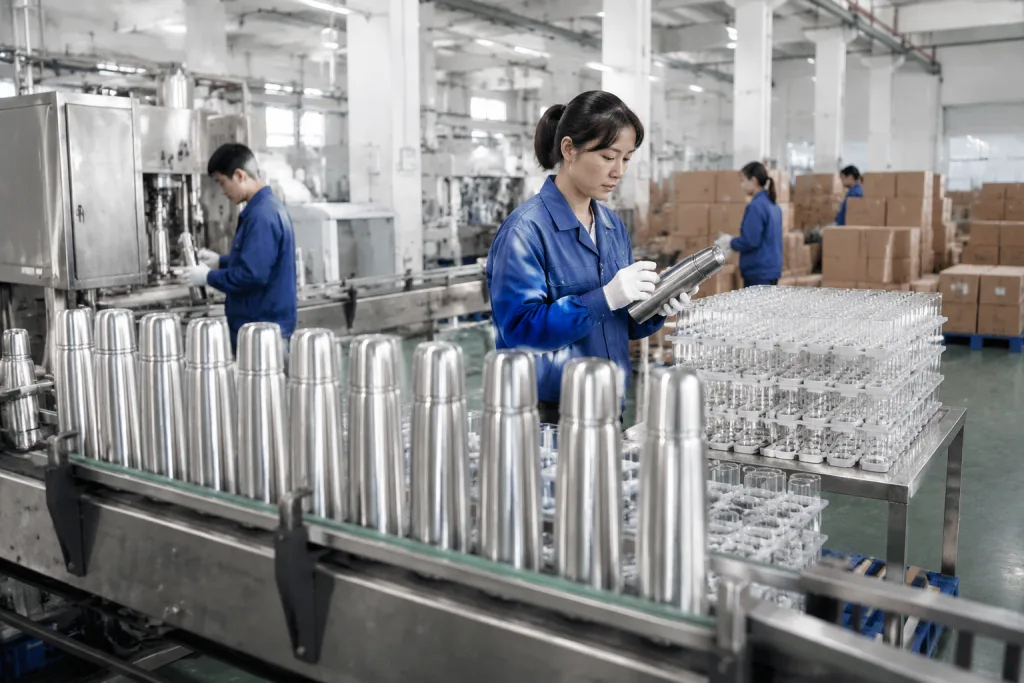
- A Zhejiang, China factory with 600,000 units/month capacity should still reserve 35-50 days for decorated mass production in peak season
You are probably looking for a lead-free glass thermos factory because a stainless quote by itself misses the real risk: what breaks once the line starts running. A clean rendering tells you nothing about whether the liner chips after a 76 cm drop-carton test, whether the stopper starts leaking after 500 open-close cycles, or whether the logo is still readable after 200 dishwasher runs. Outdoor chains and promo buyers usually focus on unit price first. We think that is the wrong question to ask. The expensive miss is the one QC finds after the goods leave Ningbo.
At BottleForge Industrial in Zhejiang, China, we see buyers compare a glass-lined factory thermos with a stainless thermos custom program as if the QC logic matched. It does not. The failure points are different, the test plan is different, and a tighter spec sheet often saves 30 to 45 days of rework. Last month a buyer flagged a PO typo on stopper material, and that single line would have pushed the whole custom thermos run off spec. If you buy bulk thermos or customized thermos programs for distribution, start with failure modes first and styling second.
Where projects usually go sideways
Buyers ask for a lead-free glass thermos factory, then send an RFQ built for a stainless bottle. We’ve seen this go sideways in one email thread. A glass-lined vacuum thermos fails one way; a stainless vacuum flask fails another. Your spec sheet has to match the product on the line. If you sell into outdoor retail, distributor thermos channels, or thermos promotional campaigns, sort defects early: cosmetic, functional, or claim-generating. Last month a buyer flagged a 2 mm logo shift as “critical,” while the real risk was stopper seepage after a 45° tilt test.
The usual sourcing mistake is buying on photo and price. A supplier thermos quote at USD 3.80 can look stronger than one at USD 4.35, but the math doesn’t work if the cheap version uses a 0.35 mm outer shell, loose stopper tolerance, or decoration that fails tape test after 200 rubs. You pay later in returns, rework, and replacement stock. In Zhejiang, China, the factories that quote in 30 minutes are often skipping the questions that matter, like neck finish tolerance and carton drop height.
- Glass-lined thermos risk: liner cracking after thermal shock, neck impact damage during cap assembly, poor stopper fit, and breakage we sometimes catch in a 3-drop inner-pack test.
- Stainless thermos risk: vacuum loss from pinhole leaks, weld defects around the bottom seam, base denting on thin-gauge bodies, flavor retention, and coating adhesion failure after cross-hatch tape test.
- Shared risk: lid leaks, carton drop damage, wrong logo placement, mixed accessories, and weak incoming inspection—QC pulled one lot with black PP stoppers packed against a PO that clearly said gray.
If you are buying custom thermos, customizable thermos, or thermos bulk programs, ask the factory to classify defects by critical, major, and minor under an agreed AQL plan. This is the right question to ask. We typically suggest AQL 2.5 for major defects and 4.0 for minor defects for standard export orders. Critical defects such as lead content noncompliance, exposed sharp edges, or leakage should be zero-acceptance. On our floor, leakage means 100% check on the line for the agreed test method, not a casual spot check at the end.
A serious thermos manufacturer will also split pre-production approval into three checkpoints: sample signoff, decoration signoff, and packaging signoff. Skip one and production starts guessing. That is how manufacturer thermos programs drift from approved sample to final shipment. We ship better when each checkpoint has one signed reference, one color standard, and one packaging mark sheet; otherwise you end up arguing over a carton print typo after 5,000 pcs are already packed.
When the liner or shell fails
The first hard failure is the body itself. In a lead-free glass thermos factory, the liner has to survive hand loading, vacuum bake, and a truck ride after packing. In a stainless build, the shell and inner wall have to get through welding, vacuum pull, and daily knocks without going soft or leaking. Buyers still spend half the meeting on color cards and 500 ml vs 750 ml. That is the wrong question to ask. If the body structure is weak, the product dies before the finish starts to matter.
Lead-free glass failure points
For glass-lined units, ask what glass composition is running on the line and how lead-free compliance is checked lot by lot. You need material declarations and migration testing that match EU REACH requirements where needed. The liner wall should stay even, with no thin area around the shoulder or neck; on one return batch we cut open, QC measured a neck section under 1 mm and that was where the break started. Thin necks are a repeat problem. We have seen them fail after one light hit on a sink edge.
What goes wrong most often: the outer shell looks fine after the drop, but the inner glass liner is cracked, and the customer finds out only when heat retention falls off.
Stainless failure points
For stainless thermos manufacturer orders, the core specs are steel grade, wall thickness, and vacuum integrity. For mainstream custom stainless thermos, 18/8 stainless steel, equivalent to SUS304, is usually enough. A common build is 0.4 mm outer wall and 0.4 mm inner wall. Entry-level promotional thermos can drop to 0.35 mm, but dent resistance gets worse fast; we have seen the base dish in after a 1-meter carton drop. If the item is for outdoor retail, call out at least 0.4/0.4 mm and ask for vacuum retention data at 6, 12, and 24 hours.
If your thermos supplier pushes 316 stainless on every project, be careful. 316 has its place, especially with high-salt or acidic content exposure, but plenty of buyers do not need the extra 12% to 20% material cost. The math does not work on most gift and promo programs. A practical manufacturers thermos quote should spell out where the upgrade matters, not turn it into a price ladder. We ship both grades, and buyer pushback usually starts the moment the delta passes 15%.
- Ask for: steel grade certificate, wall thickness spec in mm, vacuum test records, and the impact test standard the line runs.
- Reject if: visible weld discoloration inside the neck, unstable base, oil residue, or body weights that swing sample to sample by more than 8 g.
For both glass and stainless, a 1-meter packaged drop test on 6 sides is a reasonable starting point for export cartons. If you are shipping Amazon FBA or parcel channels, push packaging harder from day one. We have seen standard export foam pass sea freight and still fail small-parcel handling 12 days later.
Leakage starts at the closure
Most thermos leaks that buyers blame on the bottle start at the closure. Stopper design, thread tolerance, gasket hardness, and vent geometry decide if the unit stays dry in a backpack or throws a side-drip at breakfast. We’ve seen vendors pass a 30-minute upside-down sample test, then fail after 600 open-close cycles on the line. That gap matters.
For a lead-free glass thermos factory, stopper fit is tighter work because too much closing torque can load the neck area and crack it. For stainless units, the usual problem is PP or Tritan molding drift of 0.2-0.3 mm, which creates intermittent leaks on 3% to 5% of a batch instead of all pieces. QC pulled the sample, it looked fine, then the buyer flagged carton No. 8 from the same lot. This is the defect that slips past a simple final check.
What to put on the spec sheet
- Leak test: 100% inverted test for 30 minutes before packing.
- Cycle test: open-close stopper or lid 500 to 1,000 cycles.
- Gasket material: food-grade silicone, typically Shore A 50-60.
- Pour test: controlled stream with no side-drip after 3 pours.
- Heat test under load: 95°C fill, then leak check after pressure equalization.
If you buy thermos custom units with cup caps, push-button lids, or screw stoppers, ask for life data by closure type. A screw stopper usually runs better than a push-button assembly, especially on 3,000-piece and 5,000-piece promo orders where end users are rough on the product. Push-button lids look premium. They also add failure points: springs with inconsistent rebound, extra seals, moving plungers, and assembly spread at the torque station.
At our Zhejiang facility, we usually tell promotional thermos buyers not to chase over-engineered closures under USD 5.50 FOB unless they accept more after-sales risk. Frankly, this is the wrong question to ask if the target is low complaint rate. The math doesn’t work. Simple closures are easier to run, easier to inspect with a go/no-go gauge, and easier for your QC team to clear at pre-shipment.
Decoration fails faster than insulation
A thermos can hold heat for 12 hours and still come back as a return if the logo wears off after 7 days on shelf. Decoration failure gets missed too often in custom thermos projects. Outdoor retail buyers watch shelf appearance hard; one EU buyer flagged a scratched sample after 3 store-handling cycles. Promo buyers care even more, because the logo is the product. The mistake is simple: artwork gets approved, but no one locks the test method before the line starts.
The print method should match the actual surface, order volume, and how rough the end use will be. Silkscreen works for simple 1-2 color logos and usually starts to make sense at 1,000 pcs MOQ; we run a 120T mesh screen for fine text, and that detail matters. Laser engraving is slower, but it holds up well on powder-coated or brushed stainless surfaces. Heat transfer handles full-wrap graphics, though QC pulled the sample more than once for edge lift near the seam. UV print looks clean on approval samples. Then it fails fast if the coating stack is unstable. We have seen this go sideways, so "which print looks nicest" is the wrong question to ask.
For glass-lined and stainless units alike, the decoration spec should cover:
- Cross-hatch adhesion test, minimum 4B on coated areas.
- Rubbing test: 50 dry rubs and 20 wet rubs with no major loss.
- Dishwasher disclaimer if the product is hand-wash only.
- Logo position tolerance, usually ±2 mm.
- Pantone matching tolerance agreed before production.
If you are buying thermos customizable or thermos customized models for a distributors thermos program, ask the factory to approve decoration on the actual production material, not a substitute sample. We still see factories show a brushed sample, then ship bulk on powder coat and act surprised when the appearance shifts. Last month the buyer flagged a black powder-coated body that made the same Pantone mark read darker by almost half a shade. That is not a small miss. It starts with the wrong sample on the table.
Typical FOB adders are practical to know. One-color silkscreen might add USD 0.08 to 0.18 per unit. Laser engraving often lands around USD 0.12 to 0.25. Powder coating may add USD 0.35 to 0.70 depending on finish and order size. Those numbers matter when a thermos supplier quote looks unusually cheap. We have seen POs where decoration was listed as "logo incl." with no method typed in, and then the math did not work once durable finish was added back.
Packaging damage is a design defect
Buyers call it transit damage when a shipment lands with dented bases, cracked cups, or broken liners. Sometimes that is true. In our factory, it is often a packaging spec problem written into the PO on day one. This shows up fast on lead-free glass thermos orders, because the glass liner can fracture even when the outer carton still looks clean. We have seen QC pull a sample from a container-load order, shake the unit once, and hear liner contact inside. If the packaging brief just says “standard export packing,” this is the wrong question to ask. It tells the line nothing about protection.
Retail, distributor, and e-commerce packs should not share the same carton logic. For retail shelves, buyers usually want a gift box with EPE or molded pulp and cleaner print registration within 2 mm. For thermos distributor or thermos distributors channels, we run the math on carton count, cube, and pallet stacking first, because master carton efficiency drives cost. For e-commerce, a pretty box that fails a drop test is dead on arrival. We have had buyers flag a crushed lid after a marketplace trial shipment of 48 pcs, and the issue was the insert, not the thermos.
Minimum packaging controls
- Inner support that stops vertical movement by more than 5 mm.
- Master carton burst strength suitable for stacking, often 5-ply export corrugate.
- Carton drop test on 1 corner, 3 edges, and 6 sides.
- Barcode scan check and FNSKU placement if Amazon-bound.
- Moisture protection for sea freight, especially in summer shipments from China.
If you order bulk thermos from Zhejiang in peak humid months, add desiccant and polybag requirements where appropriate. We ship through summer weather above 80% RH, and container condensation does damage long before anyone talks about stainless. The steel body is usually fine; cartons soften and printed surfaces scuff. On glass-lined units, cap and cup separation matters just as much. If those accessories move inside the gift box, they chip the neck ring or scratch decoration before the pallet even clears Ningbo. We have seen this go sideways from a 1 mm loose insert gap.
We usually tell buyers to budget USD 0.25 to 0.90 for packaging depending on whether they want a white box, a mailer-safe color box tested for parcel handling, or a presentation-grade gift set with heavier board. The math doesn't work if you force packaging to the cheapest line item and then watch claim rate jump from 0.5% to 3%. One buyer pushed back on USD 0.12 extra per set; after the first shipment, the replacement cost was 4 times that number.
Compliance paperwork can still fail
A thermos can look clean, pass leak testing, and still get blocked because the paperwork is off. We see this on the line more than buyers expect. The file says one thing, the carton says another, and then customs or the retailer stops the shipment. This is where supplier thermos and suppliers thermos discussions go sideways. Buyers ask, "Is it food safe?" That is the wrong question to ask. The real questions are which market, which standard, and which exact component set was tested.
For Europe and North America, the document set should match the exact SKU family on your PO, down to the lid revision and print color. We usually check body, lid, stopper, gasket, paint, print, and any straw or carry part, even a 3 mm silicone bite valve if one is fitted. For stainless and glass thermos, common checkpoints include REACH-related substance screening, LFGB or food-contact migration where requested, and CPSIA or ASTM considerations if the item is marketed to children. QC pulled a sample last month where the adult bottle report covered the 500 ml body only, but the kids version had a new shoulder strap buckle. If you are sourcing kids sizes under the Stainless Thermos category crossover, do not assume adult documentation is enough.
- Factory system checks: BSCI or Sedex social audit, ISO 9001 process control, traceable lot coding tied back to the injection date wheel.
- Product checks: material declarations, test reports by component, packaging compliance where required, especially if the buyer flagged recycled-content claims.
- Inspection checks: pre-production sample, in-line inspection, final random inspection at AQL 2.5 if your spec calls for it.
The safest move is to write compliance into the RFQ and PO before we run mass production. State the market, the label claims, and whether recycled-material statements appear on packaging. We have seen a single PO typo switch "EU food contact" to "gift use only," and that created a 12-day delay versus 3 days for document release. If you want a lead-free glass thermos factory to declare lead-free status, ask what test basis supports the claim and whether it covers glaze, decoration, and accessories, not only the main liner.
A reliable manufacturer thermos partner in China should be ready to share a document matrix before deposit, not after packing starts. We ship faster when that matrix is locked early. If a factory avoids specifics, expect delays later; the math doesn't work any other way. Paperwork problems can hold a shipment just as effectively as a leak defect, and in some cases longer—18 days at port for a missing component report is not unusual.
How to spec the order cleanly
The safest way to buy from a lead-free glass thermos factory or any thermos manufacturer is simple: do not make the factory guess. Vague POs cost money. We have seen one missing note on lid finish turn into a 5,000 pc rework. Clear specs let the line run the same way on Monday and on day 18 of production. This matters whether you buy 1,000 pieces for a promotional thermos campaign or 50,000 pieces for outdoor retail distribution.
A workable sourcing package should include a product drawing or marked-up photos, capacity tolerance, material grade, wall thickness, color reference, decoration file, packaging structure, carton marks, test standards, inspection plan, and delivery term. Put numbers on the sheet where you can: body wall 0.5 mm or 0.4 mm, logo position ±1.5 mm, carton drop test height. If you skip three of those items, you leave space for avoidable disputes. QC pulled samples before where the PO said "matte black," but the buyer flagged gloss 60° because no Pantone or texture panel was attached.
Baseline commercial numbers buyers can use
- MOQ for stock mold stainless thermos: usually 1,000 pcs per color.
- MOQ for custom color box: often 2,000 pcs.
- New mold lead time: 20-30 days.
- Mass production lead time: 35-50 days after approvals.
- Typical deposit term: 30% with balance against inspection or copy documents.
At BottleForge Industrial in Zhejiang, China, our output is up to 600,000 units per month across stainless and related drinkware, but capacity does not remove risk. The control point is frozen specifications before production starts. We run pre-production checks against the BOM, color chip, and packaging mockup, and this is where a caliper and sealing test save trouble later. In thermos vendor and thermos suppliers discussions, insist on a pre-production sample signed against the final bill of materials, not a "close enough" reference unit. Frankly, "close enough" is the wrong standard to approve.
If you are comparing custom thermos, custom thermos with glass lining, and stainless options side by side, ask each factory to quote the same inspection standard and the same packaging level. That is the only fair comparison. We have seen this go sideways when one supplier priced egg-crate dividers and another priced plain partitions in a 5-layer export carton. Otherwise you are not comparing like for like. You are comparing one honest quote with two assumptions.
For outdoor retailers, I would rather see you buy a simpler unit with stable 0.8% complaint rates than a feature-heavy bottle with a 3% return risk. The math does not work once returns, replacement freight, and shelf damage hit the account. On one project, the buyer wanted a push-button stopper with 6 small plastic parts; after cycle testing, the sample failed at 1,200 presses. For promotional brands, the same logic applies: a dependable customized thermos delivered on time protects your campaign better than a clever mechanism that fails in the field.
Get a thermos spec review before you place PO
Send your target price, quantity, artwork, and market. We will review failure points, MOQ, compliance, and lead time before mass production starts.
Frequently asked questions
What should I ask a lead-free glass thermos factory before placing a custom order?
Start with the failure points, not the catalog. Ask for the exact glass or stainless construction, stopper design, wall thickness, lead-free or food-contact test basis, and the factory’s AQL standard. For commercial terms, confirm MOQ, decoration options, packaging style, and real production lead time. A sensible baseline is 1,000 pcs per color for stock molds, 35-50 days for mass production, and 30% deposit. Also ask for leak testing method, heat-retention data at 6 and 12 hours, and carton drop-test standards. If the factory in China cannot answer those with numbers, you are not yet comparing reliable quotations.
Is a glass-lined thermos or stainless thermos better for outdoor retail?
For outdoor retail, stainless usually gives you fewer claims. It resists drops better, dents more predictably, and handles rough use in a way glass-lined products do not. A glass-lined thermos can offer clean taste and classic insulation performance, but once the liner cracks, the unit is done. For camping, commuting, and backpack use, a 304 stainless vacuum thermos with 0.4 mm inner and outer walls is usually the safer choice. If you still want a glass-lined option, strengthen the packaging spec and limit the product positioning to lower-impact use. Many retailers carry both, but they should not be spec’d as if the risk profile is identical.
How do I compare quotes from thermos suppliers fairly?
Make every thermos supplier quote the same BOM and inspection standard. That means same capacity, same steel grade or glass structure, same wall thickness, same lid type, same decoration method, same packaging level, and same test requirements. If one quote is USD 0.40 cheaper, check whether it quietly downgraded packaging, reduced wall thickness from 0.4 mm to 0.35 mm, or excluded logo setup and carton marks. Also align trade terms such as FOB Ningbo or FOB Shanghai. In Zhejiang, China, pricing can vary for honest reasons, but most large gaps come from mismatched assumptions. A side-by-side cost sheet removes most confusion fast.
What MOQ and lead time are realistic for customized thermos production?
For a stock mold customized thermos, 1,000 pcs per color is a realistic MOQ in most China factories. Some simple undecorated runs can go lower, but unit cost rises quickly. Custom packaging often starts around 2,000 pcs, and a new mold can require USD 1,200 to USD 3,500 plus 20-30 days of development time. For decorated production after sample approval, expect 35-50 days in normal season and closer to 50-60 days during peak periods. If a thermos manufacturer promises 15 days for a fully customized order, treat that as a warning sign unless they are using ready materials and very simple packaging.
Which QC tests matter most for promotional thermos orders?
For promotional thermos, the critical tests are leak testing, decoration durability, odor check, and packaging drop performance. Start with 100% leak testing for 30 minutes inverted. Add a stopper cycle test of at least 500 cycles and a dry/wet rub test for printed logos. If the unit is powder coated, request cross-hatch adhesion at 4B or better. For shipment protection, require a packaged drop test and barcode scan verification if the goods enter retail or FBA channels. Many promotional claims come from scratched logos or lid leaks, not from insulation itself. AQL 2.5 for major defects and 4.0 for minor defects is a practical starting point for most distributor thermos programs.