Key Takeaways
- Typical MOQ starts at 1,000 pcs for standard lead-free glass insulated water bottle bulk orders
- Factory lead time is usually 25-35 days after sample approval and deposit
- A well-made double-wall glass bottle should hold 6-12 hours of temperature retention depending on lid and fill temperature
- Expect FOB China pricing around USD 2.10-4.80 per unit for custom logo programs, excluding freight
Read the glass spec first
Start with the one line that matters most: material specification. A true lead-free glass insulated water bottle uses soda-lime or borosilicate glass with a written lead-free declaration, not a slogan in the catalog. We ask for the material declaration, REACH for Europe, and food-contact test reports for the U.S. before we talk print layout. On our line, QC pulled one sample last month and found a PO typo that said “borosilciate”; that kind of slip is a red flag, not a small detail.
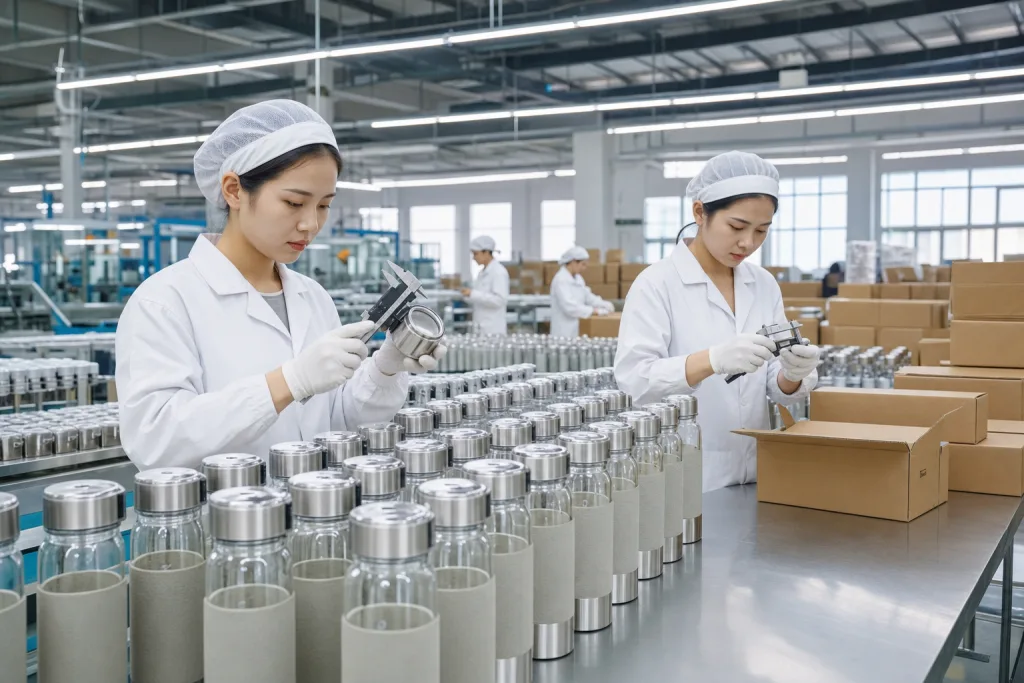
Glass thickness is not decoration. For a retail-ready bottle, the inner wall usually runs 1.2-1.8 mm depending on volume, while the outer wall sits around 1.5-2.0 mm on double-wall builds. Thicker glass cuts breakage, but the carton weight goes up fast. For a 500 ml format, 280-380 g finished weight is the range we run after lid and sleeve are counted. That is the number buyers should pin down, because shelf handling and export freight both feel it.
Ask the lead-free glass insulated water bottle supplier whether the build is vacuum-insulated, air-insulated, or plain double-wall with a thermal gap. Buyers keep treating “insulated” as one standard. It is not. A vacuum process needs different tooling and a tighter reject check, and the line behaves differently when seals fail. If the factory cannot explain the insulation method in plain terms, the math does not work. You are buying a claim, not a spec.
Check the lid like a leak test
The lid is where most lead-free glass insulated water bottle factory complaints start. We test drip resistance at 45 degrees, inverted shake leakage, and open-close cycling on the bench. For retail orders, I want 5,000 cycles on the sealing parts. That is not a badge. It keeps returns off the dock after the first carton hits North America or Europe.
Check the gasket material. Food-grade silicone is standard, but the fit and hardness decide the result. A loose gasket becomes a warranty claim fast. We had one buyer flag a PO typo on the lid spec, and QC pulled the sample because the 2.2 mm groove did not match the gasket. If you are selling a lead-free glass insulated tumbler or bottle in outdoor channels, ask for a threaded lock or reinforced snap system, not a decorative top. Splash-proof is fine for a desk. It is the wrong spec for a backpack, bike cage, or commuter tote.
Buyer impact: better lid engineering cuts leakage claims, keeps cartons dry, and gives you cleaner reviews. On branded lead-free glass insulated water bottle programs, that is worth more than saving USD 0.08 per unit. We ship a lot of those. The math does not work any other way.
Measure insulation with real expectations
Insulation claims need numbers, not sales talk. For a double-wall lead-free glass insulated water bottle wholesale order, the result depends on room temperature, starting fill temperature, and the lid. If a factory throws out “12 hours hot” with no test conditions, we skip it until they show the setup. A straight commercial target is 6-8 hours for warm retention and 8-12 hours for cold holding, and the line will still shift if you change the cap or the fill volume.
We do not treat the glass cavity as the whole story. Cap geometry, neck finish, and a silicone base all change heat loss. For a lead-free glass insulated water bottle private label program for lifestyle retail, the wrong move is to promise more than the bottle can hold. Buyers in Europe and North America ask for honest claims, and one German client flagged a PO typo on “12h” because their legal team wanted the test basis in writing. We run internal checks, then QC pulled the sample after 2 hours and 6 hours to confirm the curve. A Zhejiang factory shipping 200,000 units per month should have that paperwork ready.
Practical rule: if the factory cannot tell you the exact temperature drop after 2 hours and 6 hours, they have not tested enough production samples.
Decoration changes the whole order
Decoration is where lead-free glass insulated water bottle custom sourcing stops being a sample game and turns into production discipline. Screen printing, decal firing, UV printing, and laser marking behave differently on glass, full stop. We run 6-color screen on the line for simple logos, and the buyer usually feels the difference once they see the first 200 pcs. If you want a clean premium look, keep the print area tight and use 1 or 2 spot colors. Big wrap graphics look fine in a mockup, then the curve on the bottle makes the edge wobble.
For a lead-free glass insulated water bottle OEM order, the factory should give you the decoration limit by artwork coverage and curing temperature. On glass, screen printing usually gives the best cost-to-wear ratio for a plain logo. Laser looks sharp, but it often belongs on the metal cap or the accessory ring, not the glass body. If your program is a lead-free glass insulated water bottle ODM project, ask whether we already have molds with usable decoration zones. That can shave 15-25 days off development and cut tooling risk. The buyer once pushed for a 280 mm wrap on a curved bottle, and QC pulled the sample after the first bake because the edge lifted.
Brand owners should decide early whether they want a lead-free glass insulated water bottle branded item with premium retail packaging or a lean bulk pack for club and corporate sales. Decoration, label position, and carton design all move landed cost. A 3-piece gift box can add weight fast, and the freight bill does not care about your branding story. The right lead-free glass insulated water bottle manufacturer will show you the cost swing before you approve artwork. We had one PO with a typo on the carton mark and the buyer flagged it before shipment; that saved a reprint and a week on the schedule.
Packaging decides your damage rate
Glass packaging is not where you cut corners. For a lead-free glass insulated water bottle bulk order, we run molded pulp or EPE inserts, a double-wall master carton, and a clear drop-test target before the line starts. I want one 76 cm drop test on the outer carton, not a promise on email. AQL 2.5 for major defects and 4.0 for minor defects is a common baseline, and if your market is rough on freight, tighten it.
If you sell through retail chains or Amazon, the carton has to survive pallet wrap and barcode scans. A lead-free glass insulated water bottle private label job usually needs the retail carton to show SKU, country of origin, care instructions, and FNSKU labeling where needed. We have seen buyers send a PO with the wrong barcode format, and that stops the whole booking. Tell the factory whether the goods go to a distributor warehouse, a fulfillment center, or store shelving. Those are three different packing specs.
From a cost angle, upgraded packaging can add USD 0.18-0.60 per set, which is cheaper than refunding broken units after transit. QC pulled the sample last month and the 5-layer outer carton held, while a thin insert cracked at the corner after one drop. The math does not work in favor of cheap packaging. In Zhejiang, the factories that ship clean cartons treat packaging as part of the product, not a side job.
Use factory numbers to judge reality
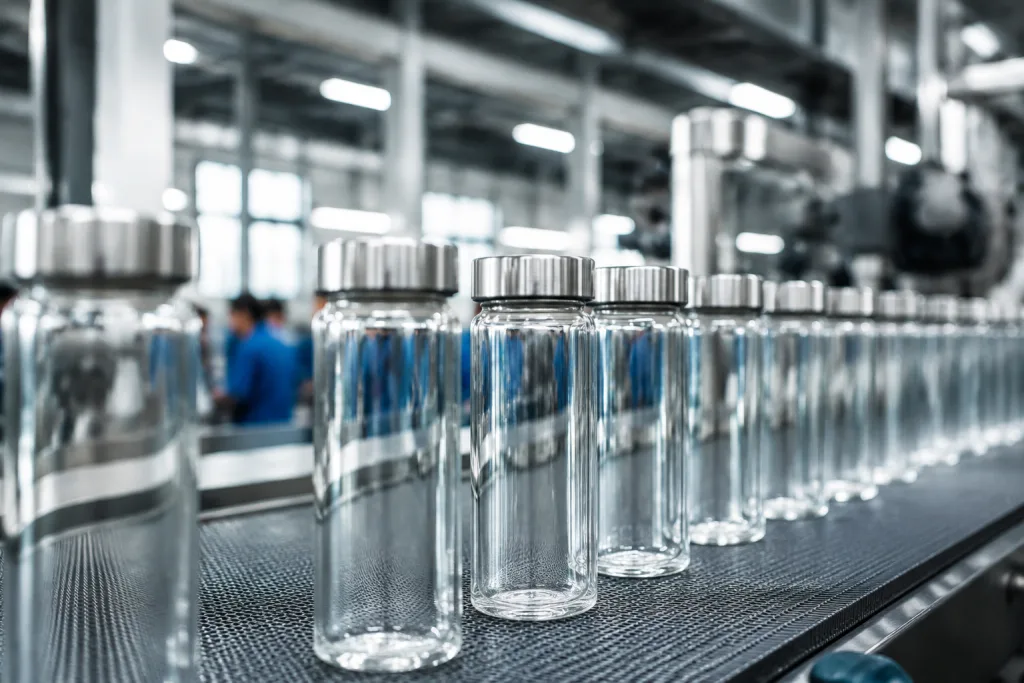
Capacity is the first filter. A lead-free glass insulated water bottle wholesale order dies fast if the line cannot keep schedule. We ask for monthly output, sample turnaround, and MOQ by design. A Zhejiang factory we run with can move 180,000-250,000 units a month across 4 lines, with 1,000 pcs MOQ for stocked shapes and 3,000 pcs for custom tooling. Sample lead time usually sits at 7-12 days, and mass production lands at 25-35 days after sample sign-off.
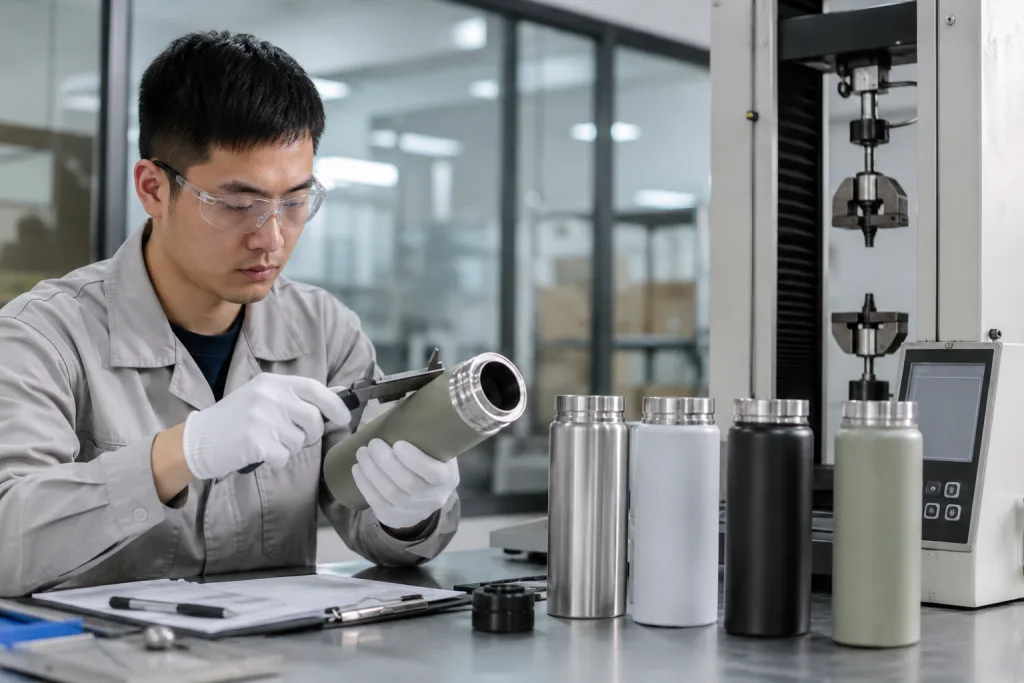
Ask for process details, not promises. Does the factory do incoming raw glass inspection with calipers and a go/no-go ring gauge? Do they run in-line leak checks on every batch, or only pull a sample? How do they handle broken necks, uneven rims, or print misalignment? A buyer flagged a PO once because the carton spec said 24 pcs, then the packing list showed 20; that typo cost two days. If the supplier is real, they will talk in reject percentage, carton drop test standard, and spare-parts policy for lids and seals. If they dodge, the math does not work.
If your first order is 500 units, the setup fee goes up and the unit price follows. That is normal. We had a customer push back on this last month, then QC pulled the sample and found the lid gasket off by 0.4 mm. The right question is not “can you do it?” but “at what MOQ, and what does the landed unit cost look like?”
Match the product to your channel
The best lead-free glass insulated water bottle wholesale choice depends on the channel. Outdoor retailers usually ask for a lid that survives a 1.2 m drop test, muted colors, and cartons that hold up after repacks at the DC. Brand owners push for a clean unboxing and tighter logo placement. Distributors want the same mold, same logo position, same carton count, season after season.
If you are building a lead-free glass insulated water bottle branded range for Europe, compliance and pack copy matter as much as the look. We have seen a buyer flag a 2 mm label typo on the PO and stop the line for a reprint. For North America, channel-specific labeling, carton codes, and steady supplier files can save you trouble at the warehouse gate. Start with one 450-500 ml format, one lid style, and one decoration method. That first order stays controllable, and the margin math works.
The right lead-free glass insulated water bottle manufacturer should map the job to standard wholesale, custom, private label, OEM, or ODM based on your lead time. We do not force every buyer into tooling. QC pulled the sample, checked the logo centerline at 3 mm, and the answer was clear: match the product structure to your volume, then price the risk straight.
Request a Zhejiang factory spec sheet
Send your target size, MOQ, and artwork. We’ll quote a lead-free glass insulated water bottle wholesale program with real factory numbers, not vague promises.
Frequently asked questions
What MOQ should I expect for lead-free glass insulated water bottle wholesale?
For a standard wholesale program, MOQ is usually 1,000 pieces per color or per design if the mold is existing. If you need a new shape for lead-free glass insulated water bottle custom work, 3,000 pieces is more realistic because of tooling and print setup. Some Zhejiang factories will accept 500 pieces for a test run, but unit cost will be higher, often by 12-20%. Ask whether MOQ applies to total order quantity or per SKU, because that changes your assortment plan quickly.
How much does a lead-free glass insulated water bottle cost FOB China?
For a common 450-500 ml format, FOB China pricing often falls around USD 2.10-4.80 per unit depending on glass thickness, lid type, print complexity, and carton spec. A plain lead-free glass insulated water bottle supplier may quote lower on a stock shape, while a lead-free glass insulated water bottle branded program with custom packaging can move above USD 5.00. Freight is separate. If you want a realistic landed-cost model, add customs clearance, inland trucking, and at least 3-8% variance for packaging changes.
Can I get private label and OEM options at the same time?
Yes. Many buyers combine lead-free glass insulated water bottle private label branding with OEM features like a custom lid color, logo position, and retail carton. The key is to define which parts are stock and which parts are custom. If you change only the logo and outer carton, the program stays cheaper and faster. If you also change mold details, you are moving into lead-free glass insulated water bottle odm territory. Good factories in Zhejiang will separate setup costs, so you can see what each change adds.
What compliance documents should I request?
At minimum, ask for food-contact material declarations, REACH-related declarations for Europe, and any applicable third-party test reports for glass and silicone parts. For North America, buyers often ask for FDA-related food-contact support documentation, though the exact need depends on the product structure and sales channel. If you are using a lead-free glass insulated water bottle manufacturer for retail, also request carton drop test data and a sample AQL inspection report. A serious supplier should be able to produce these within a few days, not a few weeks.
How do I reduce breakage in transit?
Use molded inserts, double-wall cartons, and a drop-test target before mass shipment. For lead-free glass insulated water bottle bulk orders, breakage can often be cut below 1% if the packaging is engineered properly and the factory checks rim chips, neck stress, and lid fit. Keep pallet heights reasonable and avoid overfilling cartons. If your order is for Amazon or a 3PL, make sure the outer box dimensions fit the receiving requirements and label the cartons correctly. A small packaging upgrade is usually cheaper than a claim cycle.