Key Takeaways
- For most B2B programs, a practical MOQ for custom lead-free glass bottles is 1,000-3,000 pcs per SKU, with 30-45 day lead time after sample approval
- Ask for test scope before ordering: REACH, LFGB or FDA contact compliance, and AQL 2.5 final inspection reduce preventable claims
- Decoration drives risk more than the bottle itself; silk screen, decal, spray, and bamboo sleeve options affect breakage, cost, and delivery by 5%-20%
- A realistic sea-freight damage target for glass drinkware is under 1.0% with proper drop-tested export cartons and dividers
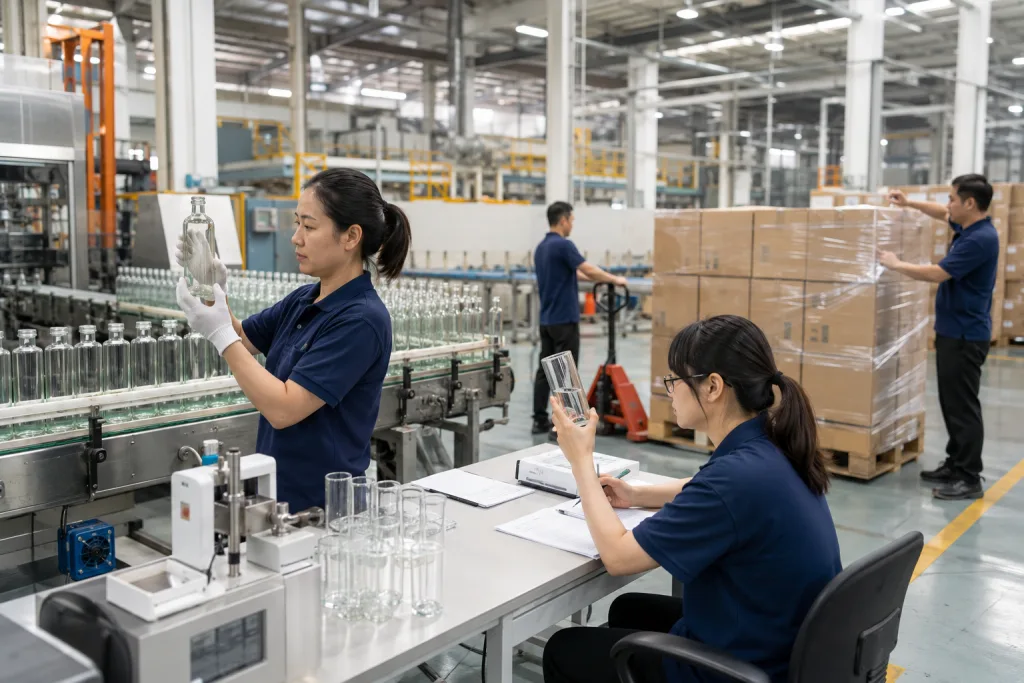
You are not buying a sample for a photo shoot. You are buying a production system: glass composition, decoration method, packaging strength, compliance paperwork, and a supplier that can repeat the same spec on 5,000 units and then 50,000 more. On the line, a sample can look clean under booth light, then fail after a 20-cycle rub test or arrive in a 32 ECT carton that crushes in transit. This is where deals go wrong. The quote looks low, then the first 5,000 units land with print rub, weak cartons, or missing REACH paperwork.
A better approach is to lock four decisions early: the glass format you need, the compliance proof that is non-negotiable, the customization risk you will carry, and the China factory metrics that matter more than headline price. In Zhejiang, where we run into 20-plus drinkware factories within a few hours' drive, those calls usually decide the shipment date. We have seen this go sideways over a 1 mm wall-thickness change, a buyer flagging logo color drift, or a PO typo that delayed carton print for 12 days. Price matters, of course, but this is the wrong first question to ask.
Start with the four buying decisions
If you source from a lead-free glass drinkware supplier, do not treat every glass program as interchangeable. We’ve seen this go sideways. A straight-wall borosilicate bottle for office retail, a soda-lime tumbler for a promotion, and a custom growler for beverage distribution fail in different places on the line, packout, and delivery. On our side, QC pulled a sample last month where rim thickness drifted by 0.6 mm, which matters a lot more on a retail bottle than on a low-cost event cup.
The four decisions are straightforward:
- Decision 1: Material and use case. Borosilicate handles thermal shock better and usually fits hot-cold programs. Soda-lime is often cheaper for cold-fill orders, but it runs heavier and can break more easily in transit if the wall is pushed too thin. Buyers ask for the lightest unit to save freight; this is often the wrong question to ask if the drop-test target is 76 cm in a mailer.
- Decision 2: Compliance evidence. If you sell in Europe, you need REACH awareness and often LFGB-related contact testing based on the full bill of materials. In North America, FDA contact compliance and California-related chemical review may matter. Test the full set: lids, sleeves, inks, seals. We’ve had a buyer approve the glass, then flag the silicone seal after lab review because the PO only listed “clear lid ring” with no grade noted.
- Decision 3: Customization level. A blank stock bottle with logo print can move in 20-30 days. A fully customized drinkware project with new mold, custom color sleeve, and gift box may take 45-60 days or more. If a new mold is involved, we normally need 12 days for mold sampling before mass production, and the first-off sample gets checked with a caliper and capacity fill test on the bench.
- Decision 4: Supply model. Your business model changes the order plan. A brand owner might book 3,000 pieces for launch and reorder by season. A canteen distributor often wants mixed SKUs and faster replenishment. If you are one of several canteen distributors in a promo channel, the first PO is only part of the math; carton count, MOQ split, and repeat lead time usually decide whether the program works.
At BottleForge Industrial in Zhejiang, China, we see buyers save more money by cutting remake risk than by forcing another USD 0.08 off unit price. The math does not work otherwise. If your launch quantity is 2,000 pieces, one bad decoration run can wipe out the whole price win, especially if the buyer flagged logo scratch-off after tape adhesion testing. Experienced buyers ask for process capability, not just FOB Ningbo pricing.
If your team also buys metal bottles, the risk is different. A canteen manufacturer for stainless items watches welds and vacuum retention. A glass canteen factory watches wall consistency, annealing, rim quality, impact protection, and print adhesion. We run polariscopy checks for stress on glass; the stainless line does not. The sourcing logic changes with the material.
Pick the right glass construction
Your brief should lock the glass spec first. Do that before packaging or logo placement. On most custom drinkware programs, the choice is borosilicate or soda-lime, and bottle shape drives more breakage cost than buyers expect. We see this on the line all the time: the buyer asks about gift box finish first, then QC pulls the sample and the body profile is the actual problem.
Borosilicate for premium bottle programs
High borosilicate glass is the standard pick for tea bottles, infuser bottles, and office drinkware because it handles bigger temperature swings without the same crack risk. A typical wall thickness is 2.2-3.0 mm depending on bottle diameter and capacity. For a 550 ml bottle, that usually gives a better weight-to-durability balance than chasing ultra-light glass, which is where we’ve seen projects go sideways after drop testing. On a stock-format bottle with a basic lid, unit pricing from China may run roughly USD 1.10-2.20 FOB depending on quantity and packaging. One buyer pushed for 1.8 mm on a slim body to save cents; the math didn’t work once replacement claims started.
Soda-lime for value-focused distribution
Soda-lime glass can fit tumblers, cold beverage bottles, and some canteen promotional projects with an aggressive target price. It works if the use case is controlled and you are not selling it as a hot-cold commuter bottle. This is the wrong question to ask: “What is the cheapest glass?” Ask where the bottle will be used, who will carry it, and whether it will see outdoor retail. If your distributor drinkware channel covers travel or camping, warranty claims can wipe out the saving fast. We’ve had buyers flag chipped rims after transit on low-cost bodies packed with thin dividers, only 250 gsm, so the material choice and pack-out have to match.
Shape affects breakage and decoration
Tall narrow bottles look clean on a rendering, but they take sea transit worse than compact bodies with protected shoulders. Wide-mouth formats are easier to clean and give more room for canteen customizable accessory options like straws, sleeves, or infusers. A custom growler or customizable growler adds another checkpoint: cap seal performance and pressure assumptions. We usually check this with a vacuum gauge and torque test, because buyers sometimes assume any thick glass body can handle carbonation. It cannot. If the product will hold still beverages only, state that clearly on artwork and carton markings.
A glass bottle that looks premium on a desk may be the wrong bottle for a distributor growler or high-turn promotional program. Use case first, silhouette second.
If you are sourcing for a canteen vendor or canteen suppliers network, ask the factory to recommend 2-3 proven stock bodies before opening a new mold. In Zhejiang and other China manufacturing hubs, using an existing mold can save USD 1,500-4,000 and 15-25 days. We ship plenty of programs this way, and the sample stage is smoother because the mouth finish and base diameter are already stable. One PO we received even misspelled the lid finish code, and the stock body still saved the schedule. For many buyers, that is the difference between a seasonal launch and a missed window.
Verify compliance beyond the bottle
“Lead-free” on its own is not enough. The right question is: what was tested, who ran it, and against which exact BOM version. We have seen this go sideways. The bottle body passed, but QC pulled the sample and found risk in the decal ink, the silicone ring at 2.0 mm, the bamboo lid varnish, or the color spray on the outside wall.
Ask your lead-free glass drinkware supplier for these documents before deposit hits the account:
- Material declaration: confirm the glass type, then list each lid, gasket, sleeve, straw, and coating material by spec, not just “silicone” or “plastic.” On one PO, the buyer typed “PP seal” but the sample used a silicone ring, and that mismatch stalled approval.
- Applicable test reports: REACH screening for EU-bound programs, food-contact testing where relevant, and any customer-specific restricted substances list. If the lid has bamboo plus PP, the lab file should break that out by component.
- Quality plan: incoming material checks, in-process adhesion testing, and final inspection standard, usually AQL 2.5 for major defects and 4.0 for minor defects. On the line, we usually run a cross-hatch adhesion check before mass packing.
For Europe, buyers usually ask for LFGB, REACH, and dishwasher performance, often in the same approval round. For North America, the focus is usually FDA-related food contact compliance plus retailer protocols. If your order uses a bamboo or PP lid, it becomes a multi-material file fast. Your customized drinkware test file should name every contact part, not just “glass bottle.”
Do not assume old reports carry over. A 2023 test on a clear bottle with black print does not cover a 2025 customized canteen with white underprint, a soft-touch sleeve, and a new stopper color. The math does not work. We ship revised artwork all the time, and even a small ink change can trigger a new review. If you are a canteen distributor serving 6 or 8 end clients, weak importer-of-record paperwork can land that liability on your side.
Factory social compliance matters too. If your customer needs BSCI or a similar audit trail, ask in the first email, not after sampling. The buyer flagged this on us last season after carton artwork was already approved. Plenty of canteen manufacturers and canteen suppliers in China can make the product. Fewer can match the full paperwork pack, packaging restrictions, barcode label rules, and claim-handling standard your retail customer wants. That gap is where “cheap” gets expensive.
Customization choices that change the risk
Most buyers fixate on bottle cost. That is the wrong question to ask. The bigger risk is which customization route gives your brand enough shelf impact without pushing defects up or dragging the line from 25 days to 35. On glass programs we run, decoration and accessory changes usually add 5%-20% to unit cost, and a 0.3 mm logo shift is often what holds shipment, not the glass body itself.
Low-risk customization
- Single-color silk screen on stock glass: usually the fastest route for custom canteen or customizable drinkware launches. Expect MOQ around 1,000 pcs per SKU and production in 25-35 days after artwork approval. On the line, a single-pass screen is easier to control than layered graphics, so QC pulls fewer offset samples.
- Laser marking on coated accessories: works on some lid components but not on clear glass itself in the same way as metal. Good for subtle branding. Buyers ask for the same sharp effect they get on 304 stainless lids; on glass, the math doesn't work.
- Standard kraft box with label: lowers packaging lead time and transit complexity. We ship these faster because there is no custom insert knife mold to confirm, and carton drop testing is simpler.
Higher-impact, higher-risk customization
- Full-wrap decals or multi-pass print: stronger shelf presence, but registration and rub resistance need tighter control. A 2-pass print looks good on the approval sample, then QC pulled the sample from bulk and found edge misregister on the shoulder curve.
- Color spray or frosted finish: attractive for premium retail, but coating consistency and scratch resistance need testing. We usually check film appearance under a 6000K light box, and the buyer flagged patchiness on one frosted lot last season.
- New mold bottle development: best for canteen customized brand identity or a customized growler shape, but adds tooling, sampling rounds, and 20-30 extra days. We have seen this go sideways when the first mold trial comes out 18 g over target weight.
- Gift box sets: good for DTC and seasonal retail, but increase drop risk and packing labor. A box set with glass straw, brush, and lid means more hand packing, more insert fit checks, and more chances for transit breakage.
If you are a canteen manufacturer buyer working across categories, do not copy your steel bottle process onto glass. A stainless custom canteen may take aggressive embossing, powder coat, and rough handling on the warehouse floor. Glass will not. You need tighter artwork control, better insert support, and stricter carton validation; last month we rejected an insert that let the bottle neck move 6 mm inside the shipper.
Ask for pre-production samples that match mass-production decoration, not hand-made showroom samples. We have seen buyers approve a beautiful sample, then reject the bulk because the production screen line weight looked different by 0.2 mm. That is preventable. Lock artwork dimensions, Pantone reference, logo position tolerance, and adhesion standard before the PO goes live; we even caught one PO with the logo callout typed 12 mm from base instead of 21 mm.
Judge the factory, not just the quote
A serious supplier is not hard to judge if you ask shop-floor questions. This is the right test. You are not trying to trap them; you are checking whether they run export orders with control from PO to loading. In Zhejiang, the better factories answer fast, and they answer with numbers, not sales talk. If the buyer flagged a lid-fit issue last month, the team should be able to tell you what changed on the line.
- MOQ by SKU: stock glass with custom logo is often 1,000 pcs; if you add a custom-color sleeve, straw, or handle, MOQ usually moves to 2,000-3,000 pcs because accessory vendors run their own minimums.
- Lead time: 7-12 days for pre-production samples, 30-45 days for normal production, and peak season can stretch that to 50 days if decoration slots are full. We have seen 12 days vs 18 days on the same sample just because the decal oven queue got backed up.
- Capacity: ask for monthly output by category. A useful benchmark is 300,000-500,000 units/month across drinkware lines, not a vague “large capacity.” Ask how much of that is borosilicate glass, how much is tumbler assembly, and how many packing lines they run per shift.
- QC process: incoming inspection, inline checks, vacuum or leak checks where relevant, adhesion testing, carton drop tests, and final AQL inspection. QC pulled the sample should mean something specific: pull force, logo adhesion, rim chip check, and a written defect limit, not a quick look under warehouse lights.
- Packaging validation: ask whether export cartons use dividers, egg-crate partitions, or EPE inserts and whether transit tests are documented. One cracked-glass claim can wipe out the savings from a cheap quote, so this is not the place to guess.
BottleForge Industrial, based in Hangzhou, Zhejiang, typically works on 1,000-piece MOQ for stock custom logo projects and 35-45 day lead time for repeatable programs. That part is normal in China. The better question is whether they still hold those numbers in September through November, when one missing silicone ring supplier can push shipment from 38 days to 52. We have seen this go sideways.
For canteen vendors and canteen vendor networks, replenishment discipline matters more than the first order. That is where margin gets protected. Ask what happens if your reorder lands during a raw-material squeeze. Do they reserve accessory sources? Can they match lid color batches within a stated tolerance, such as Delta E control or a signed color chip? Can they provide barcode application or FNSKU labeling if you ship to Amazon FBA? One PO typo on barcode position can hold a whole packing run for half a day.
A canteen factory or canteen supplier that only talks about price is usually showing weak process control. This is the wrong question to ask first. A reliable canteen manufacturers shortlist should talk about defect definitions, sampling plans, documentation, and claim resolution timelines. Ask who signs the final inspection report, what AQL level they run, and how they handle a 3 mm rim chip found after arrival. That is what protects your margin after the container lands.
Build cost around total landed risk
Unit price matters, but the better comparison is total landed cost with breakage, remake risk, and inventory fit worked in. We have seen buyers chase the lowest FOB number, then lose the saving on 18 broken cartons and one rushed reprint. Glass is not forgiving.
Use this method to compare offers on a 2,000-piece customized drinkware order. Run the sheet line by line.
- FOB bottle cost: compare the same spec, the same packaging, the same lid, and the same print coverage. If one quote uses a 1.8 mm wall and the other uses 2.2 mm, stop there and reset the math.
- Tooling or setup: split one-time mold cost from recurring screen or decal charges. We often see a PO typo here, where setup is listed once but billed again on the repeat order.
- Inspection cost: third-party final inspection in China may cost a few hundred USD; on glass, that is usually money well spent. On our line, QC pulled the sample at AQL 2.5 and caught logo shift before packing started.
- Damage allowance: estimate expected breakage in transit. A strong supplier should target under 1.0% sea-freight damage with proper cartons. Ask for the carton drop-test record and the divider spec, not just a promise.
- Claims response: ask whether shortage or quality claims are settled by credit note, remake, or next-order deduction. This is the wrong question to skip, because a cheap claim process on paper can turn into 21 days of email.
If Supplier A is USD 0.12 cheaper but needs a 3,000-piece MOQ, while Supplier B is slightly higher with a 1,000-piece MOQ and better packaging, Supplier B can be the cheaper option if you reduce excess stock and claims. The math does not work if 1,200 pieces sit for 9 months, or if the buyer flagged a weak master carton and you end up paying for replacements. We ship plenty of promo programs where demand is uneven in the first 60 days.
For distributor drinkware, distributor canteen, or distributor growler channels, SKU discipline is everything. Too many buyers split one launch into three soft colorways, then each SKU lands below a 500-piece reorder signal and the warehouse starts carrying dead stock. Better to launch one customized canteen well, prove sell-through, and scale than to fill a warehouse with slow-moving glass.
Align Incoterms and transit expectation early. FOB Ningbo or FOB Shanghai remains common for Zhejiang factories. If your team is new to China sourcing, confirm carton marks, pallet rules, loading photos, HS code usage, and document timing before balance payment. We have seen clean production runs go sideways because pallet height was 120 mm over the warehouse limit or the shipping mark missed one PO digit.
When to use glass and when not to
Not every brief should become glass. We tell buyers that early, usually before sampling, because the wrong material choice gets expensive fast. If the project needs drop resistance above 3 falls from 1.2 m, outdoor sports use, or lower freight weight on a 40HQ load, glass is the wrong answer to ask around. We have seen this go sideways: the branding looked sharp, then the buyer flagged breakage risk after the first transit test.
Glass works well when you need:
- Clean taste positioning with visible beverage color, fill level, and fruit or tea presentation
- Office, wellness, tea, or tabletop use where the bottle sits on a desk, tray, or meeting table
- Premium retail gift sets with controlled handling and fitted packaging, often with 10 mm EPE or EVA inserts
- Short-run custom drinkware using stock molds that we can brand quickly, sometimes from 1,000 pcs MOQ
Glass is a weaker fit when you need:
- High-abuse travel or gym use where the bottle gets dropped into lockers, cup holders, or concrete-floor bags
- Low landed cost after freight, because the math does not work once unit weight jumps by 0.25 kg to 0.4 kg
- Insulated performance expectations beyond what a simple double-wall glass line can hold in real use
- Large-format field use where a custom growler gets handled roughly during loading, pouring, and washback
This matters for category buyers sourcing across canteen manufacturers, canteen distributors, and wider drinkware lines. A customizable canteen in stainless may beat a glass concept for commuting, bike use, or school channels. A glass bottle can win if the brief is tea clarity, clean taste, and desktop presentation. QC pulled one sample last month where the PO said “frosted amber” but the approved artwork was clear smoke, and that kind of mismatch matters more in glass because the product is always on display.
The best suppliers in China do not push one material into every program. We run the comparison side by side: where glass sells better, where it creates claims, and what pack-out it needs to survive the route from Zhejiang to your warehouse. Carton drop test, divider spec, inner box fit—all of that matters. That is the standard you should buy against.
Need a straight answer on your glass project?
Send your target quantity, bottle size, decoration, and market. We will advise on MOQ, compliance path, and a realistic Zhejiang, China production schedule.
Frequently asked questions
What documents should I ask from a lead-free glass drinkware supplier before ordering?
Ask for a full bill of materials, not just a glass statement. You want the glass type, lid material, silicone gasket, sleeve, coating, and print ink details. Then request current test reports relevant to your market, such as REACH-related screening for EU programs and food-contact compliance for North America where applicable. Also ask for the factory’s inspection standard, ideally AQL 2.5/4.0, and packaging specification with carton dimensions and drop-test method. If your customer requires social compliance, request BSCI or similar audit status early. Reports should match the actual SKU configuration. A report on clear glass with no decoration does not fully cover a bottle with color spray, bamboo lid, and custom decal.
What is a normal MOQ for custom lead-free glass bottles from China?
For stock-shape glass bottles with custom logo, a normal MOQ is usually 1,000 pieces per SKU. If you add custom lid colors, sleeves, or gift boxes, MOQ often rises to 2,000-3,000 pieces because accessory suppliers in China need their own minimum runs. A fully new mold can require higher commitment plus tooling, often USD 1,500-4,000 depending on complexity. If you are testing a market, ask whether the supplier can standardize the bottle and vary only packaging or print. That can keep the MOQ closer to 1,000 pieces while still giving you a customized drinkware presentation. For repeat orders, buyers often negotiate mixed-color runs only after the factory sees stable volume.
How long does production usually take for customized glass drinkware?
A practical timeline is 7-12 days for pre-production samples after artwork confirmation, then 30-45 days for bulk production on a normal custom logo order. If the program includes a new mold, multi-component packaging, or complex decoration like full-wrap decals and sprayed finishes, add 15-25 days. Peak season can extend lead times in Zhejiang and other China drinkware clusters, especially before major retail shipping windows. Do not plan only around factory output. Add time for third-party inspection, export booking, and any carton revisions if the drop test fails. For glass, a rushed 25-day production often costs more later in claims than a controlled 40-day schedule.
How can I reduce breakage when importing glass drinkware by sea?
Start with the bottle shape and wall thickness. A 2.2-3.0 mm wall on a 500-600 ml borosilicate bottle is a common practical range, but the final design matters. Then focus on packaging: individual protection, dividers or egg-crate partitions, strong export cartons, and pallet stability where allowed. Ask the supplier for carton drop-test practice and loading photos from prior shipments. Keep gift packaging separate from transit protection; a pretty box alone is not shipping protection. During final inspection, include carton integrity checks and packed-drop sampling. A good target is under 1.0% sea-freight damage. If a supplier cannot discuss damage rates or packaging logic clearly, treat that as a sourcing risk.
Is glass a good choice for promotional and distributor channels?
It can be, but only for the right channel. Glass suits premium canteen promotional programs, office gifting, tea and wellness retail, and tabletop use where clean taste and product visibility matter. It is less forgiving for rough-use sports, commuting, and low-price mass promotions. If you are a distributor drinkware or canteen distributor buyer, be strict about end use. A stock glass bottle with one-color print can work well at 1,000-2,000 pieces if you keep the format simple and the packaging protective. A customized growler or fragile gift set may look attractive, but it needs stronger carton design and a customer who accepts the higher landed cost and handling risk.