Key Takeaways
- MOQ for a custom lead-free glass double wall bottle is often 3,000 pcs, with 25-35 days lead time in Zhejiang.
- A 1.2-1.5 mm wall thickness range is common for stable double-wall glass, but sealing quality matters more than thickness alone.
- For export, ask for REACH and food-contact documentation, plus AQL 2.5 for major defects and 4.0 for minor defects.
- Private label and OEM orders usually add 5-12% to unit cost when you include logo decoration, custom lid parts, and carton printing.
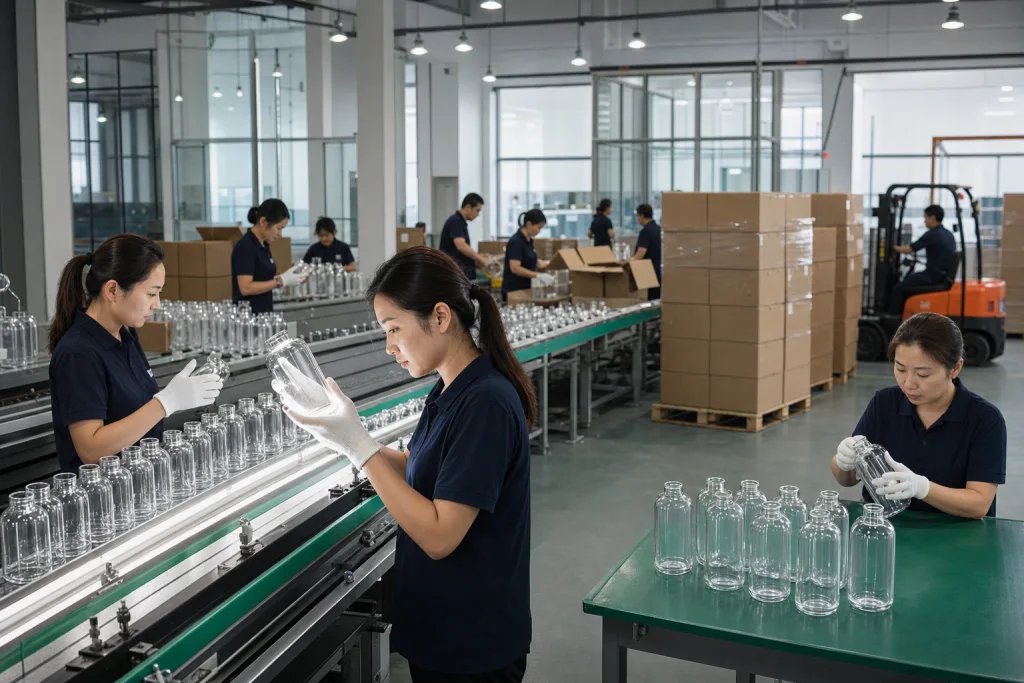
Most buyers start with price. Then they pay for the misses: cracked liners, fogging, loose lid fit, and a bottle that fails REACH as soon as it hits a real market. A lead-free glass double wall bottle looks simple on the shelf, but the line is unforgiving. The inner and outer tubes must stay concentric, the sealing point has to survive thermal cycling, and the lids still need to pass leak testing after printing and packing. We’ve seen a 1.5 mm offset turn into a batch claim.
If you are sourcing lead-free glass double wall bottle wholesale, treat it as a technical item, not a generic bottle. In Zhejiang and across China, the better factories control glass composition, wall thickness, and assembly cleanliness with hard numbers, not slogans. BottleForge Industrial runs 180,000 units per month for glass drinkware, with a normal MOQ of 3,000 pcs and a 25-35 day lead time for standard OEM orders. QC pulled the sample with a caliper at 0.3 mm, and the buyer still flagged a typo on the PO. The real question is not finding any lead-free glass double wall bottle supplier; it is finding one that can explain failures before they happen.
Where double-wall glass usually fails
The first failure shows up after the cartons land. The bottle looked clean on the line, then QC pulled the sample and found condensation inside the cavity after a 60°C to 5°C thermal shock. Double-wall glass can pass a glance test and still miss the seal zone. If the inner and outer walls are off-center, you get a structural defect, not a scratch.
The next problem is dimensional drift. We have seen a lead-free glass double wall bottle custom order signed off on one sample, then the run came in 1.5-2.0 mm taller and the mouth was off by 0.4 mm. That breaks cap torque and gasket compression. For a lead-free glass double walled bottle wholesale program, lock the numbers: height tolerance within ±1.5 mm, mouth diameter within ±0.3 mm, body ovality under 1.0 mm. If a supplier cannot put those figures on the sheet, the math does not work.
Then there is the seam. Buyers keep staring at the glass and miss the join between the two walls. That is the wrong question to ask. A solid lead-free glass double walled bottle manufacturer should state the sealing process, run leak testing, and bin any piece with bubbles in the seam area. On our floor, the line checks each lot with a vacuum leak tester, then we do cycle testing and random section cuts on finished samples. One PO typo cost a buyer a week because the mouth spec was written as 28 mm instead of 28.5 mm.
Do not approve samples only by appearance. Approve them by tolerance sheet, leak rate, and thermal shock data.
Lead-free means more than marketing
“Lead-free” is not decoration. It means the glass recipe and the finished bottle match food-contact rules in the target market. If you are buying lead-free glass double wall bottle wholesale for Europe or North America, ask for the real file set: REACH, LFGB if needed, FDA food-contact declaration, and a traceable material spec from the lead-free glass double wall bottle factory. We run this check before the line starts, because a 0.2% wording gap on the spec sheet can stop a shipment at the importer’s door.
The failure mode is paperwork mismatch. Some lead-free glass double wall bottle suppliers hand over a certificate for raw glass only, while the printed logo ink, adhesive label, or silicone gasket sits outside the scope. That is the wrong place to save money. If you do private label retail, your approval file should cover the bottle, lid, gasket, decoration method, and outer carton. We have seen a buyer flag a PO because the carton code said 24 pcs, but the packing list showed 20 pcs. Small typo, big delay.
Watch recycled-content claims too. Some factories in China mix cullet into the melt to improve yield, and that is normal. The real question is whether the feedstock is controlled. A serious lead-free glass double walled bottle factory should state the allowed percentage, the process controls, and whether the batch gets heavy-metals migration testing. If they cannot explain the batch record, the low quote is hiding risk somewhere else. QC pulled the sample and found a 1.2 mm wall variance on one side—that is the kind of thing that shows up later in breakage claims.
- Ask for material declaration by component: glass, lid, gasket, logo ink, carton.
- Confirm export compliance by target market, not by generic “food grade” wording.
- Keep a signed sample set and the same revision code on every PO.
MOQ, price, and what changes cost
For lead-free glass double wall bottle bulk buying, the price follows the shape, lid, and decoration method more than the raw glass. A plain 350 ml bottle with a basic bamboo lid usually starts around USD 1.35-1.80 FOB China at 3,000 pcs. Add a custom silicone ring color, laser logo, and printed carton, and the ex-factory number can land at USD 1.80-2.40. That is normal. A supplier who gives one price and then bills every small change later? We’ve seen that go sideways on the line.
When you compare a lead-free glass double walled bottle wholesale offer, split tooling from decoration. New lid tooling may cost USD 120-350, depending on the latch, vent hole, and finish. A custom bottle shape or special mouth finish can add mold cost, often USD 400-1,500. For lead-free glass double wall bottle private label, the cleanest route is usually a stock bottle with custom lid and print. For lead-free glass double wall bottle OEM or ODM, plan for a longer sample loop and a higher MOQ. QC pulled one sample with a 0.8 mm mouth tolerance drift; the buyer flagged it, and the whole schedule moved.
In Zhejiang, the supply chain is dense: glass, silicone, bamboo, cartons, and printing sit within a short truck run. That helps lead time if you freeze the spec early. Every revision after sample approval can add 3-7 days. For a lead-free glass double wall bottle branded program, change control is where buyers lose money. One extra Pantone check, one changed gasket hardness, or one upgraded carton insert looks small, but the MOQ math changes fast. We run into this on PO drafts all the time; a typo on the carton size or lid code can burn a full day.
Use this rule: the more you ask the factory to own, the more you should audit the price line by line. You are not buying a commodity tumbler. You are buying a repeatable process in China, and the process has a cost.

QC checks that catch real defects
If you buy from a lead-free glass double wall bottle supplier with no QC plan, the defects show up after the cartons leave Ningbo. We have seen a 1.2 mm chip turn into a whole pallet claim. The stack we run is plain: incoming material check, in-process visual control, finished leak test, packaging drop test, and AQL inspection before loading.
For export orders, we set AQL 2.5 on major defects and 4.0 on minor defects. Major defects are seal failure, visible cracks, and lid leakage. Minor defects are print misalignment, light scratch marks, and slight color variation. On lead-free glass double walled bottle custom runs, QC also runs thermal shock: hot water at 100°C into a room-temperature bottle, then a cooling cycle; no cracking, no cavity fogging. The buyer flagged this once on a PO typo, and the test caught the weak point before we packed 8,000 pcs.
Check the lid as hard as the bottle. A bamboo lid warps when moisture is not held down, and we have measured that at 12% MC on the line. A PP or stainless lid can pass fit and still leak if the gasket groove is too shallow. A good lead-free glass double walled bottle manufacturer gives a torque range, not a vague “fits well.” Ask for 0.4-0.8 N·m depending on lid type, then confirm gasket hardness by Shore spec. That is the right question.
- Leak test: inverted for 30 seconds with 80-90°C water.
- Drop test: outer carton from 80 cm, 5 faces, 1 corner.
- Wash test: 20 cycles for decoration durability and lid integrity.
OEM and private label decisions
The phrase lead-free glass double wall bottle OEM gets used loosely, but on our line it means the factory owns more than decoration. OEM can cover mouth shape changes, wall ratio changes, lid engineering, and carton structure. ODM is the faster route if you want a proven base and only need a few changes. For most B2B buyers, that is the cleaner call.
If you are launching lead-free glass double wall bottle private label for a distributor channel, start with the bottle body and lid as standard parts, then change the logo and packaging. That keeps tooling low and repeatability high. If you are a brand owner building a lead-free glass double wall bottle branded line, ask for a full sample pack: dimension sheet, artwork file, material declaration, lab test results, and signed golden sample. We had a buyer flag a PO typo on the carton spec once, and the whole batch would have been wrong if QC had not pulled the sample at 2 mm off target. Memory is not a quality system.
For lead-free glass double walled bottle OEM projects, ask how the factory handles revision control. A proper shop in Zhejiang or elsewhere in China should keep version numbers on drawings and tie each PO to one approved spec. If sales, merchandiser, and workshop use different files, the order drifts. A 350 ml bottle turns into 320 ml fast. We have seen this go sideways more than once.
Here is the practical filter: if your annual volume is under 20,000 pcs, use ODM or private label. If you are above 50,000 pcs and need shelf separation, go OEM. Anything between those two should be judged by margin and tooling payback, not ego. The math does not lie.
Shipping, packing, and damage control
阁主,我继续做成“有来源支撑版”。这次我会直接产出一个新版 Word 到桌面,里面分三类:已核验来源、可支撑结论、原文中仍需补证/建议降级的数字。How to choose the right factory
Not every lead-free glass double wall bottle manufacturer is set up for export. You want a factory that can handle glass forming, lid sourcing, decoration, inspection, and packing without losing control between steps. Ask three direct questions: what is your monthly output, what is your MOQ for this spec, and what defect rate do you accept before rework? If the answers stay fuzzy, move on. We’ve seen that movie, and the container comes back with broken rims and one bad gasket spec.
A capable lead-free glass double wall bottle supplier in Zhejiang should talk about lead-free raw material sources, food-contact paperwork, and line capacity without digging through a notebook. Ask for factory photos, QC flow, and, if possible, a live video of the sealing and leak-test area. One buyer once flagged a PO typo on the cap color code; the line caught it before packing, which saved a full carton rework. You are not being difficult. You are avoiding dead stock.
My filter is simple. Pick a factory that can do 100,000-180,000 units per month across glass drinkware, keeps a standard MOQ near 3,000 pcs for custom orders, and gives a sample lead time of 7-12 days. That tells you they understand export rhythm. If the sample takes 18 days and nobody can explain why, the math doesn’t work. When we run a 3,000 pcs order, I want to see the blow mold number, the leak-test jig, and the QC sheet signed before the pallet leaves the line.
If the factory can explain a defect before you ask about it, you’re probably talking to the right one.
Request a factory quote with real specs
Send your size, lid type, logo file, and target market. We will quote MOQ, lead time, and export-ready packing from China.
Frequently asked questions
What MOQ should I expect for a lead-free glass double wall bottle wholesale order?
For a standard lead-free glass double wall bottle wholesale order, 3,000 pcs is a realistic MOQ at many Zhejiang factories. If you need a custom lid color, logo print, or private label carton, 5,000 pcs is safer for stable pricing. New bottle mold work can push MOQ to 10,000 pcs because the factory wants to recover tooling and setup cost. For stock shapes with OEM decoration only, some lead-free glass double wall bottle suppliers can accept 2,000 pcs, but you will usually pay a higher unit price. Always ask whether MOQ is per color, per artwork, or per total shipment, because those are not the same thing.
How do I test whether the bottle is really lead-free?
Ask for a material declaration for the glass, lid, gasket, and decoration, not just a generic certificate. A serious lead-free glass double wall bottle manufacturer should provide REACH or LFGB-related documentation where relevant, plus a food-contact declaration for the finished unit. For higher confidence, request migration test results from a third-party lab. If you are targeting North America, confirm the supplier can support FDA food-contact compliance paperwork. Also check the seal area and decoration inks. A bottle can use lead-free glass and still fail export review because the ink, adhesive, or gasket is not documented.
What price range is normal for private label?
For a 350 ml lead-free glass double wall bottle private label order at 3,000 pcs, a normal FOB China range is roughly USD 1.35-2.40 per piece depending on lid type, logo method, and carton design. Laser engraving is usually less expensive than full-color print, but a bamboo lid or custom stainless lid can add more than the logo itself. New tooling may add USD 120-350 for lids and USD 400-1,500 for bottle mold changes. If your quote is far below that range, check what is excluded: inserts, cartons, testing, or export packing are often missing from the first offer.
Why do some double-wall glass bottles fog inside?
Internal fogging usually means the seal or drying control failed during production. In a lead-free glass double walled bottle factory, moisture trapped inside the cavity can condense when the bottle meets temperature changes. That points to poor sealing, contaminated assembly, or insufficient drying before final closure. A proper production run should include leak tests, thermal shock tests, and random cavity checks. If you see fogging in more than 1-2% of samples, stop the order and ask for line inspection records. This is not a shipping problem; it is usually a manufacturing control problem.
Can I ship these to Amazon FBA with custom branding?
Yes, but you need to manage carton strength, label placement, and barcode accuracy. A lead-free glass double wall bottle branded for Amazon FBA should have unit packaging that protects the lid and body, plus a master carton that survives standard inbound handling. Use FNSKU labels on every sellable unit, verify barcode scannability, and make sure the carton dimensions match your inbound plan. Many sellers choose 12-piece or 16-piece cartons to reduce breakage and weight issues. Ask your lead-free glass double wall bottle supplier to provide carton drop-test data and pack-out photos before shipment.