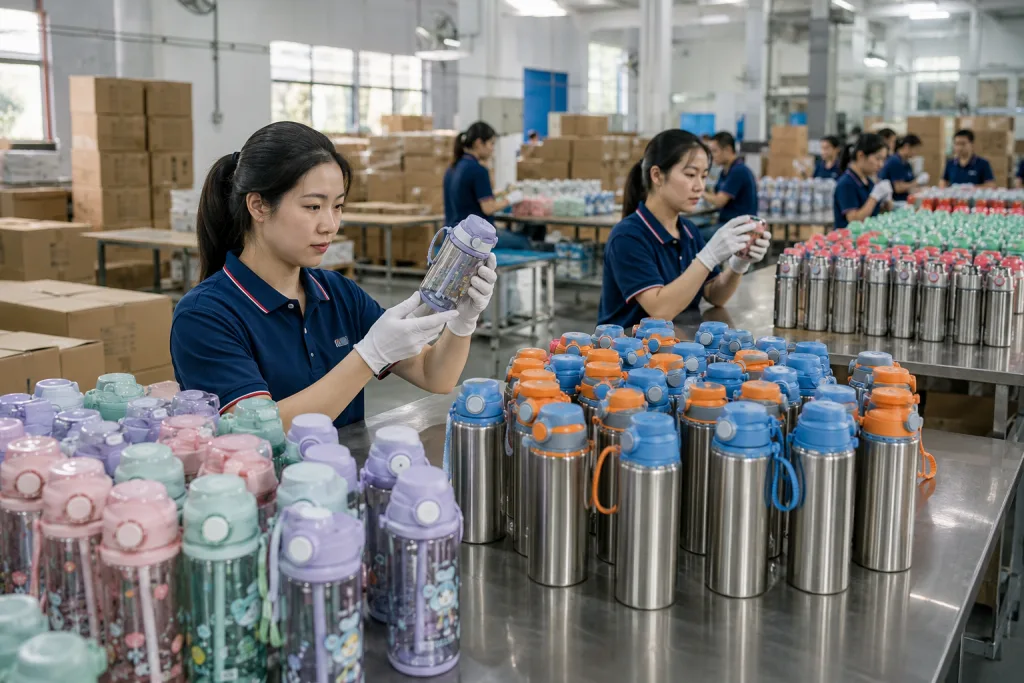
Key Takeaways
- For a custom kids water bottle, expect MOQ of 1,000-3,000 pcs per color, with 25-40 days production after sample approval
- Use AQL 2.5/4.0, 24-hour leak tests, and 3M tape adhesion tests to reduce defect risk below 2.5%
- Typical FOB China pricing runs about USD 1.35-2.80 for Tritan kids bottles and USD 2.90-5.20 for 18/8 stainless styles at 5,000 pcs
- Ask for CPSIA, REACH, LFGB or FDA material declarations plus factory social audits such as BSCI before placing a school program order
If you buy for a school district or import kids products, the problem is not finding a bottle. The problem is finding kids water bottle vendors that can meet safety, target cost, and ship date on the same PO. A bottle can look good in a catalog and still fail on odor after 24 hours sealed, leak rate on a 1.2 m drop test, paint adhesion on the 3M tape pull, or migration testing. We have seen QC pull a sample that passed photos but failed after the cap sat in a 60°C oven. Then your August delivery turns into September, and parents notice fast.
If you source from Zhejiang, China, screen a children water bottle manufacturer before you spend 7 days waiting for samples. Ask the practical questions first. Which lid design leaks less in school use? What MOQ is normal for a custom kids water bottle—1,000 pcs or 3,000 pcs per color? What documents should a children water bottle supplier show before deposit? This is the right place to start, because the wrong question is often color or shape before compliance. This guide answers those points directly, with a checklist approach, factory-floor details, and real numbers we run into on the line.
What should you check first?
Start with risk, not decoration. School district buyers often ask about color, logo area, and landed cost first. That is the wrong question to ask. Your first screen should be product safety, age fit, and whether the factory can run the order without drama. If a children water bottle factory cannot answer compliance and production basics in one email, move on. We see this early: a buyer sends a PO with a logo size note, but no one on the supplier side can confirm FDA, LFGB, or the lid material.
Your first checklist should cover five points:
- Material: Tritan, PP, silicone, or 18/8 stainless steel. Ask for resin or steel grade, not just “BPA free.”
- Age use: 3+, 6+, or school-age only. Spout geometry and handle size should match actual users.
- Leak control: One-click lids look good, but simple screw lids usually leak less in backpacks.
- Cleaning: Removable straw, accessible corners, and dishwasher guidance.
- Factory readiness: MOQ, mold ownership, lead time, and audit status.
For school programs, ask if the children water bottle supplier can support repeat orders with color consistency. This gets missed a lot. Pantone matching on lids and bottles sounds easy until you reorder 6 months later and the blue shifts enough that the buyer flagged it across two campuses. A steady children water bottle manufacturer in Zhejiang, China should keep color masterbatch records, retain approved pre-production samples, and log the injection setting used on the line.
At BottleForge Industrial, our kids bottle lines run roughly 300,000 units per month across plastic and stainless programs, but capacity alone means nothing. QC pulled the sample last month on a stainless run because the outer wall came in 0.03 mm light, and that small miss changed the hand feel. Ask for wall thickness ranges. For Tritan bodies, you will commonly see 0.8-1.2 mm depending on size and shape. For stainless insulated bodies, inner 0.4 mm and outer 0.5 mm is a normal mass-market structure. Vendors who cannot state basic construction specs are usually trading, not close to production.
Which bottle type fits your program?
Not every bulk school water bottle should use the same build. The right spec comes from end use, child age, and target sell price. We usually start with one question from the line: daily campus use, fundraiser resale, or district giveaway?
For school giveaways or district programs
A single-wall Tritan or PP bottle is usually the practical pick. At 500-700 ml, FOB China pricing at 5,000 pieces often lands around USD 1.35-2.20 depending on lid complexity, print method, and packaging. A large share of children water bottle wholesale orders sits in this range. The reason is simple. You hold unit cost down, keep carton weight lower, and ship more pieces per master carton. Last month a buyer flagged freight first, not bottle cost, and the math proved them right.
For retail or premium fundraising
Vacuum stainless gives stronger perceived value. A 12 oz to 16 oz custom kids bottle with powder coating and straw lid may run USD 2.90-5.20 FOB China at 5,000 pieces. It costs more, but resale margin is better, and schools like the durability story. On the floor, we run coating thickness checks after curing because thin powder on corners gets scratched fast. If you want premium, this is the right question to ask: what margin will the school make per piece, not just what is the FOB?
For younger children
Choose fewer parts. A simple flip spout with a silicone seal and detachable straw is easier than spring-loaded lids with three hidden cavities. Every extra moving part increases warranty claims and cleaning complaints. QC pulled the sample on one spring lid project because the hidden pocket held rinse water after 24 hours. We've seen this go sideways.
When you compare children water bottle vendors, ask each factory to recommend one structure at three target prices: entry, mid, premium. A capable children water bottle supplier should map specs to budget fast, usually after checking MOQ, logo method, and whether the PO says individual polybag or color box:
- Entry: PP or Tritan body, 1-color silk screen, polybag, 1,000-3,000 MOQ
- Mid: Tritan body, carry handle, 2-color print or wrap, color box, 2,000-5,000 MOQ
- Premium: insulated stainless, powder coat, laser logo or wrap, custom box, 3,000-5,000 MOQ
If you are a children water bottle distributor or one of several children water bottle distributors serving multiple school systems, standardizing lid platforms matters. Shared lids across 2-3 body shapes cut spare-part problems and speed reorders. We ship replacement lids by carton count, and mixed platforms always create counting errors. This is one of the easiest long-term savings a children water bottle vendor can offer.
How do you verify safety claims?
This is where new buyers burn 2 to 3 weeks. “Food grade” is not a test report. “BPA free” does not cover a school file or importer file. You need a document trail tied to the exact resin, silicone, ink, and finished bottle SKU. On our side, QC pulled the sample and matched the lid BOM code before we released any compliance file.
For a custom children water bottle or children water bottle customized project, ask for:
- Material declarations: FDA or LFGB contact compliance for the relevant materials
- CPSIA: especially for children-oriented products sold in the US
- REACH: for Europe, including SVHC position
- Phthalates and heavy metals: especially for printed parts, soft components, and coatings
- Dishwasher or temperature-use guidance: based on actual factory validation, not assumption
If the bottle is marketed for children, check whether any part becomes a small-parts risk after abuse testing. This is not a paperwork question. We have seen push-button caps open after a 1.2 m drop, and a loose valve insert can turn a quality claim into a compliance hold. The buyer flagged this once on a straw nozzle that measured 31 mm after breakage, which is exactly why drop and pull tests matter.
Good children water bottle manufacturers in China should send recent test reports from recognized labs, plus a BOM-level explanation of what was tested. The report should point to the same material family, print ink system, and contact parts you are buying. If a supplier sends a 2021 report for a different lid tool, that is a warning sign. We have seen this go sideways when the PO says 304 stainless body with a PP lid, but the file on hand covers Tritan and a flip-top cap from another project.
You do not need every possible test before sampling. You do need enough evidence to know the factory understands the compliance path for your market.
For school district buyers, ask one direct question: can the factory support batch testing before shipment if required? This is the right question. Many children water bottle suppliers in Zhejiang can coordinate third-party testing within 5-7 working days, and we usually hold 12 pcs per color for lab pulls. Build that into your lead time if your PO requires it. Delaying loading by 7 days is cheaper than dealing with a compliance issue after the goods land.
What MOQs and pricing are realistic?
Buyers hear two claims all the time: low MOQ and factory-direct pricing. Usually you pick one. For kids water bottle vendors, MOQ comes down to the bottle body, number of colors, print method, and packaging setup. On our line, a logo change is easy; a new body color that needs masterbatch matching and sample approval is where the quantity starts climbing.
Typical ranges for bulk children water bottle orders from China look like this:
- Existing mold, standard color: 1,000 pcs per item can be possible
- Custom color body plus logo: 2,000-3,000 pcs is more normal
- Custom made kids bottle with new mold: 5,000-10,000 pcs plus mold cost
- Retail gift box with inserts: often raises MOQ because packaging suppliers have their own minimums
If you are buying children water bottle bulk for one district and one logo, keep the design tight. One body, one lid, one print position usually saves more money than pushing the unit price down by USD 0.05 while adding 3 extra SKUs. We have seen this go sideways: the buyer flagged the price, then approved 4 lid colors and a window box, and the math stopped working.
As a rough FOB benchmark from Zhejiang, China:
- Tritan 500-650 ml with straw lid, 1-color print: USD 1.35-2.20 at 5,000 pcs
- PP economy school bottle, basic screw cap: USD 0.85-1.40 at 10,000 pcs
- 18/8 vacuum stainless 12-16 oz, powder coat: USD 2.90-5.20 at 5,000 pcs
- Custom packaging adds: USD 0.18-0.65 depending on box structure and insert
For a children water bottle promotional program, ask for three quote versions: FOB, EXW, and delivered to port warehouse if the supplier can arrange inland trucking. This is the right comparison. We ship from Zhejiang every week, and inland trucking to Ningbo can shift by USD 120-280 per load depending on carton count and whether the truck books same day or next day.
If you need a custom logo kids bottle for Amazon FBA or retail, request carton dimensions and net/gross weights before deposit. Do it early. A 12 mm change in bottle height can change case pack, pallet fit, and freight efficiency by 8-15%. QC pulled one sample last season where the PO had the height typed as 235 mm instead of 253 mm, and that small typo would have broken the carton drop test setup.
How should samples and approvals work?
Most order problems start before production. Not on the line. A tight sample process cuts off arguments later. If you buy a custom school water bottle or distribute children’s bottles, ask for a written approval path with version control on every PDF and photo. We’ve seen one PO typo on lid color turn 5,000 pcs into a rework job.
A workable sequence looks like this:
- Step 1: stock sample in 3-7 days to check shape, size, and lid function
- Step 2: pre-production sample in your color and logo in 7-12 days
- Step 3: packaging mockup with barcode, warning text, and carton marks
- Step 4: signed approval file covering Pantone, logo size, finish, and accessory list
For children water bottle custom projects, define what actually needs approval. This is the right question. Usually that means color, logo position, seal structure, straw material, and packaging text. We also ask buyers to lock the straw ID and silicone shore hardness in the file; a change from 50 Shore A to 60 Shore A, or 8 mm to 7 mm straw diameter, can shift leak results even if the bottle looks the same on the table.
Ask the children water bottle factory for pilot-run photos and inline QC points. Not just finished sample shots. QC pulled the sample should mean something: leak test at set vacuum or inverted hold time, torque or closing-force check, print adhesion by 3M tape test, drop test from the agreed height, and visual inspection against your standard master. AQL 2.5 for major defects and 4.0 for minor defects is a common starting point for drinkware. If the supplier says “no need for inline checks,” we’ve seen this go sideways.
Lead time for a bulk kids bottle order is usually 25-40 days after sample approval and deposit. In peak season, July to October often adds 7-10 days. Zhejiang gets tight before holiday and back-to-school shipments, and decoration capacity is usually the first bottleneck, not bottle blowing. If your school launch date is fixed, count back from the delivery date and leave room for one failed sample round. We run plans that way every season. One extra sample round can mean 12 days vs 18 days depending on logo process and carton proof timing, so build it in early.
What quality controls actually matter?
A lot of inspection sheets look complete on paper and still miss the defects that turn into claims. On bulk kids bottle orders, we care less about a 2 mm paint speck and more about failures the child or parent will find on day one.
Your QC checklist should include:
- 24-hour inverted leak test: check all lid types, with extra attention on straw and flip lids
- Drop test: usually from 0.8-1.0 meter on key orientations; we run base, side, and lid-impact positions, because one weak hinge will show up fast
- Print adhesion: 3M tape test after curing; QC pulled the sample right off the line once because the oven dwell time was short by 3 minutes
- Odor check: random sample after sealing in warm condition; this catches bad silicone batches that look fine but smell off
- Vacuum retention: for stainless, test against agreed temperature-loss standard
- Thread and fit consistency: lids from one lot should fit bodies across the lot; this is where a go/no-go gauge saves trouble
If this is your first order with children water bottle manufacturers, do not skip pre-shipment inspection. We have seen one stable item go sideways from a single print run, or from one silicone batch that changed fit by less than 0.5 mm. The buyer flagged it only after cartons were packed. A third-party inspection in China costs far less than one rejected container, and the math doesn't work any other way.
For schools, practical defects matter more than tiny finish marks. A small scratch on the base is often acceptable. A lid that pops open in a backpack is not. Write your defect priorities into the PO and QC standard. Be specific. We ship better when the line knows a backpack leak is major and a light base mark is minor.
Ask how spare parts are handled. A serious children water bottle supplier should be able to supply extra seals, straws, or lids at 1-2% of order quantity. We usually pack them by color and cavity lot, which avoids mix-ups later. This matters for district maintenance stock and for importers selling replacement packs. If the product is truly children water bottle customizable across multiple colors, confirm the spare parts stay interchangeable across batches. We have seen buyers approve six colors, then one PO typo changed a lid insert spec and created body-to-lid mismatch on the next run.
How do you choose the right vendor?
After you compare 5-8 kids water bottle vendors, the gap is usually not unit price. It is line control. We have seen buyers save $0.08 per bottle, then lose 12 days because the cap torque drifted and QC pulled the sample at 1.2 N·m instead of the approved range. The right factory repeats quality, replies with clear numbers, and ships to the date on the PO.
Use this final checklist when choosing among children water bottle vendors:
- They answer technical questions with actual numbers, such as bottle weight, wall thickness, leak-test standard, or drop height, not sales language
- They provide recent test reports matched to a similar build, not a random FDA or LFGB file from another lid set
- They quote realistic MOQ and lead time; if the line capacity is 30,000 pcs per day, a 100,000-piece order does not ship in 7 days
- They can show audit status such as BSCI or ISO-style quality controls, plus basic in-process records from the line
- They understand label, carton mark, and FNSKU requirements if you also sell retail; one wrong carton mark or a typo on the PO can hold a shipment
- They offer a clear claim policy for leakage, print defects, and shortage, with a stated inspection basis such as AQL 2.5 if that is how they run claims
If you are buying children water bottle promotional items for schools, ask one extra question: what percentage of orders ship on time in peak season? This is the right question. A disciplined factory should pull the number from shipment records, not improvise on a call. We usually trust an honest 92-95% more than “always on time,” because August and September get tight and every factory in Zhejiang is chasing cartons, silicone seals, and truck space.
For buyers in Europe and North America, sourcing from Zhejiang, China often makes sense because bottle bodies, lids, seals, coatings, and packaging sit within a short supply radius. That cuts sample revision time; on some programs, we see 12 days vs 18 days from drawing approval to revised pre-production sample. The math does not work if a supplier is far from its component base. Still, concentration brings congestion in peak months, and we have seen this go sideways when a factory books no safety stock for straws, paint, or corrugated cartons.
If a children water bottle wholesale supplier gives you fast answers, stable samples, clean documents, and realistic production planning, that is usually the vendor you keep. Not the cheapest one on day one. The one that does not create a leakage claim on day forty because the buyer flagged loose threads, mixed gasket hardness, or 2 mm logo shift in mass production.
Shortlist a safer kids bottle supplier now
Send your target size, quantity, market, and logo file. We will recommend bottle structures, realistic MOQ, compliance path, and an FOB China quote within 24 hours.
Frequently asked questions
What is a normal MOQ for a custom kids water bottle order?
For existing bottle shapes, 1,000 pieces can work on a standard color, but most custom kids water bottle programs land at 2,000-3,000 pieces per color with logo printing. If you need a children water bottle customizable with custom packaging, mixed lid colors, or inserts, MOQ often rises because packaging suppliers have separate minimums. New mold projects usually start around 5,000-10,000 pieces plus tooling cost. For school district buyers, the best way to keep MOQ manageable is to standardize one body and one lid, then vary only the logo or carton label.
Which material is better for school use: Tritan or stainless steel?
It depends on budget and use. Tritan is lighter, lower cost, and usually easier for younger children to carry. A 500-650 ml Tritan bottle is often USD 1.35-2.20 FOB China at 5,000 pieces. Stainless steel feels more premium and insulates, but unit cost is higher, usually USD 2.90-5.20 FOB for 12-16 oz vacuum styles. For elementary school daily use, simple Tritan bottles with fewer parts often produce fewer complaints. For resale, fundraising, or premium programs, stainless offers stronger perceived value and better margin.
What compliance documents should a children water bottle supplier provide?
At minimum, ask for material declarations and recent test reports relevant to your market. For the US, that often includes FDA-contact suitability, CPSIA considerations for children’s products, and checks for phthalates or heavy metals where applicable. For Europe, ask about REACH and, depending on the material and positioning, LFGB. The key point is traceability: the reports should match the same material family, contact parts, coatings, and printing system used in your bottle. If the supplier can only send generic “BPA free” statements, that is not enough for a serious importer or school procurement file.
How long does production usually take after sample approval?
For a standard bulk kids water bottle order, expect 25-40 days after pre-production sample approval and deposit. Stock samples usually take 3-7 days, while color-and-logo pre-production samples often take 7-12 days. Peak season can add another 7-10 days, especially before back-to-school and holiday shipping windows in China. If you also need third-party lab testing or final inspection, add about 5-7 working days. A realistic schedule from first sample request to shipment is often 5-8 weeks for standard projects and longer for new molds.
How can I compare children water bottle vendors fairly?
Use the same RFQ structure for all vendors. Ask each one to quote the same size, material, lid type, print method, packaging, MOQ, and incoterm. Then compare five practical points: sample quality, document quality, response speed, production lead time, and defect-control plan. Require a leak test standard, AQL level, and carton spec in writing. Also ask whether they are a true children water bottle factory or a trading company managing multiple plants. A slightly higher FOB price can still be the better deal if the vendor delivers 95% on time and keeps defects below AQL 2.5/4.0.