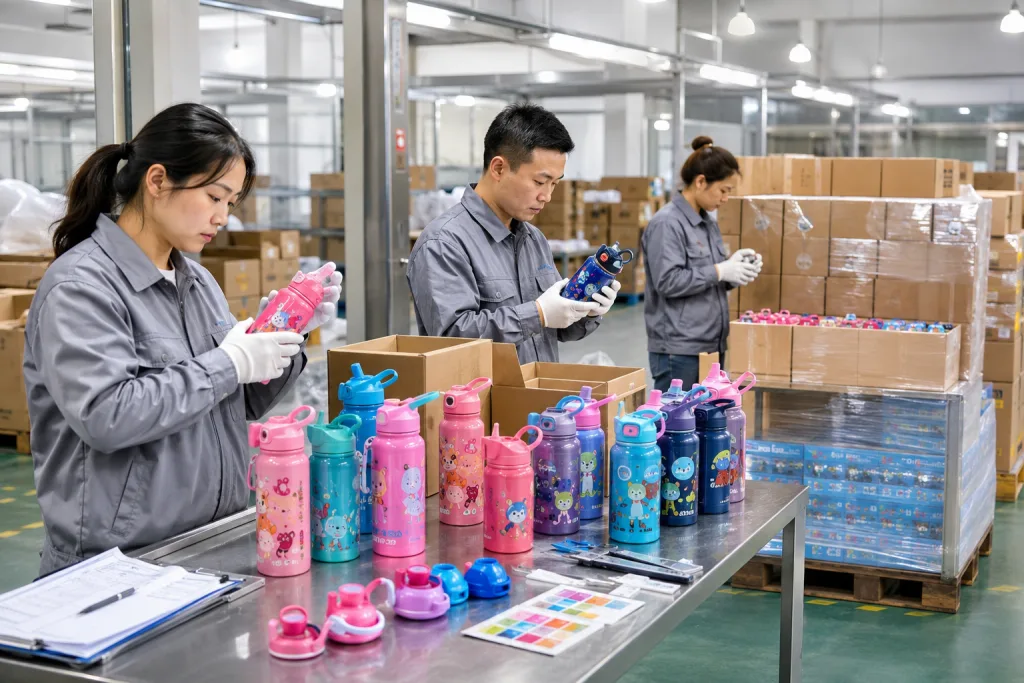
Key Takeaways
- Lock down bottle, lid, straw, gasket, and decoration specs before deposit; changing PP grade or silicone hardness by even 5 Shore A can create leak failures.
- For bulk school water bottle orders, require AQL 2.5 for major defects and 4.0 for minor defects, plus 100% leak testing before packing.
- A realistic MOQ for a custom kids bottle is often 1,000-3,000 units per colorway, with 30-45 days production after sample approval in Zhejiang, China.
- Compliance is not a footnote: ask for REACH, LFGB or FDA food-contact data, ASTM/CPSIA where applicable, and migration test reports tied to your exact SKU.
You spot a bad kids water bottle vendor late: after the first leak complaint, after lids split in cold-weather testing, or after a school district asks why the carton label does not match the PO. On paper, 40 factories can quote a custom kids bottle in one afternoon. That part is easy. The hard part is shipping 3,000 to 30,000 units with the same lid fit, print registration, test compliance, and packing accuracy as the approved sample. We have seen this go sideways over a 0.3 mm thread tolerance and one carton-label typo on a purchase order.
If you buy for schools, museums, retail programs, or seasonal promotions, think like a failure analyst. Not just a buyer. In Zhejiang, where a big share of China's drinkware production sits, the gap between a clean pre-production sample and mass production usually shows up in mold wear, resin swaps, screen-print setup, or rushed assembly on the line. If your vendor runs 600,000 units per month and quotes a 35-day lead time, this is the wrong question to ask. Ask how they control the order. QC pulled the sample, approved the Pantone match, then mass production drifted on the second print run because the screen tension was off. That happens more than buyers think.
Where kids bottle projects fail first
The first failure is rarely dramatic. It starts with a small gap between what you thought you ordered and what the factory line thought it could ship. A school buyer writes “spill-proof straw bottle, 450 ml, for ages 5-10.” The children water bottle manufacturer reads “standard 16 oz mold, PP flip lid, random silicone color, screen print logo.” Same PO, different product. We’ve seen this go sideways over a 2 mm straw cut and a lid color the buyer never approved.
If you source from a children water bottle factory in Zhejiang or elsewhere in China, most problems start at five weak points:
- Uncontrolled components: lid body, push button, straw, bite valve, handle, and gasket coming from 4 or 5 sub-suppliers, with no single golden sample locked on the line.
- Decoration drift: logo size off by 3 mm, Pantone mismatch, or poor adhesion on powder coat or Tritan surfaces; QC pulled the sample and the logo scratched after 20 tape pulls.
- Dimensional variation: thread tolerance, straw length, gasket seating, base roundness; one lid closes fine at 0.8 N·m, the next leaks because the gasket sits high.
- Compliance assumptions: a generic test report offered for “similar material” instead of your actual production lot; this is the wrong question to ask if the report does not match your resin batch.
- Carton and labeling errors: wrong barcode, wrong assortment, mixed lid colors, or missing warning labels; last season we saw a PO typo swap 12 pcs/inner with 24 pcs/inner and the buyer flagged it at arrival.
A practical kids water bottle vendor should turn your idea into a control document, not just a quote sheet. Ask for a full specification table with capacity tolerance, bottle weight tolerance, material callouts, decoration position, packaging method, carton drop requirement, and test plan. We run this before mass production. If the supplier sends only renderings and a unit price, you are still buying assumptions, and the math doesn’t work once rework starts.
For a custom school water bottle order, the minimum useful spec sheet should include bottle height, diameter, neck finish, wall thickness, lid torque range, silicone gasket hardness, print method, logo dimensions, inner and master carton details, and pass/fail standards. Add actual numbers. For example: wall thickness 0.55 mm, logo position ±1.5 mm, lid torque 0.7-1.0 N·m, gasket hardness 50 Shore A, carton drop 76 cm. Without that, even a competent children water bottle supplier will fall back to house standards that do not match school use, dishwasher exposure, or rough handling by children. We ship plenty of house-standard bottles. School orders are different.
Leaks start with tolerances, not luck
Leak claims turn a bulk kids water bottle program into a cost problem fast. Buyers often point at assembly first. Most of the time, that is the wrong question to ask. The issue starts with tolerance stack-up on the line: a lid seals on the golden sample, then fails in production when bottle neck diameter runs +0.25 mm, gasket cross-section runs -0.15 mm, and thread start drifts from cavity to cavity. We see this in PP caps pulled straight off a 16-cavity tool, where cavity 7 and cavity 12 do not behave the same.
If you are buying a bulk children water bottle with flip straw or bite valve design, put the sealing system in plain numbers on the PO. No broad wording. No “fit well” comments. A children water bottle vendor should confirm:
- Neck finish tolerance, for example ±0.20 mm
- Silicone gasket hardness, typically 50-60 Shore A
- Thread engagement turns and closing torque window
- Straw insertion depth and cut length tolerance
- 100% vacuum or inverted leak test before packing
For school programs, ask for a leak test standard that matches how kids actually use the bottle. A bench check alone is not enough. We run three checks on this type of item: 100% inverted water test for 30 minutes, random sample drop test from 1.0 meter when filled to 80%, and thermal cycle test from 5°C to 40°C on retention samples. QC pulled the sample, squeezed the body by hand, and over-torqued the cap because that is what happens in real use. Kids leave bottles in cars, drop them from desks, and crank the lid down harder than spec.
Materials matter more than the catalog implies
Tritan bodies, single-wall 18/8 stainless, and food-grade PP lids do not fail for the same reason, so one material claim tells you nothing. Tritan can stress-whiten near gate marks if tooling polish is off or ejector force is uneven. Stainless can leak at the shoulder seam if forming drift shows up after 8,000 to 10,000 pcs on the line. PP lids can warp after a resin grade change; we have seen 0.30 mm lid flatness shift from one approved lot to the next. A reliable children water bottle supplier should not stop at “BPA-free.” It should state the exact resin family and the approved sub-supplier.
A sample that does not leak proves one sample. A production leak test proves process control.
If your children water bottle customized order includes multiple lid colors, ask for cavity-level traceability on first production. Some buyers push back on this and say it is too much for a kids bottle. Then one cavity starts making out-of-round buttons, the buyer flagged it after goods reached the warehouse, and field failure rate jumps to 3.5%. We have seen this go sideways over one small PO typo and one mixed carton of lids from the wrong cavity record.
Lids break when resin and tooling drift
The second failure mode shows up at the lid: cracked hinges, weak carry loops, and push buttons that start dragging after repeated use. We see this a lot on custom kids bottle programs with bright masterbatch colors, soft-touch overmold parts, and one-hand opening lids. These small features fail first. On our line, QC pulled a sample last spring where the button gate area had turned white after 200 presses.
A children water bottle manufacturer may use PP, ABS, or copolyester in different lid zones. That part is normal. Trouble starts when a sub-supplier swaps the resin grade to save $0.03 per set, or when the mold wears and leaves 0.15 mm flash in the button track. Then the buyer flags sticky action, and the math doesn't work. In a 30,000-piece run, tiny resin and tooling drift becomes a return problem fast.
To reduce breakage in a children water bottle custom project, specify the abuse points:
- Hinge cycle life: ask for 3,000-5,000 open-close cycles with no fracture.
- Carry handle load: 10 kg static load for 1 hour is a useful benchmark for school use.
- Button function: no sticking after 500 cycles and no accidental opening in a drop test.
- Odor requirement: no obvious plastic odor after 24-hour hot water conditioning.
For a children water bottle wholesale order, ask for pre-production samples from actual mass-production tooling, not just 3D prints or hand-finished pilot pieces. This is the wrong sample to approve. A polished pilot lid can hide parting-line flash, sink marks near the hinge boss, and ejection stress around the button pin. We run into this on 4-cavity lid molds more than buyers expect. A real vendor in Zhejiang should be fine showing cavity count, mold life, and the spare-part plan for lids and straws.
Check spare components too. For district or institutional buyers, replacement lids save programs every year. We had one PO with the school color code typed wrong, and spare lids fixed the issue without scrapping bottles. If MOQ for spare lids is 2,000 pieces and lead time is 20 days ex-works China, build that into the contract. A children water bottle distributor often skips the spare-part discussion unless you ask straight, but we've seen this go sideways when claims start in month six.
Print quality fails in the second run
The first custom logo kids bottle run often passes because everyone is standing at the line, watching first articles and checking each print. Trouble shows up on the second or third reorder. Artwork gets pulled from an old file, another operator sets the screen printer, or the body finish changes from gloss to powder coat. If your program uses mascots, school logos, or licensed artwork, decoration control is part of acceptance criteria, not a cosmetic extra. We have seen this go sideways over one wrong AI file version on a PO.
On children water bottle promotional orders, QC pulled the sample most often for blurred screen edges, color shift, bad registration on curved walls, and print that rubs off after 20 wash cycles. On powder-coated stainless bodies, under-cured coating kills adhesion; we check cure with a solvent rub and oven record, not guesswork. On Tritan or PP, surface energy and pretreatment decide whether the ink holds or peels. The buyer usually asks about logo color first. The wrong question is adhesion after use.
A practical children water bottle vendor should define decoration by process and test, not by photo approval. Your purchase spec should state:
- Print method: silkscreen, heat transfer, pad print, UV print, laser, or wrap
- Pantone reference and acceptable variance
- Logo position from base and side seam in millimeters
- Adhesion test method, such as cross-hatch or tape pull
- Dishwasher or hand-wash claim, if any
For a custom made kids bottle using two-color silkscreen, a realistic registration tolerance is often ±0.5 mm, and we normally check that with a loupe on first-off samples. For large wraps, ask for a seam placement standard so key artwork does not land on the mold split line. We run into this on 500 ml bodies all the time. If you need children water bottle customized with names, class codes, or variable data, confirm whether the factory prints in-line or applies labels by hand; manual personalization adds cost and raises error risk. Last season one buyer flagged 37 pieces because class code 2B was applied as 28.
Do not approve color from a phone photo. Use physical chips or a signed master sample. On a 5,000-unit bulk school water bottle order, a 5% shade shift may still be technically usable, but schools reject obvious mismatch between district colors and delivered goods fast. We ship against the signed standard, not against someone’s screen brightness. Set that expectation before production starts, not after the goods are on the water in China.
Compliance paperwork often hides the real gap
Buyers often exhale when a PDF shows FDA, LFGB, or REACH. That is usually where the gap starts. A resin supplier’s generic report is not a finished-goods report for your exact children water bottle bulk SKU. We have seen QC pull a sample and find the bottle body passed, but the straw pigment or logo ink changed the compliance scope. The lid, straw, color masterbatch, print ink, gasket, and even the paper insert all need to match the shipped build.
If you sell into Europe or North America, ask your children water bottle suppliers for a file set tied to the final configuration, not a “similar item” report from 18 months ago. This is the wrong question to ask: “Do you have a certificate?” Ask which lab report covers this SKU, this color, this lid set, and this packaging. On our side, the lab request sheet usually lists each component line by line, down to the silicone gasket hardness and the 0.6 mm printed film on the insert card. Depending on market and use, that file may include food-contact migration testing, REACH SVHC declaration, CPSIA relevant substance screening, ASTM physical safety references where applicable, and packaging compliance statements. If the bottle is positioned for younger children, age grading and small-parts risk need a harder review.
For a competent children water bottle vendor, the compliance file should cover:
- Bill of materials with material and color references
- Test report naming the exact SKU or construction
- Factory quality system, such as ISO-based procedures
- Social audit availability, often BSCI for institutional buyers
- Change-control commitment if resin, ink, or sub-supplier changes
In China, some factories test once and keep sending the same file for 2 or 3 years. That does not work for a live private-label program. We have seen this go sideways after a sub-supplier swapped a gasket source and nobody updated the paperwork. Ask for renewal timing and sample retention. We usually tell buyers to hold 1 signed golden sample, 1 sealed production sample from shipment, and 1 compliance file copy per PO; on the line, we label the retained unit with PO date and carton number so there is no argument later. For annual school tenders, that habit saves weeks of back-and-forth.
What to put into the PO
Add a clause stating that no material, colorant, gasket source, or decoration ink may be changed without written approval. Short line. Big protection. We ship under this rule with large accounts because the math does not work if a factory treats “equivalent material” as its own call. It moves that decision back to you, where it belongs.
Packing mistakes create expensive quiet losses
Some of the most expensive failures are not product defects. They start in packing. We have seen mixed lid colors packed into the same master, 24 pcs written on the carton but 20 pcs loaded, missing FNSKU labels, and retail boxes crushed because the outer carton wall was too soft at 5-layer spec. One PO even had the insert code typed as “A12” instead of “A21,” and the line packed the wrong school flyer for 3,000 sets. If you buy from children water bottle distributors or direct from a children water bottle factory, packaging control needs the same discipline as leak testing on the vacuum jig.
For children water bottle wholesale and Amazon or retail channel orders, spell out every packaging layer. Write the unit pack, insert direction, barcode position in mm, carton size, gross weight cap, and pallet pattern. We run into buyer pushback here because they think “standard export packing” covers it. It does not. If your goal is direct import from Zhejiang, get the export carton right at origin, not after the goods reach a domestic re-pack warehouse.
- Master carton burst strength: ask for a measured standard, not “export carton.” We usually confirm 5-ply or 7-ply board with a carton sample pulled from the line.
- Drop test: require a 6-face carton drop on packed goods, especially for gift box programs. QC should record corner damage, not just say “pass.”
- Barcode control: require scan verification before sealing cartons. We use a handheld scanner at the packing table because relabeling after taping wastes hours.
- Assortment control: require a photo record of carton contents by SKU and lid color. This is where mixed-color school orders usually go sideways.
For a bulk kids bottle order shipping to school districts, carton weight matters. Keep masters under 15 kg if warehouse handling is manual. We have had buyers ask for 18 kg to cut carton count, but the math does not work once boxes start getting dragged across concrete floors. If the order includes custom children water bottle assortments by school color, require carton maps and pallet labels. One mixed pallet can burn 2 hours of sorting labor after unloading.
Quality control should include an in-line packing audit and a final random inspection using AQL. A common baseline is AQL 2.5 major, 4.0 minor. That is not perfect quality; it is a shipping decision. QC pulled the sample, checked label position, counted units per carton, and verified insert version against the approved artwork. For higher-risk launches, especially a new children water bottle customized mold, add a pre-shipment inspection plus loading supervision. It costs far less than a partial container claim after a 28-35 day ocean transit from China.
How to buy with fewer surprises
If you are choosing between children water bottle manufacturers, stop comparing FOB price alone. A quote of USD 1.85 versus USD 2.10 tells you almost nothing until the spec is locked: wall thickness in mm, resin grade, gasket hardness, print method, packaging, and testing scope. We have seen buyers miss a 0.3 mm wall difference and then ask why drop-test failures jumped. The cheaper bottle often costs more after claims, spare-part requests, and rework. This is the wrong first question to ask.
For most custom kids water bottle programs, a sensible buying sequence looks like this:
- Confirm target market, compliance scope, and channel requirements.
- Shortlist a children water bottle vendor with relevant mold experience, not just a broad catalog.
- Approve a full specification sheet and BOM before tooling changes or deposit.
- Review pre-production sample from production tooling.
- Set QC gates: in-process checks, leak test, decoration approval, and final AQL inspection.
- Approve packaging and shipping marks before mass packing begins.
Typical numbers are straightforward. MOQ for an existing custom school water bottle mold is often 1,000-3,000 units per color. New-tooling programs can push practical MOQs to 3,000-5,000 units. On our line, decoration samples usually take 7-12 days, while new mold revisions take 20-30 days because QC pulled the sample only after fit check and torque test. Mass production is often 30-45 days after final approval, depending on season and whether the factory in Zhejiang controls both bottle forming and lid assembly in-house. If lid assembly is outsourced, we have seen 32 days turn into 41 days.
Ask the vendor one blunt question: what usually goes wrong on this SKU? A serious export team should answer with specifics about gasket seating, print registration, button springs, straw fit, or packaging compression. Last season, one buyer flagged crooked logo placement; the issue was screen registration drifting by 1.5 mm after 2,000 cycles. That answer tells you more than a polished brochure. The right kids water bottle vendor does not promise zero problems. It shows you the controls that keep normal production problems from landing on your side.
Need a kids bottle spec reviewed before ordering?
Send your target capacity, lid style, compliance market, and artwork. We will flag likely failure points, MOQ, and lead time before you commit.
Frequently asked questions
What MOQ should I expect from a kids water bottle vendor for a custom school order?
For an existing bottle and lid mold with custom logo and standard colors, MOQ is usually 1,000-3,000 units per colorway. If you need a custom mold, special handle, or unique lid geometry, practical MOQ often moves to 3,000-5,000 units because the factory needs to amortize tooling setup and process tuning. For spare lids or straws, many China suppliers will accept 2,000 pieces per item. If your order mixes several school colors, ask whether MOQ applies per body color, per lid color, or per final SKU. That detail affects both price and inventory planning more than most first-time buyers expect.
How do I verify a children water bottle manufacturer can handle school-grade durability?
Ask for test data tied to the actual construction, not a generic catalog claim. At minimum, request 100% leak testing, hinge cycle testing of 3,000-5,000 opens, a filled drop test from 1.0 meter, and handle load testing around 10 kg static for 1 hour. Also ask for a sample from production tooling, not only a polished sample room piece. If the vendor has made similar bulk school water bottle programs, it should show previous QC checklists, AQL standards, and replacement-part planning for lids and straws. A good sign is a factory that can explain likely failure points before you ask.
What compliance documents should a children water bottle supplier provide for Europe or North America?
For food-contact drinkware, ask for documentation linked to your finished SKU: material declarations, migration testing where applicable, REACH SVHC statement, and market-specific reports such as FDA or LFGB depending on destination and product claim. If the item is aimed at younger children, review CPSIA-related substance screening and any physical safety concerns like detachable small parts. You should also ask for the BOM, ink and colorant references, and a written change-control statement. Generic reports from raw material vendors are helpful, but they do not replace testing on the assembled bottle, lid, straw, gasket, and decoration used for your production run.
What lead time is realistic for children water bottle customized orders from China?
For an existing model with custom logo, expect 7-12 days for pre-production samples and about 30-45 days for mass production after approval. If you add new colors, retail packaging, or a lot of assorted SKUs, the schedule may move toward the longer end. New tooling or lid modifications can add 20-30 days before sampling is ready. In peak season, some Zhejiang factories quote 35 days but need 45 days once decoration lines and packaging are fully loaded. Ask for a day-by-day production plan covering molding, decoration, assembly, inspection, and packing, not just a single ship date.
Should I buy from children water bottle distributors or direct from a China factory?
It depends on volume, customization level, and how much process control you need. A distributor can be useful for smaller runs, local stock, and simpler reorders, but it usually adds margin and may limit your control over materials, QC, and spare parts. Direct factory buying makes more sense when you need custom children water bottle programs, lower ex-works or FOB cost, and detailed specification control. For orders above roughly 3,000-5,000 units per SKU, direct factory sourcing in China often gives better value if the supplier has solid export communication, compliance support, and an inspection plan.