Key Takeaways
- For most custom kids water water bottle projects, a workable MOQ is 3,000-5,000 units per color, with 35-45 day lead time after sample approval
- AQL 2.5 for major defects and 4.0 for minor defects is a practical inspection standard for bulk school water bottle orders
- PP, Tritan and 18/8 stainless steel each fit different age groups, price bands, and compliance needs; wall thickness and lid design matter more than color
- For EU and North America, ask for REACH, LFGB or FDA-contact declarations, plus ASTM or CPSIA-related testing where children’s use is involved
You are not buying a fashion accessory. You are buying a bottle kids drop off desks, bite at the spout, lose on the bus, refill 6 times a day, and drag across school floors. That changes the sourcing math fast. A kids water bottle supplier that fits a corporate tumbler order can be the wrong fit for a school district rollout or a kids-product importer. The right questions are about compliance, leak rate, spare-part risk, and whether the line can hold print registration within 1 mm across 20,000 units. Trend colors come later.
From Zhejiang, China, we see the same mistake every season. Buyers push hard on FOB first, then burn 12 days fixing lid leaks, crushed master cartons, or missing FDA and LFGB files that should have been ready before deposit. QC pulled the sample on one order last month and found 3 caps failing a simple upside-down leak check after 30 minutes. This is the wrong question to ask at the start. If you are comparing a children water bottle manufacturer in China, especially in Zhejiang, use a checklist that matches how procurement runs in real life. Start with the questions below and you will avoid most expensive mistakes.
What makes a supplier school-ready
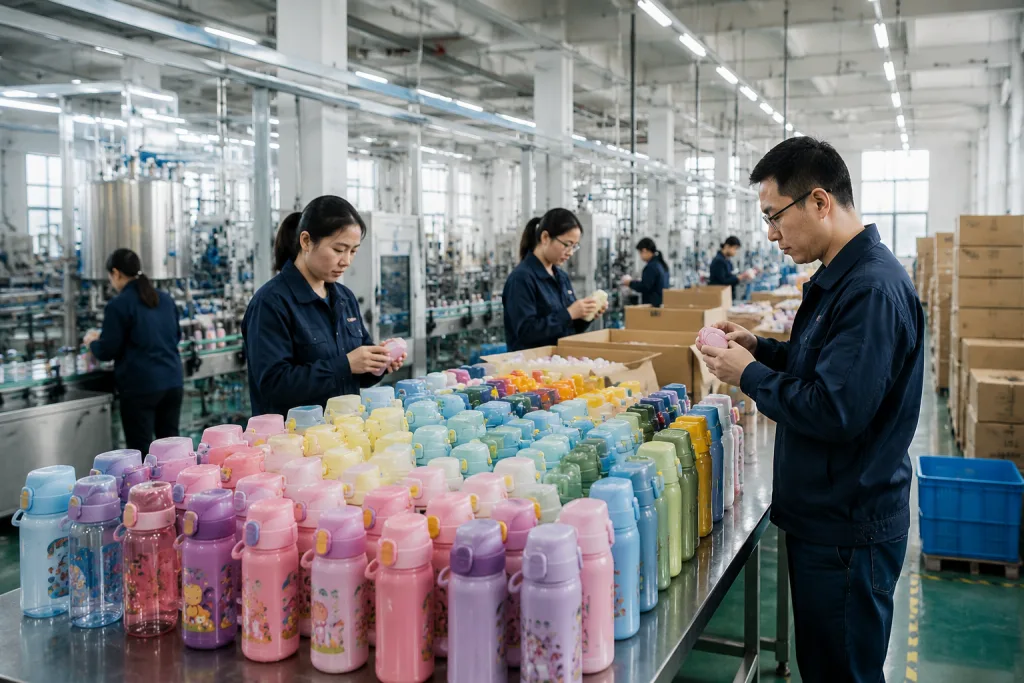
A real kids water bottle supplier for schools and kids brands needs to answer operating questions fast, not just email a catalog and price sheet. For bulk school water bottle programs, the job is repeatability: same color from lot to lot, clean compliance files, and cartons that hold up after pallet drops and district redistribution. School district buyers usually push on spill complaints, how fast the bottle comes apart for washing, and whether the straw bite size fits the target age group. Importers look at landed cost, defect rate, and whether the reorder in 90 days matches the first PO. We see both sides on the line. Last month QC pulled a cap sample because the silicone vent was 0.3 mm off spec, and that small miss becomes a parent complaint fast. A capable children water bottle supplier has to cover both buyer groups without hand-waving.
Ask direct questions early. How many units per month can the factory run on kids SKUs? How many assembly lines are actually running those lids and straws? This is the right question, because a 10,000-unit PTO fundraiser and a 120,000-unit retail program do not load the plant the same way. At BottleForge Industrial in Zhejiang, China, we talk capacity on day one and break it down by molding, coating, and final assembly. A factory producing 300,000 to 500,000 bottles per month across categories usually handles back-to-school spikes better than a small workshop with one assembly line and one ultrasonic welding station. We have seen buyers assume “monthly capacity” means finished packed goods, then find out it only meant raw bottle bodies.
- MOQ: 3,000 units per model is common for a standard bulk kids water bottle order; custom colors, molds, or decorated lids push this higher, and mixed-color packs often trigger buyer pushback on carton counts.
- Sampling: 7-10 days for logo samples, 15-20 days if you need a new mold insert or custom accessory; we usually confirm logo position with a printed mockup after one buyer sent a PO with the mascot name misspelled.
- Mass production: 35-45 days after deposit and sample sign-off is normal in China; if the lid needs a new tool trial, 35 days is not realistic and the math does not work.
- Inspection: Ask whether the supplier works to AQL 2.5/4.0 and can support third-party inspection before shipment; on our side, QC checks thread fit and drop-test samples before cartons are sealed.
Vague answers turn into real trouble later. We have seen this go sideways as mixed components, color drift between lots, or lids from one tool forced onto bodies from another, then the buyer flagged leaks after arrival. That is why you should evaluate a children water bottle factory as a production system, not a product page. If a supplier cannot tell you which tool set runs your lid or how they separate lot numbers at packing, that is a red flag.
Which bottle material should you buy
For a bulk children water bottle program, material choice is usually the first decision that moves the budget, and buyers often look at the bottle body first. We’ve seen this go sideways. Most claims come from the lid set: lid, spout, straw, and silicone seals. On our line, QC usually pressure-checks the assembled lid at 0.03 MPa before packing because that is where leaks start. The right pick depends on the age group, where kids will use it, and your target FOB.
PP plastic
PP is the low-cost workhorse for younger age groups. It is lighter than stainless steel, and simple decorated bottles at volume often land around USD 1.20-2.20 FOB. We ship a lot of these for school promotions and entry-level children water bottle promotional programs, usually with MOQs starting at 3,000 pcs per colorway. The weak point is shelf feel. Buyers like the price, then flag scratch marks on glossy bodies after carton rub tests.
Tritan
Tritan sells well when the bottle has to look clean and clear on shelf. It is common in children water bottle customizable and children water bottle custom projects where color clarity matters, especially for transparent bodies with gradient print. A practical FOB range is often USD 1.80-3.20, depending on lid complexity and decoration. Ask for dishwasher guidance, drop-test feedback, and transit scuff results. Last season, one buyer pushed back after seeing haze on bottles packed without PE bag separation, so this is not a small detail.
18/8 stainless steel
For premium school, outdoor, and insulated ranges, 18/8 stainless is still the safer long-run option. Single-wall kids bottles may start around USD 2.50-4.00 FOB, and double-wall vacuum versions usually move to USD 4.50-7.50 FOB or higher. Ask for body wall thickness, such as 0.4 mm inner and 0.5 mm outer for insulated models. This is the right question to ask. Cheap gauges save a few cents per unit, but the math doesn’t work if denting goes up and vacuum failures show up in incoming inspection.
A low-priced bottle body is not a good buy if the lid leaks after 30 classroom uses.
Whether you need children water bottle customized or a standard children water bottle wholesale item, ask the supplier which component has produced the most claims over the last 12 months. We run that data by SKU. An honest children water bottle manufacturer will usually tell you the same thing: the lid system causes more trouble than the bottle body.
How custom is truly custom
Buyers ask for a custom kids water bottle, but they usually mean 1 of 3 jobs: logo on an existing mold, color changes on stock parts, or a full new design. Those are not the same project. Cost, lead time, and failure risk move fast between them. We have seen POs where “custom bottle” meant only a 1-color logo, while the buyer expected a new cap shape. That is where projects go sideways. If you are talking to a children water bottle vendor or children water bottle distributors, get the definition locked before sampling starts.
For most school programs and importer orders, the workable option is customizing an existing mold. We run body Pantone matching, lid color swaps, silicone part changes, printed logos, laser marking on stainless, and custom hangtags or mailer boxes on the same line. This is the standard route for a custom logo kids bottle or custom school water bottle. You skip mold cost in most cases and stay around a 35-45 day lead time. On one recent order, QC pulled the sample because the lid color was 1 shade off the approved chip under the light box.
Tooling matters once you ask for a new handle, a character cap, different straw geometry, or a bottle diameter that fits a lunch bag pocket at 70 mm instead of 75 mm. New mold work in China can cost roughly USD 3,000-12,000 for simpler plastic components and more for complex multi-part assemblies. Development time is often 25-45 days before production sampling. Buyers sometimes push for new tooling and first shipment in the same month; the math does not work. Even before mass production, we usually need to check fit, drop test points, and leak performance on pilot samples.
- Low-risk customization: silkscreen, heat transfer, powder coat color, pad print, hangtag, barcode sticker. These are normal line changes with low setup risk.
- Medium-risk customization: lid colorway changes, new silicone mouthpiece color, printed measurement marks, retail box redesign. The buyer often flags color migration or carton fit at this stage.
- High-risk customization: new lid tooling, custom character parts, novelty closures, mixed-material assemblies. This is where assembly tolerance, like a 0.3 mm mismatch, starts causing leaks or bad fit.
If you need a custom children water bottle or custom made kids bottle for a licensed or private-label range, ask who owns the mold, whether cavity maintenance is included, and what happens if the first pilot run fails leak testing. This is the right question. Ask for the answer in writing, with the mold number and responsibility list on the quotation or PI. Good children water bottle manufacturers in Zhejiang, China will put that on paper, not bury it in chat messages.
What compliance documents should you request
For kids products, paperwork is not a formality. It is part of the product. A credible children water bottle supplier should spell out which tests cover the bottle body, which cover printing or sleeve decoration, and which cover packaging or age grading. If a supplier only says “food grade” and cannot name LFGB, FDA, or the migration standard on the report, keep pushing. We’ve seen this go sideways when QC pulled the sample and the lid gasket was silicone, but the report only covered the PP cup body.
For Europe, buyers usually ask for REACH-related declarations, LFGB where applicable, and migration testing for food-contact materials. For North America, FDA-contact compliance declarations are standard, and kids programs often add CPSIA review, lead and phthalates checks on accessible parts, and ASTM references based on the product design and age claim. A straw bottle for a 3+ program should also be checked for small parts and mechanical hazards. This is the wrong question to ask if you only ask for “one certificate.” The line may run one model with 4 materials in the drinking path, and each one needs to match the file.
Your checklist should include:
- Material declaration: PP, Tritan, silicone, stainless steel grade such as SUS304 or 18/8, matched to the BOM and the actual lid set on your PO.
- Test reports: migration, heavy metals, BPA statement if requested by your market, with the report tied to the same decoration method and color batch.
- Factory audit: BSCI or equivalent social compliance if required by your brand or retailer; some buyers set MOQ at 3,000 pcs only after this file is cleared.
- Quality system: ISO-based process control is useful, but ask how it changes actual inspections, sample size, and hold points on the line.
- Packaging compliance: barcode accuracy, carton drop resistance, labeling language, warning statements; we ship after checking scan grade and doing a carton drop from 76 cm.
If you buy through children water bottle distributors or a children water bottle distributor, verify whether the reports are model-specific or just generic old reports from another SKU. That mistake is common because the buyer flagged it after production more than once. A proper children water bottle factory should connect the report to the actual model, lid, decoration method, and material batch used for your order. We have even seen a PO typo where the cap code changed from C-218 to C-281, and the test file no longer matched the shipped lid.
How do you control quality in bulk
Most failures in children water bottle bulk orders are not dramatic. We see the same defects repeat on the line: a bottle drips after a 45° tilt, a straw splits after 2,000 cycles, a logo shifts by 2 mm, a hinge pin backs out. On a 50,000-unit shipment, that kind of repeat issue gets expensive fast. This is why the quality plan needs to be fixed before deposit, not argued about after QC pulled the sample.
For a serious bulk kids bottle or bulk children water bottle project, ask the supplier to list the control points in writing on the PI or QC sheet. We usually lock 6 checks: incoming resin and 304 stainless verification, lid fit inspection with a go/no-go gauge, leak test method, vacuum retention test for insulated items, print adhesion test, and final random inspection. AQL 2.5 for major and 4.0 for minor defects is a reasonable baseline for many import buyers. If a factory avoids numbers here, the buyer flagged the right problem.
Critical checks worth naming
- Leak test: inverted and side-placement checks, often 30 minutes to 2 hours depending on model. This needs a written pass standard, not “no leak.”
- Drop test: packed and unpacked, especially for school-use items likely to be dropped from desk height. We usually run 76 cm to 90 cm depending on pack style.
- Straw cycle test: opening and closing repetitions for flip-top lids. 2,000 cycles is a common starting point on kids lids.
- Print adhesion: cross-hatch or tape test for decorated surfaces. QC often uses 3M tape and checks edge lift right after pull.
- Carton check: gross weight, carton dimensions, and pallet stability for warehouse handling. A 1.5 kg carton variance can throw off Amazon booking.
If you are buying from a children water bottle vendor in China, do not accept “100% no leak” without a defined method. This is the wrong question to ask. Ask how many units are tested in line, what is sampled at final inspection, and whether failed lids are reworked or scrapped. For Amazon or e-commerce importers, add carton label verification, FNSKU placement, and suffocation warning review where relevant; we have seen one PO held up over a single SKU typo on the outer carton. Good quality control also means the receiving warehouse can book in the goods without relabeling, recounting, or rework.
What pricing questions actually matter
Buyers ask for the “best price” too early. That is the wrong question to ask. The better question is which mix of material, lid structure, decoration, and packing gives you the lowest complaint-adjusted cost after the goods land. A kids water bottle supplier can cut price fast by dropping steel thickness from 0.5 mm to 0.4 mm, using a simpler silicone seal, reducing print area, or packing in a plain white box. We run those options every week. The real issue is whether the bottle still fits your channel, your return rate, and your shelf standard.
For reference, a simple plastic children water bottle wholesale item with single-color print may land at USD 1.20-2.00 FOB China at higher volume. Tritan bottles with more complex lids may be USD 1.80-3.20. Stainless insulated kids bottles can run from USD 4.50 to over USD 7.50 depending on capacity, coating, and accessories. These are not promises, just practical sourcing ranges. On the line, the same 500 ml bottle can move by USD 0.18-0.35 just from matte spray vs. standard gloss and whether the lid has a one-click button with a lock ring.
Questions worth asking your children water bottle suppliers:
- Is the quoted price based on one logo position or two?
- Does the MOQ apply per color, per model, or per logo artwork?
- Are spare straws or replacement lids included in the cost option?
- Does the carton pack optimize pallet count for EU or North American warehouses?
- Is the quote FOB Ningbo or Shanghai, and what is the CBM per 1,000 units?
This part matters more than buyers expect. Freight and claim rate can erase a USD 0.08-0.15 unit saving fast. We have seen importers in Zhejiang, China choose a bottle that costs USD 0.12 more, then save money overall because the master carton passed a 76 cm drop test and complaint rate came in 2% lower. QC pulled the sample on one order because the PO typo mixed two cap colors into one carton, and that kind of mistake gets expensive on children water bottle customized projects with 6 or 8 SKU variants. The math does not work if the quote looks cheap but the program ships messy.
A short shortlist before you place
Before issuing a purchase order to any children water bottle manufacturer, children water bottle suppliers, or children water bottle vendors, run a tight shortlist. It saves weeks and exposes weak suppliers fast. Most school buyers and importers do not need 20 quotes; 3 is enough if those 3 can answer technical questions without dodging. We’ve seen buyers compare 12 offers and still miss a 0.3 mm wall-thickness gap on the drawing.
- Step 1: Request 2-3 comparable bottle models with capacity, weight, material spec, and packing data. Ask for net weight in grams, carton size, and how many pcs per ctn, or the numbers are useless.
- Step 2: Ask for MOQ, sample lead time, production lead time, and nearest port in China. Put the reply in one table. A clean supplier will answer “MOQ 3,000 pcs, sample 5 days, bulk 25 days, Ningbo” instead of sending a sales brochure.
- Step 3: Review test reports and confirm whether they match your exact model and decoration process. This is where QC pulled the sample on one project and found the report was for plain body only, not the printed lid the buyer flagged.
- Step 4: Approve a pre-production sample showing logo, color, barcode, and packaging details. Check the PMS color, barcode scan, and even PO wording. We had one order where the master carton mark carried the wrong item code by one digit.
- Step 5: Book third-party inspection or define your own acceptance method before balance payment. AQL 2.5 is common, but this is the wrong question to ask if your spec sheet is still loose.
If you are sourcing custom kids bottle, custom kids water bottle, or a children water bottle custom school fundraiser item, add one more check: ask how replacement parts will be handled after delivery. Ask for a number. We usually suggest spare lids, straws, or seals at 1-2% of order quantity, packed by SKU, because mixed spare parts on the line go sideways fast.
The right supplier relationship in China is usually not the one with the lowest first quote. It is the one that gives you predictable reorders, fewer claims, and straight answers when something breaks in transit or a seal fit runs loose after drop test. We ship plenty of repeat school programs, and the math doesn’t work if each reorder starts with the same argument over lead time, spec, and claim handling. That is what separates a usable children water bottle distributor network from a reliable factory-backed sourcing setup.
Get a practical quote from a factory team
Send your target quantity, material preference, logo file, and delivery deadline. We will reply with MOQ, FOB pricing, lead time, and realistic production options.
Frequently asked questions
What MOQ should I expect from a kids water bottle supplier?
For stock molds with simple logo printing, a practical MOQ is usually 3,000 units per model, sometimes 1,000-2,000 units for selected ready items. If you want mixed lid colors, custom packaging, or multiple artwork versions, expect 3,000-5,000 units per variant. New tooling can push the launch quantity above 5,000 units to absorb mold cost. For school district programs, ask whether the MOQ applies per color or total PO. That detail matters. A quote that looks flexible can become expensive if the supplier requires 3,000 units for each colorway. In Zhejiang, China, serious factories will usually give you both the standard MOQ and the trial-order MOQ so you can compare risk.
How long does a custom kids water bottle order usually take?
If you use an existing bottle mold, logo samples usually take 7-10 days. After sample approval and deposit, production is commonly 35-45 days. During peak seasons in China, especially before back-to-school and year-end gift programs, 45-60 days is safer. If you need a new lid or bottle mold, add 25-45 days for tooling and pre-production testing before mass production starts. Freight time is separate. FOB Ningbo or Shanghai is typical for Zhejiang shipments. Build your internal calendar backward from delivery date and leave time for third-party inspection, carton approval, and barcode checks. Buyers get into trouble when they count only factory days and forget approval cycles.
Which tests are most important for children water bottle bulk orders?
Start with food-contact compliance for the target market: REACH or LFGB-related requirements for Europe, and FDA-contact declarations for North America. For children’s items, also review accessible-part safety, heavy metals, phthalates where relevant, and any CPSIA or ASTM-related concerns tied to design and age grading. Beyond lab paperwork, ask for functional tests: leak testing, drop testing, print adhesion, and for insulated bottles, vacuum retention checks. If the bottle uses a straw or flip lid, request cycle testing on the hinge and mouthpiece. A lab report from 18 months ago on another model is not enough. The report should match your exact material set, decoration process, and lid construction.
Should I buy from a children water bottle factory or a trading company?
Either can work, but you should know what you are paying for. A factory usually gives you better control over component specs, production scheduling, and corrective action when defects appear. A trading company can be useful if you need several product categories combined into one shipment or lower communication load. The risk with a non-factory source is slower technical answers and less transparency on who actually builds the product. Ask direct questions: who owns the tooling, who performs in-process QC, and where final assembly happens? If the answer stays vague, that is a warning sign. For repeat custom programs above 10,000 units, factory-backed supply is usually the safer structure.
What should school buyers include in the purchase order for custom school water bottle projects?
Your PO should spell out more than item name and quantity. Include material grade, capacity tolerance, approved color references, logo size and placement, leak-test requirement, packaging style, carton pack, barcode format, and inspection standard such as AQL 2.5/4.0. Add the approved pre-production sample date and state that mass production must follow that sample. If replacement parts matter, note spare lids, straws, or seals as a separate line item, often 1-2% of order quantity. For district programs, also define delivery mark requirements by school or warehouse if needed. A clear PO reduces rework and makes it easier to resolve claims with your children water bottle supplier after arrival.