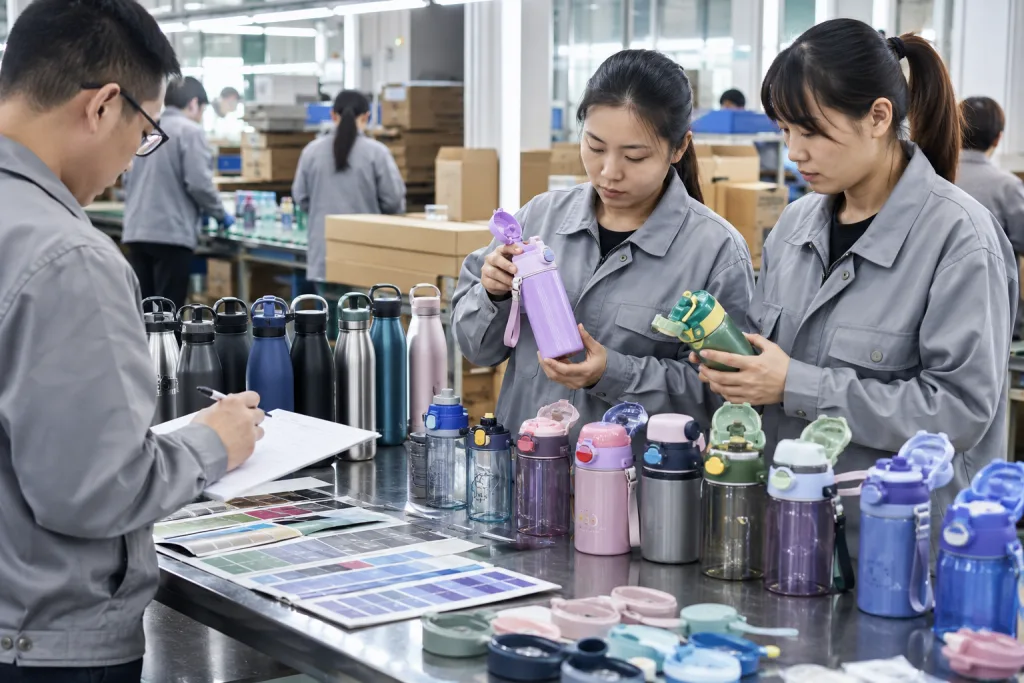
Key Takeaways
- Set leakage standards before mass production: 0 leaks in a 1-hour inverted test from a 200-piece sample is a practical baseline.
- For custom kids water bottle orders, PP lids, food-grade silicone seals, and 18/8 stainless bodies typically add only USD 0.18-0.65 over lower-grade options.
- AQL 2.5/4.0 final inspection on 5,000 units usually catches print, assembly, and carton failures before shipment.
- Plan 35-45 days for mass production after sample approval; typical MOQ is 1,000-3,000 units per color depending on mold and decoration.
You are not buying a generic giveaway when you source a kids water bottle promotional program. You are buying something that gets dropped in classrooms, stuffed into lunch bags, kicked under school bus seats, and sent back by retail if the cap leaks on day 3. The failure points are boring because they repeat: leaking lids, chipped coatings, misprinted logos, odor complaints, and test reports that do not match the actual shipment. We have seen QC pull a sample with a 1.2 mm logo shift and a lid torque out of spec on the same order. If you buy on price alone, the math does not work after arrival, when the line is finished and your easy fixes are gone.
For school district buyers and importers, the job is to write a tighter spec before production starts. This is the right question to ask first, not "what is your lowest price?" A capable children water bottle manufacturer in Zhejiang, China can build a safe, reliable item at the right cost, but only if you lock down material, testing, decoration, packaging, and inspection points early. We run into the same preventable mistakes every season at BottleForge in Zhejiang, China: a PO typo on print color, no drop-test requirement, or carton count changing after sample approval. That is where kids programs go sideways.
Where these orders usually fail
Most problems in kids water bottle promotional orders are not big factory blowups. They start with 4 or 5 small spec gaps. A school buyer wants a fun bottle, an importer pushes FOB down by $0.12, a children water bottle supplier in China quotes in 24 hours, and no one writes the failure points into the PO. We have seen this go sideways over a 0.3 mm straw slit or a cap color note buried in WeChat. Then the shipment lands, QC photos look fine, and the complaints start.
The common pattern looks like this:
- The body material is acceptable, but the straw valve is too soft and deforms after 20 to 30 dishwasher cycles.
- The bottle passes a basic leak check at the children water bottle factory, but starts dripping after inland trucking because lid torque on the line was running at 0.8 N·m on one shift and 1.2 N·m on the next.
- The logo looks good on the pre-production sample, then rubs off on 8% of mass production because print adhesion testing with 3M tape was skipped.
- The test report covers raw material, not the finished assembled item shipped under your PO; we have even seen a PO typo pull the wrong lid code into the file set.
- The unit pack looks retail-ready, but the master carton crush strength is too low for export stacking, and QC pulled the sample after a carton corner collapsed under a 22 kg top-load check.
If you are buying bulk children water bottle, bulk school water bottle, or children water bottle promotional assortments, "Which style is cheapest?" is the wrong question to ask. Ask which failure costs more after delivery. For school distribution, leaks and broken spouts are usually the first complaint; one buyer flagged 63 leaking pieces out of 2,400 before campus handout. For importers and children water bottle distributors, compliance paperwork mismatch and decoration defects usually hurt more because they stop warehouse intake and turn into customer claims.
In Zhejiang, China, many factories can produce 300,000 to 500,000 units per month across sports and kids lines. Capacity is not the hard part. The hard part is locking one children water bottle customized program to your exact standard, from approved sample to final shipment, with no gray area on seal ring hardness, print position tolerance, or carton spec. We run into this on the floor all the time: the sample is signed, but the AQL sheet never states whether a 1.5 mm logo shift is pass or fail.
The material spec is often too loose
Buyers often ask for a custom children water bottle that is safe, durable, and affordable. Fair ask. It is still not a production spec. On the line, “safe material” leaves too much room, and two bottles can look the same at first inspection while using different resin grades or a thinner 0.2 mm straw wall.
For a practical kids bottle build, define each component separately:
- Body: Tritan, single-wall 18/8 stainless steel, or food-contact PP depending on budget, target age, and drop-test expectation.
- Lid: food-grade PP is the common school-use choice; we’ve seen buyers flag ABS lids after odor complaints in summer cartons.
- Seal: LFGB or FDA-grade silicone, with hardness called out if valve performance matters; 50-60 Shore A is a normal range to lock down.
- Straw: silicone or PE, with wall thickness specified when bite resistance matters; if you skip this, QC pulled the sample and found kids can collapse it too easily.
If you need a low-cost bulk kids bottle for events, a 450-500 ml PP bottle can work. If you need better odor resistance and a bottle that still looks good after 12 months of school use, Tritan is usually the better pick. For premium custom school water bottle merchandise, single-wall stainless takes drops better and hides wear better, but the added weight is real; we’ve seen a 280 g bottle lose out to a 190 g option after the buyer compared schoolbag load.
Typical FOB China pricing can vary like this at 3,000 units: PP kids bottle around USD 1.10-1.60, Tritan around USD 1.75-2.60, and single-wall stainless around USD 2.20-3.40 depending on lid complexity and print. That is the normal spread we quote. The wrong question is “which one is cheapest?” The better question is what return rate your program can absorb, because one cracked lid or odor complaint at retail wipes out the savings fast.
Ask your children water bottle manufacturer or children water bottle vendors to list resin grade, stainless grade, seal material, and color masterbatch on the quotation or specification sheet. We also push buyers to put the approved BOM code on the PO; once we caught a PO typo that swapped a lid color suffix and almost sent the line to the wrong masterbatch. That matters when you are sourcing children water bottle wholesale programs from China through a trading company, a direct children water bottle factory, or multiple children water bottle suppliers.
You do not need the most expensive material. You need the exact material defined well enough that it cannot drift during production.
Leakage starts at the lid assembly
When buyers complain about a bulk kids water bottle order, leakage is usually the first claim we see. The body almost never causes it. The lid stack-up does. A flip-top lid can look solid on the screen and still fail on the line because the seal groove is off by 0.2 mm, the hinge pin sits slightly skewed, or the closing force is too light. We’ve seen this go sideways fast.
For school use, ask how the lid is assembled and tested. This is the right question. Some children water bottle manufacturers in China do one quick air-pressure check on the first 20 units and move on. That does not protect a shipment going to students. QC pulled the sample, it passed, and carton No. 188 still leaked later because the line never locked a finished-goods standard into the PO. Put the test method in writing.
Useful leakage checkpoints
- 100% on-line water fill or vacuum leak check for assembled lids if the design is straw-based or push-button.
- Inverted test for 60 minutes with no visible leakage.
- Drop test from 80-100 cm, then repeat leak test.
- Torque or closure-force standard recorded at line start and every 2 hours.
For a custom kids bottle or custom made kids bottle with a carrying handle, also check whether the handle load pulls the lid body out of round. We have seen this on lower-cost designs where the handle pins sit too close to the sealing area—sometimes less than 3 mm from the gasket seat. The bottle passes static inspection, then leaks after 200 to 300 carry cycles. A buyer flagged this once after playground use, not at incoming inspection.
If your volume is 5,000 units or more, ask for a pre-production assembly review and a golden sample signed before mass production. Any decent factory in Zhejiang should be comfortable with that. We run this review at line start with the assembly fixture, torque gauge, and approved sample on the table. At our level, typical MOQ for a standard kids line is 1,000 units per color for existing molds, and lead time is usually 35-45 days after deposit and artwork approval.
For children water bottle custom projects using a new mold, do not approve tooling based only on 3D rendering. Get an actual T1 sample. Then test it the way a child uses it: open it 500 times, drop it from desk height, bite the spout, squeeze the body, and carry it by the lid. We ship fewer claims when buyers do this early, and the math doesn’t work if you skip it and find the leak after mass production.
Print and coating problems show up late
A logo problem on a kids bottle almost never shows up at quote stage. We usually see it after 2 weeks of handling, after 1 dishwasher cycle, or when cartons rub during transit and the base ring scuffs the next bottle. This is where children water bottle customizable programs break down. Buyers often pick decoration from a rendering, then the line tells a different story.
For custom logo kids bottle orders, match the print method to the surface and the abuse level:
- Silkscreen: low cost and fine for 1-2 color art, but we run cross-hatch adhesion checks on curved PP and coated metal because a 0.5 mm registration drift or weak ink bite will show fast.
- Heat transfer: better for multicolor graphics, but edge lift shows up if surface energy is low or curing time is short; QC pulled samples last month with corners lifting after carton compression.
- Laser engraving: durable on stainless, especially 304 stainless, but it will not give the bright child-facing graphics most school promo buyers want.
- Digital print or UV print: strong shelf look, but scratch resistance depends on the coating stack, and this is the wrong place to save money if bottles will ride loose in backpacks.
The safer move is to lock a decoration test panel before mass production. Ask your children water bottle vendor for adhesion and abrasion standards, not only an artwork mockup. We usually set 3M tape test, 50 dry rubs, 20 wet rubs, and dishwasher-cycle confirmation if the PO says dishwasher safe. If that line is missing from the PO, we've seen this go sideways.
Color consistency causes its own trouble. On school orders, a district may ask for one Pantone blue across 10,000 pieces, and the buyer flagged a shift once because two lots were off by eye under store lighting. On lower-end PP or Tritan items, molded body color can move slightly from lot to lot, so sign off a physical sample and a tolerance target before the first 500-piece pilot. That matters even more if you buy through multiple children water bottle distributors or split sourcing between two children water bottle vendors in China.
Do not ignore coating thickness on stainless bodies. A paint layer that is too thin might save $0.03 per piece, but chips show up faster at the bottle base and shoulder, and our thickness gauge usually catches the weak spot there first. For repeated student use, the math doesn't work on cheap paint. Better coating control beats one extra accessory every time.
Compliance paperwork can be misleading
This is where importers get burned late. The bottle looks saleable on the table, but the paperwork behind the shipment does not match what is in the cartons. Buyers ask a children water bottle supplier for “test reports,” get one PDF back, and sign off too fast. We have seen reports tied to last year’s PP lid, while the current PO used a new straw vendor and a 0.4 mm printed film wrap.
For Europe and North America, the test scope has to match the material set, the age grade, and where you sell it. Start with this list, then check the actual BOM with the factory or children water bottle distributors before production closes:
- Food-contact compliance relevant to the market, such as REACH-related declarations for EU chemical management where applicable.
- Finished-product migration or material safety testing from a recognized lab when needed.
- CPSIA-related checks for the US if the product is sold as a children's item in the relevant category.
- ASTM or other mechanical safety review if there are biteable, detachable, or impact-sensitive components.
- Factory audit status such as BSCI or ISO 9001 if your sourcing policy requires it.
Traceability is the part that matters. QC pulled the sample, and the report needs to tie back to the same body resin, the same lid material, the same print, and the same outside parts source. If the straw comes from a different sub-supplier, compliance continuity is broken. We have seen this go sideways over one silicone seal that measured 2 mm thicker than the approved sample.
For importers buying children water bottle bulk from China, ask for a document pack tied to the PO number and revision level. We run this by PO and artwork version on the line because small changes matter. If artwork changes from unprinted to printed, update the pack. If the seal material changes, update the pack. The wrong question is “Do you have a report?” The right question is “Does this report match this shipment?” That is what keeps your own QA team or a retailer compliance desk from stopping goods after booking.
Carton quality is an expensive blind spot
Buyers often spend 3 days arguing over bottle body cost and 20 minutes on cartons. That is the wrong question to ask on export orders. We have seen clean custom kids water bottle production turn into a claim file because the outer carton softened after one wet pallet corner. Dents, logo scuffs, cracked lids, and mixed carton sizes usually start at packing, not on the bottle line.
For a bulk school water bottle program, split the spec into unit pack and master carton. Do not lump them together. If the bottles go straight to schools, a polybag plus cardboard divider is often enough, and we run this setup on 500 pcs lots without trouble. If the goods go to an importer warehouse and then parcel outbound, ask for an individual box with corner protection, barcode position, and a real drop requirement. Last month a buyer flagged crushed spouts because the inner box had only 8 mm top clearance.
Write these details into your packaging spec:
- Master carton size and maximum gross weight, ideally under 15 kg for easier handling.
- Carton board grade and burst or edge crush standard.
- Inner partition requirement for painted or printed bottles.
- Drop test standard for the unit box if sold retail.
- Shipping marks, FNSKU or outer carton labels, and scan position.
For Amazon or 3PL programs, carton consistency is where orders go sideways. The bottle can pass inspection and still get hit with receiving penalties if the label is off by 15 mm or the carton size drifts from the booking data. We ship mixed-color children water bottle customized orders every season, and this gets messy fast when 4 school names share one container. QC pulled the sample on one run because the PO said "Naby Blue" instead of "Navy Blue," and that typo would have split the assortments at receiving.
A practical final inspection in China should cover carton drop checks, count verification, barcode scan tests, and assortment accuracy. We usually start with AQL 2.5 for major defects and 4.0 for minor defects, then tighten if the program is retail or Amazon. On the floor, the inspector should use a handheld scanner and re-weigh at least 1 sealed carton per SKU to catch pack-out drift. If a supplier says "the product is fine" and pushes back on carton checks, we have seen that end badly.
How to spec the order before deposit
The cleanest way to prevent production trouble is to issue a tight purchase spec before deposit. We have seen orders stall over a 2 mm handle gap, a wrong Pantone callout, or a PO typo on carton marks. If you are buying from a children water bottle manufacturer, a children water bottle supplier, or a trading company in Zhejiang, the document needs to remove guesswork from the line.
Your control sheet for a children water bottle promotional project should include:
- Capacity, dimensions, and weight tolerance, such as 450 ml, 185 mm bottle height, and ±5 g unit weight.
- Exact body, lid, straw, and seal materials, for example 304 stainless body, PP lid, silicone seal, and PE straw.
- Approved color references and decoration method, with Pantone codes, logo size in mm, and whether you run silk print, heat transfer, or spray finish.
- Leak test standard, drop test standard, and odor standard. This is where QC pulled the sample most often on new kids lids.
- Packaging layout, carton spec, and shipping mark file, including carton size, gross weight in kg, and barcode position.
- Required documents: test reports, declaration files, inspection report, and production photos if needed.
- Inspection stage: pre-production sample, in-line check, and pre-shipment final inspection.
If you are new to a children water bottle manufacturer in China, ask for 1 approved pre-production sample, 1 sealed golden sample, and 1 retained production sample from mass goods. Basic, but it works. We usually label the retained sample by PO number and date because six weeks later the buyer flagged a shade difference, and that sealed sample settled it fast.
For buyers focused on commercial practicality, yes, pricing can still stay competitive. A standard custom school water bottle or custom children water bottle program from Zhejiang stays cost-effective if you use existing molds, keep the logo in one position, and skip fancy lid structures with 5 small parts. This is the wrong question to ask if the idea is cutting QC to save a few cents. The math doesn't work. The big savings come from a proven design the factory already runs and a precise spec the line can execute without stopping to confirm details.
That is usually the difference between a reorderable program and a one-time shipment that takes 60 days to clean up after delivery.
Send your kids bottle spec for review
We will check your design, material stack, MOQ, and QC risk points, then propose a practical China production plan within 2 working days.
Frequently asked questions
What is a realistic MOQ for kids water bottle promotional orders?
For existing molds, a realistic MOQ is usually 1,000 to 3,000 units per style or color, depending on material and decoration. A simple PP or Tritan bottle with one-color silkscreen may start near 1,000 units. A stainless custom kids water water bottle with multiple logo positions, special color matching, or retail packaging may need 2,000 to 3,000 units. If you need a new mold for a children water bottle custom program, tooling cost can run from about USD 3,000 to USD 12,000 and the MOQ often increases. In Zhejiang, China, many factories will quote lower MOQs to win the order, but you should confirm whether that price includes normal scrap allowance, packaging setup, and decoration line efficiency.
Which material is best for bulk school water bottle programs?
It depends on budget and use case. For low-cost school events, PP is often the most economical at roughly USD 1.10 to 1.60 FOB China for 3,000 units. For daily student use, Tritan is a better middle ground because it has better clarity, odor resistance, and impact performance, often around USD 1.75 to 2.60. For premium programs, single-wall 18/8 stainless is tougher and more upscale, usually around USD 2.20 to 3.40. If you are buying children water bottle bulk for younger users, focus on lid safety, straw design, and sealing quality more than body material alone. A strong body with a weak spout still creates returns.
How do I check whether a children water bottle supplier is controlling quality properly?
Ask for the control points, not just a promise. A reliable children water bottle supplier should show incoming material checks, in-line assembly checks, leak testing records, and a final inspection standard such as AQL 2.5/4.0. For a 5,000-piece order, you should expect sample-based final inspection plus functional checks like inverted leak testing, drop testing, and barcode verification if needed. Also ask for photos or video of the production line and the approved golden sample. If the supplier in China cannot explain seal material, closure method, or how often they test during the shift, they are likely depending too much on end-of-line sorting instead of process control.
Can I order children water bottle customized with my logo and school colors without long lead times?
Yes, if you use an existing mold and keep the specification practical. Most standard custom logo kids bottle orders can move in about 35 to 45 days after sample approval and deposit. A pre-production sample usually takes 5 to 10 days, depending on print method and color matching. If you require exact Pantone matching, custom packaging, and multiple assortments for different schools, add another 5 to 7 days for approval and packing setup. New mold development is slower and commonly takes 25 to 45 days before mass production even starts. The fastest route in China is almost always an existing bottle platform with controlled decoration and clear QC checkpoints.
What documents should I ask for before shipping a children water bottle wholesale order?
At minimum, ask for the commercial invoice, packing list, final inspection report, and product-specific compliance file tied to the actual order. For children water bottle wholesale into Europe or North America, that usually means material declarations, relevant lab reports for food-contact or children’s product requirements, and any retailer-requested forms. If your program uses printed decoration, make sure the report scope covers the decorated finished item, not only raw plastic pellets or steel sheet. It is also smart to request a BOM-linked specification sheet and carton mark approval. For large importers, I recommend putting the PO number and revision on the compliance pack so your warehouse and QA teams can match documents to the exact shipment.