Key Takeaways
- A usable RFQ for a kids bottle should define capacity, material, straw type, testing standard, packaging, and target price within 24 hours of first contact
- Typical MOQ for a custom kids water bottle is 3,000 to 5,000 units per color, with sample lead time of 7 to 12 days and bulk lead time of 25 to 40 days
- For school and North America programs, ask for CPSIA-related testing, ASTM drop checks, REACH screening, and AQL 2.5 final inspection before shipment
- A missing PO detail such as FNSKU labeling, spare straw quantity, or carton drop standard can add USD 0.08 to 0.35 per unit later
You are not buying a generic bottle. You are buying a product for children, and that changes the sourcing process fast. School admins check it, parents read the label, and customs may pull cartons for document review. A reliable kids water bottle manufacturer should start with lid bite resistance, leak rate limits, migration testing, drop tests from 1.2 m, and labeling layout before anyone talks about Pantone colors. If a factory opens with color charts and skips compliance, this is the wrong supplier. We have seen QC pull a first sample with a straw valve that failed after 300 bite cycles, and the buyer had already signed off the logo position.
At BottleForge Industrial in Hangzhou, Zhejiang, China, we see the same pattern every season: buyers lose 3 to 5 weeks because the RFQ is vague, samples get approved without a test plan, or the PO misses key line items. Last month one PO even listed “304 straw” but not the silicone spout grade, and the line had to stop for clarification. Whether you buy bulk school water bottle programs for a district or need children water bottle custom projects for retail, the process needs discipline from day one. We run into the same buyer pushback every year—“Can’t we confirm testing after artwork?” No. That is where projects slip from 12 days to 18 days, and the math doesn’t work.
Start with a usable RFQ
Most delays start before sampling starts. We get a one-line inquiry for a custom kids bottle, send 10 quotations, and then the buyer sees they are not lined up: one is Tritan, one is 18/8 stainless, one is single wall, one is vacuum, and the leak test standard is different on half of them. Then 3 to 5 days are gone. If you want pricing you can compare from a children water bottle factory in Zhejiang or anywhere else in China, the RFQ needs to lock the basics first. This is the right question to ask.
For a school-age bottle, specify at least these points:
- Capacity: 350 ml, 450 ml, 500 ml, or 600 ml
- Body material: 18/8 stainless steel, Tritan, PP, or recycled material if required
- Wall structure: single wall or double wall vacuum
- Lid system: flip straw, screw cap, spout, carry loop
- Age target: 3+, 6+, or 8+
- Compliance: CPSIA, REACH, LFGB, CA Prop 65 if relevant
- Decoration: silkscreen, heat transfer, powder coat, laser, wrap print
- Packaging: color box, white box, PDQ, polybag, barcode label
- Trade term: FOB Ningbo, FOB Shanghai, or DDP if requested
Your target quantity also needs to be on page 1. A bulk children water bottle quote at 1,000 units is a different job from children water bottle wholesale at 20,000 units; the mold amortization, print setup, and carton math change fast. On our line, QC pulled a 500 ml single-wall Tritan kids bottle with flip straw and one-color print that quoted at USD 1.55 to 1.95 FOB China at 5,000 units, while a 350 ml insulated stainless version landed around USD 3.10 to 4.60 FOB at the same quantity, depending on lid tooling and finish. Buyers push back on that gap all the time, but the math doesn't work if the lid has a new straw cap mold.
Add PO line items early, even before the formal PO exists. Tell the supplier your expected carton count tolerance, barcode format, sample approval method, and whether spare parts are needed. We have seen a PO typo turn 24 pcs/ctn into 12 pcs/ctn, and that kind of mistake shows up only after the shipping mark is printed. For school programs, I suggest adding 1% extra straws and 0.5% extra lids into the quote request. Small cost. Fewer claims later.
Screen the factory, not just the bottle
A clean sample from the wrong plant is still the wrong call. School district buyers and kids-product importers should vet the manufacturer before paying for tooling or pre-production samples. Ask straight questions. We hear buyers worry about sounding tough; that is the wrong question to ask. You are trying to avoid a six-figure claim, a missed ship window, or 1 lid leak in every 40 cartons.
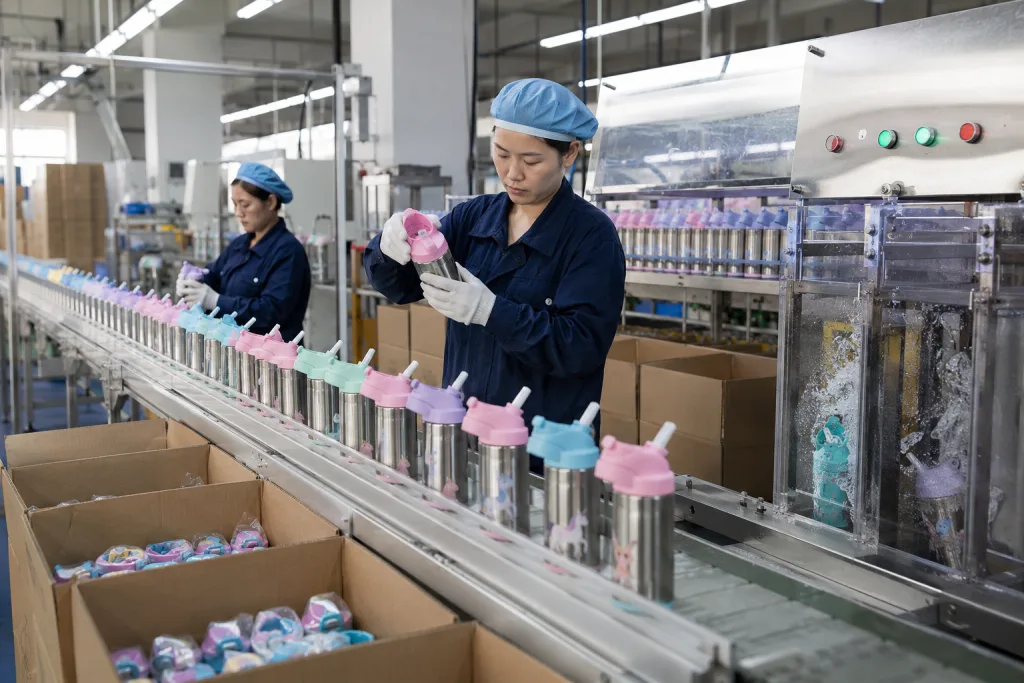
Start with hard factory data. A children water bottle manufacturer producing 600,000 to 1,000,000 units per month, running in-house leak testing, and quoting a standard MOQ of 3,000 units per SKU usually has process discipline on the line. On our side in Zhejiang, we run vacuum leak testers and torque checks on cap fit, and common lead times are 7 to 12 days for logo samples and 30 to 35 days for bulk after deposit and artwork approval. If a supplier promises 12-day mass production in peak season and cannot show capacity by line or mold count, we have seen this go sideways.
What to ask during qualification
- Audit status: BSCI, Sedex, ISO 9001, or customer audit history
- Testing workflow: migration, odor, dishwasher, drop, and leak protocols
- AQL plan: typically AQL 2.5 major / 4.0 minor for final random inspection
- Traceability: date code, cavity code, lot marking, carton labeling
- Tool ownership: who owns molds for custom lid or handle parts
- Sub-suppliers: source of straw silicone, paint, and Tritan resin
For children water bottle suppliers, the real test is not logo printing. It is whether they can hold the same seal, color, and fit across 10,000 units after you signed off the sample and QC pulled the sample again from final packing.
If you need children water bottle customized programs for retail chains, ask whether the factory can read retailer manuals and execute FNSKU labeling, carton mark rules, and pallet limits down to the mm. We have had buyers flag overhang on a 1200 x 1000 mm pallet after the PO already carried a carton count typo. If you are a children water bottle distributor or one of several children water bottle distributors supplying schools, ask if the supplier supports mixed-SKU container loading and keeps spare lids, straws, and handles in reserve for 12 months. If they only say yes and show no stock plan, the math does not work.
Build the sample plan properly
Sampling is where buyers approve trouble without meaning to. We see it often: the buyer asks for a logo sample, QC pulls the sample, the print looks clean, and bulk starts before anyone checks leak performance or hinge life. For a custom made kids bottle, looks are only one checkpoint. You need a sample plan tied to approval points, test standards, and PO line items. If that sounds picky, good. We’ve seen this go sideways.
Use these sample stages when possible:
- Reference sample: an existing mold with a similar body and lid, 2 to 3 days, mainly to confirm size, grip, and lid direction before you spend time on artwork details
- Pre-production sample: actual color, logo, packaging, 7 to 12 days, with the real print method, barcode placement, and fit check on the line
- Golden sample: approved final standard kept by both buyer and factory, sealed and dated so later bulk claims do not turn into memory contests
Your sample PO should list more than SKU and price. On our side, the buyer flagged a PO once that said “light bule lid,” and that typo became a 2,000-piece argument. Put these line items in writing:
- Body color by Pantone code
- Lid color and straw color
- Print method and logo size in mm
- Leak test standard, for example 30 minutes inverted, no visible leakage
- Drop test, for example 1.0 m packed and 1.2 m unpacked
- Odor standard after 24-hour sealed storage
- Dishwasher requirement if claimed
- Packaging mockup and barcode position
For children water bottle promotional orders, buyers often under-spec the packaging because the unit price is low. This is the wrong question to ask. Promo orders get rough handling, and we ship them on tighter schedules, sometimes 12 days vs 18 days for a regular retail run. If you need a bulk kids water bottle program for giveaways, specify carton burst strength, master carton dimensions, and inner pack quantity. We run carton drop checks with a taped master carton on the floor because weak outer boxes crush fast in transit. A weak carton can turn a USD 1.80 bottle into a claims problem.
Ask for a sample test report plan at the start. A children water bottle supplier should be ready to send samples to SGS, TUV, or Intertek in China before bulk production. If the bottle is intended for younger users, confirm small-part risk around mouthpiece caps, carry loops, and removable bumpers. Our hinge-cycle jig has caught lids failing before 200 cycles, even when the first sample looked perfect. A nice-looking custom children water bottle is not enough if the lid hinge fails after 200 cycles.
Write the PO like a specification
Once you move to mass production, the PO needs to read like an engineering sheet, not a sales email. We see this go sideways all the time: the buyer flagged a lid vent change from an old email, but the signed PO and annex never showed it. On the line, our supervisor works from the approved document set, not a mailbox. Put every key detail into the order itself or the stamped annex.
A strong bulk kids bottle PO should list the commercial and technical points below. This is not busywork. QC pulled a sample once because the PO said “assorted colors” with no split, and the packing team had no basis to run 4,000/3,000/3,000.
- SKU code and description: for example 450 ml Tritan custom school water bottle with flip straw, plus lid type or straw version if you have more than 1 option
- Quantity by color: blue 4,000, green 3,000, pink 3,000
- Unit price: USD FOB Ningbo or Shanghai, with the Incoterm written on the PO instead of buried in chat
- MOQ rule: 3,000 per color or 5,000 mixed if agreed
- Over/under shipment tolerance: usually plus/minus 3%
- Production lead time: 30 days after deposit and artwork signoff; if cap and bottle print approvals are separate, state both dates
- Payment term: 30% deposit, 70% against inspection or copy B/L
- Compliance documents: REACH, LFGB, CPSIA-related report set as applicable
- Inspection standard: AQL 2.5/4.0 with buyer or third-party inspection
- Packaging: insert, user warning, color box, carton marks, pallet spec, and carton size if your warehouse charges by cubic meter
If you sell to e-commerce or distribute through a children water bottle vendor network, add FNSKU, suffocation warning, country of origin mark, and carton label format. We have had buyers send the FNSKU in the wrong size—50 mm x 30 mm on the PO fixed that. If you are a children water bottle distributor serving school systems, include replacement parts availability. A practical term is 12 months of lid and straw support at fixed spare pricing.
For children water bottle custom orders with new mold work, split tooling from product pricing. State mold fee, cavity count, ownership, maintenance responsibility, and the exact trigger for mold release. In China, this matters. This is the wrong question to ask: “If I pay something, do I own the mold?” The better question is what the signed document says about a 2-cavity tool, repair cost, and release after final payment.
Control bulk production and inspections
After deposit, the real control work starts. This is where the factory earns its keep. For kids products, we run a 3-point control plan: pre-production review, inline checks on the line, and final random inspection. If the order is above 20,000 units or uses multiple colors and inserts, add a pre-shipment packaging audit. We have seen this go sideways when a gift box insert was 2 mm short and nobody caught it until packing.
A decent children water bottle manufacturer checks incoming material, runs print adhesion tests, and tests assembled lids by lot. QC pulled the sample, not just once at the end. Typical inline checks include:
- Vacuum retention for insulated bottles
- Thread engagement and torque range
- Leak test by inversion and shake
- Print position tolerance, often within plus/minus 1.5 mm
- Color variance against approved Pantone
- Straw cut length and fit
For a bulk school water bottle project, ask for production photos and a short QC report before 30% of the order is completed. Ask early. A print issue fixed on day 5 is manageable; the same issue found after 10,000 units are packed burns cash fast. We usually send photos from the silk screen station, lid assembly, and packed master cartons, and the buyer flagged one job last year because the logo sat 1.8 mm high against the approved sample.
Use AQL with purpose, not as a buzzword. For children water bottle wholesale orders, AQL 2.5 major and 4.0 minor is common, but you need to define major in writing on the PO. This is the wrong question to ask: “Do you follow AQL?” Better question: “What fails as major?” Leakage, sharp edges, failed odor, detached decoration, or wrong warning label should be major defects. Slight carton scuffing is usually minor. If the project is sensitive, some buyers tighten to AQL 1.5 major, and we have also seen a PO typo where “odor test” was missing from the final inspection list.
Do not ignore packaging tests. Cartons should pass drop and compression expectations for your route. Shipments from Zhejiang, China to North America can sit through long drayage, 3 warehouse moves, and hard stacking, so carton math matters. If your master carton is oversized to save packing labor, the math does not work. We ship enough of these to know that a weak carton edge crush result at 8 kg load turns into damage claims fast.
Plan logistics, claims, and reorders
The last stage is not freight booking alone. It is making sure the order lands cleanly, clears without document drama, and runs again without resetting the whole project. This is where an experienced children water bottle vendor pulls ahead of a trading desk that just passes emails.
Before shipment, lock the document pack: commercial invoice, packing list, test reports, origin statement if needed, inspection report, and carton barcode file. For North America retail and marketplace shipments, check FNSKU or retailer labels on both unit packs and cartons; we have seen one PO held because the outer carton print showed the right code, but the unit sticker missed one digit. If pallets are required, state pallet size, wrap method, and maximum height in mm, not "standard pallet." For a typical 40HQ load, product density can swing fast by bottle structure, especially with wide PP straw lids, so ask for an estimated load plan before production ends. QC usually pulls this from the carton spec and CBM sheet on the line.
Claims policy needs to be written down. No shortcuts. A workable setup looks like visible defect claims within 30 days of receipt, concealed shortage within 15 days, and spare-part support at agreed rates. For children water bottle customized programs, keep a retained sample and one export carton from each PO. We mark the carton with the PO number and sealing date in black ink after final AQL 2.5 inspection. This is the wrong place to stay vague; vague claims language turns a small cap leak into a 3-week argument.
Reorder planning is where the math starts to improve. Once artwork, carton layout, and test reports are stable, a repeat bulk kids water bottle order can often cut 5 to 10 days from approval time and reduce unit cost by USD 0.03 to 0.12 depending on decoration and packaging complexity. If you are building a school range, standardize lid platforms across 2 or 3 body sizes. Shared components lower MOQ pressure and make replacement parts easier. We run this setup often, and the buyer usually feels it on the second PO when one lid mold supports 2 SKUs instead of 4.
If you work with a children water bottle manufacturer in Zhejiang, China for a long-term program, ask them to maintain a BOM archive, approved Pantone chips, and golden samples by PO number. Add one more control: record the silicone seal hardness and lid torque range on the sample card, such as 50 Shore A and 0.8-1.0 N·m. That sounds basic, but it is how you avoid color drift and lid mismatch six months later. We have seen this go sideways after a reorder where the PO had a one-letter color typo and nobody checked the stored chip.
Send your kids bottle RFQ with specs first
Share target quantity, bottle type, compliance market, artwork, and packaging. We will review feasibility, MOQ, sample timing, and FOB pricing from Zhejiang, China.
Frequently asked questions
What MOQ should I expect from a kids water bottle manufacturer?
For stock molds, a realistic MOQ is 3,000 to 5,000 units per SKU, often split by 1 to 3 colors. Some factories in China will offer 1,000-unit trial orders, but the unit cost usually rises by 12% to 25% and decoration options narrow. If you need a custom lid or new handle mold, practical MOQ can move to 5,000 to 10,000 units because the supplier needs to absorb setup and material risk. For school district projects, ask whether mixed-color packing is allowed within one PO. That can help you reach MOQ without overbuying one color.
Which tests matter most for children water bottles sold in Europe or North America?
Start with material compliance and then move to performance. For Europe, REACH screening is common, and LFGB may apply depending on your market. For North America, ask for CPSIA-related substance checks where relevant, plus CA Prop 65 screening if your channel requires it. Beyond chemical reports, insist on leak testing, drop testing, odor evaluation, coating adhesion, and dishwasher checks if that claim appears on packaging. For school use, I would define a leak standard of 30 minutes inverted with no visible leakage and a packed drop test of 1.0 meter. Testing in China before mass production usually costs far less than handling claims after import.
How long does sampling and bulk production usually take?
If you are using an existing mold, reference samples can be ready in 2 to 5 days. A proper pre-production sample with exact color, logo, and packaging usually takes 7 to 12 days. Bulk production for a standard order of 5,000 to 20,000 units is commonly 25 to 40 days after deposit and sample approval, depending on season and decoration method. Stainless insulated models with multiple paint steps usually sit at the longer end. If your PO includes custom packaging, barcode labels, and third-party testing, add another 5 to 7 days for coordination. Buyers who approve artwork late are usually the real reason schedules slip.
What details should be on my PO to avoid disputes?
Treat the PO as a technical document. Include capacity, material, color by Pantone, lid style, straw material, logo size and position, packaging spec, carton marks, barcode type, unit price, MOQ, lead time, inspection standard, and compliance documents required. Also add shipment tolerance, spare-part quantities, and replacement policy. For e-commerce or retail, include FNSKU placement and carton dimension limits. If you are ordering a custom kids water bottle with tooling, separate mold fees from product cost and state tool ownership clearly. Many disputes happen because buyers rely on chat screenshots instead of a signed specification sheet attached to the PO.
How do I compare children water bottle suppliers beyond price?
Ask each supplier for the same RFQ, then compare five things: sample quality, response accuracy, compliance readiness, production capacity, and defect control. A quote that is USD 0.12 cheaper can become expensive if the factory cannot pass inspection or misses labeling rules. Look for clear answers on AQL, audit status, test history, lead time, and spare parts. Ask for photos of leak testing, assembly lines, and packaging stations. A reliable children water bottle supplier in Zhejiang or elsewhere in China should be able to explain why a lid design is safe for kids and where failures usually happen. Technical honesty is worth more than aggressive pricing.