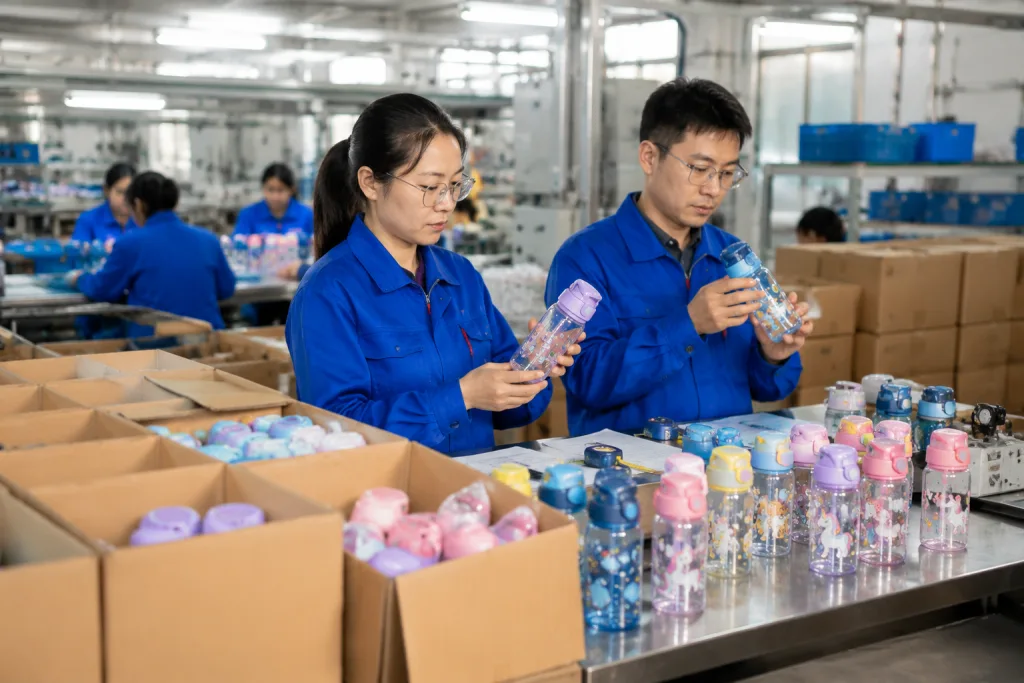
Key Takeaways
- Set measurable specs early: 304 stainless inner wall 0.4 mm, leak test at 0.03 MPa, and 1.2 m drop test on 6 faces reduces avoidable claims.
- Typical MOQ for custom kids water bottle programs is 3,000-5,000 pcs per color, with sampling in 7-12 days and mass production in 30-45 days from art approval.
- For school and retail orders, confirm REACH, LFGB or FDA food-contact scope, CPSIA/ASTM requirements where applicable, plus AQL 2.5/4.0 before deposit.
- A children water bottle customized for kids should prioritize lid durability and cleanability over complex features; 20-30% of field complaints come from caps, straws, and seals.
If you buy for a school district or import kids drinkware at scale, the worst mistakes do not show up on the quote sheet. A bottle can look fine in a PDF and still fail in use: odor complaints after the first wash, lids leaking in backpacks after a 1.2 m drop test, paint scratching by day three, or one loose straw valve that turns a routine shipment into a compliance hold. We have seen QC pull a sample from the line, squeeze the spout, and find a part fit issue in under 30 seconds. That is where kids water bottle distributors lose margin fast.
You do not need a prettier catalog. You need a tighter spec. From Zhejiang, China, we run into the same issue every season: a buyer asks for a bulk children water bottle, approves artwork, then finds out too late that cap torque, gasket material, drop test standard, or migration requirement was never locked on the PO. Last year one PO even had the lid color code typed wrong by one digit, and the buyer flagged it only after pre-production samples. A good children water bottle manufacturer catches those gaps before tooling starts, because fixing them after mass production begins is the wrong time to ask.
The cap fails before the bottle
In bulk kids bottle programs, the cap causes more returns than the bottle body. Buyers usually spend the meeting on color, logo size, and carton price. Then the market hits back with leaks, sticky push buttons, cracked hinge pins, and straws that trap residue. If you buy for distribution or schools, start the RFQ from the lid structure. That is the part that fails on the line and in the field.
Ask for the full lid BOM: PP or Tritan spout cover, silicone gasket hardness, spring material on any push-button lid, and whether the handle is molded in one piece or assembled with pins. For school use, simple wins. We run plenty of flip lids with fewer than 8 assembled parts, and they hold up better than novelty lids built with 12-16 parts. More joints mean tolerance stacking. The math doesn't work. Last month QC pulled a sample with a 0.4 mm pin offset, and the button jammed after repeated opening.
- Leak test: 0.03 MPa air pressure or inverted water test for 30 minutes.
- Torque spec: define closing torque and opening torque range, not just “tight fit.”
- Cycle test: 3,000 to 5,000 open-close cycles for push-button lids.
- Straw pull test: specify retention force so the straw does not detach too easily.
For children water bottle wholesale orders in Zhejiang, China, we often recommend a one-piece silicone seal over multi-seal designs. It cleans faster, costs less to replace, and stays more stable in mass production. On one 10,000-piece school order, the buyer flagged hidden water under a dual-seal lid after first inspection, and we've seen this go sideways once parents start posting photos. If the program is a custom school water bottle for district use, pick wide-mouth cleaning access over a hidden-straw mechanism. Parents spot mold risk fast. School buyers hear about it faster.
When you approve a pre-production sample, do not twist the cap once and call it done. Open it 50 times, fill it with warm water at about 40°C, shake it, and leave it upside down in a backpack test.
Odor and taste complaints start with materials
A bottle that leaks is obvious. A bottle that smells like plastic costs you later, and the claim rate is harder to contain. We see this in kids bottle programs when the buyer pushes price down to the last $0.03 and nobody checks what changed on the line. The usual causes are low-grade silicone, poor masterbatch, recycled plastic put into a water-contact part, or bad post-molding cleaning. QC pulled one straw set last spring with a sharp odor after a 24-hour closed test, and the issue traced back to a color batch change.
For plastic custom children water bottle projects, write the water-contact resin into the spec: Tritan, PP, or food-contact silicone for seals and straws. For stainless versions, define 18/8 or SUS304 interior, with electropolished or properly passivated inside surfaces if needed. A children water bottle factory should tell you the body wall thickness, such as 0.4 mm inner and 0.45 mm outer on a standard vacuum kids bottle, not just say “good quality steel.” This is the wrong question to ask if you only compare unit price and skip material stack details.
What to lock into the purchase spec
- Food-contact declaration by material and component.
- Applicable testing scope: FDA or LFGB, plus REACH where your market requires it.
- No intentional BPA, phthalates, or lead in coatings and decorations.
- Odor check after hot-water rinse and 24-hour closed storage.
For Europe, a lot of children water bottle suppliers in China run to REACH and LFGB-related testing protocols. For North America, school buyers may also need CPSIA-related attention depending on product design and intended age grading. If your program includes a silicone straw bite area, ask whether colorants in the silicone are tested separately. The buyer flagged this on one PO after the lab passed the clear silicone but not the pink bite valve, and yes, that detail gets missed.
If you are comparing children water bottle manufacturers, ask how they separate virgin food-contact raw material from general production stock. A serious factory in Zhejiang should have lot traceability, retained material labels, and bin control by batch number. We run this with tagged bags and hopper labels at each injection machine, because we have seen this go sideways when general PP sits too close to food-contact stock. If not, your “bulk school water bottle” turns into a complaint campaign because someone saved 3 cents on a gasket.
Decoration looks good, then wears off
Artwork approval is where buyers get burned. We see this on kids bottle POs all the time: the pre-production sample looks clean, then the logo starts scratching after 3 days in a school bag or color shifts after 20 dishwasher cycles. On one 8,000-piece order, QC pulled the sample and the print looked fine at packing, but the buyer flagged edge peel after a coin-rub check. Price pressure usually drives the decoration choice, and that is the wrong question to ask if the bottle is meant for daily school use.
Match the decoration method to the bottle material and the abuse level. For stainless kids bottles, powder coating plus screen print is common because the setup cost works, but the coating has to cure on the line at the right temperature and time, and adhesion needs to be checked, not assumed. For Tritan or PP bottles, pad print, screen print, heat transfer, and in-mold label each behave differently in production; we run them with different fixture setups, ink systems, and MOQs. If the bottle is for elementary students, assume drop marks, desk friction, and zipper scratches from day 1.
- Adhesion test: cross-hatch tape test after cure. We usually cut a 1 mm grid with a blade and check tape pull before mass run approval.
- Abrasion test: 50 to 100 dry rubs minimum for routine school use. If the buyer wants dishwasher use too, 100 rubs is the safer floor.
- Dishwasher statement: either certify top-rack suitability with a test method or mark hand-wash only clearly. We have seen carton claims go sideways because the artwork said one thing and the insert said another.
- Color tolerance: define Pantone target and acceptable visual delta in production lighting. Check under the same light box used for approval, not under warehouse lamps.
For children water bottle customized projects, embossed logos, debossed marks, or laser marking on certain parts usually outlast printed decoration. The math does not work if you save a few cents on print and then replace 600 bottles later. This matters on district-wide custom school water bottle orders, where the buyer cares more about replacement cost than shelf appeal.
Do not skip placement tolerance. A children water bottle vendor can show a centered logo sample, but if the print position tolerance is not written on the PO, production drift of 2-4 mm will still get argued as acceptable. We have even seen a PO typo that said "center" with no ± spec, and the line followed its normal jig tolerance. On a 5,000-piece bulk kids bottle order, that turns into a visible complaint fast.
Vacuum performance and dents get ignored
If you are sourcing insulated SKUs from children water bottle manufacturers, write thermal spec and dent spec on the same PO. Buyers ask for “keep cold 12 hours” all the time, then skip the test condition and get three different quotes for three different builds. That is not a factory problem. A solid children water bottle supplier should lock the details first: bottle volume, fill temperature, ambient temperature, test time, and endpoint temperature. We’ve even seen a PO say “12 hrs cold” with no method attached, and the buyer flagged the sample later because one lab tested at 25°C room temp and another at 20°C.
On a standard 350-450 ml custom made kids bottle in stainless steel, we usually run a vacuum body with 0.4 mm inner wall and 0.45-0.5 mm outer wall. The lighter shell cuts FOB and trims a few grams, but it dents faster in school bags and during ocean transit. QC pulled the sample on one 400 ml run and the vacuum was still good after impact, but the sidewall showed a 6 mm dent that made the retail pack unsellable. If the packed carton fails a drop test, the bottle can arrive ugly even with the vacuum chamber intact.
Ask for these controls:
- Vacuum retention test by batch, with reject criteria tied to the actual temperature-loss limit.
- Body dent check after packed carton drop from 76 cm or 1.0 m, depending on your transit standard.
- Rim roundness and thread gauge check so caps fit consistently.
- Weld and base inspection for pinholes or vacuum loss.
For children water bottle bulk programs shipping from China to North America, packed drop performance matters as much as bottle construction. Inner partitions, polybag thickness, and master carton burst strength decide whether you land clean or eat a 3% damage claim. We ship runs where a 5-ply master carton passes, then the line swaps to a softer divider board and dents start showing at the bottom radius. If you sell to schools, a slightly heavier bottle is usually the better buy. Saving $0.12 FOB sounds good in the meeting; the math doesn't work once replacement claims start.
BottleForge Industrial in Zhejiang runs drinkware programs at up to 300,000 units per month, and we keep seeing the same mistake: buyers define insulation and treat packaging like a side note. It is part of the spec. If insulation is part of the promise, define the test method and the pack-out together.
Compliance gaps usually hide in accessories
On paper, the bottle body passes food-contact testing. The misses usually sit in the accessories: bite valves, carry straps, decorative charms, printed sleeves, or small removable stoppers. We see this on the line all the time. A 304 stainless body is fine, then QC pulled the sample and found a loose stopper under 32 mm, which changed the risk level fast. This is where children water bottle distributors get squeezed between easy sourcing and product liability.
For school district buyers and importers, age grading is not a side note. It drives the review. If the bottle is meant for young children, detachable small parts will get extra scrutiny. If it is sold as a children water bottle customized item for promotions or fundraising, the accessory set often changes after the first sample; we have seen a PO typo swap a sewn strap for a clip-on strap, and the test scope got missed right there. The wrong question to ask is whether the bottle already passed once.
Accessories that deserve separate review
- Silicone straws and bite valves
- Neck straps and buckle assemblies
- Decorative toppers or molded character parts
- Name labels, stickers, and shrink sleeves
A competent children water bottle manufacturer should map each component to its required test scope and keep approved supplier records by item code, lot, and change date. Ask whether incoming QC checks silicone hardness with a Shore A durometer, color consistency against the signed chip, and odor by lot. Ask whether metal pins, if any, are stainless or plated steel. We ship fewer claims when this is checked at incoming inspection, not after assembly. Plated parts are a corrosion complaint waiting to happen after repeated washing, and the buyer will flag it after one dishwasher cycle.
If you source from a children water bottle factory in Zhejiang, China, request copies of existing BSCI or ISO documentation if social compliance or quality system support matters to your program. They do not replace product testing. They do show whether the factory runs controlled records, change logs, and supplier files. Then set an AQL standard for final inspection. AQL 2.5 for major defects and 4.0 for minor defects is a common baseline for children water bottle wholesale orders, but we have seen this go sideways on retail packs packed 24 pcs per carton, so tighten it for district contracts or shelf-ready packaging.
Sampling goes smoothly, mass production drifts
The approved sample is not the shipment. We see this mistake often on custom kids bottle orders at 5,000 pcs and 50,000 pcs. The hand-finished sample on the sales desk usually comes from the best operator, a fresh-polished mold, and a slow line speed. Bulk production is different. The line changes by shift, 4-cavity tools do not all run the same, decoration may move to an outside vendor, and packing speed starts driving defects. We’ve seen this go sideways when a buyer approved a perfect sample with a clean silk-screen edge, then mass goods showed 1.5 mm print shift on cavity No. 3.
To stop that drift, set a real approval chain. For a custom kids water bottle order, we normally ask for three checkpoints: a visual sample, a pre-production sample made with actual materials and tooling, and a golden sample signed against a written spec sheet. This is the wrong place to save time. Chat screenshots are not a spec, and a PO note with a typo like “mat blue” instead of “matt blue” has caused color claims before QC pulled the sample and stopped the run.
- MOQ: 3,000 pcs per color or model is still the common starting point for custom programs from children water bottle vendors in China.
- Sampling: 7-12 days for print samples, 15-25 days if new tooling is involved.
- Lead time: 30-45 days for repeat orders; 45-60 days if a new lid mold or complex gift box is added.
- Inspection: in-line QC plus pre-shipment inspection on your AQL standard.
For children water bottle customizable projects, ask for a limit sample set for defects: acceptable scratch, unacceptable paint chip, acceptable seam line, unacceptable print shift. Put the judgment in a physical sample box, not only in email text. This cuts arguments fast. If the order is children water bottle promotional and tied to back-to-school delivery, ask which step is the bottleneck. In Zhejiang plants like ours, it is often coating cure time of 24 hours or outsourced packaging capacity, not steel forming on the body line.
School buyers should also lock carton markings, FNSKU or item labels if needed, and spare-part ratios for straws or seals. Small detail, big headache. We usually recommend a 1% spare seal pack, and on some straw lids we push 2% because the math doesn't work if one damaged silicone ring holds up a full case claim.
The cheapest quote inflates total cost
Compare children water bottle suppliers on total landed risk, not just the unit price. The cheapest line on the quote often turns into rework, claims, late delivery, and a bottle that fails before one school term is over. We have seen an 8% lower offer traced back to 0.35 mm inner steel instead of 0.4 mm, softer silicone on the straw seal, lighter QC on the line, or a sales team that goes quiet after deposit. That gap gets paid somewhere. Usually by the buyer.
For a basic 350-500 ml plastic custom children water bottle, FOB China pricing might sit around USD 1.20-2.20 depending on resin, lid complexity, and decoration. For a vacuum stainless custom kids bottle, USD 2.80-4.80 FOB is common for mainstream volume. Those ranges move with packaging, testing scope, and order quantity. We run into this all the time: a quote that is USD 0.18 below the pack looks good until the buyer flags thin master cartons, no drop test, or a missing spare straw set. Ask what was removed. This is the right question.
Smart buyers ask each children water bottle supplier the same practical questions:
- What is included in the quote: tooling, print screens, test fees, spare parts, export carton upgrades?
- What defects showed up on this model in the last 12 months, and at what rate? QC pulled one lid sample here last month with a hinge crack at 5,000-cycle testing.
- What is the claim policy if leakage exceeds 1% on arrival?
- Can you provide repeat-order consistency data by cavity or batch?
Whether you are a children water bottle distributor, one of 12 children water bottle distributors serving regional schools, or a private-label importer, margin comes from predictable execution. Zhejiang is still one of the strongest drinkware sourcing regions, and we ship a lot of good product out of here, but glossy samples do not tell you how the bulk goods will run. We have seen this go sideways over one typo on a PO, one unconfirmed Pantone, or one cap gasket change without notice. The buyer who writes the tighter spec usually gets better factory behavior.
Get a tighter kids bottle spec before you buy
Send your target market, volume, and lid style. We will review likely failure points, MOQ, compliance scope, and realistic lead time from Zhejiang, China.
Frequently asked questions
What MOQ should kids water bottle distributors expect for custom orders?
For most standard models, expect MOQ of 3,000-5,000 pcs per color or design from a China factory. If you choose an existing mold and simple one-color print, some children water bottle suppliers may accept 2,000 pcs. New lid tooling, multi-part accessories, or gift boxes usually push MOQ higher. For school district programs with multiple logos, ask whether the factory can keep the bottle body common and split only decoration. That can reduce inventory risk. Sampling for a custom kids water bottle usually takes 7-12 days for artwork samples and 15-25 days for new tooling or revised lids.
Which tests matter most for a bulk school water bottle program?
Start with leak testing, odor evaluation, and food-contact compliance by component, not just by finished bottle. For Europe, buyers often ask for REACH-related compliance plus LFGB or equivalent food-contact testing. For North America, FDA food-contact requirements are common, and age grading may trigger additional checks depending on design. Operationally, require a 1.0-1.2 m drop test, cap cycle test of 3,000-5,000 openings, and an AQL final inspection standard such as 2.5 major and 4.0 minor. If the bottle is insulated, also define a vacuum retention test with actual fill and ambient temperatures.
Is stainless or plastic better for children water bottle wholesale orders?
It depends on use and budget. Plastic bottles, often in Tritan or PP, are lighter and usually cost USD 1.20-2.20 FOB China in mainstream volumes. Stainless insulated bottles cost more, often USD 2.80-4.80 FOB, but hold temperature better and feel more premium. For elementary school programs, lighter weight can matter if students carry the bottle daily. For retail or gift-driven programs, stainless usually gives better perceived value. Whichever material you choose, the lid system is still the main failure point, so review cap BOM, gasket quality, and cleanability before deciding.
How long does production take for a custom children water bottle order?
For an existing model from a Zhejiang factory, production is typically 30-45 days after sample approval and deposit. Add 7-12 days for print samples or 15-25 days if you need new tooling. Complex packaging, extra compliance testing, or peak season back-to-school demand can extend total lead time to 45-60 days. If you are ordering from China for school deadlines in Europe or North America, build in inspection time plus ocean transit. A practical plan is to lock artwork at least 75-90 days before required ship date for standard programs, longer for new lid development.
How can I reduce claims when buying from children water bottle manufacturers?
Write a tighter spec and inspect to it. Define material grade, wall thickness, leak test method, drop test height, print adhesion requirement, odor standard, and carton construction. Approve a golden sample and a defect limit sample set before production. Require in-line QC and a pre-shipment inspection at your AQL level. Ask for spare seals or straws equal to 1% of order quantity, especially for custom school water bottle programs. Finally, choose simpler cap structures. In our experience, many field complaints come from over-designed lids rather than the bottle body itself, even when the quote looked attractive.