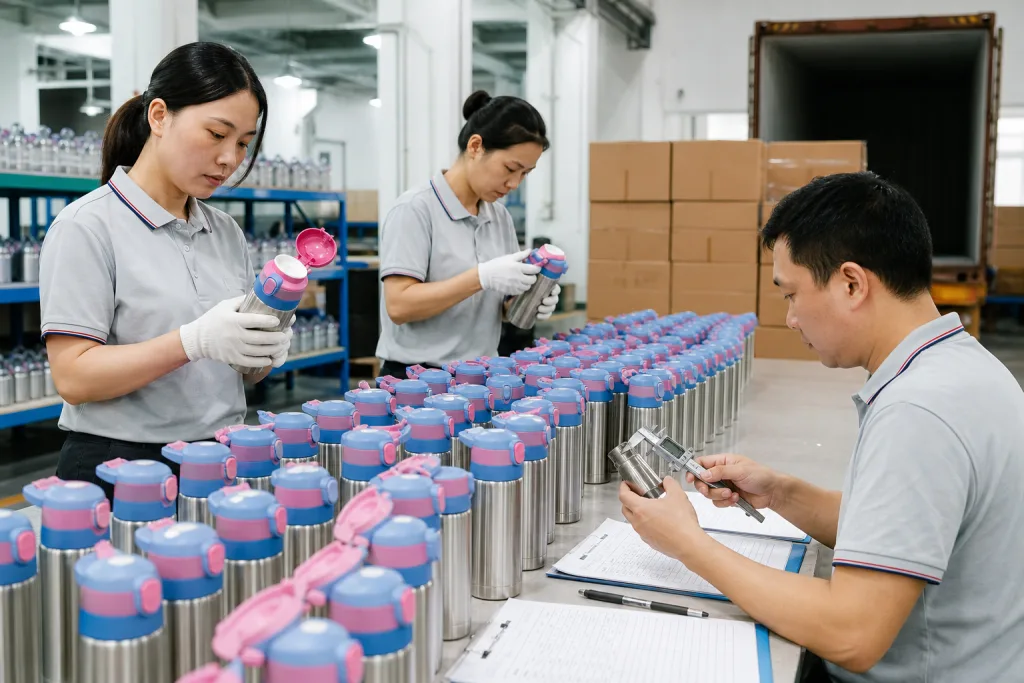
Key Takeaways
- Set the bottle format first: 350-500 ml is the safest range for school use, with 0.4-0.5 mm single-wall stainless or 2.0-2.5 mm Tritan body thickness
- For custom kids water bottle orders, expect practical MOQs of 3,000-5,000 units per color and lead times of 25-40 days after sample approval
- Use AQL 2.5 for major defects and request 100% leak testing on every bulk school water bottle shipment before carton sealing
- For Europe and North America, ask for REACH, LFGB or FDA material declarations, plus ASTM/CPSIA testing where child-use claims apply
If you buy for schools or kids retail, the wrong bottle creates work far beyond the unit price. We’ve seen one 5,000-piece PO turn into 3 weeks of after-sales over leak claims, odor complaints, cracked lids, missing compliance files, and logos fading after 2 dishwasher cycles. A kids water bottle distributor should take that risk off your desk. Fast quotation is not the main issue. The real question is who can ship a bottle that stands up to child use, clears Europe or North America compliance, and still fits your target cost after freight and duty.
Most buyers sourcing from Zhejiang, China end up deciding 4 things first: material, lid system, decoration method, and order plan. This is where projects usually go off track. On the line, QC pulled plenty of pre-production samples that were fine on color but wrong on straw fit by 0.8 mm, so the full brief had to be reopened. Get these 4 points clear early and your bulk children water bottle program runs clean. Miss them, and even a good children water bottle factory in China can lose 12 days vs 18 days just remaking samples around a brief that was wrong from the start.
Start with the four buying decisions
School district buyers and kids-product importers usually start with decoration because the logo is the first thing everyone sees on the sample. We think that is the wrong question to ask. On our line, the print comes after the hard decisions: body material, lid structure, decoration method, and order architecture. Those four points drive unit cost, complaint rate, and lead time far more than artwork size on a 500ml bottle.
- First: bottle body material. Tritan, polypropylene, stainless steel, and occasional glass do not sit in the same cost bracket. They change bottle weight, drop performance, compliance paperwork, and freight math. A 304 stainless body adds grams fast; a Tritan body usually cuts shipping weight and gives the buyer a clear wall, but scratch visibility is different. We have had buyers switch material after a 1.2m drop test on the concrete floor.
- Second: lid structure. Straw lid, flip spout, screw cap, or push-button lid decides leak risk more than any other part on the bottle. QC pulled the sample more than once because the silicone ring was 0.5mm off spec, and that was enough to fail an inverted leak test. Buyers often push for the one-click lid because it looks better on shelf, then flag callbacks later when kids do not close it fully.
- Third: decoration method. Silk screen, heat transfer, UV print, laser marking, and pad print wear differently after abrasion and dishwasher exposure. We run tape tests and rub tests before approval, not after the claim comes in. A bright cartoon graphic may look good on a pre-production sample, but if the ink edge chips after 300 rubs, the math does not work for a school program.
- Fourth: order architecture. MOQ by color, by lid style, by decoration, and by carton pack decides whether your children water bottle wholesale plan actually holds up. This is where POs get messy. We have seen a buyer split 3,000 pcs into 6 colors, 2 lids, and 4 print layouts, then wonder why the quoted MOQ changed after packing review.
Once these four decisions are fixed, a kids water bottle distributor can get a quote that means something. Without them, price comparisons go sideways because the products are not matched. One supplier may quote single-wall 18/8 stainless with a basic screw lid; another may quote Tritan with a one-click straw lid and silicone bumper. Both may be labeled a bulk kids bottle, but they are not substitutes, and the carton weight proves it fast.
At BottleForge Industrial in Hangzhou, Zhejiang, we usually tell new buyers to lock the use case before they lock the shape. A school lunch program, gift shop resale, sports day giveaway, and back-to-school retail need different specs, spare-part plans, and packing rules. Last month one PO even had the lid color code typed wrong, and the buyer caught it only at sample approval. If you need children water bottle promotional stock for a 30-day campaign, print speed and landed cost may matter most. If you are buying custom school water bottle units for a district contract, spare parts, repeat supply each year, and complaint handling matter more.
A children water bottle distributor earns your trust by saying no to the wrong spec before mass production, not by saying yes to every sketch.
Pick the body material by use
Body material is where a lot of kids bottle projects slip. Buyers ask for the lowest FOB first, then add drop resistance, no smell after milk use, dishwasher cycles, and a better hand feel. The math doesn’t work on the same low-cost bottle. We’ve seen this go sideways after a PO came in with “cheap clear body” typed on line 4, then the buyer flagged stress cracks after the first 1.2 m drop test.
Tritan and food-grade plastics
For low weight and bright color, Tritan and PP are still the standard choice in children water bottle bulk programs. A 400 ml Tritan bottle usually weighs around 120-180 g depending on wall thickness and lid structure. It stays clear, takes abuse, and shows logo print cleanly, which matters on a silk-screen line. For school-age users, a Tritan body with PP lid and food-grade silicone seal is usually the best balance on cost, weight, and complaint control.
Run at least 2.0 mm wall thickness on drop-risk areas. Thinner bodies save a few cents per unit, but failure rates jump after drops from desk height, around 700-750 mm in our in-house check. If your landed price is under pressure, cut straw parts or extra trim colors first. Do not cut body thickness. That is the wrong place to save money.
Stainless steel
If you need better durability and temperature retention, 18/8 stainless is the safer pick than painted low-grade metal. For single-wall kids bottles, 0.4-0.5 mm body thickness is common. For vacuum bottles, inner and outer walls, welding, and copper coating add cost and time on the line. A 350 ml vacuum kids bottle often costs 40-70% more than a comparable plastic bottle, but crack complaints are lower. QC pulled one sample last month with a bad weld ring at the bottom seam, which is why factory inspection matters more here than brochure claims.
What school buyers usually choose
For a bulk school water bottle tender, most working specs sit in these ranges:
- Capacity: 350-500 ml
- Mouth diameter: 45-55 mm for easy cleaning
- Weight: under 250 g for younger users
- BPA-free declaration plus REACH/FDA supporting documents
If a children water bottle manufacturer cannot tell you why one material fits your use better than another, move on. Serious children water bottle manufacturers in China should link the spec to the failure mode: cracked shoulder, warped thread, odor retention after 3 wash cycles, or denting in carton drop tests. Catalog numbers alone tell you nothing.
The lid decides complaint rate
Buyers ask us which part fails first. It is the lid. Not the bottle body, not the logo print. The lid drives complaint rate, whether you source from a children water bottle supplier, a children water bottle vendor, or direct from a children water bottle factory. On our line, QC pulled 8 leak samples out of a 500-piece pilot once; all 8 traced back to lid fit, not the bottle shell.
For children, two mainstream lid systems and one premium option show up again and again:
- Screw cap with carry loop: usually the lowest complaint rate, with the simplest tooling and the easiest seal control. Best fit for younger age groups and school distribution. We run torque checks at 0.8-1.2 N·m on this type, and the math works.
- Flip straw lid: convenient and popular, but the extra parts create extra leak points. Check silicone straw fit, bite valve hardness, and hinge life. A buyer flagged a loose straw joint on a 3,000-piece order last year because the tube OD was off by 0.3 mm.
- Push-button one-hand lid: gives a better shelf look and higher unit cost, but it breaks more often after drops. This is the wrong lid for rough school use unless the drop data is solid.
For a custom kids bottle program above 10,000 units, ask the supplier for hinge cycle data or at least internal drop-test records. A workable baseline is 1.0 m drop test, 10 cycles on filled samples, with no lid burst or major leakage. For school use, request 100% vacuum or air-pressure leak testing before packing, especially for straw designs. We ship this way on repeat school orders because we have seen random AQL pulls miss slow leaks that show up 12 days later.
Check cleaning too. Parents and schools complain when mold builds in hidden channels. A simple straw path with removable silicone parts beats a lid with an internal spring cavity that nobody can reach with a brush. If replacement straws or seals are available, ask for spare ratios upfront. We usually suggest 1-2% extra lids or seal sets with the original bulk kids water bottle shipment. The cost is low compared with reshipping parts from Zhejiang, China six months later. We have even seen a PO typo turn 1% spares into zero, and that went sideways fast.
If you are evaluating children water bottle distributors, ask this directly: Which lid design gives you the lowest after-sales rate on kids products? They should answer with a number, not a brochure line. If they cannot tell you whether their screw cap runs at 0.3% complaints and their push-button lid runs at 1.8%, they are probably just forwarding catalog PDFs.
Decoration must match the abuse level
A children water bottle custom project usually fails at the repeat-order stage, not on day one. The first sample looks fine. Then the bottle spends 6 hours in a backpack with a metal lunch box, drops off a desk, and gets scrubbed with a hard nylon brush. We have seen logos look worn after 3 weeks. Decoration has to match that abuse, or the math doesn’t work.
For custom children water bottle orders, the main options are:
- Silk screen: low setup cost and clean spot colors, best for simple logos. Good for 1-3 color branding. On our line, this is the usual pick for MOQ 3,000 units and up, especially when the buyer wants a clear Pantone match on one panel.
- Heat transfer: better for full-wrap graphics and mascots. More visual impact for school merchandise, but surface prep matters. If the bottle body has oil residue before transfer, QC pulled the sample fast because the edge lift shows up first near the shoulder curve.
- UV print: vivid detail and useful for short runs, but scratch resistance changes with the coating system. Buyers like it for 1,000-piece event orders, then flag scratches later if the varnish stack was chosen on price only.
- Laser marking: ideal on powder-coated stainless for durable monochrome branding. No color pop, but on 304 stainless with powder coat, this is one of the safest options for long-term use.
For children water bottle customizable programs, ask for an adhesion test standard in writing. A simple tape test is not enough. Ask for abrasion testing, dishwasher simulation if relevant, and visual criteria for acceptable print shift. We usually put this on the pre-production approval sheet with the test method listed, because “dishwasher safe” is where claims go sideways fast. If the bottle is marketed to schools, do not promise dishwasher safety unless the exact print system has been validated.
Custom made kids bottle projects also need artwork positioning tolerances. On cylindrical bottles, 2-3 mm print shift may still be acceptable. On shaped bottles with character graphics, that same 2-3 mm can make the eyes or text look crooked. This should be agreed at pre-production sample stage, not after goods are on the water. We have even had a PO with the mascot logo centered from the grip groove by mistake, and the buyer flagged it only after mass production photos.
For children water bottle promotional use, a simpler decoration can be fine if the target price is tight. For shelf retail or district-branded reorders, pay a bit more for a finish with lower return risk. That is the right tradeoff. Cheap print gets expensive the minute schools start sending peeling-logo photos, and then one 5,000-piece order turns into a claims discussion instead of a reorder.
MOQ, pricing, and shipment planning
A kids water bottle distributor needs MOQ logic spelled out on page 1. If not, the quote looks cheap and then the add-ons start showing up: extra lid color, separate insert, hand-pack fee, higher carton count. On our side in Zhejiang, MOQ usually breaks on four points: bottle body, lid color, decoration method, and packaging style. We run quotes this way because the line runs this way.
Typical working numbers for a custom kids water bottle order are:
- Stock mold bottle with standard lid: 3,000 units
- One body color plus one lid color: 3,000-5,000 units
- Custom logo screen print: often from 1,000 units, but best pricing starts above 3,000
- New mold development: commonly USD 3,000-12,000 depending on complexity
- Lead time: 7-12 days for pre-production sample, 25-40 days for mass production
For planning, a basic 400 ml Tritan bulk kids bottle with screw lid and one-color logo may sit around USD 1.20-2.20 FOB China at volume. A more complex 450 ml straw bottle may land around USD 1.80-3.20 FOB. Vacuum stainless kids bottles can move from roughly USD 2.80 to above USD 5.50 depending on finish and packaging. These are planning bands, not promises. The wrong question to ask is “what is your cheapest price?” Ask what changes the price by USD 0.08, USD 0.20, or USD 0.50 per unit—paint, print pass, and gift box usually move it fast.
Our Hangzhou facility and partner lines in Zhejiang can support around 600,000 units per month across drinkware categories, but children bottle lead time still depends on lid parts and decoration capacity. A silicone straw valve that is 0.3 mm off spec can stall assembly for 2 days; we have seen this go sideways on rush orders. That is why forecast quality matters. If you need split shipments by school district or SKU labeling for Amazon FBA, mention it before sampling, not after QC pulled the sample and carton layout is locked.
Serious children water bottle suppliers also talk about carton drop resistance, master carton count, and pallet efficiency. Last month a buyer flagged a quote that saved USD 0.06 per bottle, but the carton cube went up 18% and the container math did not work. We test carton fit with actual pack-out on the floor, not spreadsheet guesswork. A bottle that saves USD 0.06 on unit cost but adds 18% more carton volume is not necessarily the better import decision.
Compliance papers you should not skip
For kids’ products, the paperwork is part of the shipment. We see buyers focus on shape, color, and price first, then get stuck later because the file set does not match the actual bottle. It happens whether you buy from children water bottle distributors or direct from a children water bottle manufacturer. Europe and North America ask for different documents, and a one-page material statement is the wrong place to stop. On our side, QC usually checks the SKU code on the carton label against the test report before the sample leaves the office.
For EU-bound goods, ask for REACH compliance and, if the bottle is for food contact, LFGB-related testing where it applies. For the US and Canada, ask for FDA food-contact declarations for the relevant materials, then check CPSIA or ASTM scope if the product is sold as a child-use item. The final list should be confirmed against age grading, product claims, and retail channel. This is where deals go sideways: a 500 ml bottle sold as a general drink bottle is one file set, while the same bottle with a toddler claim can trigger extra review. We have had buyers flag a PO because the lab report showed the old lid code, not the current one.
At order stage, ask for:
- Material declaration for bottle, lid, straw, seal, and paint/coating
- Recent test reports from a recognized lab
- BSCI, Sedex, or social compliance documents if your customer requires them
- ISO 9001 or internal quality system overview
- AQL inspection standard and defect definitions
AQL matters more than first-time buyers expect. For bulk school water bottle orders, a common setup is AQL 2.5 for major defects and 4.0 for minor defects, with zero tolerance for safety-critical issues like exposed sharp edges, missing seals, or failed leak test. Put odor limits, color tolerance, and print position acceptance into the purchase order in writing. Be specific. If the logo can drift only 1.5 mm, write 1.5 mm. If the leak test is 100% checked on the line with 0.03 MPa air pressure, write that too.
If a children water bottle supplier says “no problem” but cannot send clean documents with matching item codes, treat it as a warning. Good factories in China know the compliance file must match the exact SKU, material set, and finish you are buying. We have seen simple mistakes cause delays of 12 days vs 18 days on approval, just because the straw material on the report was PE while the production BOM showed silicone. The buyer flagged it, and they were right.
How to qualify the right supply partner
The final decision is not only product fit. It is partner fit. We see this on the line all the time: one children water bottle vendor can turn a 7-day promo order fast, then miss a 45-day replenishment window because planning is weak. Another factory is good at OEM development and mold follow-up, then takes 36 hours to answer a basic lid tolerance question. You need a screening method that matches your sales channel, not a generic vendor scorecard. This is the wrong question to ask if you only compare unit price.
For school district buyers and importers, these questions expose the gaps fast:
- Can you provide 2-3 existing kids bottle formats with test records and defect history?
- What is your real MOQ by color and by print method?
- Do you run 100% leak testing or only random checks?
- Can you support barcode labeling, retail insert packing, and multilingual warning labels?
- What percentage of orders ship on time in the last 12 months?
Also ask for a pre-production control flow. A capable children water bottle factory should show the full route: incoming material check, in-line assembly inspection, leak test at 0.2 MPa, decoration inspection, and final carton audit. QC pulled the sample on one PO last month because the warning label file had a French typo and the outer carton mark did not match the packing list. That is the kind of miss you want to catch before mass production. If they use third-party inspection, ask if they work to your checklist and AQL plan.
For buyers sourcing from Zhejiang, China, video audits help, but they do not tell the whole story. Request live footage from assembly, leak testing, and packing lines, plus photos of mold storage racks and raw material traceability by lot card. We have seen this go sideways when a buyer approved a clean video, then found mixed lid shades in the first shipment because color separation on the floor was loose. If your initial order is below container volume, run a pilot order of 1,000-3,000 units from stock molds before you commit to a fully custom children water bottle wholesale launch.
The right kids water bottle distributor helps cut uncertainty early. That means clear quotes, lead times that hold up at 35 days instead of slipping to 50, matching documents, and straight answers when the buyer flagged an inconvenient technical point. We ship smoother repeat orders when the first PI, carton marks, barcode file, and test standard all line up. Get that discipline early, and reorders are easier.
Get a practical kids bottle sourcing review
Send your target capacity, lid type, logo method, and quantity. We will recommend the safest spec, realistic MOQ, and lead time for your program.
Frequently asked questions
What MOQ should I expect from a kids water bottle distributor?
For a stock mold custom kids water bottle, a practical MOQ is usually 3,000 units per design, with some logo-only programs starting at 1,000 units. If you want a new lid color, custom packaging, or multiple body colors in one order, the effective MOQ often rises to 3,000-5,000 units per SKU. New molds can add USD 3,000-12,000 depending on complexity. If you are testing a school program, ask whether the supplier can use existing molds and standard carton packs first. That is usually the safest way to launch a bulk kids water bottle order without carrying too much slow stock.
Which material is best for a bulk school water bottle program?
For most school use, Tritan is the best balance of weight, durability, and cost. A 400-500 ml Tritan bottle with PP lid is lighter than stainless, easier for younger children to carry, and usually lands in a lower FOB range. Stainless steel makes sense when durability and insulation matter more, but unit cost is often 40-70% higher. Avoid pushing wall thickness too low just to save a few cents. On plastic bottles, 2.0-2.5 mm in high-impact areas is more reliable. If your buyers want simple cleaning and low complaint rates, pair the bottle with a screw cap or a basic straw lid rather than a complex one-touch mechanism.
How do I check if a children water bottle manufacturer is compliant for Europe or North America?
Ask for documents tied to the exact SKU, not generic claims. At minimum, request material declarations for bottle body, lid, straw, seals, and coating. For Europe, review REACH-related paperwork and food-contact testing as required. For North America, request FDA food-contact declarations and confirm whether CPSIA or ASTM testing is needed for the way the product is marketed. You should also ask for recent lab reports, social compliance records such as BSCI if required by your customer, and the factory's AQL standard. Good suppliers in China can provide matching item codes and recent reports within 2-3 working days. If the paperwork is inconsistent, pause before paying the deposit.
What is the safest lid style for children water bottle bulk orders?
For the lowest complaint rate, a screw cap with carry loop is still the safest choice. It has fewer moving parts, better sealing stability, and lower breakage risk after drops. Flip straw lids are popular and child-friendly, but they need tighter control on silicone fit, hinge strength, and leak testing. Push-button lids look premium but usually create the most after-sales issues in school use. For any lid style, require 100% leak testing before packing and ask for drop-test records at 1.0 meter with filled samples. If you expect long-term reorders, buy 1-2% extra replacement lids or seal sets with the first shipment.
How long does a custom children water bottle order usually take?
For an existing mold, plan about 7-12 days for sampling after artwork and color confirmation, then 25-40 days for mass production after sample approval and deposit. Packaging development, lab testing, or peak-season congestion can add 5-15 days. If you need FNSKU labels, mixed carton marks, or split shipments by school district, build that into the timeline at the start. A common mistake is approving the bottle sample but delaying artwork approval for retail boxes. That can hold the entire order. If you buy from Zhejiang, China before back-to-school season, reserve production at least 60-75 days before your required ship date.