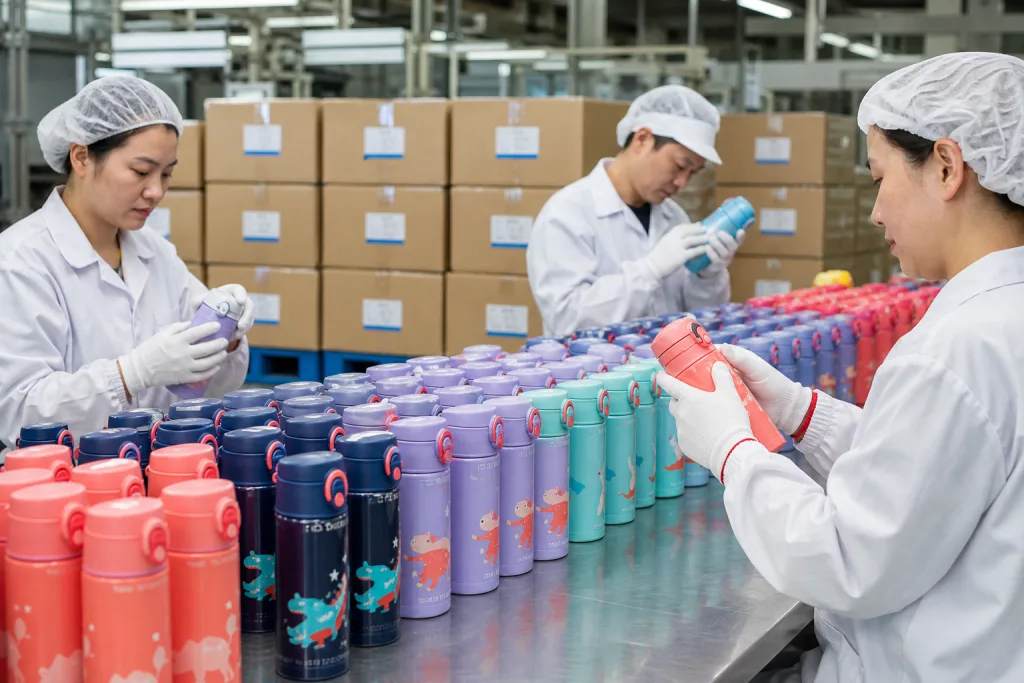
Key Takeaways
- Set measurable specs early: 1.0-1.2 mm Tritan body wall, 1.5 m drop test, and 24-hour inverted leak test reduce common claims fast.
- For most children water bottle custom projects, MOQ is usually 3,000-5,000 pcs per color with 25-35 day lead time after sample approval.
- Use AQL 2.5/4.0 final inspection plus 100% vacuum or inverted leak checks on assembled lids, not just visual QC.
- Ask for CPSIA, REACH, LFGB or FDA material declarations, and require migration and small-parts verification before shipment.
You usually find a bad kids bottle order after the container lands. Pre-production samples looked clean, logo colors matched, and the landed cost penciled out. Then 1,200 cartons hit the warehouse and the problems start: lids seep in school bags, straws back out after a drop, or the print fails after 20 dishwasher cycles. We have seen QC pull a sample from the line with a 0.3 mm gap at the lid seat, and that tiny miss turned into a full rework discussion. For school district buyers and importers, a kids water bottle customizable program rarely fails from one dramatic error; it fails from a stack of small specs nobody locked down.
That is the real issue with custom kids water water bottle projects from China, and Zhejiang is no exception. The bottle body is straightforward. The risk sits in the details: resin grade, bite-valve Shore hardness, 1.2 m drop test height, vent design, ink adhesion, and carton compression. This is the wrong question to ask if the discussion starts with color only, because the pretty rendering never tells you what happens after 6 weeks on the water and truck route. If you are buying a bulk kids water bottle or a custom school water bottle, you need to spec for failure before production starts, down to the valve fit and the master carton burst result.
Where kids bottle orders actually fail
Buyers new to a kids water bottle customizable program usually start with shape, color, and logo position. Fair enough. But that is not where orders blow up. The costly failures show up later: leaks after drop test, odor complaints when the bottle sits 48 hours after molding, missing compliance files, carry loops tearing at 6 kg pull force, and decoration wearing off before the first semester. We have seen buyers argue for a brighter lid color, then lose far more money on a gasket issue. That is the wrong question to ask.
At a Zhejiang children water bottle factory, this pattern repeats. A school buyer asks for a 350-500 ml bottle, one-hand flip lid, soft straw, and a child-safe carry loop. The first sample from a trader often looks clean on the desk. Then the order goes to production scale: 20,000 units, 4 Pantone colors, 2 lid molds running on the line, and outside printing on part of the job. That is where variation turns into claims. If the straw durometer shifts by 5 Shore A, the sip feel changes and parents notice. If the silicone gasket section is 0.3 mm too thin, random leaking starts after tilt test. If the bottle shoulder radius is too tight, screen printing stretches near the curve; QC pulled the sample for that exact issue on a 2023 PO where the buyer also typed the wrong item code.
For a bulk children water bottle order, think in failure modes:
- Functional failure: leakage at the spout seal, opening force above the agreed range, straw collapse after repeated suction, cap hinge cracking before the cycle test is done.
- Safety failure: non-compliant materials, small detachable parts under torque test, sharp flash left at the gate, poor venting that affects drinking flow.
- Cosmetic failure: color mismatch against approved chip, print misregistration over 1 mm, sink marks near the handle base, weld lines showing on the front panel.
- Logistics failure: crushed master cartons, scuffed lids from loose inner packing, mixed SKUs in one carton, wrong barcode labels because the buyer flagged the label file too late.
If you are dealing with children water bottle manufacturers in China, ask about failure history, not just the catalog. A serious supplier should be able to say their flip-top hinge had a 1.8% field complaint rate three years ago, then they changed the pin diameter from 2.2 mm to 2.8 mm and reran cycle testing. That answer means the factory has been through claims, teardown, and correction. We trust that more than a polished sample case.
Leakage starts at the lid stack
Most leak claims on a custom kids water bottle start in the lid stack, not the bottle body. Buyers often treat leakage as one defect. On the line, we usually split it into 6 failure points: gasket compression set, weak thread engagement, a warped lid body, bad vent balance, straw damage during insertion, or latch tolerance drift. QC pulled one sample last month with a 0.3 mm lid warp, and that was enough to break the seal after a simple side drop.
For a bulk school water bottle project, write the lid spec expecting normal production variation. This is the right question to ask. Require:
- 100% assembled leak test, either vacuum or 24-hour inverted water test.
- Silicone gasket hardness range, such as 50-60 Shore A.
- Thread start and stop tolerance confirmation by go/no-go gauge.
- Latch cycle test, for example 3,000 open-close cycles with no fracture.
- Filled drop test: 1.0-1.5 m depending on age group and bottle size.
Wall thickness matters too. A 400 ml Tritan body at 0.8 mm can pass a quick hand check and still flex enough on side impact to unseat the gasket after repeat drops. We usually recommend 1.0-1.2 mm body wall for school-use bottles, with more material around the neck finish if the cap uses a hard snap closure. We have seen buyers push for 0.8 mm to save resin, but the math doesn't work once claims start.
What to put on the PO
Do not write “leakproof.” Write a statement your factory and inspector can test: 0 leaks in 200 pcs after 24-hour inverted test at ambient temperature, with assembled straw and gasket, filled to 90% volume. Then add a field-use check: 0 functional leaks after 10 drops from 1.2 m onto plywood over concrete. We ship against wording like this because it leaves less room for argument. We also see basic PO mistakes here; one buyer flagged leakage on a PO that said “gasker” instead of “gasket,” and the spec was unclear from day one.
Sample approval does not prove production sealing performance. It proves one assembled sample was good on one day.
If you buy from a children water bottle vendor or children water bottle distributor, ask whether they mold the lid in-house or buy it from another shop. When the lid and body come from 2 factories, stack-up problems show up fast and claims move slower. We have seen this go sideways when a body thread is within print, the lid is within print, and the assembled fit still fails AQL 2.5 leak inspection.
Materials pass samples and fail real use
A bottle can pass a quick smell check in the office and still trigger odor complaints after 14 days in school use. We’ve seen this on the line. The root cause is usually one of four things: resin grade mismatch, the wrong color masterbatch, weak overmold bonding, or a straw path that traps milk or juice after one rinse. For children water bottle customizable orders, material choice is not just a paperwork item. It hits complaint rate, return rate, and re-order confidence.
On the body, most importers stay with Tritan, PP, or stainless steel, but the math changes by age group. Tritan gives clear appearance and solid drop performance. PP cuts unit cost and usually runs faster in injection molding. Stainless steel holds temperature, but the bottle gets heavier, and we ship more dent-related claims on insulated kids models after carton drops from 76 cm. For preschool and primary school programs, this is the wrong question to ask: “Which material sounds premium?” A plain single-wall Tritan or PP custom children water bottle is often the better commercial choice.
Ask your children water bottle manufacturer for the exact resin designation, not just “food grade,” plus the full declaration package. QC pulled the sample on one PO because the buyer typed “Traitan” instead of Tritan, and that small typo turned into a full material reconfirmation. Depending on your market, require FDA or LFGB food-contact declarations, REACH SVHC statement, CPSIA tracking support, and phthalate or BPA-related declarations if claimed. If the bottle is sold in North America to children, confirm the child-related regulatory path before mass production. Not after tooling color approval.
Most odor trouble comes from additives, not the base resin. Dark masterbatch is a common one. Soft-touch paint is another. Low-cost TPE mouthpieces also get flagged. If you need a children water bottle customized with a soft bite valve, call out migration-safe food-contact silicone or TPE grade and ask for a hot-water odor check. Our factory check is simple: fill with 60-70°C water, close for 2 hours, cool, then compare against an approved control sample. If the supplier pushes back on this test, we’ve seen this go sideways later.
For cleaning, specify straw inner diameter in mm and confirm a brush can pass through the full path. A 4 mm straw that looks fine on the drawing can still hold pulp residue if the bend radius is too tight. The buyer flagged this once after classroom use with yogurt drinks. For school programs, a straight straw path with fewer hidden cavities beats a clever lid mechanism most of the time. That matters whether you are buying children water bottle wholesale for retail or a children water bottle promotional program for a district campaign.
Decoration looks good until it rubs off
The claim we see most on a custom logo kids bottle is not bad artwork. It is bad adhesion. The buyer signs off the pre-production sample, we ship, cartons get handled twice in the warehouse, then the logo starts scratching after use or dishwasher cycles. It shows up first on curved shoulders and matte paint, where ink film thickness is harder to hold on the line.
For a custom made kids bottle, the decoration method has to fit the material and the abuse level. Silk screen works well for simple spot colors on PP, Tritan, or painted steel, and the setup cost stays sensible once you run 3,000 pcs MOQ and up. Heat transfer handles detailed graphics, but QC pulled samples before with edge lift around the film border when temperature drifted 8°C off target. Laser marking lasts on coated stainless steel and gives a clean mark, but on clear Tritan the effect is weak, so this is the wrong question to ask. UV digital print gives artwork freedom, though we have seen it go sideways if the supplier skips proper adhesion checks after curing.
Do not accept “dishwasher safe print” as a sales phrase. Ask for the actual test method. On our side, a workable standard for school-use programs looks like this:
- Cross-hatch adhesion test after full cure.
- Dry rub and wet rub test, 50 cycles minimum.
- Dishwasher test, 20 cycles for baseline and 50 cycles for premium programs.
- Tape pull test after hot-cold cycling.
If your bulk kids bottle order needs Pantone matching, set the tolerance in writing. For 4 molded parts from different tools, visual approval against a signed chip under D65 light is usually the honest standard, not a promise that every lot will be identical. The same Pantone reads differently on PP, silicone, and Tritan; we have had buyers flag this on cap-to-body match before first mass production, and they were right to ask early. Your children water bottle suppliers should tell you this up front, not after the cartons land.
Placement drift is the other repeat problem. Curved kids bottle bodies give you less room than a straight tumbler, and a 2 mm shift is enough to make the graphic look off-center. If the mascot has to face front when the straw lines up, put a clocking note on the PO, because “print centered” is not enough. We once saw a PO typo that approved front logo placement but said nothing about lid orientation, so the print was technically correct and still wrong in use. That happens on a custom kids bottle. Easy to prevent if assembly orientation is written into the approved sample notes.
Compliance gaps are usually document gaps
School district buyers often assume compliance starts and ends with safe material. That is incomplete. Real compliance means you can show what resin was used, which supplier lot came in, and which batch ran on the line for that PO. This is where a lot of children water bottle vendors miss the mark. They send a generic report dated last year, but QC cannot tie it to your actual production lot or the 12-cavity mold used that day.
For a children water bottle bulk program, ask for a clean compliance file before deposit release: bill of materials, resin declarations, colorant declarations with masterbatch codes, gasket and straw material declarations, lab report scope, and carton/label claims review. If the product is for younger children, check whether any detachable accessory becomes a small part after abuse testing. We have seen buyers approve a soft topper, then flag it after a 90N pull test. Decorative charms look good in a sales sample, but this is the wrong place to take risk.
At BottleForge-style production in Zhejiang, a disciplined process includes incoming material lot records, patrol checks every 2 hours, and final inspection to AQL. For this category, AQL 2.5 for major defects and 4.0 for minor defects is common, but some school bids ask for tighter limits on leakage and sharp-edge defects. QC pulled the sample and found a burr at the spout edge measuring 0.3 mm; that piece is reject, not debate. Treat leaks as critical or at least automatic reject conditions. A pretty bottle with a 1% leak rate is still a failed program.
What documents you should request
- Food-contact compliance declaration for the destination market.
- REACH SVHC statement for EU shipments.
- CPSIA-related support if sold as a children’s item in the US.
- BSCI or social audit status if required by your organization.
- ISO 9001 or equivalent quality-system overview if available.
- Traceable production date code or cavity code plan.
This is not paper for paper’s sake. When a district asks why one carton of 48 pieces smells different from the rest, batch traceability gives your children water bottle distributor a straight answer. We have had this exact pushback before, and the fix came from matching the odor issue to one silicone gasket lot, not from guessing on a call.
Packaging failures create fake product defects
A lot of defect claims start in packing, not on the line. We’ve seen a bottle body arrive scratched, a spout look dusty, or a hinge snap in transit, then QC pulled the retained sample and the factory sample was clean. The issue was carton loading, weak inner dividers, or a master carton packed too tight. On a bulk kids water bottle shipment from China to North America, ocean freight vibration and top-load compression will expose every weak packing point.
If you are buying a custom school water bottle for direct distribution, match the pack to the sales channel. This is where buyers often ask the wrong question: “What is the cheapest pack?” Retail color box, plain white box, and bulk polybag pack do not fail the same way. Polybag-only packing cuts a few cents but raises scuffing fast; we ship samples like this only for low-risk programs. A color box presents better, but if the board grade is too light, corners collapse under stack pressure. For export masters, call out burst strength or edge crush requirement and keep a gross weight cap. Many buyers already prefer under 12-14 kg per carton because the math works better for handling and crush resistance.
Barcode and assortment mistakes create quiet losses. If your order is split by school color, grade, or mascot, put outer carton marking requirements on the PO: SKU, color, quantity, and production date. We’ve seen one PO with “navy” typed as “nany,” and the whole assortment had to be opened and sorted back out. For e-commerce or Amazon-related projects, confirm FNSKU label placement and carton labeling in writing, down to label side and height in mm if needed. A children water bottle suppliers team can run good molding and still hand you chargebacks because the labeling discipline was loose.
We usually recommend a carton drop simulation on pilot production. One packed master gets dropped on one corner, three edges, and six faces from practical handling height, then the line rechecks cap breakage, straw displacement, and print abrasion. Simple test. Good data. We’ve seen this catch cap cracks and logo rub marks before mass production, which is cheaper than arguing over a full container of damaged stock from Zhejiang or anywhere else in China.
How to spec and inspect before paying balance
If you want fewer surprises from a children water bottle manufacturer, tighten the purchase spec first. A longer complaint email later won’t fix a bad PO. For a children water bottle customizable order, the spec sheet should stay lean—usually 3 to 5 pages in our factory—and remove gray areas on function, appearance, testing, packaging, and documents. On the line, one missing note like “logo center +2 mm” is enough to start an argument nobody wants.
Cover the basics: capacity tolerance, net weight tolerance, dimensions, material by component, approved colors, logo position, and packaging. Then write the controls that stop failures before mass production. This is where buyers cut corners, and we’ve seen this go sideways.
- Function: 24-hour inverted leak test, opening force range in N, latch cycle requirement, drop test height such as 1.2 m on 6 faces.
- Appearance: acceptable weld line area, color standard, print registration tolerance, flash limit such as 0.2 mm at the parting line.
- Safety: no sharp edges, no detachable small parts after abuse, compliant food-contact materials.
- Packaging: inner pack method, carton weight cap like 12 kg, barcode format, carton marks.
- Inspection: AQL level, critical defect definition, sample size, and rework rules.
For many projects, MOQ in Zhejiang is 3,000 pcs per color for an existing mold and 5,000 pcs or more if you need custom components. Typical lead time is 25-35 days after deposit and sample sign-off, plus 3-7 days for final inspection and booking. A factory running 500,000-800,000 units per month can still miss your date if artwork approval drags or packaging components arrive late. We ship this every month, and the math doesn’t work if the buyer approves the insert card 6 days late but still asks to keep the same vessel date.
Before balance payment, use a third-party or buyer-side final random inspection. Check leakage, odor, assembly, logo adhesion, carton labeling, and count. QC pulled the sample on one order last summer and found 14 cartons with the wrong barcode because a single digit on the PO was typed wrong. If you are sourcing through children water bottle distributors rather than directly from a children water bottle factory, still ask who owns corrective action and replacement cost if the issue is found after arrival. This is the right question to ask before the PO.
Treat a children water bottle custom project like a controlled manufacturing program, not a giveaway item. Results are better. You get fewer returns, fewer reprints, and a bottle parents keep using instead of replacing after one semester.
Spec your kids bottle program before production starts
Send your target price, capacity, compliance market, and artwork. We will review failure risks, MOQ, lead time, and the right QC points for your order.
Frequently asked questions
What MOQ should I expect for a kids water bottle customizable order?
For an existing mold, a realistic MOQ is usually 3,000 pcs per colorway, sometimes 2,000 pcs if the decoration is simple and the factory is filling spare capacity. If you need a custom lid color, printed strap, or private mold insert, expect 5,000 pcs or more. Stainless versions and multi-part lids often carry higher MOQs because of assembly setup and component sourcing. For school district programs with 2-4 mascot designs, you can sometimes split 10,000 pcs across artwork variants if the bottle body and lid color stay the same. Ask whether MOQ applies per SKU, per color, or per artwork. Those are not the same thing.
Which material is best for a custom kids water water bottle: Tritan, PP, or stainless steel?
For most school-use programs, Tritan is the safest all-around choice because it is clear, lighter than stainless, and more impact-resistant than many low-cost plastics. PP is cheaper and works well for opaque bottles, but it can feel less premium and may show sink or warp more easily on larger bodies. Stainless steel is good when insulation matters, but it adds weight, cost, and dent risk. For a 350-500 ml children bottle, many buyers choose Tritan body with PP lid and silicone gasket. If the user age is lower, simplify the lid and avoid too many removable parts. Ask for wall thickness around 1.0-1.2 mm on Tritan school bottles.
How do I make sure the logo on a custom logo kids bottle does not peel off?
Specify the decoration method based on substrate, then require adhesion testing in writing. For simple 1-2 color logos on plastic, silk screen is usually the most economical. For coated stainless, laser or durable screen print can work well. Require cross-hatch adhesion, tape pull, dry and wet rub testing, plus dishwasher validation if you market the bottle as dishwasher safe. A practical benchmark is 20 dishwasher cycles minimum for standard school programs and 50 cycles for premium retail. Also control graphic placement on curved bodies. If logo orientation matters relative to the straw or handle, add an assembly clocking note to the approved sample.
What QC checks matter most before a bulk kids water bottle shipment leaves China?
Focus on function first. The top five checks are 24-hour inverted leak test, drop test with water fill, smell check after warm-water hold, print adhesion test, and packaging verification. On final inspection, use AQL 2.5 for major and 4.0 for minor as a baseline, but classify leakage as critical or automatic reject. Ask your inspector to open multiple cartons from different pallet positions, because top cartons and center cartons can behave differently after packing pressure. Also verify barcode labels, carton marks, quantity per carton, and color assortment. A shipment can be physically good and still become expensive if labels, counts, or assortments are wrong.
How long does production take for children water bottle custom orders from Zhejiang?
For an existing bottle model with standard packaging, 25-35 days after deposit and sample approval is normal. Add 5-10 days if you need new mold tweaks, custom printed boxes, or lab testing that is not already in place. Pre-production sample approval often takes longer than buyers expect, especially when Pantone matching and artwork orientation are involved. Final inspection and booking usually need another 3-7 days. During peak season, factories in Zhejiang and other parts of China can extend by 7-15 days if lid components, gaskets, or printed boxes are delayed. If you have a hard delivery date, work backward from shipment and freeze artwork early.