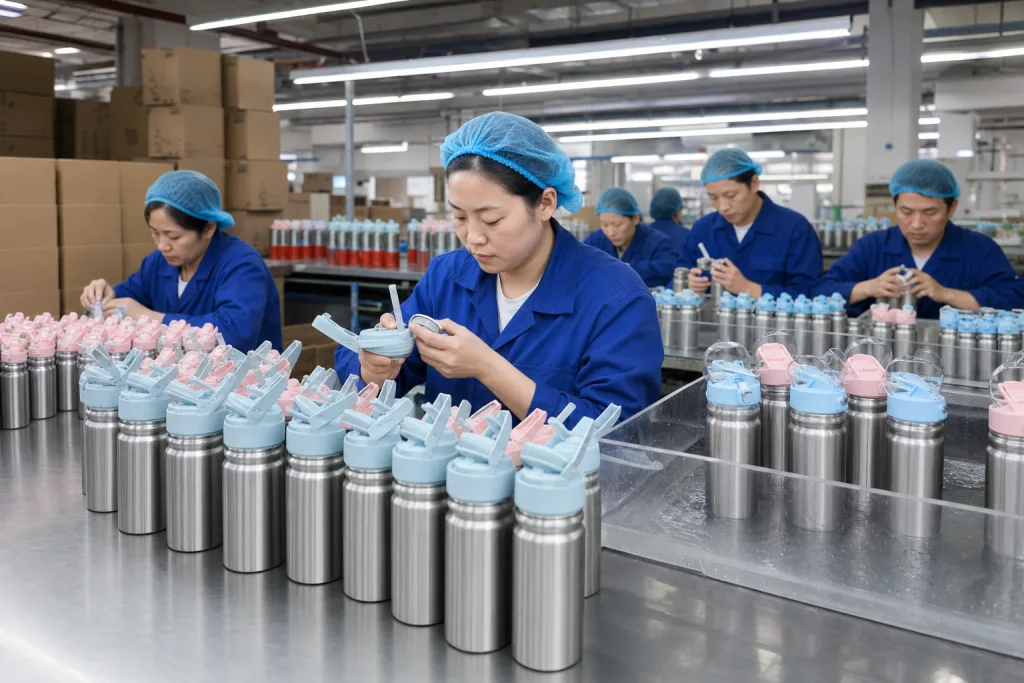
Key Takeaways
- For a 450 ml kids bottle, MOQ is often 3,000-5,000 units per colorway, while a fully new lid mold can add USD 4,000-12,000 and 25-40 days
- A realistic production timeline in Zhejiang, China is 7-12 days for samples and 30-45 days for mass production after sample approval
- Set AQL before deposit: common levels are Critical 0, Major 2.5, Minor 4.0, with 100% leak testing and random drop tests
- Typical FOB China pricing for mid-range kids bottles is about USD 2.10-4.80 depending on material, print method, straw assembly, and packaging
You are not buying a generic bottle. You are buying something a child will carry, drop from a 700 mm desk, chew on the spout, wash 2 times a day, and throw into a school bag for 180 school days a year. That changes the vendor check list fast. Color, logo, and price still matter, but they come after material compliance, lid safety, leak rate, and repeatable quality on the line. We have seen this go sideways: the buyer chased a low FOB number, QC pulled the sample, and 3% of lids leaked at vacuum test. The quote looked cheap. The after-sales cost did not.
A workable way to source from Zhejiang or wider China is to run one order from brief to shipment and watch where the risk shows up. Assume you are a brand owner or distributor in Europe or North America placing 8,000 units of a 450 ml kids bottle with a flip straw lid, silicone bumper, and retail box. That volume is enough to expose bad planning, but still small enough that MOQ, mold choices, and decoration method change the math on every unit. We ship orders like this every month, and the wrong question to ask first is “What is your best price?” Ask how the lid seals, what torque spec they run, and what inspection finding failed on the last similar PO.
Start with the use case
Start with a buyer brief we actually see on the line. You need a school-friendly kids bottle for a private label launch in Germany and Canada: 8,000 units on the first PO, split into two Pantone colors, one-color logo, and an individual color box. You also want a backup route through a canteen distributor network later, so the shape cannot look like it is only for toddlers. That decision changes the build fast. Material changes. Lid style changes. Decoration area changes. On our side, the first thing sales checks is whether the 8,000 pcs should run as 4,000 + 4,000 by color or with a spare 2% packing buffer, because that affects carton planning on day one.
For kids, most buyers cut the construction to these workable formats:
- Single-wall Tritan: lighter, usually FOB China around USD 2.10-3.00 for 400-500 ml.
- Single-wall 18/8 stainless steel: more durable, usually USD 2.60-3.70.
- Vacuum stainless steel: premium but heavier and more expensive, usually USD 3.80-4.80 for 350-450 ml.
For preschool and primary school, low weight usually wins over insulation. We have seen this go sideways when a buyer starts with “premium” and ends up with a bottle that is too heavy for a 5-year-old lunch bag. Tritan or thin-wall single-wall stainless is often the better call than a bulky flask. This is the wrong question to ask: “Which option looks more high-end?” Ask instead what a child can carry, open, and put back into a side pocket 20 times a day. QC pulled one sample last season at 286 g, and the buyer flagged it right away against their target weight.
You also need to pin down the use case before tooling or artwork layout. Is it for lunch bags, sports clubs, museum gift shops, or a back-to-school campaign? A canteen promotional order for an event can run with simpler packaging and one stock lid. A retail program cannot; the math does not work if the shelf presentation is weak or the unboxing feels cheap. If the bottle must fit a lunch bag side pocket, keep diameter below 75 mm. If children will use it one-handed, test the flip mechanism with low finger force on actual samples, not just a drawing. If the bottle is for ages under 6, avoid loose decorative parts and call out a stronger hinge cycle test. On our bench, we usually check lid action after repeated opening cycles before we sign off the PP sample.
This is where buyers often mistake custom drinkware for logo printing only. For kids products, customization starts with function. A capable canteen factory in Zhejiang should ask for age group, market, washing method, and target retail price before quoting logo position or print size. If a factory jumps straight to artwork without asking those basics, slow down. We ship plenty of clean-looking bottles, but the ones that reorder are the projects where the spec sheet was right before the decoration file was right.
Build the specification before quotes
If you send an RFQ to kids drink bottle vendors without a real spec, you get noise back. “Need customizable drinkware for kids” is not a brief. It is how buyers end up comparing 6 prices built on 6 different assumptions. We see this on the line all the time, and this is the wrong question to ask.
For this 8,000-unit example, your specification should include:
- Capacity: 450 ml ± 5%
- Body material: Tritan or SS304, food-contact declaration required
- Lid: PP with food-grade silicone straw and seal
- Target weight: under 230 g if plastic, under 300 g if steel
- Leak performance: zero leakage after 30 minutes inverted
- Drop test: 3 drops from 1.0 meter when empty, no crack causing leakage
- Color: 2 Pantone references
- Logo: 1-color silkscreen or laser if steel
- Packaging: 1 pc/color box, 24 pcs/master carton
- Compliance: REACH, LFGB or FDA depending on market, and CPSIA/ASTM where applicable for children’s use claims
With that sheet in place, quotes are easier to compare. A solid canteen supplier or canteen vendors group should show MOQ, cavity count, tooling status, FOB port, sample fee, and testing capability, not just throw out one cheap number. We usually also expect carton size and gross weight in kg, because freight math changes fast at 24 pcs/master. If a supplier sends one low price with no assumptions, no lid structure note, and no test scope, skip it. We have seen that go sideways after the PO, usually when QC pulled the sample and found the straw hardness was never defined.
Stock model or new mold?
For first orders under 10,000 units, stock bodies with color and packaging changes are the safer play. You can still make the bottle read like a custom canteen or a customized drinkware line by changing the lid color, bumper, print size, hangtag, or carton layout. Full custom tooling starts to make sense when annual volume is above 30,000-50,000 units, or when your design gives a margin edge that pays back the mold cost. On our side, a new cap mold review usually starts with a 0.2 mm parting-line check, so no, custom is not just “open a mold and run.”
A stock model with private-label changes can save 20-35 days and remove USD 4,000-12,000 of tooling risk on a first launch.
The same logic applies if you also buy adult SKUs like a customizable canteen, custom growler, or travel tumbler from the same source. We tell buyers to keep the kids bottle simple on launch. Then expand after the vendor proves execution on sampling, print registration, and drop test consistency. One buyer flagged a PO once because “straw seal” was typed as “straw set,” and that tiny typo delayed approval by 3 days.
Compare suppliers like an engineer
Once you have 5 to 8 quotations, stop staring at FOB price. Compare execution. You need to know which kids drink bottle vendors can ship the order with stable quality, not just a clean Excel sheet. In Zhejiang, we see this every month: a trading company quotes fast, then asks a workshop to figure out the mold fit, print cure, and packing spec later. A real canteen factory usually runs injection, polishing, assembly, and packaging in-house, or through audited partners with records you can check. Ask who owns the key process. This is the right question.
Ask each supplier for these numbers:
- Monthly capacity for the selected model, such as 200,000-400,000 units/month
- Normal MOQ by color and by logo
- Sample lead time and mass production lead time
- Defect history for leakage and print adhesion
- In-house tests available: salt spray, dishwasher, drop, leak, vacuum retention if insulated
- Audit status: BSCI, ISO 9001, Sedex if relevant
If a supplier says “we are a canteen manufacturer,” ask for process detail, not slogans. For example: 6 automatic screen-print lines, 2 laser stations, 4 assembly lines, 300,000 units/month at peak, and a leak test run at 0.03 MPa on the line. That tells you something real. A brochure does not. We have seen buyers get a nice PDF, then find out the cap assembly was outsourced to a shop 40 km away with no incoming QC record.
Compare communication discipline the same way. If one canteen vendor sends a quote with assumptions, carton size, gross weight, and accessory cost split, while another replies “best price USD 1.95,” the math does not work. The second quote is missing cost and missing control. Last season one buyer flagged a PO typo on straw color at the pre-production stage; the supplier who checked details caught it in 2 hours, and the loose-quote supplier would have packed 12,000 wrong units.
This is also where you test range fit. If you are building a broader catalog, it is useful if the same supplier can support adjacent SKUs such as canteen custom, canteen customizable, customized canteen, customizable growler, or customized growler programs under the same QC system and similar AQL habits. Fewer vendors usually means fewer handoff errors. We run into this with distributors that want school bottles and sports bottles first, then add a small distributor growler program at 1,000 pcs MOQ using the same print inspection standard.
Do not let assortment distract you from the core check. Can this supplier make your kids bottle repeatably at your target cost and defect rate, batch after batch? QC pulled the sample once is not enough; you want the same seal fit, the same print adhesion, and the same carton packout on the next 3 orders too.
Sampling is where problems surface
Buyers often look at samples as a logo and color check. For kids bottles, that is the wrong question to ask. Sampling is where weak points show up before you lock an 8,000-unit PO. In our 8,000-unit scenario, expect 7-12 days for pre-production samples if you use a stock body and existing lid mold, or 15-25 days if custom color matching and packaging dielines are involved. On our line, QC pulled samples that looked fine in photos but failed after 20 lid cycles.
Ask for three sample types if possible:
- Existing sample to check structure fast and see if the base diameter and handle size already work for the target age group
- Color/print sample to sign off appearance, Pantone match, and logo position before you burn time on revisions
- Pre-production sample made with the actual mass-production materials, print method, and assembly setup we run on the line
Check the details that turn into claims later: straw insertion force, lid opening angle, odor after a hot-water rinse, silicone flash, print registration, sharp edges under the handle, and whether a child can carry it with one hand. This part gets missed. We usually gauge flash at the bite valve line and watch for edges a finger can catch under 0.5 mm lip transitions. If the body is steel, inspect weld cleanliness and inside electropolish finish. If it is Tritan, look for flow marks and stress whitening around the hinge area. One buyer flagged whitening after a 1-meter drop test, and we have seen that go sideways fast.
You should also confirm test requirements in writing. For example, we ask buyers to mark them on the PI so there is no argument later over what was approved:
- 100% leak test during assembly
- 24-hour standing leak verification on retained samples
- Paint or print adhesion with 3M tape test
- Dishwasher advice printed on packaging if not top-rack safe
- Migration or food-contact testing by SGS, TUV, or Intertek as needed
If you plan to sell on marketplaces, packaging data matters too. Approve barcode placement, suffocation warning text, country-of-origin marking, and carton label format now, before production starts. We ship cartons every week where the buyer only caught a label issue at final file check, and that costs days. For Amazon FBA, many buyers also request FNSKU application at origin. Last month a buyer sent a PO with the carton mark typo "MADE IN ZHEJIANG, CHIAN"—better to catch that at sample stage than after 2,400 boxes are printed.
A supplier who knows the product should push back when the request does not match real use. A soft-touch coating may look good on a customized drinkware lifestyle bottle but wear poorly on a school item after 3 months in and out of lunch bags. A tall, narrow bottle may look premium but tip too easily on a 600 mm classroom desk. The math doesn't work. That kind of pushback saves rework, claims, and one more painful sample round.
Lock QC before paying deposit
Most sourcing problems start the same way: the buyer signs off on a nice-looking sample, pays 30% deposit, and waits until finished goods to talk about inspection. We’ve seen this go sideways. By that stage, fixing a lid fit issue or logo error means rework, delay, and an argument over who pays. Put the QC standard on the PO before deposit, not after QC pulled the sample at final.
For this order, your purchase documents should define:
- AQL: Critical 0, Major 2.5, Minor 4.0
- Approved sample reference with dated photos
- Material callouts for body, lid, straw, seal, bumper, and packaging board grade
- Color tolerance, usually within practical Pantone variance for the chosen material
- Leak standard, odor standard, and logo adhesion standard
- Carton drop requirement and palletization if needed
What counts as a major defect?
For kids drink bottles, major defects should be written in plain language. Leakage is major. A cracked hinge is major. A detached carry strap is major. So are wrong material, wrong logo, missing warning text, sharp burrs on the spout, and dust or black specks inside the bottle. On one 5,000-piece order, the buyer flagged a warning line missing from the gift box because of a typo on the PO artwork file. Minor defects are different: a 1 mm print offset, slight color shift on PP, or scuffing on the master carton that the end user never sees.
If the vendor assembles several soft parts, ask how they control the line. This is the right question to ask. A decent factory should be able to tell you the first-piece check method, hourly leak test frequency, and how they trace each lot by date code or carton code. We run first-piece confirmation at line start, then leak checks with an air-pressure fixture every hour. If the factory cannot explain traceability in 2 minutes, stop there.
Third-party inspection is usually money well spent. On 8,000 units, a pre-shipment inspection often runs about USD 250-400 depending on city and travel. That cost is small next to one rejected container or 400 leaking bottles coming back from your warehouse. For a new order, or for a push-button lid with 3 assembled silicone parts, book a DUPRO at 20-30% completion, not just final inspection. Final-only checks miss process drift, and the math doesn't work once 8,000 units are packed.
This discipline matters even if you buy across categories, whether from canteen suppliers, canteen manufacturers, or a mixed distributor drinkware network. Kids bottles need the hardest gate. One failed drop test on a 5-layer carton or one loose straw valve brings more reputational damage than the average adult tumbler order.
Price the order beyond unit cost
Let’s price the full order, not just the headline quote. Say a Zhejiang supplier offers USD 2.68 FOB Ningbo for a 450 ml Tritan kids bottle with PP flip lid, silicone straw, one-color silkscreen, and color box at 8,000 units. That gets attention. It does not tell you what you will actually spend.
Your landed-cost worksheet should include:
- FOB unit price: USD 2.68
- Sample charges: USD 80-200; in 3 out of 5 projects we see this credited back after bulk order
- Mold or mold modification: USD 0 if stock, or USD 500-2,000 for small accessory changes like a straw tip or latch button
- Inspection: about USD 300; most buyers set AQL 2.5 and QC pulled the sample from packed cartons, not the assembly table
- Lab testing: USD 250-800 depending on scope
- Sea freight and destination charges
- Duties and broker fees
- Packaging extras such as inserts, stickers, FNSKU labels, or PDQ trays; a 12 mm pulp divider costs more than a thin paper insert, but we’ve seen the thin one fail drop test
Run the math line by line. A cheaper quote often loses after freight claims and rework. We ship enough kids bottles to say this plainly: 36 units per carton with weak dividers is the wrong place to save money. One buyer flagged corner crush after a 1.2 m drop test, and another supplier’s lid showed a 1.8% leak rate at final check. The savings were gone before the container landed.
Ask suppliers to break out decoration cost from body cost where possible. This helps when you compare a basic school program against a more premium customizable canteen or customized canteen range later. It also helps if you are a canteen distributor running different customer tiers. Promo margins and retail margins do not behave the same. We have even seen a PO typo swap matte print for gloss print, so separated costing makes revisions cleaner.
If you are building a broader hydration line, use the same costing logic on adjacent items like a customized growler or distributor canteen assortment. Kids bottles need tighter control on returns, leak complaints, and scuff marks, so budget for stronger inspection and stronger packaging from day one. Saving USD 0.06 per unit on packaging sounds smart until complaint rate jumps from 0.7% to 1.4%. The math doesn’t work.
Manage production and shipment calmly
After deposit, order management should feel dull. That is the goal. On an 8,000-unit stock-model order, we usually run 30-45 days after pre-production sample approval, and peak season often adds 7-15 days before back-to-school and the Q4 promo rush. On the floor, one missed silicone straw gasket can stall packing for half a day, so fewer surprises beat daily noise.
Set milestone dates at the start:
- Deposit received
- PPS approval
- Packaging approval
- Raw material in-house
- First assembly date
- DUPRO date if applicable
- Final inspection window
- Balance payment and vessel cutoff
Ask for production photos from the line, not just finished cartons. You need to see color consistency, logo registration, and how assembly is actually being run. QC pulled the sample on one kids bottle order because the pad print sat 1.2 mm off-center; the buyer would never catch that from a closed master carton photo. If your supplier in China runs clean records, they should send carton codes, daily output by line, and hold or rework logs when a problem shows up.
Shipping terms matter. FOB Ningbo or Shanghai is standard for many Zhejiang factories, and for a newer importer, FOB is usually simpler than EXW because the factory handles export clearance and books against the vessel cutoff. For a small test run, DDP can work, but check the math. We have seen DDP quotes where the margin was buried inside freight by USD 0.28 per bottle, and the buyer flagged it only after comparing the packing list.
Before release, verify document accuracy: commercial invoice, packing list, HS code, carton marks, test reports, and origin statement where needed. This is where small errors turn expensive fast. We have seen a PO typo on a carton mark force relabeling of 420 cartons, and that cost more than applying marketplace labels, retailer routing marks, or distributor carton marks at origin. If goods are going to multiple channels, split labels before shipment, not after arrival in Europe or North America.
The best kids drink bottle vendors do more than make the bottle. They close the loop on specification, testing, inspection, and export documents, and that is what keeps repeat orders clean. If a supplier only talks about unit price and lead time, that is the wrong question to ask.
Need reliable kids bottle sourcing from China?
Send your target capacity, material, MOQ, and market requirements. We will review feasibility, quote practical options, and flag risks before sampling starts.
Frequently asked questions
What MOQ should I expect from kids drink bottle vendors?
For a stock kids bottle with standard lid, MOQ is commonly 3,000 to 5,000 units per model, often with 1,000 to 2,000 units per color. Some China suppliers in Zhejiang will accept 2,000 units if you use existing colors and simple packaging, but the unit cost may rise by USD 0.10 to 0.25. If you need a fully new lid or body mold, practical MOQ usually starts above 10,000 units, and annual demand should ideally be 30,000 units or more. Always ask whether MOQ applies by SKU, colorway, print, or shipment date. Those are not the same thing.
Is Tritan or stainless steel better for a kids bottle program?
It depends on use, not fashion. Tritan is lighter and usually cheaper, often USD 2.10 to 3.00 FOB China for 400-500 ml. It works well for school and activity programs where low weight matters. Single-wall 18/8 stainless steel is more durable and can feel more premium, usually USD 2.60 to 3.70 FOB. Vacuum stainless is best only if insulation is essential, because weight and cost both increase. For children under about 8 years old, many buyers prefer lighter bottles under 250 g empty. Whatever you choose, confirm food-contact compliance, odor performance, and 100% leak testing.
How do I check whether a canteen manufacturer is really capable?
Ask for evidence you can compare. Useful signs include monthly capacity, such as 200,000 to 400,000 units, in-house decoration lines, assembly lines, audit reports like BSCI or ISO 9001, and a clear QC flow. Request sample lead time, mass lead time, and the defect criteria they use. A capable canteen manufacturer should explain AQL, leak testing, traceability, and how they handle rework. If they can only discuss price, they are not controlling the process tightly enough. For a first order, also check whether they can support third-party inspection and provide REACH, LFGB, FDA, or ASTM-related documents where relevant.
What tests matter most for custom kids drinkware?
Start with the tests that prevent returns. For most kids bottles, that means 100% leak testing during assembly, drop testing from about 1.0 meter, print adhesion, odor check after rinsing, and food-contact compliance for all wetted parts. If you sell into Europe, REACH and LFGB-related checks are common; for North America, FDA and sometimes CPSIA or ASTM-related expectations may apply depending on claims and design. Lab testing can cost roughly USD 250 to 800 per SKU depending on the scope. If your lid includes moving parts, ask for hinge cycle testing too, especially for school-use bottles.
How long does a custom order usually take from China?
For a stock model with custom colors, logo, and packaging, expect about 7 to 12 days for samples and 30 to 45 days for production after sample approval. If you need new tooling, add around 25 to 40 days depending on the complexity of the body or lid. Peak periods can add another 7 to 15 days. A realistic total from RFQ to shipment is often 6 to 10 weeks for a straightforward private-label order. The best way to protect timing is to finalize artwork, warnings, carton marks, and QC standards before deposit so production does not pause over preventable questions.