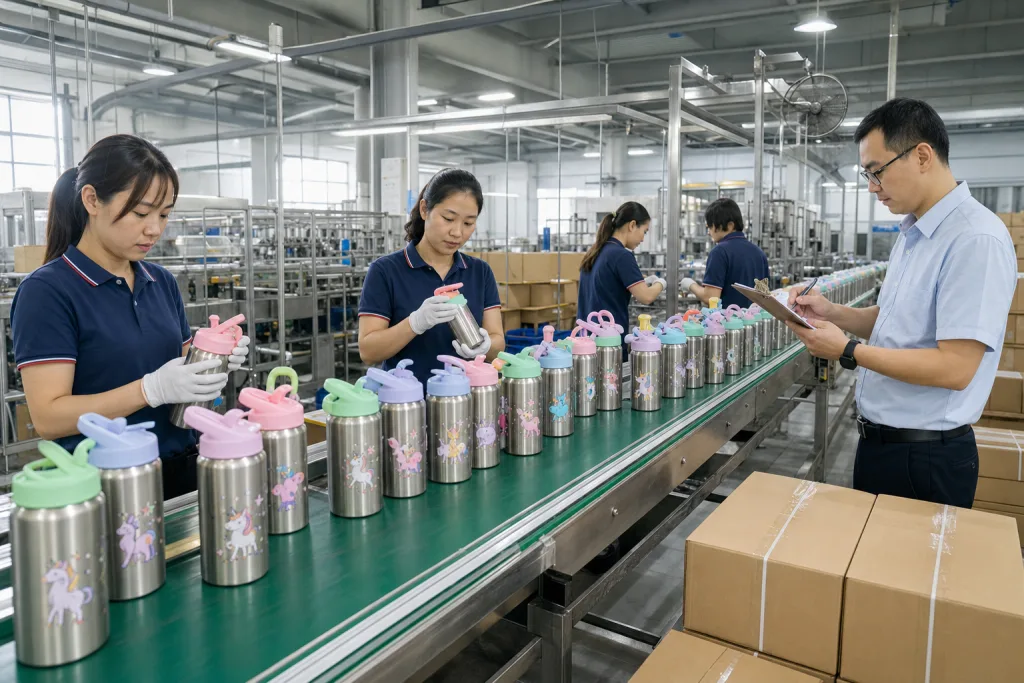
Key Takeaways
- For most kids drink bottle promotional orders, MOQ starts at 1,000-3,000 units per SKU, with 25-35 day production after sample approval.
- A 350-450 ml bottle with PP lid and silicone straw usually lands around USD 1.80-4.20 FOB China depending on material, print, and packaging.
- Use AQL 2.5 for major defects and 4.0 for minor defects, plus 100% leak testing before export from Zhejiang, China.
- For Europe and North America, ask for REACH, LFGB or FDA-contact compliance, and ASTM/CPSIA checks when the design targets young children.
You are not buying a generic bottle if the end user is a child. A kids drink bottle promotional project carries tighter safety limits, stricter decoration rules, and almost no tolerance for leaks, odor, or cracked lids. We see failures on the line fast: a straw bite test leaves marks after 200 cycles, a lid hinge cracks at 1.2 mm, or artwork lands on a part kids chew, drop, and send through the dishwasher every day. Most purchasing mistakes start with the wrong material brief, a target price that does not match the spec, or a PO typo that puts the print on the mouthpiece instead of the bottle wall.
At our Zhejiang plant, we hear the same four questions from brand owners and distributor buyers: which material is safest, what tests matter, what MOQ is realistic, and how to hold lead time when each lid color changes. The answers are practical. No fancy talk. QC pulled a sample last month because the pink masterbatch shifted from Pantone by more than 1 Delta E, and the buyer flagged it before mass packing. This is the wrong question to ask if you only want the lowest unit price. You need a checklist that fits compliance, cost, and what the factory can actually run and ship.
What should you specify first
Start with the use case, not the logo. Your brief should lock five points before you ask any canteen manufacturer for a quote: age group, capacity, drinking method, material, and compliance market. Miss one, and 6 suppliers will quote 6 different bottles, so the price comparison means nothing. We see this every week. Last month one PO said “kids bottle, 400ml” but missed the lid type, and the line sampled three cap options from one neck finish.
For school-age programs in Europe and North America, 350-500 ml is the working range. Under 300 ml, parents push back that it will not last through a school day. Over 500 ml, the unit gets heavy for small hands, and freight math gets ugly fast; a 520 ml bottle often ships at a worse carton efficiency than a 420 ml one. Straw lids sell well, but they bring more parts and more leak points than a basic sipper lid. If the campaign is cost-driven, a direct-spout PP lid is usually the safer call. We have seen this go sideways after a 1.2 m drop test, where the straw cap popped open and QC pulled the sample.
- Age 3-5: rounded profile, fewer detachable parts, easier grip, lighter wall; we usually keep the body easier to hold with a smaller diameter around 65-70 mm.
- Age 6-10: 350-450 ml, carry handle, simple flip straw or spout; buyers often ask for one-hand opening, but the hinge needs cycle testing on the line.
- School and club promo: focus on decoration area, dishwasher guidance, and replacement lid availability; this matters more than adding one more accessory.
Tell the canteen factory whether you need stainless steel, Tritan, or food-grade PP. State the market clearly too: EU, US, or both. That changes the test file and label review. This is the wrong question to ask late in the project. A canteen customizable project for a museum shop may work with a simple one-color print. A customized drinkware order for retail packs may need barcode placement, warning copy, and drop-test review, and the buyer flagged this before because the barcode sat across a curved panel and would not scan. The fastest sourcing process comes from locking these basics first. Every extra strap, bumper, or insert adds tooling risk, sourcing risk, or both, and sometimes the math does not work on a 3,000 pcs MOQ.
Which material fits kids best
No material wins every program. The right pick depends on target price, age group, and how the bottle gets used. Buyers ask if stainless steel is always the best choice. Usually, that is the wrong question to ask. Stainless gives better insulation and stronger shelf value, but a school giveaway order with a USD 2 cap needs a different answer than a retail customized canteen line. We’ve seen this on the line: one PO even marked “kid botttle” and the real issue was not the typo, it was the weight limit for first-grade school bags.
Stainless steel
For premium kids bottles, 18/8 stainless steel is the standard. Single-wall cuts weight and cost. Double-wall vacuum keeps drinks cool longer, often 12 days in transit testing without dent complaints vs 18 days of complaint-free domestic replenishment, but it adds cost and makes surface control tighter because any ripple shows under print. Typical body thickness is 0.4-0.5 mm for the outer wall and 0.3-0.4 mm for the inner wall on vacuum items. On our side, QC pulled the sample and checks the shoulder weld before powder coat because that area loves to show defects. For a 350 ml kids vacuum bottle, FOB China often lands between USD 3.20 and 4.80 at 1,000-3,000 units.
Tritan or clear copolyester
Tritan is a strong option if low weight matters and parents want to see the water level. Sports clubs like it. Promo packs move fast with it. It usually comes in below vacuum stainless and gives the lid factory more freedom on color matching for PP lids and silicone sleeves. The weak point is simple: scratch marks show after repeated desk drops and brush cleaning. We see buyer pushback here all the time—“why does the sample look older after 2 weeks?” Because clear bodies show wear faster than painted steel. For a 400 ml Tritan bottle with PP lid, expect around USD 1.80-2.70 FOB at moderate volumes.
PP and mixed-material bottles
PP bottles or PP-lid combinations are built for tight budgets and bigger runs, often 5,000 pcs MOQ and up in canteen promotional projects. The math works on price. It does not give a premium hand feel. Decoration wear is the main watchpoint, especially with simple silk screen on curved areas; we check adhesion with a 3M tape pull after curing. If your buyer flagged logo rub-off on a last project, ask about print method first, not just material.
For most B2B buyers, the safest middle ground is a 350-450 ml bottle with a stainless body, PP lid, and food-grade silicone straw. You get decent drop resistance, workable FOB, and clean branding space on the straight body section.
If you also source adjacent categories such as a custom growler or customizable growler, keep those projects separate from kids bottles. We ship them under different assumptions. The use case, compliance file, packaging test, and complaint pattern are not the same. A kids bottle carton might need a straw-cleaning brush and warning copy in 6 pt type, while a growler project is more likely to get pushback on capacity tolerance or cap torque in kgf·cm.
What safety documents really matter
This is where new buyers waste money on the wrong paperwork or miss the one gap that bites later. A kids drink bottle promotional order is not a standard customizable drinkware SKU. If the graphics, straw, or shape are clearly child-directed, the buyer will press on resin grade, small parts, and coating safety. We see this on the line all the time: a simple cap decoration becomes a compliance question once the pull force on a small silicone charm drops under spec.
For Europe, start with REACH and food-contact compliance. That is the baseline. LFGB is often added by German retail buyers, and we have had buyers flag it even on a 3,000 pcs promo run. For the US, FDA food-contact expectations are standard. If the bottle has child-directed features, some accounts also ask for CPSIA-related review. Retail is its own gate. Package warnings, age grading, and label text matter as much as the lab report; we have seen a PO held because the warning copy on the gift box missed one age mark.
- Ask for: material declarations for steel, PP, silicone, paint, and printing ink, down to the grade used on your SKU.
- Review: migration or food-contact reports from a recognized lab; QC pulled the sample from the same lid and straw set, not a similar bottle from last year.
- Check: detachable parts, bite-prone components, and sharp edge risks, especially around straw tips and handle joints under a 5 mm edge or gap check.
- Confirm: dishwasher guidance and temperature-use limits in the manual or label, because buyers ask whether the print survives 70°C wash cycles.
Do not assume a report from an old custom drinkware project covers your exact SKU. It usually does not. A lid color change, new print, or added straw can change the risk profile and the test scope. This is the wrong question to ask: “Can I use the same report?” Ask instead what changed in material, decoration, or structure. Good canteen manufacturers in Zhejiang usually keep test history by material family, batch, and supplier code, but final responsibility still sits with the importer. If you sell into large retail, ask your canteen vendor for a document pack: BSCI or social audit if required, test reports, production flow chart, AQL plan, and packaging specification. That cuts onboarding time — we have seen 12 days vs 18 days — and it works better than ten rounds of email promises.
How do MOQ and pricing move
MOQ usually gets set by the part that has the least room to move: lid color, body finish, print setup, or retail packaging. Buyers hear one low MOQ and assume it covers every version on the PO. It doesn’t. On our line in Zhejiang, the first thing we check is the lid shell and print fixture. Standard MOQ for kids bottles is usually 1,000 units per model and 500 units per color when we run existing tooling, but fully customized canteen programs can move to 3,000-5,000 units per SKU once you add special mold parts or gift boxes. This is the wrong question to ask if you only want the lowest MOQ; the better question is which part is locking the order.
Here is the practical pricing logic:
- Material: Tritan and PP usually land below vacuum stainless. The gap is not just raw material cost; 304 stainless bodies also bring welding, vacuuming, and more QC points.
- Decoration: one-color silkscreen is cheaper than wrap print, UV print, or multi-position artwork. We’ve had buyers flag a 0.8 mm logo line that filled in after print testing.
- Packaging: plain white box may add USD 0.08-0.18; color retail box can add USD 0.22-0.65. If the insert needs a tight drop-test fit, the math changes fast.
- Accessories: straws, handles, sleeves, and cleaning brushes all increase assembly time. QC pulled the sample once because the brush bag was packed into the wrong master carton count.
A realistic FOB China guide for a 350-450 ml kids drink bottle promotional order is:
- PP or simple plastic body: USD 1.20-2.10
- Tritan with printed logo: USD 1.80-2.70
- Single-wall stainless: USD 2.10-3.10
- Double-wall vacuum stainless: USD 3.20-4.80
If you are a canteen distributor or one of several canteen distributors bidding for the same program, ask the factory to quote three versions side by side: base spec, recommended spec, and retail-upgrade spec. We do this all the time, usually on one quote sheet, so the buyer can see where USD 0.18 or USD 0.42 is coming from. That works better than forcing one target price that the line cannot hold. Buyers who do this early usually save 7-12% by cutting low-value extras instead of cutting the core bottle quality later. We’ve seen this go sideways when a PO typo combines two lid colors under one SKU and nobody catches it until mass production.
Where do promotional bottles fail
Most complaints we handle are not on the bottle body. They start at the lid, straw, silicone seal, or print. On one 5,000-piece kids bottle order, QC pulled 12 leaking samples and every one traced back to the seal groove, not the 304 stainless body. A procurement manager should ask each canteen supplier the same failure questions before signing a PO. This is the right question to ask.
Your inspection checklist
- Leak test: 100% test on assembled bottles, inverted for a defined time, usually 20-30 minutes.
- Odor check: random inspection after sealing and after 24-hour hold.
- Cap torque and hinge cycle: test repeated opening and closing to a set cycle count.
- Print adhesion: tape test and rub test after curing.
- Drop test: packed and unpacked samples, especially for retail programs.
- Straw fit: pull-force check so parts are secure but still cleanable.
AQL should be written into the PO. For custom drinkware and kids bottles, AQL 2.5 major and 4.0 minor is common. Spell out major defects in plain words: leakage, wrong artwork, odor, cracked lid, missing seal, exposed sharp edge. We have seen POs with “logo position OK” and nothing else; then the buyer flagged a 3 mm print shift and the factory argued it was acceptable. Do not leave the standard vague.
If you are buying from a canteen factory in China for Amazon FBA, add carton drop, barcode scan, and FNSKU placement checks. We ship plenty of FBA orders where outer carton drop performance matters more than the bottle finish, because one failed corner crush can block check-in. If you are buying for wholesale distribution, carton strength and inner-pack count matter more than shelf-ready labeling. Good canteen vendors will ask which channel you run before production. Weak ones say yes to everything, and we have seen this go sideways at the warehouse.
Decoration needs extra care on kids items. Big logos near the mouth area are a mistake. Put artwork on the body center, where abrasion is lower and hand contact is lower. On the line, we usually check cured print with a 3M tape pull before packing. Laser marking is durable on stainless. Silkscreen can save cost for broader color branding, but the curing temperature and adhesion result have to be controlled, or the math doesn't work.
How much lead time is normal
For existing models, sampling usually runs 5-10 days for a plain sample and 7-12 days for a logo sample. Mass production usually lands at 25-35 days after sample approval and deposit, and the spread comes from order quantity, pack-out, and how many print positions we run on the line. In peak season, August to November, add 7-10 days if you buy from Zhejiang or other major China drinkware clusters. We’ve seen this go sideways when a buyer books vessel space first and asks lead time second. If the project needs a new lid mold, plan 35-50 days for tooling and validation before production starts, and expect T1 and T2 sample checks with caliper readings on fit points down to 0.2 mm.
Our typical capacity is 300,000 units per month across standard drinkware lines, but that does not mean every kids bottle order ships in three weeks. This is the wrong question to ask. Capacity is not the same as component readiness. One custom silicone color, one late paper insert, or one straw valve that fails drop test can stop the full PO. Last month QC pulled the sample because the carton insert copy still had the old SKU code, and that alone cost 4 days.
To keep lead time realistic, use this checklist:
- Freeze artwork before pre-production sample approval.
- Avoid changing Pantone colors after the first color chip is signed.
- Approve packaging dielines within 48-72 hours.
- Book inspection 5-7 days before ex-factory date.
- Leave buffer for lab test or transit if your customer launch date is fixed.
For a customizable canteen program with multiple SKUs, ask the factory to stagger production by lid color family or packaging type. That cuts line changeover loss. We run jobs this way because swapping just one silicone lid family can burn 2-3 hours on the line once you count cleaning, first-piece signoff, and color confirmation. Experienced canteen manufacturers in Zhejiang usually push this sequencing because it cuts rework and helps keep on-time delivery above 95%. If your supplier cannot explain how it schedules molding, painting, and packing, expect schedule surprises.
When should you customize deeply
Not every project needs a ground-up custom bottle. Deep customization makes sense only when the volume and margin cover the tooling bill and the risk on the line. If your annual forecast is under 10,000 units for one kids SKU, stick with an existing bottle body and change the color, logo, and box. That is usually the smarter buy. If your forecast is 50,000 units or more, a new mold for a handle, character topper, or proprietary lid starts to pencil out. We usually check this against one hard number first: steel tooling cost versus projected sell-through. This is the wrong question to skip.
Ask your canteen manufacturer these direct questions:
- Which parts can be changed without new tooling?
- What is the mold cost for a new lid or handle?
- How many cavity tools will be needed to hit the delivery window?
- Can replacement parts be ordered later at 500-1,000 units?
For promotional buyers, the route that wins most often is semi-custom: a standard bottle with a custom lid color, custom print, custom hangtag, plus a spare straw. You get shelf difference without taking full mold risk. We ship programs like this all the time for school campaigns, museum gift sets, and event merchandise, and the MOQ usually stays easier to manage. One recent buyer flagged a straw color mismatch on the pre-production sample, and fixing that was simple because the bottle body stayed standard.
If you also buy broader lines such as custom canteen products for adults or a distributor growler assortment, keep supplier scorecards separate. Kids bottles need tighter review on sealing, hygiene, and child-use durability. QC pulled the sample on one lid last season and found a leak after repeated flip-top cycling, even though the same factory ran adult growlers with no issue. A supplier that does solid work on customized growler or custom growler projects is not automatically the right fit for child-focused drinkware. The math doesn't work if you save 3% on unit price and then lose the order on complaints, replacements, or failed drop testing.
Get a workable kids bottle quote, not guesswork
Send your target market, capacity, artwork, and price range. We will suggest the right spec, MOQ, testing path, and lead time from Zhejiang, China.
Frequently asked questions
What is a realistic MOQ for kids drink bottle promotional orders?
For existing bottle models, most B2B buyers should expect 1,000 units per model and around 500 units per color or artwork variation. If you use a standard white box and one-color logo, some projects can start at 500-1,000 units, but that is not the norm for every spec. Once you add a custom lid color, retail gift box, extra accessories, or new mold parts, MOQ usually moves to 2,000-3,000 units per SKU. Fully tooled programs can reach 5,000 units or more. Always ask whether the MOQ applies to the bottle body, the assembled SKU, or the packaging set. In China, many misunderstandings come from those being quoted separately.
Which print method is best for kids bottles?
For stainless bottles, laser marking is the most durable option and usually adds less complaint risk over time, especially for school use. For colorful branding, silkscreen remains the standard because it is cost-effective and works well at volume. Expect one-color silkscreen to be the lowest-cost branded option, while multi-color wrap print or UV print costs more and needs tighter artwork review. Keep artwork away from the mouth area and high-abrasion grip zones. On a 1,000-3,000 unit run, the decoration cost difference between simple silkscreen and more complex print can be USD 0.08-0.35 per unit. For kids drink bottle promotional projects, durability usually matters more than visual complexity.
How long does production take from approval to shipment?
For an existing model with approved artwork, plan 25-35 days for mass production after deposit and final sample sign-off. A plain sample normally takes 5-10 days, and a logo sample takes 7-12 days. Add time if you need retail packaging, third-party testing, or multiple lid colors. During peak season in Zhejiang, China, lead time can stretch another 7-10 days because coating, printing, and packing lines fill first. If new tooling is required, budget 35-50 days for mold development and validation before the production clock starts. The safest schedule includes a 5-7 day buffer for inspection and any rework needed before vessel booking.
What quality standard should we put in the PO?
Write the standard directly into the purchase order and inspection brief. A common setup is AQL 2.5 for major defects and 4.0 for minor defects. Major defects should include leakage, cracked lid, missing seal, sharp edges, wrong logo, strong odor, and failed function of the straw or spout. Minor defects can include small print blemishes within agreed tolerance, slight color variation, or packaging scuffs. You should also require 100% leak testing on assembled units before packing, plus random checks for odor, print adhesion, carton drop resistance, and barcode readability if the order goes to retail or FBA. Without written criteria, the factory and buyer will judge defects differently.
Should we choose stainless steel or Tritan for a promotional kids bottle?
If your target is premium positioning, longer use life, and stronger perceived value, stainless steel is usually the better choice. A 350-450 ml double-wall bottle typically lands around USD 3.20-4.80 FOB China, while single-wall versions can be lower. If your target is lighter weight, lower cost, and visual transparency, Tritan is often more practical at around USD 1.80-2.70 FOB for common specs. For school programs, sports clubs, and volume giveaways, Tritan can be the efficient answer. For gift retail, museum stores, and higher-end promotions, stainless usually wins. The decision should match your budget, user age, and expected product life, not just trend preference.