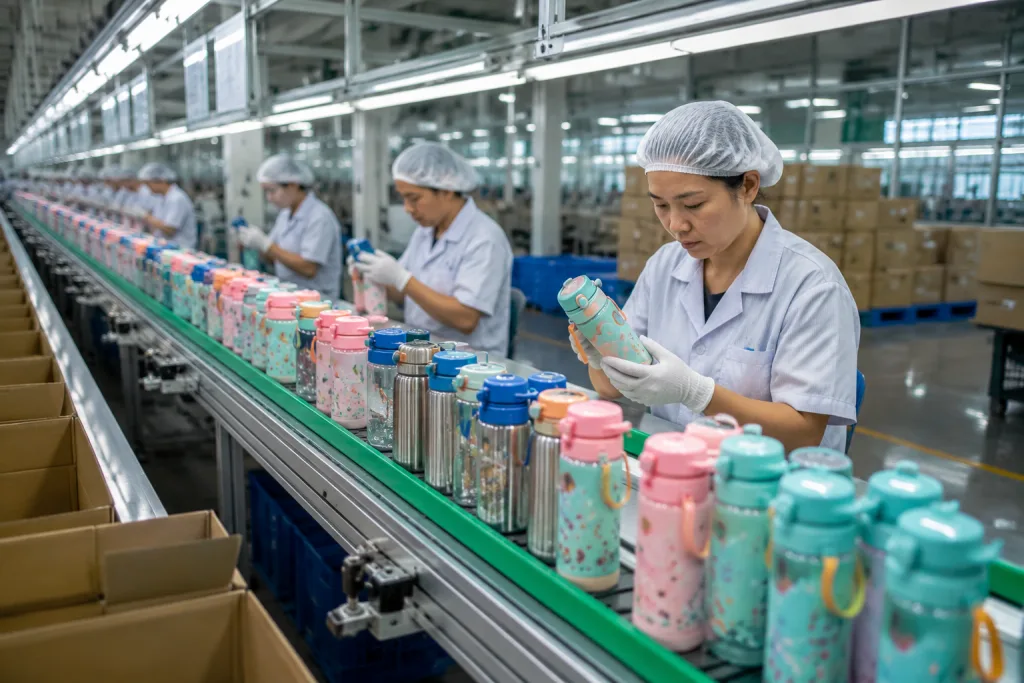
Key Takeaways
- For a custom kids bottle program, expect MOQ around 3,000 units per color and 35-45 days lead time after sample approval
- Use AQL 2.5 for major defects and 4.0 for minor defects, with 1.0 for critical safety issues on child-use drinkware
- A 304 stainless inner wall at 0.4-0.5 mm and food-grade PP or Tritan lid parts usually balance cost, safety, and durability
- Budget roughly USD 2.20-4.80 FOB Ningbo for mid-volume 350-500 ml custom drinkware, depending on lid complexity and print method
You are not buying a generic bottle. You are buying fewer complaints, smoother customs clearance, and a launch date your sales team can keep. That is why selecting kids drink bottle manufacturers is a different job from buying adult tumblers or a fast promo canteen run. Children’s products bring tighter checks on odor, leakage, coatings, drop resistance, and migration testing. On our line, QC pulled a straw-lid sample after a 1.2 m drop test because the bite valve split. A cheap China quote gets expensive fast when the lid fails after three weeks in school bags.
At BottleForge Industrial in Zhejiang, China, we see the same pattern every month. Buyers ask for a 350 ml bottle with a straw lid, then learn the real job is locking age grade, material compliance, decoration durability, packaging, and AQL before mass production. We run into the same pushback: "Why is the kids bottle quote higher than the adult 500 ml?" This is the wrong question to ask. The issue is not body size; it is risk control on parts, print adhesion, and test standards. If you are a procurement manager, brand owner, or canteen distributor, this is the order flow you should control from day one.
Start with the real order brief
Use a real brief. You are a North American brand selling back-to-school hydration through retail and e-commerce. You need 12,000 units of a 400 ml insulated kids bottle with a flip straw lid, soft carry handle, and one-color logo. Your target landed cost has to support a USD 14.99 retail price. You also want the design left open for future canteen custom and custom canteen variants for school fundraising, sports clubs, and museum gift shops. On our side, this usually means the line checks bottle diameter first—if the body OD shifts by even 1.5 mm, the future lid-sharing plan starts to break.
The first mistake 7 out of 10 buyers make with kids drink bottle manufacturers is asking for price before the brief is fixed. This is the wrong question to ask. If the lid style, steel grade, print method, and pack-out are still moving, the quote moves with them. We’ve seen this go sideways over one PO typo that said “straw lid” while the artwork file showed a screw cap. A usable RFQ should include:
- Capacity: 350 ml, 400 ml, or 500 ml. The 400 ml range works well for ages 4-10.
- Body material: single-wall Tritan, single-wall 18/8 stainless, or double-wall vacuum stainless.
- Age grade: for example 3+ or 6+.
- Lid function: straw, spout, push-button, or screw cap.
- Leak requirement: no leakage after 30 minutes inverted and after 10 open-close cycles.
- Decoration: silk screen, heat transfer, powder coat, laser mark, or wrap print.
- Compliance market: EU REACH, LFGB where needed, and US CPSIA/ASTM-adjacent child-use expectations depending on product type and packaging claims.
- Packaging: PDQ tray, mailer-safe box, or retail color box with barcode and warning text.
If you are also a canteen vendor or distributor drinkware buyer, ask whether the same tooling can support adult SKUs later. We ship more shared-platform programs now than five years ago because the math works better. A canteen manufacturer in Zhejiang may quote lower if the platform can be shared across kids and family collections. That matters because new lid tooling can add USD 2,500-6,000 and 15-25 days, while using an existing platform can shorten development to 7-12 days for a pre-production sample. Last month, QC pulled the sample on one family-set project and flagged only the handle hardness, not the thread fit, because both sizes were already running on the same neck finish tool.
Choose materials that survive real use
For kids, material choice is not a marketing line. It drives dent rate, odor complaints, print wear, and test cost. Most buyers end up with 3 routes, and the wrong pick usually shows up on the line first: scratched bodies, loose straws, or a coating fail after a 24-hour salt spray check.
Option 1: Tritan body
Tritan gives clean clarity, lower shipping weight, and lower FOB pricing. A 400 ml Tritan bottle with PP lid may land around USD 1.35-2.10 FOB China at 5,000-10,000 units. We ship a lot of these for school programs because freight math is better, but scratch marks show faster than stainless, and premium retail buyers often push back on shelf value. On one 5,000-piece order, QC pulled the sample after carton drop testing and the body was fine, but the glossy print rubbed at the shoulder.
Option 2: Single-wall stainless
This is the middle-ground option, and for a lot of programs it is the right one. A 0.4 mm 18/8 body takes rough handling better than many plastics and usually cuts odor complaints. FOB can sit around USD 1.90-3.10 depending on the lid. We have seen school buyers switch here after parents flagged milk smell retention in plastic bottles. The weight goes up, of course. So does perceived value.
Option 3: Vacuum stainless
Vacuum stainless sells on hold time and shelf price. A 304 inner and 201 or 304 outer wall, typically 0.4-0.5 mm thickness, is common. Expect USD 2.80-4.80 FOB Ningbo for a 350-500 ml kids model with standard decoration. This is where buyers ask for premium colors and character licensing, but this is also where the math does not work if the target retail is too low. We have seen a 6-hour heat-retention claim create more trouble than the body spec because the sample room used one stopper and production used another.
For child-use products, the lid causes more problems than the bottle body. Specify food-grade PP for structure, LFGB-grade silicone for seals, and a bite-safe straw material if applicable. If your canteen customized program includes removable straws, ask for tensile and pull-force checks to reduce small-part risk; we usually ask the line to record pull data in kgf on first-off samples. Also confirm coating standards. A matte powder coat looks premium, but poor pre-treatment leads to chipping. Ask the canteen factory for salt spray and adhesion results, especially if you plan canteen customizable outdoor themes or sports licensing colors. We have had buyers focus on bottle wall thickness and miss the coating stack, then the buyer flagged edge chipping around the handle seat after 2 weeks.
What you want is not the cheapest material stack. You want the one that keeps complaint rate below 1.5% after the first season.
In Zhejiang, China, a lot of canteen suppliers show the same catalog photos. The real test is simple. Can they state the exact resin grade, steel grade, wall thickness, and seal hardness on the call, or do they need to run back to the workshop 3 times and still send a PO with the straw spec typed wrong? That is the wrong supplier to bet on.
Price the order without fooling yourself
Now the money part. Say the target is 12,000 vacuum bottles in three colors, 4,000 per color, one logo, one retail box. A quote from kids drink bottle manufacturers usually breaks out like this, and you want each line shown clearly before the PO is signed:
- Unit price: USD 3.25 FOB Ningbo for 400 ml vacuum bottle, powder-coated body, PP flip straw lid, one-color silk screen logo
- Logo screen charge: USD 45 per color per artwork
- Package design setup: USD 120-200 if the dieline is new
- Pre-production sample: USD 80-150 each, often refundable against bulk order
- Outer carton update: usually included if carton marks are simple
MOQ is where buyers get caught. Factories may state 3,000 units MOQ on the website, but on the line it often means 3,000 per model, 1,000 per color, 500 per logo version. We run into this with canteen distributors all the time. One buyer wants 12,000 total, then slips in 6 logo versions after the PI is issued. The math doesn't work unless the supplier agrees to mixed-color production under one PO. A flexible plant can take 12,000 total with four carton mark variants; a rigid one will add USD 0.08-0.20 per unit because QC has to separate stock by mark, and the packing table slows down.
Logistics density matters. A 400 ml vacuum bottle with retail box may pack 24 units per master carton, around 54 x 36 x 29 cm, gross weight about 10.5-11.5 kg. That carton size affects freight, pallet count, and how your warehouse team handles replenishment. If you ship into FBA or retail, ask for FNSKU labeling, suffocation warnings where required, and carton drop standard before mass packing starts. We have seen buyers flag this late, after QC pulled the sample carton and found the warning line missing. Then the US relabel cost lands at USD 0.18-0.35 per unit, which can wipe out the margin on a club-logo program.
For timing, the honest Zhejiang schedule is 3-5 days for quotation revision, 7-10 days for decorated sample, 30-35 days for production after deposit and sample sign-off, plus 5-10 days in peak season if the lid assembly line is full. August is tight. If a supplier offers 18 days for a new customized drinkware order in August, this is the wrong question to ask; ask which step they plan to skip. We've seen this go sideways after the sample approval stamp, with missed vessel cutoff, rushed AQL 2.5 inspection, or a PO typo on carton marks that no one fixed before printing.
Lock the sample before the factory runs
The sample stage is where expensive mistakes are still cheap. On one kids bottle PO, the buyer approved “sample ok” in one line, then flagged the handle feel after 12,000 pcs were already on the line. Split approval into three parts: engineering sample, decorated pre-production sample, and packaging sample. Don’t roll all three into one vague email.
Engineering sample is for function first. Check dimensions, handle strength, opening force, leak resistance, and whether a child can open the lid with one hand. Record bottle height, base diameter, net weight, mouth diameter, and straw insertion depth. We usually measure with a digital caliper and a force gauge, not by feel. If the bottle tips too easily, widen the base 3-5 mm before mass production. That small change saves arguments later.
Decorated pre-production sample is for appearance and finish. Verify color, print placement, and surface feel. On powder coat, ask for Pantone approximation tolerance and gloss level. On silk screen, check edge sharpness and abrasion resistance; QC pulled the sample once and found the logo shifted 1.8 mm on a curved wall, which was still visible to the eye. For canteen promotional jobs, decoration failure is often the top complaint, not the vessel body. Buyers usually focus on leakproof claims first. Fair enough. But we’ve seen this go sideways on retail programs because the print scratched in store testing.
Packaging sample is not just artwork approval. Confirm barcode scan, insert fit, drop protection, country-of-origin marking, and any age warning text. We also check whether the bottle rattles inside the box after the EPE or paper insert is packed. If you are buying from China for Europe, make sure the importer details and recycling marks follow your legal review. This is where small PO typos show up too; we once caught the wrong EAN on an inner box before shipment.
Ask kids drink bottle manufacturers to issue a sample approval sheet with measurable criteria. This is the right question to ask:
- Leak test: pass after 2 hours inverted, no visible drops
- Vacuum retention: temperature loss target after 6 hours, such as less than 15°C from 95°C fill in lab conditions
- Coating adhesion: cross-hatch 4B or 5B target
- Drop test: 3 drops from 80 cm with no functional failure
- Print position tolerance: plus or minus 2 mm
Yes, it sounds strict. It should be. Whether you call it customized drinkware, customizable drinkware, customized canteen, or customizable canteen, the approved sample is your contract reference when the bulk lot arrives. Without that signed sheet, a canteen vendor will say the deviation is normal production variation. Sometimes that is true. Often, the math doesn’t work.
Run production with QC checkpoints
After the deposit lands, the order still needs managing. We run QC by stage, not by hope. For a 12,000-unit order, set three checkpoints: raw material verification, inline inspection at 20-30% completion, and final random inspection based on AQL. On our floor, QC usually opens the first incoming carton and checks wall thickness with a digital caliper before the line starts.
Raw material verification needs the basic documents matched to the PO: steel grade certificates, plastic resin declaration, silicone grade, and packaging board spec. If the order includes a custom growler or customizable growler in the same PO family, separate the child-use parts in the paperwork and carton labels. This is not admin trivia. We have seen buyers mix adult and kids standards on one file, then the buyer flagged the silicone report because the PO note was typed for the wrong SKU.
Inline inspection should happen when 20-30% of the goods are complete and at least 1,000 units are assembled. Earlier than that, the sample size is thin. Later than that, rework gets expensive fast. Check the usual problem points:
- Lid hinge stress whitening
- Straw bite valve flash or burrs
- Print misalignment
- Dent at body shoulder after vacuum process
- Poor thread fit causing cross-threading
- Color variance between body and lid handle
QC pulled the sample on one kids bottle run last month and found cross-threading at 7 pieces out of 200 because the capping torque had drifted 0.4 N·m. That is why this checkpoint matters.
Final inspection should follow an agreed AQL plan. A practical standard for kids drink bottle manufacturers is AQL 1.0 for critical defects, 2.5 for major, and 4.0 for minor. Keep the definitions plain. Critical means anything with safety risk: sharp edge, loose small part, failed migration paperwork, or serious leak. Major means functional failure or a defect that gets rejected at retail. Minor means small cosmetic issues that do not affect use. The wrong question to ask here is whether AQL can replace process control. It cannot.
If you are a canteen distributor or canteen distributors group buying for schools, ask for 100% leak testing before packing. Yes, it adds labor. For straw-lid products, the math still works. At BottleForge Industrial, our Zhejiang lines can process about 300,000 units per month across drinkware categories, and leak checks on child-use lids are one area we do not advise skipping to save USD 0.03. We ship these with a simple air-pressure fixture on the line, and that catches the random seal failures that spot checks miss.
Ask for photo and video records from China, but do not treat them as inspection. Photos help confirm carton marks, pallet pattern, and labeling. They do not show torque inconsistency or random seal issues. We have seen this go sideways: the pallet looked clean on video, then a third-party inspector found mixed master cartons and 3 mm print drift on the final lot. A third-party final inspection is cheap insurance against chargebacks or a delayed retail rollout.
Avoid the compliance traps buyers miss
The fastest way to lose margin on custom drinkware is finding a compliance gap after production starts. We have seen this go sideways at carton drop test stage, not just in the lab. Kids bottles are not toys, but they are child-used consumer products, so material safety, labeling, and test scope need to match the market, the materials, and the claims on pack.
For EU-facing orders, ask your canteen manufacturers for REACH SVHC declarations and food-contact migration testing that fits the actual build. If the bottle uses stainless plus PP and silicone, the lab package usually needs overall migration, then specific checks based on contact time and temperature. On the line, QC pulled one sample last month where the silicone straw hardness was 58 Shore A instead of the approved 50 Shore A, which changed the test file. For Germany-sensitive programs, buyers often ask for LFGB-oriented testing as extra cover.
For North America, align early with your lab and importer on lead, phthalates where relevant, and food-contact suitability. If the retail package says dishwasher safe, spill proof, or BPA free, prove each claim with a real protocol. Supplier habit is not evidence. A canteen manufacturer may say “dishwasher safe” because the 304 stainless body passes, but the printed logo is the weak point. We run logo adhesion checks after wash cycles, and if the print fades after 15 cycles, the complaint comes back to you, not to the factory.
Social and system audits matter for retail accounts, and this is the wrong question to ask at the end of production. If you need BSCI, Sedex, or ISO 9001 documents, ask for them before sampling or at least before PO release. Two days before shipment is too late. We ship to accounts that also require restricted substance list signoff, and the buyer flagged one case because a zipper bag ink declaration was missing, not the bottle itself.
Another common trap is mixed terminology on the PO. We have received one order sheet with “canteen customizable,” “customized growler,” and “kids bottle” on the same page, plus a lid code typo that swapped S02 to S20. That is how wrong parts get packed. Commercially, broad wording is fine. In specs, separate each item: child-use lid version, straw version, artwork version, test standard, and packaging code. A 1 mm change in straw OD or the wrong insert card can send the shipment to the wrong market and block customs release.
What a good shipment file looks like
Before you release balance payment, ask for the full shipment file. No excuses. If a supplier needs 2 days to pull basic paperwork together, we’ve seen this go sideways after cargo leaves Ningbo. For our example order, the file should include the commercial invoice, packing list, final carton dimensions and weights, booking confirmation, inspection report, sample approval reference, and the compliance reports or declarations tied to the shipped SKU. On our side, QC pulled the sealed golden sample and matched it against the final report before we shipped.
If you buy as a canteen supplier to retailers or as a distributor canteen wholesaler, ask for a pallet loading plan and barcode manifest upfront. Destination warehouses care about this stuff. We ship both Euro pallet and 1100 x 1100 mm pallet layouts, and the buyer usually flags overhang first. For Amazon or mixed-channel orders, confirm FNSKU placement, carton labels, and whether master cartons need “Made in China” on 2 panels instead of 1. This is a small check, but the wrong label can hold receiving for 3 days.
A practical final review checklist looks like this:
- PO quantity matches packed quantity with tolerance no more than plus or minus 2%
- Spare parts policy agreed, such as 1% extra straws or seals free of charge
- Carton gross weight under your warehouse limit, often 15 kg for easier handling
- Inspection report shows pass result against agreed AQL
- Lab reports match the final materials and colors, not an old similar model
- Vessel booking matches your required incoterm, usually FOB Ningbo or FOB Shanghai
The better kids drink bottle manufacturers do more than send PDFs. They flag risk before shipment leaves the line. If one color lot is 5 days late because a lid component failed the inline leak test at 0.04 MPa, you need that message early enough to split the shipment or cut launch quantities. That is the difference between a transactional canteen vendors list and a factory partner who understands where your margin disappears.
If your next range also includes customizable growler, customized growler, or broader custom drinkware for family collections, standardize this file format now. Use the same document order, same file names, same carton data sheet. We run this by PO number because buyers mix styles all the time, and once we even got a PO with the color code typoed from PK-03 to BK-03. This is the wrong question to ask: “Can the factory send documents?” The better question is whether they send the same clean file every time, across every canteen manufacturer and canteen supplier relationship you manage later.
Send your kids bottle spec for a workable factory quote
Share capacity, material, lid style, target price, and market. We will review MOQ, lead time, compliance, and likely risk points before sampling.
Frequently asked questions
What MOQ should I expect from kids drink bottle manufacturers?
For stocked shapes with standard lids, MOQ often starts at 3,000 units per model, sometimes split into 1,000 units per color. For a new lid or custom mold, practical MOQ is usually 5,000-10,000 units because tooling and setup need to be absorbed. If you need a mixed program for retail, school, and canteen distributor channels, ask whether one body can run multiple artworks under the same PO. That can lower your effective MOQ. Also confirm MOQ by component, not just by finished bottle. A supplier may say 3,000 units, but the silicone seal color might require 5,000 pieces and the retail box 2,000 per artwork version.
How long does a custom kids bottle order from China usually take?
If you use an existing bottle platform from Zhejiang or another China sourcing region, allow 7-10 days for a decorated pre-production sample and 30-35 days for mass production after approval. Add 5-10 days in peak season, especially if the order uses a push-button straw lid or multiple packaging variants. For a new mold, development can add 20-35 days before production. Ocean transit to Europe or North America is separate. If you have a hard launch date, build in at least 2 weeks of buffer for sample revision, inspection scheduling, or a packaging correction.
Which tests matter most for kids drink bottles?
The most useful tests are the ones tied to real failure points: leak testing, migration or food-contact testing for the actual material set, coating adhesion, drop resistance, and temperature retention if insulated. For QC, require 100% leak testing before packing on straw-lid products. For compliance, align with your market and lab on REACH, LFGB-oriented food-contact work where needed, and US requirements relevant to child-used consumer goods. Ask for reports tied to the final SKU materials and colors. A report on a similar adult bottle from last year does not protect you if this order uses different seals, ink, or straw compounds.
What is a realistic FOB price for a custom kids bottle?
For 5,000-10,000 units, a 400 ml Tritan kids bottle may run around USD 1.35-2.10 FOB China, depending on lid complexity and print method. A single-wall stainless version often lands around USD 1.90-3.10. A double-wall vacuum stainless bottle with powder coat and straw lid usually falls around USD 2.80-4.80 FOB Ningbo or Shanghai. Retail box, extra decoration colors, and special handle parts add cost. If a quote is far below the range, check wall thickness, steel grade, seal material, and whether leak testing and packaging are actually included.
How should I inspect a bulk order before shipment?
Use a three-step process. First, verify raw materials and paperwork before assembly starts. Second, run an inline inspection when 20-30% of goods are completed; this catches lid fit, print placement, and coating problems early. Third, do a final random inspection using agreed AQL levels such as 1.0 critical, 2.5 major, and 4.0 minor. For kids bottles, define leakage, loose parts, burrs, and sharp edges as major or critical based on your risk policy. Also review packaging, carton marks, barcode scans, and packed carton weights. A third-party inspection usually costs far less than one retail chargeback or one delayed container.